Key Takeaway
NY DFS proposed prior approval for every auto insurance rate increase. Comment period open; effective Nov. 27, 2026. What to watch on your renewal notice.
This article is part of our ongoing personal injury coverage, with 183 published articles analyzing personal injury issues across New York State. Attorney Jason Tenenbaum brings 24+ years of hands-on experience to this analysis, drawing from his work on more than 1,000 appeals, over 100,000 no-fault cases, and recovery of over $100 million for clients throughout Nassau County, Suffolk County, Queens, Brooklyn, Manhattan, and the Bronx. For personalized legal advice about how these principles apply to your specific situation, contact our Long Island office at (516) 750-0595 for a free consultation.
On September 9, 2026, Governor Hochul announced that the Department of Financial Services has proposed a regulation changing how private passenger auto insurance rates are filed in New York. Albany’s word for it is transparency. The plain version is that an insurer will need DFS to say yes before it raises your rate.
I am a personal injury lawyer in Huntington Station. My clients are drivers first and plaintiffs second, and since the spring nearly every one of them has asked me the same question: is my car insurance going down or not? This proposal does not answer that. It does change who decides when your rate goes up, and what you will be told when your bill moves.
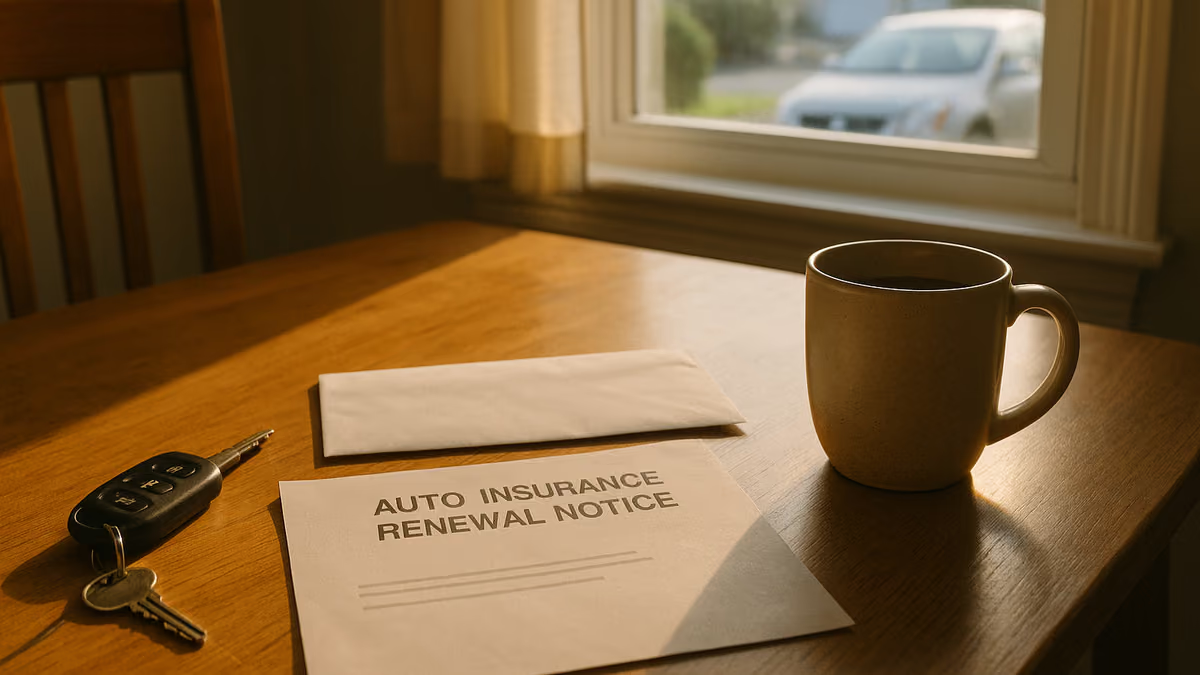
Here is what was proposed, what it changes, and what to do with the renewal notice that lands on your kitchen table this winter.
The short version
DFS has proposed a rule that requires express prior approval before any private passenger auto rate increase, ending the "flex" allowance that let insurers take small increases without asking. Decreases tied to the 2026 reforms still do not need approval, but the insurer must send you a notice explaining them. A 60-day comment period is open. The law and the regulation take effect November 27, 2026. Nothing in the rule sets your premium.
What DFS actually proposed
The regulation implements the auto insurance reforms enacted in the FY2027 state budget. I covered the reforms themselves when they passed: the new 50 percent fault bar and the deletion of the 90/180-day serious injury category. This post is about the rate side of that same package.
Free Consultation · No Fee Unless We Win
Does this apply to your situation?
Every case is different. Get a free, confidential case review from an experienced attorney who can tell you exactly where you stand.
Under current law, an insurer can implement up to two overall average private passenger auto rate increases without prior approval from DFS, as long as the cumulative effect of those increases stays within 5 percent. The industry calls that room the flex allowance. It let a carrier nudge rates upward, file the paperwork, and move on.
The proposed regulation closes that room for increases. Under it, an insurer must seek express prior approval from DFS before any upward change in private passenger auto rates. Not the third increase. Not the one that crosses 5 percent. Any increase.
Decreases are treated differently, and the difference is deliberate. A rate decrease that results from the FY2027 budget reforms can still be taken without prior approval. But the insurer must notify its policyholders about the decrease and explain why the change is happening.
Acting Superintendent Kaitlin Asrow put the purpose this way: “This regulation strengthens transparency for New York policyholders by ensuring that any increase in private passenger auto rates is subject to comprehensive and independent review.” The Governor’s line was broader: “New Yorkers deserve a transparent, fair and accountable auto insurance market that puts customers first.” Assemblymember David Weprin supported the proposal.
The regulation was published in the State Register on September 9, 2026, which started a 60-day public comment period. The law and the regulation take effect November 27, 2026.
Before and after November 27, 2026
| Situation | Today (flex allowance) | Under the proposed regulation |
|---|---|---|
| Rate increase up to 5% cumulative | Up to two overall average increases may be implemented without DFS prior approval | Express prior approval from DFS required before the increase takes effect |
| Any rate increase | Prior approval needed only once the flex allowance is used up or exceeded | Prior approval required for every upward change, with DFS review before it takes effect |
| Rate decrease tied to the reforms | May be taken without prior approval; no explanation to the policyholder required | Still no prior approval, but the insurer must notify policyholders and explain why the change is happening |
| What the policyholder is told | The new premium on the renewal notice | The new premium, plus a notice explaining any reform-related decrease |
| Who reviews an increase | The insurer's own filing, inside the flex allowance | DFS, with what the Acting Superintendent calls comprehensive and independent review |
What this means for a driver, in plain terms
Four things, none of them a promise.
Increases now need advance sign-off. An insurer that wants more money from you has to go to DFS first, with an actuarial justification, and wait for approval. That is a slower path than filing and using.
Decreases tied to the reforms still do not need approval, but they must be explained. If your carrier lowers a rate because of the budget reforms, it has to tell you it did so and why. That notice is new, and it is the part of this rule you will actually see.
The comment period is where the fight happens. The next 60 days are when consumer groups, insurers and lawyers tell DFS what the final rule should say. More on that below.
A prior approval regime tends to slow increases. It does not set rates. DFS reviewing every increase is a check on the process. It is not a guarantee that your premium falls, and I am not going to tell you it is. The rate-filing math behind the reforms is still working its way through the department, and I would not quote a savings number to anyone until a real renewal shows one.
One more thing worth separating out. Your premium is built from rating factors as well as the overall rate level. New York also changed the rules on which personal factors a carrier can use, and that is a different statute on a different clock. A renewal can move for either reason. Do not let one headline explain both.
What the comment period is for
A proposed regulation is not a final one. Publication in the State Register on September 9 opened a 60-day window in which anyone can tell DFS what works and what does not. Feedback can be submitted through the DFS website.
Insurers will use the window to argue about timing, about what counts as an upward change, and about how much detail a filing has to carry. Consumer advocates will push on the notice: what it has to say, when it has to arrive, whether it has to show the dollar effect on the individual policy rather than an average. Lawyers on my side of the aisle will watch whether the explanation requirement gives a driver enough to check the reform savings against the premium actually charged.
If you are a driver with an opinion about what your renewal notice should tell you, this is the moment to say it. I would rather see a rule that requires the notice to state what portion of a change is attributed to the reforms, in dollars, on the policy in your hand. Whether the final text goes that far will depend in part on who bothers to write in.
What to do as a driver
- Read the renewal notice all the way through, not just the total. The explanation, when it comes, will be inside it.
- Compare the premium line by line against last year's declarations page: liability, no-fault, collision, comprehensive, SUM. A lower total can hide a higher line.
- After November 27, 2026, look for the decrease explanation. If your carrier took a reform-related decrease without prior approval, it owes you a notice saying so and why.
- Shop it. A prior approval rule slows one carrier's increase; it does not stop a competitor from quoting you less.
- Keep every notice. If the promise of lower premiums is ever tested, your own renewals are the evidence.
- Do not drop coverage limits to chase savings. Cutting SUM or bodily injury limits to lower a bill is how a driver ends up uninsured against the crash that matters.
- If you were hurt and the insurer is leaning on the new fault rule to deny or shrink your claim, call before you give a statement. The rule has limits, and adjusters are testing them.
The other side of the ledger
Here is the part the press release does not say. The reforms that pay for this regulation were cuts to injured people’s rights. The new CPLR 1411(b) bars recovery for a motor vehicle plaintiff found more at fault than the defendant, and the 90/180-day category of serious injury is gone. Fewer claims, smaller claims, and in some cases no claim at all for a driver who would have recovered something a year ago.
The trade the state made was fewer claims in exchange for a promise of lower premiums. Newsday put a number on the promise in June: its report, “Long Island drivers could see insurance rates dip by 10% under new reforms,” carried the industry’s projection, and that is the figure the new decrease notices will let a driver test against a real renewal. DFS told the industry in May, at the New York Insurance Association’s annual conference, that it expected those savings to show up in filings; I wrote about what the department told insurers at the time. The notice requirement in this proposal is the mechanism by which an ordinary driver will be able to check whether the promise is kept. That is not nothing. It is also not a refund.
If you are in the group that gave something up, someone hurt in a crash where fault is contested, the Long Island car accident practice page explains how the fault bar is being argued and what still gets a case past it.
Sources
- New York Governor’s Office and Department of Financial Services, Governor Hochul Announces Proposed Regulation Requiring Prior Approval for Private Passenger Auto Insurance Rate Increases (Sept. 9, 2026): https://www.dfs.ny.gov/reports_and_publications/press_releases/pr20260909
- New York Insurance Law § 2350 (flexible rating for nonbusiness motor vehicle insurance): https://www.nysenate.gov/legislation/laws/ISC/2350
- Newsday, June 2, 2026 (Brianne Ledda), Long Island drivers could see insurance rates dip by 10% under new reforms: https://www.newsday.com/business/auto-insurance-reforms-gov-kathy-hochul-lo5ig55z
The state took something from injured drivers in May and promised the rest of us a lower bill in return. This regulation does not deliver the bill. It makes the insurer show its work before raising your rate, and explain itself when it lowers it. Hold onto the notice.
Call 516-750-0595 or request a free case review if you were hurt in a crash and the insurer is using the new fault rule to deny or shrink your claim.
Legal Context
Why This Matters for Your Case
Personal injury law in New York is governed by a complex web of statutes, case law, and procedural rules that differ from most other states. The statute of limitations for most personal injury claims is three years under CPLR 214(5), but claims against municipalities require a Notice of Claim within 90 days. Motor vehicle accident victims must meet the serious injury threshold under Insurance Law §5102(d) before they can recover pain and suffering damages.
The Law Office of Jason Tenenbaum has recovered over $100 million for injured clients across Long Island, Nassau County, Suffolk County, Queens, Brooklyn, Manhattan, and the Bronx. With 24+ years of trial and appellate experience, more than 1,000 appeals written, and 2,600+ published legal articles, Jason Tenenbaum provides the authoritative legal analysis that practitioners and injury victims need to understand their rights.
This article reflects real courtroom experience and a deep understanding of how New York courts actually evaluate personal injury claims — from the initial filing through discovery, summary judgment, trial, and appeal.
About This Topic
New York Personal Injury Law
When negligence causes serious injury, New York law entitles victims to compensation for medical bills, lost income, pain and suffering, and more. From car accidents and slip-and-falls to construction injuries and medical malpractice, the Law Office of Jason Tenenbaum has recovered over $100 million for injured Long Islanders and New Yorkers since 2002.
183 published articles in Personal Injury
Keep Reading
More Personal Injury Analysis

Hit by an Illegal E-Moto in New York? Who Pays When It Was Sold as an E-Bike
A device sold as an e-bike that exceeds New York's limits is a motor vehicle. Who pays the person it hits, what the seller faces, and what the owner risks.
Oct 25, 2026NYC's Pending E-Bike Bills: What They Would Change for People Hurt in a Crash
NYC heard 23 e-bike and delivery bills on September 30, 2026. What each text would change for hurt pedestrians and riders, and the law that applies today.
Oct 21, 2026
How Social Media Can Make or Break Your Injury Claim
Discover how social media impacts personal injury claims, from evidence rules to privacy concerns. Learn essential tips to protect your case.
Dec 23, 2024
Examination Under Oath After a Car Accident in New York
What is an EUO in a New York car accident case? When can your insurer require one, what are your rights, and how can refusing affect your claim?
Apr 5, 2026
Are Car Accident Settlements Taxable in New York?
Most New York car accident settlements are not taxable under IRC 104(a)(2). Punitive damages, interest and some medical reimbursements are the exceptions.
Apr 4, 2026How to Negotiate with an Insurance Company After a Car Accident in New York
Insurance companies have teams of adjusters trained to minimize your payout.
Apr 4, 2026Frequently Asked Questions
Common Questions About This Topic
6 answers from the firm's New York personal-injury and employment-law practice. Click any question to expand.
Is my New York car insurance going down?
Nobody can tell you that from this regulation. It does not set rates. What it does is require DFS approval before any increase, and a written explanation to you when a carrier takes a reform-related decrease. Whether your own premium falls depends on your carrier's filing and your policy. Read the renewal.
What does "prior approval" mean?
The insurer must submit its proposed increase to DFS, with the actuarial justification for it, and receive express approval before charging the new rate. Under the current flex allowance, a carrier could implement up to two overall average increases with a cumulative effect within 5 percent without that step.
What was flex rating?
A system that let an insurer file and use small overall rate changes without waiting for DFS to sign off, as long as the cumulative effect stayed inside a set band. For private passenger auto increases, the proposed regulation ends it.
When does the new rule take effect?
The law and the regulation take effect November 27, 2026. The proposed regulation was published in the State Register on September 9, 2026, which started a 60-day public comment period, so the final text could still change before then.
Can I comment on the regulation?
Yes. Feedback can be submitted through the DFS website during the 60-day comment period that began September 9, 2026. Insurers and consumer groups will be filing comments; individual drivers can too.
Does this change my claim if I was in a crash?
No. This regulation is about how insurers file rates. The changes that affect a crash claim, the 50 percent fault bar under CPLR 1411(b) and the deletion of the 90/180-day serious injury category, came from the same budget but are already in force. If an adjuster is citing the new fault rule against you, get advice before you answer.
Was this article helpful?
Disclaimer: This article is published by the Law Office of Jason Tenenbaum, P.C. for informational and educational purposes only. It does not constitute legal advice, and no attorney-client relationship is formed by reading this content. The legal principles discussed may not apply to your specific situation, and the law may have changed since this article was last updated.
New York law varies by jurisdiction — court decisions in one Appellate Division department may not be followed in another, and local court rules in Nassau County Supreme Court differ from those in Suffolk County Supreme Court, Kings County Civil Court, or Queens County Supreme Court. The Appellate Division, Second Department (which covers Long Island, Brooklyn, Queens, and Staten Island) and the Appellate Term (which hears appeals from lower courts) each have distinct procedural requirements and precedents that affect litigation strategy.
If you need legal help with a personal injury matter, contact our office at (516) 750-0595 for a free consultation. We serve clients throughout Long Island (Huntington, Babylon, Islip, Brookhaven, Smithtown, Riverhead, Southampton, East Hampton), Nassau County (Hempstead, Garden City, Mineola, Great Neck, Manhasset, Freeport, Long Beach, Rockville Centre, Valley Stream, Westbury, Hicksville, Massapequa), Suffolk County (Hauppauge, Deer Park, Bay Shore, Central Islip, Patchogue, Brentwood), Queens, Brooklyn, Manhattan, the Bronx, Staten Island, and Westchester County. Prior results do not guarantee a similar outcome.
