Key Takeaway
New York says 2026 tort reform should lower auto insurance rates. DFS now requires insurers to show the savings math by Aug. 31. What crash victims give up.
This article is part of our ongoing personal injury coverage, with 180 published articles analyzing personal injury issues across New York State. Attorney Jason Tenenbaum brings 24+ years of hands-on experience to this analysis, drawing from his work on more than 1,000 appeals, over 100,000 no-fault cases, and recovery of over $100 million for clients throughout Nassau County, Suffolk County, Queens, Brooklyn, Manhattan, and the Bronx. For personalized legal advice about how these principles apply to your specific situation, contact our Long Island office at (516) 750-0595 for a free consultation.
Every client who calls me about a crash this summer eventually asks some version of the same question: if the state changed the rules to make my case harder, am I at least going to see it on my insurance bill?
Fair question. Here is the honest answer, and it has two halves that do not arrive at the same time.
The lawsuit half already happened. It took effect on May 26, 2026, and it binds New York courts today. The premium half is still a projection sitting in a regulatory pipeline, and its first real checkpoint arrives on August 31, 2026, the date by which every auto insurer with a pending rate filing in New York must show the Department of Financial Services its arithmetic.
Quick Answer — Rates vs. Rights
Will my premium drop?
Possibly. Nothing in the statute cuts anyone's premium. DFS requires filings to reflect projected savings; it does not guarantee a decrease on any individual policy.
Who checks the math?
DFS, through new Exhibit TR-1 (Automobile Tort Reform Calculation) in the Rate Filing Sequence Checklist. Pending filings must be amended by Aug. 31, 2026.
What did victims lose?
The 90/180 serious-injury category, the old fault sequencing, and — in Article 51 motor-vehicle cases only — the right to recover at all when you are mostly at fault.
Does it hit my old accident?
It can. The trigger is the date the lawsuit is commenced, not the date of the crash. A 2024 accident filed today is under the new rules.
What DFS actually ordered insurers to do on July 1
On July 1, 2026, DFS issued Insurance Circular Letter No. 3 (2026), addressed to every insurer authorized to write motor vehicle insurance in New York, the New York Automobile Insurance Plan, and rate service organizations. Read the purpose paragraph slowly, because the verbs are the whole story. The letter exists “to ensure that Addressees reflect the impact of these reforms in all pending motor vehicle insurance rate filings by August 31, 2026 and in all future motor vehicle insurance rate filings.”
Free Consultation · No Fee Unless We Win
Does this apply to your situation?
Every case is different. Get a free, confidential case review from an experienced attorney who can tell you exactly where you stand.
Reflect the impact. Not reduce premiums by a set percentage. DFS is regulating the inputs to a rate filing, and it is doing so under Insurance Law §§ 2304(b) and 2305(c) — the excessive/inadequate/unfairly discriminatory rate standards that have always governed New York property-casualty pricing.
Three concrete obligations came out of that letter:
- Carriers must “evaluate and appropriately reflect the projected savings or reductions in claim frequency, claim severity, loss adjustment expenses, and any other actuarially indicated reductions” attributable to the reforms.
- DFS added a new Exhibit TR-1, Automobile Tort Reform Calculation, to the Rate Filing Sequence Checklist and pushed it into SERFF. It requires the percentage reduction in anticipated claims and loss adjustment expenses, plus “a complete, detailed explanation of how the Addressee derived that percentage decrease, including the specific calculations used.”
- Every pending motor vehicle rate filing must be amended to include that exhibit by August 31, 2026.
That third item is why this article exists. For the first time in this reform cycle there is a document with a number on it. A carrier that told the legislature these reforms would cut its losses now has to write down how much and how it got there, in a filing a member of the public can pull up.
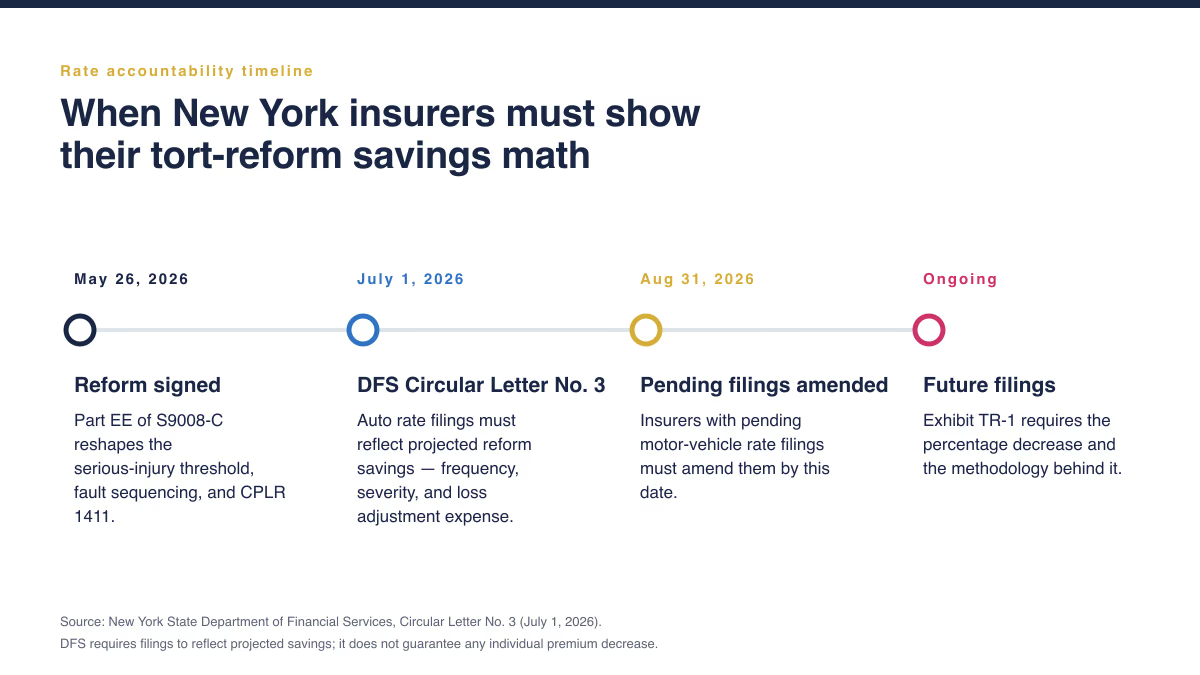
The DFS Rate-Filing Calendar — Dates That Actually Bind Someone
- May 26, 2026Chapter 58 signed. Part EE takes effect and applies to actions and proceedings commenced on or after that date. Insurance Law §§ 5102(d) and 5104 and CPLR § 1411 change.
- May 26, 2026Chapter 55 signed. Penal Law § 176.05 expands to reach anyone who "hires, requests, encourages, orchestrates, or invites" another person to stage a crash.
- July 1, 2026DFS issues Circular Letter No. 3. Exhibit TR-1 added to the Rate Filing Sequence Checklist and to SERFF.
- Aug. 31, 2026Deadline to amend every pending motor vehicle rate filing with the TR-1 savings calculation and methodology.
- Nov. 27, 2026Insurance Law § 2350 change takes effect. Carriers lose the ability to push through an overall average increase of up to 5% on nonbusiness auto without prior approval. Decreases up to 5% still flex through. 11 NYCRR Part 163 amended to match.
- May 27, 2030§ 2350 expires. Every nonbusiness motor vehicle rate filing then requires the Superintendent's prior approval.
The flex-rating change is the part nobody covered
Buried in the same circular letter is a structural change that matters more to a consumer than the press release did. Part II of Chapter 55 amended Insurance Law § 2350, New York’s flexible-rating statute for nonbusiness auto. Under the old regime a carrier could implement an overall average rate level increase of up to 5% without the Superintendent’s prior approval. As of November 27, 2026, that door closes for increases. Decreases of up to 5% still go through without prior approval, which is a deliberate asymmetry: the state made it easier to cut and harder to raise. The statute then sunsets on May 27, 2030, after which every nonbusiness motor vehicle rate filing goes to prior approval.
That gives the accountability structure a shape. Between now and November, filings still carry a flex allowance for increases. After November, an increase has to be defended in front of a regulator that is simultaneously holding the carrier’s own TR-1 exhibit estimating how much the reforms saved it. None of which guarantees anything: “projected savings” and “indicated rate change” are separate lines on a filing, and they can move in opposite directions once trend, reinsurance, and repair-cost inflation are loaded in. But a carrier asking for an increase in December has to explain that gap in writing.
Injured and Haven't Filed Yet?
Your Filing Date Is Now a Legal Strategy Decision
The new threshold and fault rules attach to actions commenced on or after May 26, 2026. If you were hurt in 2023, 2024, or early 2026 and your case is still unfiled, the law that governs it may depend on paperwork nobody has filed yet. That is not a question to answer from a blog post.
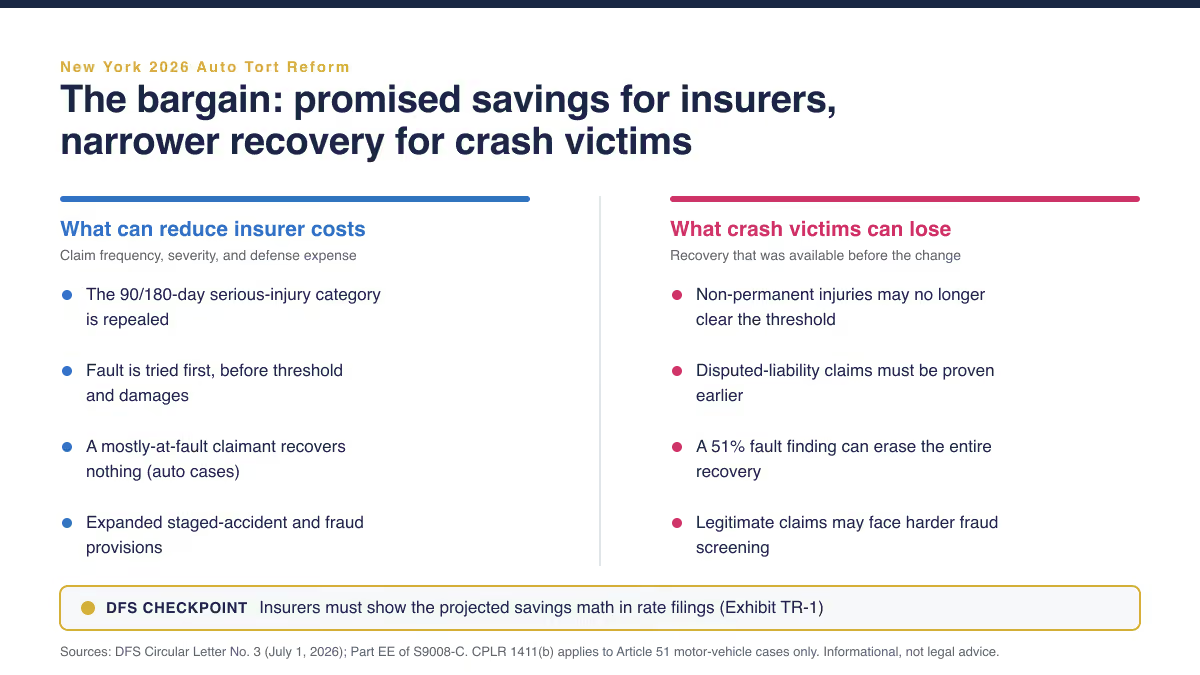
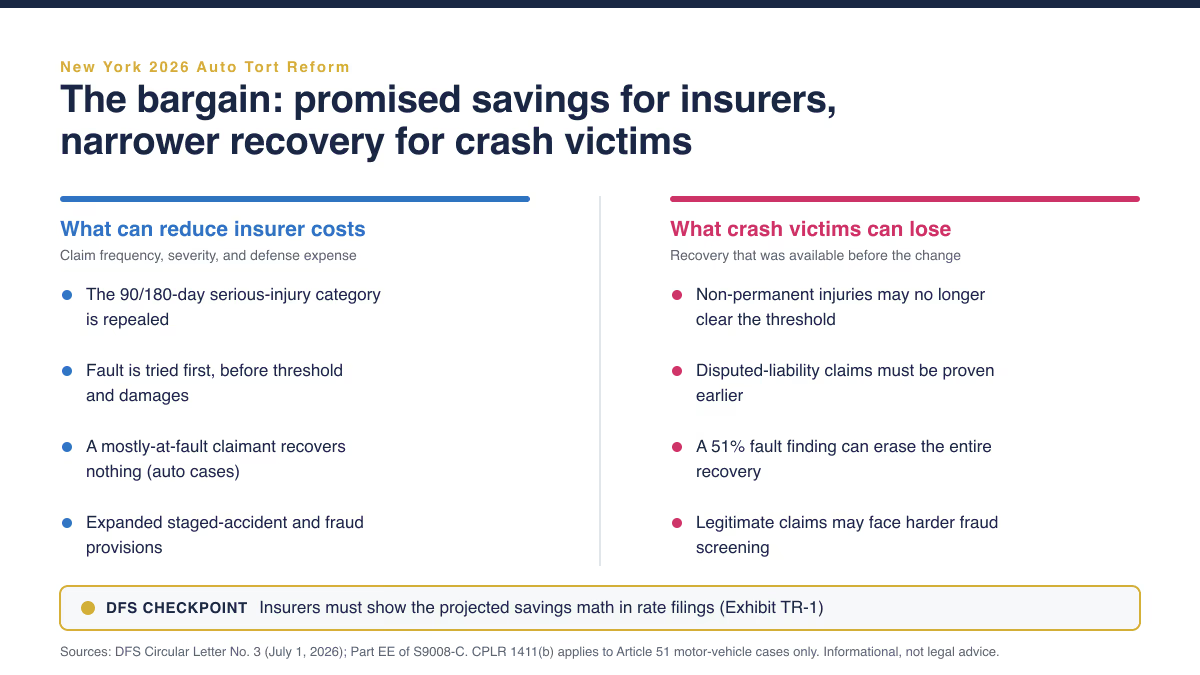
What crash victims traded for the projected savings
Here is the exchange, laid out honestly. The left column is what changed. The middle is the theory under which it lowers a carrier’s cost. The right is what it does to an injured person in Nassau, Suffolk, or the boroughs.
| Reform | Insurer-cost theory | Victim-side impact |
|---|---|---|
| 90/180 category deleted from Ins. Law §5102(d) | Fewer non-permanent impairment claims survive the serious-injury threshold, so fewer files reach pain-and-suffering exposure. | The lost-work, lost-life-for-six-months case no longer has its own pathway. It has to fit a surviving category such as fracture, permanent consequential limitation, or significant limitation of use. |
| Fault-first sequencing (Ins. Law §5104(a)) | Liability can be tried before threshold and damages, so defensible cases end earlier and cheaper. | Disputed-fault plaintiffs have to prove clean liability first, before a jury ever hears about the injury. Liability proof moves to the front of the file. |
| CPLR §1411(b) mostly-at-fault bar (Article 51 only) | Claimants whose fault exceeds the defendants' recover nothing, removing an entire tier of marginal-liability payouts. | A 51% fault finding wipes out recovery entirely. At 49% you still recover, reduced. The statute says "greater than," so an even 50/50 split is not barred. |
| $100,000 non-economic cap (Ins. Law §5104(d)) | Caps payouts to a defined set of at-fault operators: uninsured, convicted-impaired, convicted-felony/flight. | Narrow by design. Death cases are excluded, economic damages are uncapped, and the impairment and felony categories require an actual conviction. It is not a general cap on car accident damages. |
| Staged-accident expansion (Penal Law §176.05) | Criminal exposure now reaches organizers, not just the driver, which is the fraud-enforcement backbone of the affordability argument. | Legitimate claimants may see more aggressive SIU screening, examinations under oath, and referral-source questioning early in the claim. |
| Joint-and-several liability | No change. Neither the CPLR §1601 rewrite nor the §1602(6) repeal made the final text. | The innocent passenger's deep-pocket recovery survives intact. If you read that joint-and-several reform passed, it did not. See our correction piece. |
Sources: S9008-C / A10008-C, Part EE · DFS Circular Letter No. 3 (2026). Statutory mechanics are covered in depth in our full breakdown of what passed.
Two things that did not change deserve a line, because clients ask about both. Your no-fault benefits are untouched. Medical bills and lost earnings still flow through PIP under Article 51 regardless of fault, and the deadlines under 11 NYCRR § 65-1.1 are what they always were: written notice to the carrier within 30 days of the crash, medical bills within 45 days of service, lost earnings and other expenses within 90 days. Miss those and no reform helps you. Second, CPLR § 1411(b) is an Article 51 motor-vehicle carveout. If you fall on a broken stair in Massapequa, pure comparative negligence still applies and you still recover, reduced by your share.
Does this affect a case from an accident that happened before the reform?
This is the question people get wrong, and it is expensive to get wrong.
The trigger is not the accident date. Part EE of Chapter 58 took effect May 26, 2026 and applies, in the statute’s own words, to actions and proceedings commenced on or after that date. DFS characterizes it the same way in Circular Letter No. 3: Part EE “modified Insurance Law §§ 5102(d) and 5104, plus CPLR § 1411, effective May 26, 2026, for actions and proceedings commenced on or after that date.”
In New York Supreme Court, an action is commenced by filing the summons and complaint with the county clerk. CPLR § 304(a). So the operative moment is a docketing timestamp, not a crash.
Run the arithmetic on that and the trap is obvious. The statute of limitations for a negligence personal-injury action is three years under CPLR § 214(5). Someone injured in a Hempstead intersection collision in September 2024 has until September 2027 to sue. If that case was filed in April 2026, the old law governs it: the 90/180 category is available and pure comparative negligence applies. If the identical case is filed this month, it is governed by the new threshold and the Article 51 mostly-at-fault bar. Same crash, same injuries, same client, different law, because of a filing date.
Cases already pending on May 26, 2026 stay under the prior framework, which is why threshold decisions coming out of the Appellate Division right now still read like pre-reform law. Our note on a Second Department serious-injury reversal is one example: commenced years before Part EE, so the 90/180 category was still on the table. That is the clean part. The messy part is the retroactivity fight I expect over the next two years: whether applying a new substantive bar to conduct that occurred years earlier survives due-process scrutiny, and whether courts read the sequencing change as procedural or substantive. Defense firms writing on the statute have flagged the same open questions, and no appellate court has answered them. If your case is unfiled and your accident predates May 26, 2026, that is a conversation to have with a lawyer this month, not next year. We log the CPLR § 1411 text and any decisions construing it on the 50% bar status page.
How to check whether your carrier actually filed a decrease
You do not have to take anyone’s word for this. New York rate filings are public.
Renewal-Time Checklist — Four Things to Do
- 1Compare the declarations pages, not the total. Pull last year's renewal and this year's side by side and compare the bodily-injury liability and no-fault (PIP) line items specifically. Those are the coverages the reforms touch. A total that went up because you added a driver or a vehicle tells you nothing.
- 2Look up your carrier's filing. New York property-casualty rate filings are viewable through SERFF Filing Access for New York. Search your insurer's name, private passenger auto, 2026. Filings amended for the Aug. 31 deadline should contain Exhibit TR-1 with a percentage and a derivation.
- 3Ask the three renewal questions. Did my rate go down? Did my carrier cite tort reform in its filing? Has DFS approved or questioned that filing? Your broker can answer the first two in a phone call.
- 4Complain if the numbers do not reconcile. DFS takes consumer complaints about insurers at dfs.ny.gov/complaint. A filing that projects large reform savings alongside a rate increase is a fair thing to ask the regulator about.
The argument for watching this is not partisan. Carriers told Albany the reforms would reduce their losses, and DFS has now made them quantify that in writing. The reduction should show up somewhere other than the loss ratio. New Yorkers pay roughly $4,000 a year for auto coverage, about $1,500 above the national average, per the Governor’s own May 27 announcement. That number is the entire political justification for narrowing the threshold, so it is worth checking.
What to do differently if you are hurt in a crash now
The advice I gave clients in 2025 is not adequate in 2026. Fault-first sequencing and the mostly-at-fault bar moved liability proof from something you develop in discovery to something you can lose the case without. Concretely:
- Photograph the scene before the vehicles move. Final rest positions, debris field, skid marks, traffic controls from your approach. Reconstructionists work backward from rest positions, and fault percentage can now decide the case.
- Preserve video within days. Business security systems overwrite in 3 to 30 days. Nassau and Suffolk municipal cameras and MTA bus footage need a prompt written preservation demand. Dashcams record on a loop.
- Get the 911 audio and the responding agency’s records while they still exist. Those recordings are retained on a fixed schedule and then destroyed.
- Say nothing casual about fault. “I didn’t see him” is a comparative-fault admission at the scene, in the recorded statement, and in the ER intake note. Report facts, not conclusions.
- Treat promptly and consistently. With 90/180 gone, the surviving serious-injury categories run on objective proof: imaging correlated to complaints, range-of-motion measurement, EMG where indicated, specialist permanency narratives. Treatment gaps get weaponized on threshold motions.
- Get your no-fault application in within 30 days. Separate clock from the lawsuit, and an unforgiving one.
- Have the filing-date conversation early if your accident predates May 26, 2026 and no suit has been filed. Our guide to comparative fault in New York car accident cases covers how percentages actually get argued, and the settlement calculator will get you a rough range.
I represent injured plaintiffs and I defend insurance carriers in no-fault matters, often in the same week, which is why I can tell you what the other side of the file looks like now. Defense counsel got better tools in May. The answer to that is not outrage. It is better evidence, earlier.
Talk to a lawyer before the filing date decides your case
The Law Office of Jason Tenenbaum, P.C. handles car accident and personal injury matters across Nassau, Suffolk, and the five boroughs, and we litigate New York no-fault insurance disputes on both sides of the caption. If you were hurt in a crash, or you are sitting on an unfiled claim from an older accident, the 2026 changes affect what your case is worth and when it should be commenced.
- Call (516) 750-0595 for a free consultation
- Or use the secure online contact form
We work on contingency in personal injury matters. No fee unless we win.
Related Reading
- NY auto tort reform passed: the full statutory breakdown
- 50% comparative bar status tracker — CPLR § 1411 text and current status
- What the reform means for insurers and claims professionals
- DFS told insurers what the reform really means (NYIA, Bolton Landing)
- What coverage of New York’s tort reform still gets wrong
- Serious injury threshold after the 90/180 deletion
- Long Island car accident lawyer
Primary Sources
- DFS Insurance Circular Letter No. 3 (2026), Motor Vehicle Insurance Reforms (July 1, 2026)
- DFS / Governor Hochul press release on implementation guidance (July 1, 2026)
- S9008-C / A10008-C, Part EE (Chapter 58 of the Laws of 2026)
- Governor Hochul’s May 27, 2026 announcement
- Insurance Law § 5102 · § 5104 · § 2305 · § 2350
- CPLR § 1411 · § 304 · § 214
- SERFF Filing Access — New York rate filings
This article is for informational purposes only and is not legal advice, and it does not create an attorney-client relationship. The effective-date and retroactivity questions discussed here are unsettled and will be decided by the courts; anyone with a pending or unfiled New York motor-vehicle claim should obtain case-specific advice.
Last reviewed: 2026-08-14.
Legal Context
Why This Matters for Your Case
Personal injury law in New York is governed by a complex web of statutes, case law, and procedural rules that differ from most other states. The statute of limitations for most personal injury claims is three years under CPLR 214(5), but claims against municipalities require a Notice of Claim within 90 days. Motor vehicle accident victims must meet the serious injury threshold under Insurance Law §5102(d) before they can recover pain and suffering damages.
The Law Office of Jason Tenenbaum has recovered over $100 million for injured clients across Long Island, Nassau County, Suffolk County, Queens, Brooklyn, Manhattan, and the Bronx. With 24+ years of trial and appellate experience, more than 1,000 appeals written, and 2,600+ published legal articles, Jason Tenenbaum provides the authoritative legal analysis that practitioners and injury victims need to understand their rights.
This article reflects real courtroom experience and a deep understanding of how New York courts actually evaluate personal injury claims — from the initial filing through discovery, summary judgment, trial, and appeal.
About This Topic
New York Personal Injury Law
When negligence causes serious injury, New York law entitles victims to compensation for medical bills, lost income, pain and suffering, and more. From car accidents and slip-and-falls to construction injuries and medical malpractice, the Law Office of Jason Tenenbaum has recovered over $100 million for injured Long Islanders and New Yorkers since 2002.
180 published articles in Personal Injury
Keep Reading
More Personal Injury Analysis

Nassau Police Ordered to Pay $34,690.50 in FOIL Fees: What Meyer Means After a Crash
The Second Department raised a FOIL fee award against the Nassau County Police Department from $12,000 to $34,690.50. The statute, the math, and the FOIL clock.
Oct 8, 2026
Long Island Pedestrian Crashes After Dark: State Data Before the Clocks Change
From November through January, 485 of 520 evening pedestrian crashes in Nassau and Suffolk happened in the dark. State and federal data, with the CSV files.
Oct 8, 2026
Wrongful Death Statute of Limitations
Learn about wrongful death statute of limitations in New York.
Apr 15, 2025
Long Island Boating Accident Claims: Who Pays When Things Go Wrong on the Water
Hurt on Long Island waters? How New York boating accident claims work — Navigation Law §48 owner liability, Brianna's Law, BWI, maritime law, deadlines.
Jun 17, 2026
Taxi and Cab Accident Settlements in New York: What Injured Passengers and Drivers Need to Know
Taxi accident claims run on a different legal track than ordinary car accidents — TLC-regulated coverage, VTL §388 medallion-owner liability, and higher.
Apr 5, 2026
Multi-Car Accident Settlements in New York: What Victims Need to Know
Learn how multi-car pileup settlements work in New York, including how comparative fault affects your recovery, liability among multiple defendants, and what evidence wins these...
Apr 4, 2026Frequently Asked Questions
Common Questions About This Topic
7 answers from the firm's New York personal-injury and employment-law practice. Click any question to expand.
Will NY car insurance rates go down because of tort reform?
They may. Nothing in the 2026 legislation reduces any individual premium. What DFS did on July 1, 2026 was require carriers to reflect projected reform savings in pending and future motor vehicle rate filings and to document the calculation on Exhibit TR-1. Whether that produces a visible decrease on your renewal depends on your carrier's filing, DFS review, and the other cost trends loaded into the same rate indication.
When do insurers have to show DFS their tort-reform savings math?
Pending motor vehicle rate filings must be amended to include the Exhibit TR-1 Automobile Tort Reform Calculation by August 31, 2026, under DFS Insurance Circular Letter No. 3 (2026). All future filings must include it as well. Separately, beginning November 27, 2026, carriers can no longer take an overall average increase of up to 5% on nonbusiness auto without the Superintendent's prior approval.
Does New York's tort reform apply to accidents that happened before May 26, 2026?
It can, and this is the point most people miss. The reforms apply to actions and proceedings commenced on or after May 26, 2026, which means the trigger is the date the lawsuit is filed under CPLR § 304, not the date of the crash. A case already pending on May 26, 2026 stays under the prior law. An unfiled claim from an older accident may fall under the new rules if it is filed now. Speak to counsel before assuming an old accident is governed by old law.
What is the 50% fault bar in New York car accident cases?
New CPLR § 1411(b) bars recovery in a personal-injury action subject to Insurance Law Article 51 when the claimant's culpable conduct is greater than the defendant's, or greater than the combined culpable conduct of the defendants. The statutory word is "greater than," not "50% or more," so an exact 50/50 apportionment is not barred and a claimant at 49% still recovers a reduced award. It applies only to Article 51 motor-vehicle cases.
Did joint-and-several liability change in New York?
No. Neither the broad CPLR § 1601 rewrite nor the narrower repeal of CPLR § 1602(6) appears in the enacted text. The motor-vehicle exception to Article 16 remains in force, so a low-fault motor-vehicle defendant can still face joint-and-several exposure for a full judgment. Coverage stating otherwise is wrong, and we documented the error in a dedicated correction piece.
Does the reform eliminate every serious-injury lawsuit?
No. Eight categories survive in Insurance Law § 5102(d), including death, dismemberment, significant disfigurement, fracture, loss of a fetus, permanent loss of use, permanent consequential limitation of use, and significant limitation of use. What disappeared is the 90/180 pathway for non-permanent injuries. Many legitimate cases still clear the threshold; they generally require earlier and more objective medical documentation than they did before.
What should I do if I was partly at fault in a crash?
Do not assume the claim is dead, and do not concede a percentage to anyone. In a motor-vehicle case the question is whether your share is *greater than* the other driver's, and that allocation is argued with evidence, not with the adjuster's opinion. Preserve video, photographs, and witness information immediately, avoid recorded statements until you have advice, and have a lawyer evaluate the fault split before you accept any characterization of it.
Was this article helpful?
Disclaimer: This article is published by the Law Office of Jason Tenenbaum, P.C. for informational and educational purposes only. It does not constitute legal advice, and no attorney-client relationship is formed by reading this content. The legal principles discussed may not apply to your specific situation, and the law may have changed since this article was last updated.
New York law varies by jurisdiction — court decisions in one Appellate Division department may not be followed in another, and local court rules in Nassau County Supreme Court differ from those in Suffolk County Supreme Court, Kings County Civil Court, or Queens County Supreme Court. The Appellate Division, Second Department (which covers Long Island, Brooklyn, Queens, and Staten Island) and the Appellate Term (which hears appeals from lower courts) each have distinct procedural requirements and precedents that affect litigation strategy.
If you need legal help with a personal injury matter, contact our office at (516) 750-0595 for a free consultation. We serve clients throughout Long Island (Huntington, Babylon, Islip, Brookhaven, Smithtown, Riverhead, Southampton, East Hampton), Nassau County (Hempstead, Garden City, Mineola, Great Neck, Manhasset, Freeport, Long Beach, Rockville Centre, Valley Stream, Westbury, Hicksville, Massapequa), Suffolk County (Hauppauge, Deer Park, Bay Shore, Central Islip, Patchogue, Brentwood), Queens, Brooklyn, Manhattan, the Bronx, Staten Island, and Westchester County. Prior results do not guarantee a similar outcome.