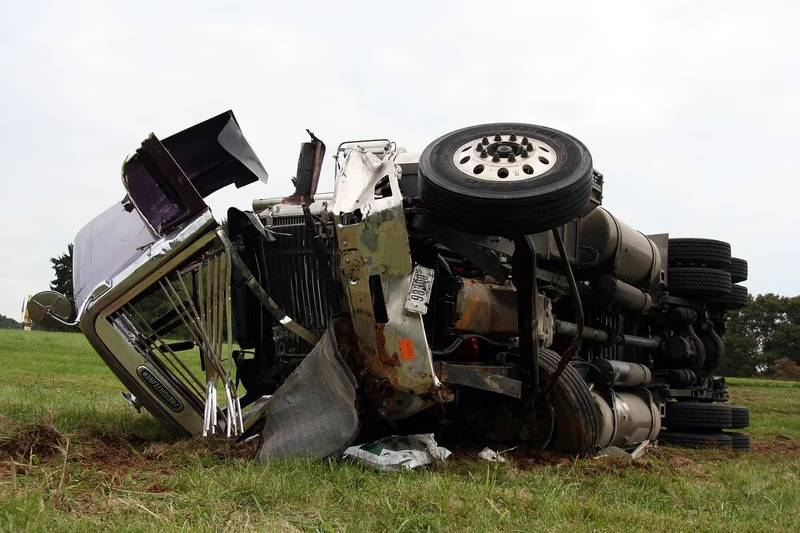
Long Island Truck
Accident Lawyer
Page updated October 2026
The Law Office of Jason Tenenbaum, P.C., in Huntington Station, represents people hurt in commercial truck crashes across Nassau and Suffolk. A truck case is proven from records federal rules make the carrier keep, some for only three or six months, so our preservation letter goes out the day we are retained. No fee unless we win.
Serving Long Island, Nassau County, Suffolk County & All of NYC
$100M+
Recovered
24+
Years Experience
$0
Upfront Cost
24/7
Available
Quick answer: the first week after a Long Island truck crash
Five things have deadlines or consequences in the first week.
- See a doctor the day of the crash and keep every appointment; this week's record is the record the insurer, and later the jury, will read.
- Get the police accident report, which carries the truck's USDOT number and the carrier's name, and file your own report with the Department of Motor Vehicles (how to get it).
- Have counsel send a preservation letter within days: the carrier must keep hours-of-service records only "not less than 6 months" (49 CFR 395.8(k)(1)) and driver vehicle inspection reports only three months (49 CFR 396.11(a)(4)).
- Give no recorded statement to the trucking company's insurer; the only insurer you owe cooperation to is your own no-fault carrier (11 NYCRR 65-1.1).
- File the no-fault application: written notice is due "in no event more than 30 days after the date of the accident," and each medical bill within 45 days of the service (11 NYCRR 65-1.1).
Reviewed October 2026. Every rule on this page is quoted from the source it cites.
The federal records
Why a truck case is not a car case
A crash between two private cars produces one driver, one policy and one police report. A crash with a commercial truck produces a motor carrier that federal law required to create and keep records about the driver, the vehicle and the trip before anyone was hurt. The case is built by obtaining those records before the carrier may discard them.
New York adopts the federal rules for carriers operating in the State, intrastate included (17 NYCRR 820.1(a), 820.6). A violation is not negligence per se. The Court of Appeals draws "a distinction between State statutes on the one hand, and local ordinances or administrative rules and regulations on the other": violation of a State statute that imposes a specific duty "constitutes negligence per se," while treating a violation of an administrative rule or regulation the same way would "substantially recast" the common law, so it is evidence of negligence for the jury (Elliott v. City of New York, 95 N.Y.2d 730 (2001)). The records are the proof.
The driver qualification file (49 CFR 391.51)
The carrier "shall maintain a driver qualification file for each driver it employs" (49 CFR 391.51(a)), kept "for as long as a driver is employed by that motor carrier and for three years thereafter" (49 CFR 391.51(c)). It shows what the carrier knew before the crash: the driving record from each licensing State, the road test, the annual review and the medical certificate (49 CFR 391.51(b)).
Hours of service and the electronic logging device (49 CFR 395.3, 395.8)
A property-carrying driver may drive 11 hours within a 14-hour window that opens after 10 consecutive hours off duty, and not past 8 hours without a 30-minute break (49 CFR 395.3(a)). "No motor carrier shall permit or require any driver used by it to drive" beyond those limits. No later than December 18, 2017 the carrier "must install and require each of its drivers to use an ELD" (49 CFR 395.8(a)(1)(i)), with exceptions for a driver who keeps a record of duty status on no more than 8 days in any 30-day period and for a vehicle manufactured before model year 2000, who may keep paper records (49 CFR 395.8(a)(1)(ii)). Records of duty status are kept "not less than 6 months from the date of receipt" (49 CFR 395.8(k)(1)). A local truck may run under the short-haul exception instead: a driver who stays within 150 air miles of the normal work reporting location and returns there within 14 hours keeps no log, and the carrier instead keeps time records for 6 months (49 CFR 395.1(e)(1)). Six months is the floor; a carrier under no duty to preserve may lawfully purge on day 181.
Inspection, repair and maintenance (49 CFR 396.3, 396.11, 396.17)
Every carrier "must systematically inspect, repair, and maintain" the vehicles it controls (49 CFR 396.3(a)); its maintenance record is retained "for a period of 1 year and for 6 months after the motor vehicle leaves the motor carrier's control" (49 CFR 396.3(c)). The driver's end-of-day report lists defects in brakes, steering, lights, tires and coupling devices; a listed defect must be repaired and certified before the vehicle runs again; the report is kept three months (49 CFR 396.11(a)). The annual inspection report (49 CFR 396.17(c)) is kept fourteen months (49 CFR 396.21(b)(1)).
Drug and alcohol testing after the crash (49 CFR 382.303)
After a crash the employer "shall test for alcohol" and for controlled substances each surviving driver if someone died, or if the driver is cited and someone was treated away from the scene or a vehicle was towed (49 CFR 382.303(a), (b)). A test not done within two hours (alcohol) or 32 hours (controlled substances) requires "a record stating the reasons the test was not promptly administered" (49 CFR 382.303(d)). Positives and refusals are kept five years, negatives one year (49 CFR 382.401).
The accident register (49 CFR 390.15)
Carriers "must maintain an accident register for 3 years after the date of each accident," with "copies of all accident reports required by State or other governmental entities or insurers" (49 CFR 390.15(b)); an accident is a fatality, an injury treated away from the scene, or a tow for disabling damage (49 CFR 390.5).
Cargo securement (49 CFR Part 393, Subpart I)
Cargo must be secured to prevent it "leaking, spilling, blowing or falling from the motor vehicle" and from shifting enough to affect "the vehicle's stability or maneuverability" (49 CFR 393.100(b), (c)); the tiedowns' aggregate working load limit must be "at least one-half times the weight of the article" (49 CFR 393.106(d)).
Minimum insurance (49 CFR 387.9)
A for-hire interstate carrier of nonhazardous property with a gross vehicle weight rating of 10,001 pounds or more must carry $750,000 in public liability coverage; a carrier of oil or listed hazardous materials, $1,000,000; a carrier of certain bulk hazardous substances, $5,000,000 (49 CFR 387.9, Table 1). The $750,000 row covers only for-hire carriers in interstate or foreign commerce; a private carrier hauling its own nonhazardous goods is not in it.
The engine control module
A diesel engine's electronic control module may retain data about a hard-braking event: speed, brake application, throttle and engine speed for a short window around it. What a given truck stores, and whether a later event overwrites it, depends on the make, the model year and the carrier's settings; no federal rule requires the carrier to keep it. The letter therefore asks that the tractor not be powered down, driven or repaired until a download is done with both sides present.
The evidence
The records in a truck case, who holds them, and how long they must be kept
Each record below has a federal minimum retention period. The period is a floor, not a promise: once it runs, the holder may discard the record unless something has already put it under a duty to keep it.
| Record | Who holds it | Minimum retention | Rule |
|---|---|---|---|
| Driver vehicle inspection reports and repair certifications | Motor carrier | 3 months | 49 CFR 396.11(a)(4) |
| Records of duty status (ELD or paper logs) | Motor carrier; the driver carries the last 7 days | 6 months from receipt | 49 CFR 395.8(k)(1), (2) |
| Back-up copy of the ELD records | Motor carrier, on a device separate from the original | 6 months | 49 CFR 395.22(i)(1) |
| Supporting documents: bills of lading, dispatch and trip records, expense receipts, fleet-management messages, payroll and settlement sheets | Motor carrier | 6 months (up to 8 documents per driver per day) | 49 CFR 395.11(c), (d); 395.8(k)(1) |
| Short-haul time records (driver exempt from logs) | Motor carrier | 6 months | 49 CFR 395.1(e)(1)(iv) |
| Shipping orders, copies of bills of lading, waybills and freight bills | Motor carrier | 1 year | 49 CFR part 379, appendix A, item I |
| Hazardous materials shipping paper | The shipper (the person who provided the paper) | 2 years; 3 years for hazardous waste | 49 CFR 172.201(e) |
| Broker's record of the load: shipper, carrier and its registration number, bill of lading number, the broker's pay | Freight broker | 3 years | 49 CFR 371.3(a), (b) |
| Inspection, repair and maintenance records | Motor carrier, where the vehicle is housed or maintained | 1 year, and 6 months after the vehicle leaves the carrier's control | 49 CFR 396.3(c) |
| Annual (periodic) inspection report | Motor carrier or whoever is responsible for the inspection | 14 months | 49 CFR 396.21(b)(1) |
| Post-accident drug and alcohol test results | Employer (the motor carrier) | 5 years for positives and refusals; 1 year for negatives | 49 CFR 382.401 |
| Accident register | Motor carrier | 3 years after each accident | 49 CFR 390.15(b) |
| Driver qualification file | Motor carrier | Employment plus 3 years; some items may be removed 3 years after they were made | 49 CFR 391.51(c), (d) |
| Roadside inspection and crash history | FMCSA (public Company Snapshot by USDOT number) | Public record | FMCSA SAFER |
| Engine control module data, camera footage | On the truck, or with whoever stores the carrier's data | No federal retention rule | None |
Retention periods quoted from the Electronic Code of Federal Regulations as in force on October 1, 2026.
Why the preservation letter has to come before the lawsuit
A subpoena or a discovery notice for these records is available only "after commencement of an action" (CPLR 3120(1)). Until then, the only thing standing between the records and the shredder is the holder's duty to preserve them. New York's Court of Appeals puts the timing at the center of any spoliation claim: the party seeking sanctions must show that the party in control of the evidence "possessed an obligation to preserve it at the time of its destruction," that it was destroyed with a "culpable state of mind," and that it was relevant (Pegasus Aviation I, Inc. v Varig Logistica S.A., 26 NY3d 543 (2015)). Where the destruction was intentional or wilful, relevance is presumed; where it was negligent, the party seeking sanctions must prove relevance (id.).
The letter fixes the date. A carrier that discards its logs on day 181 with no notice of a claim has done what 49 CFR 395.8(k)(1) allows. A carrier that discards them after receiving a letter on day 9 that names the crash, the driver, the truck and each record has destroyed evidence it knew it was asked to keep, and the court can then act under CPLR 3126. The 3-month inspection reports are the first to go, so the letter goes out the day we are retained, to the carrier, its insurer, any separate owner of the tractor or trailer, and the broker if one arranged the load.
The defendants
Who can be liable for a Long Island truck crash
Some defendants are routine once the truck is identified. Others require proof.
The driver is liable for negligent operation, proven as in any motor vehicle case. Routine.
The motor carrier answers for its driver under respondeat superior, a liability Article 16 of the CPLR does not "impair, alter, limit, modify, enlarge, abrogate or restrict" (CPLR 1602(2)(iv)); routine once employment and scope are shown. Its own negligence in hiring, retaining and supervising the driver requires proof of what it knew before the crash, and the regulatory duties above run against the carrier itself.
The owner of the tractor or trailer, if not the carrier, is liable under Vehicle and Traffic Law § 388(1) for negligent operation by anyone using the vehicle with the owner's permission; when vehicles run "in combination with one another, by attachment or tow," the owners "shall be jointly and severally liable," and "vehicle" includes a semitrailer and a trailer (§ 388(1), (2)). Routine on proof of ownership and permission, with one federal exception: an owner "engaged in the trade or business of renting or leasing motor vehicles" is not liable "by reason of being the owner" absent its own negligence or criminal wrongdoing (49 U.S.C. § 30106(a)).
A maintenance contractor, a shipper or loader, and a manufacturer of a defective part each require proof: the garage's repair orders and a retained engineer's examination of the part (49 CFR 396.17(e) lets a carrier use "a commercial garage ... as its agent"); the bills of lading and the loader's records; the part itself.
A municipality or public authority operating its own trucks is a routine defendant with a short calendar. A sworn notice of claim must be served "within ninety days after the claim arises" (in a death case, within ninety days of the appointment of the estate's representative) (General Municipal Law § 50-e(1)(a), (2)), and the action commenced "within one year and ninety days after the happening of the event," or two years after a death (General Municipal Law § 50-i(1)(c)). Nassau and Suffolk Counties follow the same sections, with trial "in the county against which the action is brought" (County Law § 52(1)). The entity that owned the truck decides the deadline.
The New York rules
New York law that decides the case
Part EE of Chapter 58 of the Laws of 2026 was signed and took effect May 26, 2026, and applies "to all actions and proceedings commenced on or after such date." Three rules below changed on that date. The date the action is commenced decides which version applies.
Comparative fault (CPLR 1411)
The claimant's culpable conduct "shall not bar recovery"; the damages are "diminished in the proportion which the culpable conduct attributable to the claimant or decedent bears to the culpable conduct which caused the damages" (CPLR 1411(a)). New subdivision (b): in a personal injury action "subject to article fifty-one of the insurance law," the claimant's culpable conduct "shall bar recovery" if it is greater than the culpable conduct of the defendant, or of all defendants combined (CPLR 1411(b)). In an action commenced on or after May 26, 2026, fifty percent at fault recovers half and fifty-one percent recovers nothing. Earlier actions are governed by subdivision (a) alone.
Fault first, then serious injury (Insurance Law § 5104(a))
"There shall be no right of recovery for non-economic loss, except in the case of a serious injury, or for basic economic loss" (Insurance Law § 5104(a)). Since May 26, 2026, no liability for non-economic loss "shall be fixed unless and until the trier of fact has determined the existence of a serious injury," and the trier of fact shall not decide serious injury "until the trier of fact has determined the party or parties at fault." Fault, then threshold, then damages.
Serious injury (Insurance Law § 5102(d))
"Serious injury" means a personal injury which results in "death; dismemberment; significant disfigurement; a fracture; loss of a fetus; permanent loss of use of a body organ, member, function or system; permanent consequential limitation of use of a body organ or member; or significant limitation of use of a body function or system" (Insurance Law § 5102(d)). The ninth category, ninety of the first one hundred eighty days, is gone for actions commenced on or after May 26, 2026 and still applies to earlier actions. The appellate rulings are in our serious injury threshold decisions.
No-fault benefits (Insurance Law § 5102(a); 11 NYCRR 65-1.1)
"Basic economic loss" is up to fifty thousand dollars per person of medical expense, lost earnings within the statutory monthly limit and other necessary expenses, paid as first party benefits regardless of fault (Insurance Law § 5102(a), (b)). Written notice to the no-fault insurer is due "in no event more than 30 days after the date of the accident," medical bills within 45 days of the service and proof of work loss within 90 days (11 NYCRR 65-1.1).
Time limits (CPLR 214(5); EPTL 5-4.1)
"An action to recover damages for a personal injury" must be commenced within three years (CPLR 214(5)). The wrongful death action "must be commenced within two years after the decedent's death" (EPTL 5-4.1(1)), with "at least one year from the termination" of any criminal action against the same defendant (EPTL 5-4.1(2)). The municipal deadlines above are shorter.
Joint and several liability (CPLR 1601, 1602(6))
A defendant whose share "is found to be fifty percent or less" pays no more than its "equitable share" of non-economic loss (CPLR 1601(1)). The limit does "not apply to any person held liable by reason of his use, operation, or ownership of a motor vehicle" (CPLR 1602(6)), to respondeat superior liability (CPLR 1602(2)(iv)), or to "reckless disregard for the safety of others" (CPLR 1602(7)). Consequently, the driver, the carrier and the owner do not receive the limit; a defendant that only loaded the cargo or repaired the brakes may (damages decisions).
Nassau and Suffolk data
Long Island Truck Crash Data, 2015-2024
We built this dataset from NHTSA's Fatality Analysis Reporting System, the federal record of every fatal crash on a public road. From 2015 through 2024, 126 fatal crashes in Nassau and Suffolk Counties involved a large truck, and 134 people died in them. That is 6.3 percent of the 2,013 fatal crashes in the two counties over those ten years.
- Suffolk recorded 73 of the crashes (78 deaths) and Nassau 53 (56 deaths).
- The Long Island Expressway was the road the police coded in 16 crashes (18 deaths), more than any other road. NY 27, Sunrise Highway and Montauk Highway, was next with 13.
- 116 of the 134 people killed were outside the truck: 63 drivers and passengers of other vehicles, 30 pedestrians, 14 motorcyclists and 9 bicyclists. 18 were truck drivers or passengers.
- 103 of the 126 crashes happened on a weekday and 77 in daylight. The four hours from 4:00 a.m. to 7:59 a.m. had 29, more than any other four-hour block of the day.
- 88 crashes involved only single-unit trucks (straight trucks, step vans, heavy pickups) and 38 involved a tractor-trailer or other combination truck. On the Expressway, 10 of the 16 involved a combination truck.
| Year | Nassau (crashes / deaths) | Suffolk (crashes / deaths) | All fatal crashes, both counties | Truck share |
|---|---|---|---|---|
| 2015 | 5 / 6 | 12 / 12 | 250 | 6.8% |
| 2016 | 6 / 6 | 5 / 5 | 196 | 5.6% |
| 2017 | 6 / 6 | 4 / 4 | 187 | 5.3% |
| 2018 | 10 / 10 | 8 / 12 | 194 | 9.3% |
| 2019 | 3 / 3 | 4 / 4 | 175 | 4.0% |
| 2020 | 2 / 3 | 7 / 7 | 180 | 5.0% |
| 2021 | 8 / 9 | 6 / 6 | 222 | 6.3% |
| 2022 | 8 / 8 | 10 / 11 | 230 | 7.8% |
| 2023 | 0 / 0 | 10 / 10 | 206 | 4.9% |
| 2024 | 5 / 5 | 7 / 7 | 173 | 6.9% |
| 2015-2024 | 53 / 56 | 73 / 78 | 2,013 | 6.3% |
Source: NHTSA FARS national files 2015-2024, accident, vehicle and person tables; STATE 36, COUNTY 59 (Nassau) and 103 (Suffolk). Truck share = large-truck crashes divided by all fatal crashes in both counties that year. File: li-truck-crashes-by-year-county.csv.
| Road (as the police coded it) | Crashes | Deaths | Nassau | Suffolk |
|---|---|---|---|---|
| I-495 Long Island Expressway | 16 | 18 | 9 | 7 |
| NY 27 (Sunrise Highway / Montauk Highway) | 13 | 13 | 3 | 10 |
| NY 25 (Jericho Turnpike / Middle Country Road) | 7 | 11 | 1 | 6 |
| NY 454 (Veterans Memorial Highway) | 5 | 5 | 0 | 5 |
| NY 109 | 4 | 4 | 1 | 3 |
| NY 25A (Northern Boulevard) | 4 | 4 | 3 | 1 |
| NY 24 (Hempstead Turnpike) | 3 | 3 | 3 | 0 |
| Suffolk County Route 83 | 3 | 3 | 0 | 3 |
| NY 112 | 2 | 2 | 0 | 2 |
The other 69 crashes were each on a different road, mostly county routes and local streets. Counts of fatal crashes, not rates: a road that carries more trucks will show more crashes. File: li-truck-crashes-by-road.csv.
| Person killed | Nassau | Suffolk | Total | Share |
|---|---|---|---|---|
| Truck driver or passenger | 10 | 8 | 18 | 13.4% |
| Driver or passenger of another vehicle (not a motorcycle) | 21 | 42 | 63 | 47.0% |
| Motorcycle rider or passenger | 7 | 7 | 14 | 10.4% |
| Pedestrian | 14 | 16 | 30 | 22.4% |
| Bicyclist | 4 | 5 | 9 | 6.7% |
| All deaths | 56 | 78 | 134 | 100% |
Person records with injury severity "fatal" (INJ_SEV 4), by person type and the vehicle they were in. File: li-truck-crash-deaths-by-person-type.csv.
Nassau's 2023 zero
The file shows no fatal large-truck crash in Nassau in 2023. NHTSA's 2023 file has 60 fatal crashes in Nassau with 88 vehicles; none carries a large-truck body code, and NHTSA's own derived flag for crashes involving a large truck marks none of them. Two of the 88 vehicles have no body type reported, so the file cannot rule out that one was a truck. Counts this small swing from year to year: Nassau had 10 in 2018 and 2 in 2020.
How we counted
We downloaded NHTSA's national FARS files for 2015 through 2024 and kept the crashes coded to Nassau County (code 59) and Suffolk County (code 103). A vehicle is a large truck under the classification in NHTSA's FARS Analytical User's Manual: body type codes 60 to 64, 66, 67, 71, 72 and 78, or code 79 when towing a trailer, which are trucks rated over 10,000 pounds. We left out four vehicles with truck body codes that FARS records as in bus service (school buses and a charter bus built on truck chassis); with that step our crash list matches NHTSA's own derived large-truck flag in every year. A crash counts once however many trucks it involved, and its deaths are every death in the crash. A tractor-trailer is a combination truck: a truck-tractor, or another truck towing a trailer. The road is the trafficway the police coded.
Limits: FARS covers only crashes in which someone died within thirty days, so it says nothing about injury crashes. These are counts, not rates; nothing here ranks a road or a county by danger. A truck's involvement does not mean the truck caused the crash. NHTSA can still revise 2024. Our earlier count for 2022-2024 included the two buses that fell in those years; this one does not. Full method, codes and the crash-by-crash list are in the files below.
Download the data
Free to reuse under the Creative Commons Attribution 4.0 license. CSV files:
- li-truck-crashes-by-year-county.csv: crashes and deaths by year and county, with all fatal crashes for comparison
- li-truck-crashes-by-road.csv: every road, ranked, with the road names exactly as the police coded them
- li-truck-crashes-by-hour.csv: by four-hour block of the day
- li-truck-crashes-by-day-of-week.csv: by day of the week
- li-truck-crashes-by-light-condition.csv: by light condition
- li-truck-crashes-by-weather.csv: by weather
- li-truck-crash-deaths-by-person-type.csv: who died, by county
- li-truck-crashes-by-truck-type.csv: single-unit vs combination trucks, and each truck body type
- li-truck-crash-list.csv: one row per crash, with its FARS case number
How to cite: Law Office of Jason Tenenbaum, P.C., "Long Island Truck Crash Data, 2015-2024," from NHTSA Fatality Analysis Reporting System national files, October 2026, https://jtnylaw.com/practice-areas/personal-injury/long-island-truck-accident-attorney/#truck-crash-data (CC BY 4.0).
Trucks and the parkways
The parkways are closed to trucks. "No Commercial Vehicles, No Tractor Trailers on New York State's Parkways," says the New York State Department of Transportation's notice, which lists eleven Long Island parkways including the Northern State and the Southern State, because the stone bridges "have posted vertical clearances as low as" 6 feet 11 inches. The Long Island parks regulation limits parkway use to "motor vehicles registered as passenger vehicles," excluding vehicles "adapted to or used for the carrying of commercial goods or materials or any vehicle which is of an overall height of more than 94 inches" (9 NYCRR 415.5(a)). A truck on the Northern State is there in violation of that rule. The data has one such crash: in 2015, a fatal crash in Nassau coded to the Northern State Parkway involved a truck-tractor.
Our work
What we do in the first thirty days
The preservation letter goes out the day we are retained, to the carrier, its insurer, the owner of the tractor and trailer if different, and the driver. It demands the qualification file, six months of records of duty status, the inspection reports, the maintenance file, the post-accident test results or the record 49 CFR 382.303(d) requires when no test was done, the accident register, dispatch records, bills of lading, camera footage, and the tractor and trailer themselves, unrepaired and not powered down, for an engine module download with both sides present. I put the retention periods in the letter. A carrier that reads that it may discard the logs on day 181, and that the letter arrived on day 9, has been told what a court will later ask it.
The New York consequence is CPLR 3126. A party that "wilfully fails to disclose information which the court finds ought to have been disclosed" faces an order deeming the issues resolved against it, barring it from supporting or opposing designated claims, or "striking out pleadings" (CPLR 3126(1), (2), (3)). The letter turns a discarded log from housekeeping into a disclosure failure.
We pull the carrier's public record the same day. The Federal Motor Carrier Safety Administration's Company Snapshot, searchable by USDOT number without charge, is "a concise electronic record of a company's identification, size, commodity information, and safety record," with its roadside out-of-service inspection summary and crash information.
The police accident report comes from the responding department (Nassau County Police, Suffolk County Police, a village department, or the State Police on the Expressway and the parkways), and the client's own report to the Department of Motor Vehicles gets filed. An investigator photographs the scene, the vehicles, the tire marks and the cargo before the truck is moved. Witnesses named in the report are interviewed while they remember which lane the truck was in.
The no-fault application is filed within the thirty days. The client's own insurer, or the insurer of the car the client was in, pays the first medical bills and lost wages, and a missed notice is excused only with written proof of "clear and reasonable justification" (11 NYCRR 65-1.1). We do not let a client lose that coverage over a form.
Damages
What New York law lets you recover
The categories follow Insurance Law Article 51. Basic economic loss, up to fifty thousand dollars per person, is paid by the no-fault insurer regardless of fault (Insurance Law § 5102(a), (b)) and is not recovered again from the defendant (§ 5104(a)). Economic loss above that amount, meaning medical expense, lost earnings, loss of earning capacity and the cost of care, is recoverable from the defendants, because § 5104(a) bars recovery only "for non-economic loss, except in the case of a serious injury, or for basic economic loss." Non-economic loss, "pain and suffering and similar non-monetary detriment" (§ 5102(c)), is recoverable once the trier of fact has found a serious injury.
The sourced insurance figure is the federal floor: $750,000 for a for-hire interstate carrier of general freight, $1,000,000 for oil or listed hazardous materials, $5,000,000 for the most dangerous bulk hazardous substances (49 CFR 387.9, Table 1). The policy actually in force, and any excess layer, is one of the first things we ask for.
Truck cases
Truck accident results
Six commercial vehicle recoveries and the record that decided each one.
$2.5M
Tractor-Trailer Collision
Driver fatigue violation on the LIE — hours-of-service logbook proved falsified
$1.8M
18-Wheeler Rear-End
Brake failure on Route 110; ECM data showed overdue maintenance
$1.2M
Delivery Truck Accident
Motorcyclist struck by Amazon van — insurer offered $20K, we got 60x more
$950K
Jackknife Accident
Tractor-trailer jackknifed on Northern State Parkway during rain
$800K
Cargo Spill Injuries
Unsecured load shifted on Southern State, causing multi-vehicle pileup
$600K
Wide Turn Accident
Box truck failed to check mirror turning off Jericho Turnpike
Past results do not guarantee a similar outcome. Each case is unique.
Before you call
Bring these to the first call
- The police report number, or the exchange slip from the scene, with the truck's USDOT number, plate and the name on the door.
- Every photograph and video from the scene.
- The hospital and each treating doctor, and the no-fault claim number if the application has been filed.
- The declarations page of your own auto policy.
- Anything the trucking company or its insurer has sent you.
Questions people search
Long Island truck accident questions
What does a Long Island truck accident lawyer do that a car accident lawyer does not?
How long do I have to sue after a truck accident in New York?
What if I was partly at fault for the truck crash?
Do I still have to prove a serious injury in a truck case?
Who is responsible for a truck crash on the Long Island Expressway or the Northern State Parkway in Nassau County?
What is different about a truck accident case in Suffolk County?
How long does a trucking company have to keep its driver logs and ELD data?
How much insurance does a commercial truck have to carry?
How many people died in truck crashes on Long Island from 2015 to 2024?
Which Long Island roads have the most fatal truck crashes?
Who is killed most often in Long Island truck crashes?
When do fatal truck crashes happen on Long Island?
Where to read the decisions
The statutes are above. How the courts apply them is in the encyclopedia.
Encyclopedia
Car, truck and motorcycle accident claims
Encyclopedia
Serious injury threshold (Insurance Law § 5102(d))
Encyclopedia
Damages, verdicts and range of motion
Guide
Truck accident lawsuit in New York
Guide
Truck accident settlements in New York
Guide
How to get a New York accident police report
Service areas and truck types
Truck accident pages by town and by truck type
Each page covers the roads, the courts and the truck types particular to that place or that kind of crash.
Melville
Truck accidents on Route 110 corridor and the Walt Whitman Mall district
Babylon
Sunrise Highway truck crashes and Long Island Expressway exits 49–53
Huntington
Our home district — LIE exits 48–50, Jericho Turnpike, Route 110
Suffolk County
All of Suffolk: LIE 56–73, Sunrise Hwy, Sagtikos State Pkwy, Route 27
Nassau County
LIE Exits 30–49, Northern/Southern State Pkwy violations, Mineola, Hempstead
Queens
LIE, BQE, Van Wyck (JFK freight), Grand Central Pkwy commercial-vehicle violations
Brooklyn
BQE, Belt Parkway, Atlantic Ave, Red Hook port-container truck crashes
18-Wheeler & Tractor-Trailer
Semi-truck and big-rig crashes — FMCSA, ELD data, multi-party liability
Amazon · FedEx · UPS · USPS
Delivery-van crashes: DSP / ISP / corporate / FTCA liability frameworks
Jackknife & Rollover
Catastrophic crashes — FMCSA cargo securement, ESC, brake-system failures

Written By
Jason Tenenbaum, Esq.
Jason Tenenbaum is a personal injury attorney serving Long Island, Nassau & Suffolk Counties, and New York City. Admitted to practice in NY, NJ, FL, TX, GA, MI, and Federal courts, Jason is one of the few attorneys who writes his own appeals and tries his own cases. Since 2008, he has authored more than 2,600 articles on no-fault insurance law, personal injury, and employment law — a resource other attorneys rely on to stay current on New York appellate decisions.
The retention periods are running
Talk to a Long Island truck accident lawyer
The carrier may discard the inspection reports after three months and the driving logs after six. The no-fault notice is due in thirty days. Call or send the form and the preservation letter goes out. There is no fee unless we recover for you.
No fee unless we win. Available 24/7. Hablamos Español.