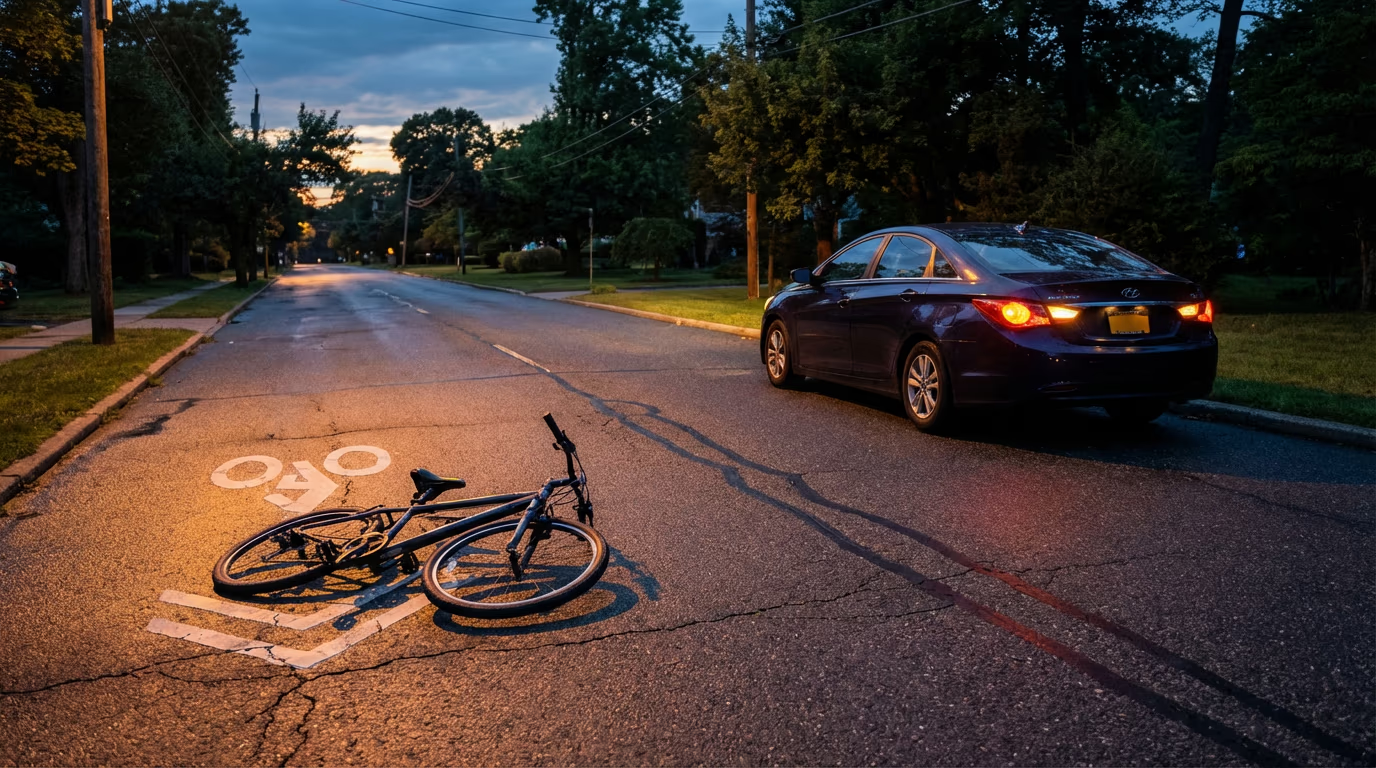
Long Island Bicycle
Accident Attorney
Page updated October 2026
Hit by a car while riding on Long Island? You can claim against the driver. No-fault pays the first $50,000 of medical bills and lost wages, and pain and suffering requires proof of a serious injury under Insurance Law § 5102(d). Our Huntington Station firm handles cyclist injury cases across Nassau and Suffolk. No fee unless we win.
Serving Long Island, Nassau County, Suffolk County & All of NYC
$100M+
Recovered
24+
Years Experience
$0
Upfront Cost
24/7
Available
Quick Answer
Long Island bicycle accident settlements typically range from $25,000 to $1,000,000+ depending on injury severity, with cases involving TBI or spinal damage resolving significantly higher. Under CPLR 214(5), you have 3 years from the date of injury to sue a driver. A claim against a town, county or other municipality needs a notice of claim within 90 days (General Municipal Law §50-e) and a lawsuit within one year and 90 days (§50-i). Vehicle and Traffic Law §1231 gives a person riding a bicycle on a roadway the rights and duties of the driver of a vehicle.
Last updated: October 2026 · Every case is unique — these ranges reflect general Long Island outcomes and are not guarantees.
Why Choose Our Firm
Why Injured Cyclists Choose Us
Experienced Bicycle Injury Attorneys
Cycling accident claims involve unique challenges — from accident reconstruction on roads with no bike infrastructure to countering insurance tactics that blame the cyclist. We know how to build these cases and win them.
No Fee Unless We Win
Every bicycle accident case is handled on contingency. You pay nothing upfront and nothing out of pocket — ever. If we don't recover compensation for your cycling injuries, you owe us nothing.
Thorough Accident Investigation
We reconstruct the accident scene, obtain traffic camera footage, subpoena the driver's cell phone records to prove distraction, secure GPS data, and interview witnesses — building an airtight case before the evidence disappears.
Deep Knowledge of NY Cycling Laws
We understand VTL §1231, §1234, safe passing requirements, e-bike regulations, and every nuance of New York cycling law — and we use that knowledge to dismantle the defense's arguments about cyclist behavior.
24+ Years Fighting for Injured Cyclists
Jason Tenenbaum has practiced personal injury law on Long Island since 2002, with over 1,000 appeals written and the courtroom skill to take your case to trial if the insurance company won't pay what it's worth.
We Know Long Island's Roads
From Route 25A and Hempstead Turnpike to Route 110 outside our Huntington Station office, we know the roads where Long Island cycling cases come from.
Proven Track Record
Bicycle Accident Case Recoveries
Bicycle accident cases require specialized knowledge of cycling law and the tenacity to fight insurance companies that routinely undervalue cyclist injuries. Here is what our advocacy has achieved.
$1.5M
Cyclist Struck by SUV Running Red Light
Nassau County
$975K
Bicycle Dooring Accident
Suffolk County
$800K
Cyclist Hit by Turning Truck
Hempstead
$650K
Bicycle Accident on Route 25A
Huntington
*Past results do not guarantee similar outcomes. Every case is different.
What Are My Legal Rights After a Bicycle Accident in New York?
Bicycle accidents on Long Island are far more than simple traffic incidents. When a two-ton vehicle collides with a cyclist protected by nothing more than a thin frame and clothing, the resulting injuries are often catastrophic. New York law recognizes the vulnerability of cyclists and provides a comprehensive legal framework for holding negligent drivers, municipalities, and other parties accountable for the harm they cause.
Under Vehicle and Traffic Law Section 1231, a person riding a bicycle on a roadway is granted all of the rights and is subject to all of the duties of the driver of a vehicle, except for the special bicycle rules and the provisions that by their nature cannot apply. A driver who says a cyclist “didn’t belong on the road” is arguing against the statute.
VTL Section 1234(a) requires a cyclist to use a usable bike lane if one is provided, and otherwise to ride near the right-hand curb or edge or on a usable right shoulder. The exceptions are written into the statute: preparing for a left turn, and moving away from the edge when reasonably necessary to avoid unsafe conditions, including fixed or moving objects, parked or moving vehicles, surface hazards, and lanes too narrow for a bicycle and a vehicle to travel safely side by side. Those exceptions answer many of the comparative fault arguments insurers raise.
New York motorists are required to maintain a safe passing distance when overtaking a cyclist: VTL §1122-a requires a driver overtaking a bicycle to pass to the left “at a safe distance until safely clear thereof.” New York has no fixed three-foot rule; what counts as safe depends on speed, lane width and conditions. When a driver passes too closely and clips a cyclist or forces the rider off the road, the driver has broken that statute, and an unexcused violation of the Vehicle and Traffic Law is negligence per se (Durkee v Sanchez-Rodriguez, 229 AD3d 1315 [4th Dept 2024]).
New York follows a comparative negligence system under CPLR Section 1411. A cyclist can recover compensation even if they were partially at fault for the accident; in a claim against a motor vehicle driver commenced on or after May 26, 2026, recovery is barred if the cyclist's share of fault is greater than the driver's. If a jury determines you were 25% at fault for failing to signal a turn, your recovery is reduced by 25% — but you still collect the remaining 75% of your damages. This is particularly important in bicycle cases where insurance companies aggressively argue that the cyclist contributed to the collision.
Cyclists struck by motor vehicles are covered under New York's no-fault Personal Injury Protection (PIP) benefits, which pay up to $50,000 in medical expenses, lost earnings (up to $2,000 a month for three years) and related costs regardless of fault (Insurance Law §5102(a)). Written notice of the claim is due within 30 days of the accident unless you can give clear and reasonable justification for the delay (11 NYCRR 65-1.1). Beyond no-fault, you can sue the at-fault driver for economic loss above $50,000 and, if you prove a serious injury, for pain and suffering.
The statute of limitations for bicycle accident claims is three years from the date of injury under CPLR Section 214. If a city, county, town or village is involved (for example, a county bus struck you or a town road defect caused the crash), a notice of claim is due within 90 days under General Municipal Law Section 50-e, and the lawsuit must be started within one year and 90 days (§50-i). On helmets: VTL §1238 requires them for bicycle operators aged one through 13 and for passengers under 14, not for adult riders of ordinary bicycles, and §1238(7) says a failure to comply with that section is not contributory negligence and does not reduce damages.
| Injury Severity | Settlement Range | Typical Timeline |
|---|---|---|
| Minor (road rash, soft tissue) | $25,000 – $100,000 | 3–6 months |
| Moderate (fractures, concussion) | $100,000 – $500,000 | 6–18 months |
| Severe / Catastrophic (TBI, spinal cord) | $500,000 – $1,500,000+ | 1–3+ years |
Every case is unique. These ranges reflect general Long Island case outcomes and are not guarantees of results.
Injured in a bicycle accident on Long Island?
Get a free case review. We'll review what happened, explain your legal options, and tell you what your cycling injury case may be worth.
Free Case ReviewWhat Causes Bicycle Accidents on Long Island?
Long Island's roads were designed almost exclusively for motor vehicles. The combination of high-speed traffic, minimal cycling infrastructure, and distracted drivers creates a dangerous environment for cyclists. Understanding the common causes of bicycle accidents helps establish fault and strengthens your legal claim.
Dooring accidents
A dooring accident occurs when a parked car's occupant opens their door directly into the path of a cyclist. Under VTL Section 1214, no one may open the door of a motor vehicle on the side available to moving traffic unless and until it is reasonably safe to do so and can be done without interfering with traffic. These crashes happen with almost no warning. The person who opened the door is the first one answerable for it.
Right hook collisions
A right hook occurs when a driver turns right directly across the path of a cyclist traveling straight in the same direction. The driver either fails to check their mirror, misjudges the cyclist's speed, or simply doesn't see them. This is one of the most common and dangerous intersection collisions for cyclists, and the turning driver is almost always at fault for failing to yield.
Left cross collisions
A left cross happens when an oncoming vehicle turns left into the path of a cyclist riding straight through an intersection. The driver typically misjudges the cyclist's speed or simply fails to see them against the background of traffic. These crashes often occur at high speed and cause severe injuries because the cyclist collides with the side of the turning vehicle.
Rear-end collisions
When a driver fails to maintain a safe following distance and strikes a cyclist from behind, the injuries are frequently catastrophic. The cyclist has no warning and no ability to brace for impact.
Distracted driving
Texting, phone use, GPS navigation, and in-vehicle screens pull a driver’s eyes off the road. At 40 mph a car covers about 290 feet in five seconds. Cyclists are among the first victims of this inattention because they are smaller and harder to see even when drivers are paying full attention.
Failure to check mirrors or blind spots
Drivers who change lanes, merge, or pull away from the curb without checking their mirrors put cyclists at extreme risk. Every motorist has a legal obligation to ensure their path is clear before making any lateral movement. A failure to perform this basic check that results in a collision is negligence.
Unsafe lane changes
Drivers who swerve into a cyclist's path while changing lanes violate VTL Section 1128, which requires vehicles to maintain a single lane until the driver has determined the move can be made safely. Cyclists riding in or near a travel lane are particularly vulnerable to sudden lane changes by drivers who don't check for two-wheeled traffic.
Road hazards — potholes, debris, and poor pavement
A pothole that barely jolts a car can send a cyclist over the handlebars. Cracked pavement, storm grates with gaps parallel to the direction of travel, construction debris, and gravel on the road surface all pose serious dangers to cyclists. When a municipal entity fails to maintain safe road conditions, it may be held liable — though these claims require filing a notice of claim within 90 days.
Commercial vehicle blind spots
Trucks, buses, and delivery vehicles have significantly larger blind spots than passenger cars. Turning trucks and buses can strike a cyclist alongside them during low-speed maneuvers. An employer can be liable for its driver’s negligence on the job, and separately for its own failure to train or supervise.
Drunk and impaired driving
Impaired drivers have delayed reaction times, reduced peripheral vision, and poor judgment — all of which make them especially dangerous to cyclists. The police report, any chemical test, and the criminal case record become evidence in the civil claim.
What Are the Most Common Bicycle Accident Injuries?
The human body has no protection against impact with a motor vehicle. Bicycle accident injuries tend to be far more severe than those in car-on-car collisions because there is nothing between the cyclist and the vehicle, the pavement, or both.
Traumatic brain injuries
Even cyclists wearing helmets can sustain concussions, contusions, and severe traumatic brain injuries. Helmets reduce the risk of skull fractures but do not prevent the brain from moving inside the skull on impact. TBIs can cause cognitive impairment, memory loss, personality changes, chronic headaches, and permanent disability that fundamentally alters every aspect of your life.
Spinal cord injuries
The force of a vehicle collision can fracture vertebrae, herniate discs, and damage the spinal cord itself. Depending on the location and severity of the injury, victims may experience partial or complete paralysis, chronic pain, loss of sensation, and permanent loss of mobility. Spinal cord injuries require extensive surgery, rehabilitation, and often lifelong medical care costing millions of dollars.
Broken collarbones, wrists, and arms
A rider who is thrown tends to land on an outstretched arm or a shoulder, and the force travels through the collarbone, wrist and elbow. A fracture is also one of the serious injury categories in Insurance Law §5102(d). Many of these injuries require surgical fixation with plates and screws followed by months of physical therapy.
Facial and dental injuries
Cyclists who go over the handlebars or are thrown from their bike frequently suffer broken noses, shattered cheekbones, orbital fractures, jaw injuries, and knocked-out or shattered teeth. These injuries often require maxillofacial surgery, dental reconstruction, and may leave permanent scarring that affects the victim's appearance and self-confidence.
Road rash and skin grafts
When a cyclist slides across pavement, the friction strips away layers of skin — sometimes down to muscle and bone. Severe road rash can require debridement, skin grafts, and months of wound care. The scarring can be permanent and disfiguring, particularly when it affects visible areas like the face, arms, and legs.
Knee and hip injuries requiring surgery
The impact of a collision or the twisting force of being knocked off a bicycle frequently damages the knee and hip joints. ACL tears, meniscus tears, hip labral tears, and patellar fractures are common bicycle accident injuries that require arthroscopic surgery, joint replacement, or both — followed by extensive rehabilitation and potentially permanent limitations on physical activity.
Internal organ damage
Blunt force trauma from a vehicle impact or from landing on the bicycle's handlebars can rupture the spleen, lacerate the liver, or cause kidney damage. Internal injuries may not present symptoms immediately, making prompt medical evaluation after any bicycle accident absolutely critical. Undiagnosed internal bleeding can be fatal within hours.
Wrongful death
When a bicycle accident results in the death of a loved one, the personal representative of the estate can bring a wrongful death action under EPTL Section 5-4.1. Damages are “fair and just compensation for the pecuniary injuries” to the family, plus medical and funeral expenses (EPTL §5-4.3). The cyclist’s own conscious pain and suffering before death is a separate claim the estate brings under EPTL §11-3.2(b). New York has not enacted the Grieving Families Act. Our firm handles these cases with the sensitivity and thoroughness that grieving families deserve.
Dangerous Roads and Bike Routes on Long Island
The state’s own crash data shows the trend. In the New York DMV’s police-reported crash file (data.ny.gov dataset e8ky-4vqe, crashes coded “Bicyclist, Collision With” in Nassau and Suffolk counties), there were 937 such crashes in 2024, 842 of them with an injury or a death, up from 659 crashes and 620 injury-or-death crashes in 2021. Nassau recorded 526 of the 2024 crashes and Suffolk 411; seven were fatal.
| Year | Nassau | Suffolk | Total | With injury or death | Fatal |
|---|---|---|---|---|---|
| 2021 | 355 | 304 | 659 | 620 | 8 |
| 2022 | 399 | 342 | 741 | 683 | 10 |
| 2023 | 450 | 366 | 816 | 742 | 9 |
| 2024 | 526 | 411 | 937 | 842 | 7 |
These are the corridors our cycling clients most often ride:
Route 25A (North Country Road) winds through the North Shore from Queens to the eastern tip of Long Island. Through Cold Spring Harbor, Huntington, and Smithtown it carries heavy traffic on a two-lane road with curves, which makes the safe-passing rule in VTL §1122-a the center of many cases.
Route 110 (Walt Whitman Road) is a major north-south corridor through Huntington Station lined with commercial entrances and exits where drivers cross the path of a cyclist riding along the edge, the setup for right-hook and left-cross collisions.
Hempstead Turnpike stretches across central Nassau County with heavy traffic, frequent bus stops, and closely spaced intersections and driveways.
Ocean Parkway is a popular recreational route. Where a rider moves between a path and the roadway, VTL §1234(c) requires a full stop before entering the roadway from a driveway or over a curb, and drivers still owe the §1146 duty of due care.
Northern Boulevard through Nassau County, Sunrise Highway crossings, and local arterials round out the list.
What to Do After a Bicycle Accident on Long Island
The actions you take in the minutes and hours after a bicycle accident directly impact the strength of your legal claim and the compensation you can recover. Follow these steps to protect your rights:
Call 911 and get medical help
Even if you feel okay, call 911 immediately. Adrenaline masks pain — concussions, internal bleeding, and spinal injuries frequently have delayed symptoms. A police report creates an official record of the accident, and the emergency room visit establishes the critical connection between the collision and your injuries.
Do NOT move your bicycle
The position of your bicycle relative to the vehicle, skid marks, and road markings is critical evidence for accident reconstruction. Leave your bike where it landed unless doing so creates an immediate safety hazard. If you must move it, photograph its position first from multiple angles.
Get the driver's information
Collect the driver's name, license number, license plate, insurance company, and policy number. If it was a commercial vehicle, note the company name displayed on the vehicle. If the driver tries to leave, get as much identifying information as you can and report it to the responding officers.
Photograph everything
Take photos of the vehicle and its damage, your bicycle and its damage, road conditions, traffic signals, stop signs, skid marks, debris, your injuries, and the surrounding area. Capture wide shots showing the intersection or road layout. Record video if possible. This evidence disappears quickly — road conditions change, vehicles get repaired, and injuries heal.
Get witness contact information
Bystanders, nearby business employees, and other drivers may have seen the accident. Collect their names and phone numbers. Witness testimony is powerful evidence, and memories fade rapidly — within weeks, details become unreliable or forgotten entirely.
Do NOT admit fault or apologize
Anything you say at the scene can be used against you. Saying "I'm sorry" or "I didn't see you" can be twisted into an admission of fault. Stick to the facts when speaking to police. Do not speculate about what happened or accept blame — liability is a legal determination, not a roadside conclusion.
File a no-fault application within 30 days
A cyclist struck by an insured motor vehicle claims no-fault benefits from that vehicle’s insurer (11 NYCRR 65-3.12(a)(1)). The benefits cover medical expenses, lost earnings and related costs up to $50,000, regardless of fault. Written notice is due within 30 days of the accident unless you can show clear and reasonable justification for a delay (11 NYCRR 65-1.1).
Contact a bicycle accident attorney before talking to any insurance company
Insurance adjusters contact accident victims quickly — and their goal is to minimize what they pay you. They may ask for a recorded statement, request a blanket medical authorization, or offer a quick settlement before you understand the full extent of your injuries. Having an attorney involved from the beginning protects you from these tactics and ensures the true value of your claim is preserved.
How Do Insurance Companies Try to Reduce My Bicycle Accident Claim?
Insurance companies have a long history of bias against cyclists. They exploit cultural assumptions about cycling and use specific tactics designed to reduce or deny bicycle accident claims. Understanding these strategies is essential to protecting the value of your case.
The first tactic is arguing the cyclist "should have been on the sidewalk." The statute points the other way: VTL §1231 gives a cyclist on the roadway the rights of a vehicle driver, and §1234 tells the cyclist where on the roadway to ride. Local sidewalk-riding rules vary by town and village, so we check the one that applies.
Next, insurers claim "you weren't wearing a helmet" as if that proves negligence. VTL §1238 requires helmets for bicycle operators aged one through 13, child passengers, and riders of class three e-bikes, not adults on ordinary bicycles. For the riders it does cover, §1238(7) says non-compliance is not contributory negligence and does not reduce damages. Insurers still raise helmet use in head injury cases; we answer it with the statute and the medical proof.
The "blind spot" defense is another favorite. The driver claims they simply couldn't see the cyclist. But every driver has a legal obligation to check their blind spots before turning, changing lanes, or opening a door. Failure to do so is negligence. We work with accident reconstruction experts who use vehicle specifications, road geometry, and sight-line analysis to prove the cyclist was visible and the driver simply failed to look.
Insurers routinely argue the cyclist ran a stop sign or red light — even without evidence to support the claim. They rely on the general assumption that cyclists don't follow traffic laws. Our attorneys obtain traffic camera footage, dashcam recordings, and witness statements to establish what actually happened at the intersection.
Social media surveillance is standard practice. Insurance investigators monitor your Facebook, Instagram, and other accounts looking for photos or posts that contradict your injury claims. A single photo of you at a family barbecue can be taken out of context to argue you're not as injured as you claim. We advise clients to restrict their social media activity immediately after an accident.
Perhaps most damaging are lowball settlement offers made before the full extent of your injuries is known. A cyclist who accepts a $25,000 offer for what turns out to be a traumatic brain injury requiring years of rehabilitation has left hundreds of thousands of dollars — or more — on the table. Having an experienced attorney ensures you never settle before your injuries are fully diagnosed and your future medical needs are understood.
New York Bicycle Laws Every Cyclist Should Know
New York has a comprehensive set of statutes governing cycling. Understanding these laws is critical for both protecting your rights on the road and building a strong personal injury claim after an accident.
VTL §1231: Rights and duties of a driver. A person riding a bicycle on a roadway has all of the rights, and is subject to all of the duties, of the driver of a vehicle, except for the special bicycle rules and provisions that by their nature cannot apply. This is the statute that puts a cyclist on the road as of right.
VTL §1234: Where to ride. Use a usable bike lane if there is one; otherwise ride near the right-hand curb or edge or on a usable right shoulder, except when preparing for a left turn or when reasonably necessary to avoid unsafe conditions, including surface hazards and lanes too narrow to share. Riders may not ride more than two abreast on a roadway and must ride single file when being overtaken.
VTL §1236: Lights and equipment. From half an hour after sunset to half an hour before sunrise, a bicycle needs a front lamp with a white light visible for at least 500 feet and a red or amber rear light visible for 300 feet, with at least one of them visible for 200 feet from each side, plus reflective devices. Every bicycle also needs a bell or similar device and a working brake. Insurers raise missing lights as comparative fault in nighttime crashes.
VTL §1238: Helmets. Operators aged one through 13 and passengers under 14 must wear a helmet; passengers aged one through four must also ride in a separate child seat; children under one may not ride at all; and every rider of a class three e-bike must wear a helmet. The statute sets no helmet rule for adults on ordinary bicycles, and §1238(7) says non-compliance with the section is not contributory negligence and does not reduce damages.
VTL §1122-a: Safe passing. A driver overtaking a bicycle must pass to the left at a safe distance until safely clear of it. The statute sets no fixed number of feet, so a pass that is safe on an empty road at 25 mph can be unlawful at 50 mph next to a curb or a bike lane.
E-bikes and e-scooters have their own definitions. Under VTL §102-c, a class one e-bike gives pedal assistance up to 20 mph, a class two e-bike can be propelled by its motor up to 20 mph, and class three (motor up to 25 mph) exists only in a city of one million or more, which on Long Island means riders coming in from New York City. No one under 16 may operate an e-bike (§1242(2)), and towns and villages may regulate them further (§1242(3)). An e-bike is not a “motor vehicle” under VTL §125, which changes which insurance applies when one is involved.
Municipal liability for road defects affecting cyclists is governed by strict procedural requirements, including the 90-day notice of claim (General Municipal Law §50-e) and, for town highways, the prior written notice rule in Town Law §65-a. A pothole or drainage grate that poses minimal risk to a car can be life-threatening to a cyclist traveling at 15 to 20 mph on thin tires.
How Is a Bicycle Accident Claim Different from a Car Accident in New York?
Many people assume that a bicycle accident case works exactly like a car accident case. It does not. Bicycle accident claims involve a fundamentally different legal framework, different insurance dynamics, and different evidentiary challenges that require specialized knowledge to navigate effectively. Understanding these differences is critical to recovering the full compensation you deserve.
The most significant difference involves no-fault insurance and the serious injury threshold. In a car accident between two motor vehicles, New York's no-fault system requires the injured party to demonstrate "serious injury" under Insurance Law §5102(d) before suing for pain and suffering. This threshold, requiring proof of a fracture, significant disfigurement, or permanent limitation for actions commenced on or after May 26, 2026 (the former 90/180-day category also applied for actions commenced before that date), prevents many car accident victims from pursuing full compensation.
Cyclists are often told the threshold does not apply to them. It does. A bicycle is not a "motor vehicle" under the Insurance Law, so a cyclist struck by a car is covered by no-fault the same way a pedestrian is, and that makes the cyclist a "covered person" under Insurance Law §5102(j). Under Insurance Law §5104(a), a covered person suing the driver for pain and suffering must prove a serious injury under §5102(d), exactly as a car occupant must. In Canner v Diamond, 187 AD3d 1127 (2d Dept 2020), the Second Department affirmed the dismissal of a Nassau County cyclist's case on that ground. Bicycle injuries are often severe enough to qualify, fractures especially, but the injury has to be proven with medical evidence from the start. Economic loss above the $50,000 no-fault limit, such as lost wages beyond what no-fault pays, can be claimed from the driver without meeting the threshold.
At the same time, cyclists struck by motor vehicles are entitled to no-fault benefits. When the car that hit them is insured, the claim goes to that car’s insurer (11 NYCRR 65-3.12(a)(1)); when it is uninsured, the claim goes to the cyclist’s own or a household relative’s policy, and if there is none, to MVAIC (65-3.12(a)(4)). No-fault pays medical bills and lost earnings up to $50,000 regardless of who caused the crash. Give written notice within 30 days (11 NYCRR 65-1.1). The claim for pain and suffering runs separately against the driver, and it depends on proving a serious injury.
The vulnerability of cyclists creates a fundamentally different injury profile compared to car occupants. A driver at 30 mph is protected by a steel frame, crumple zones, seatbelts, and airbags. A cyclist at the same speed has nothing. As a result, bicycle accident injuries are disproportionately severe relative to impact speed.
Fractures, traumatic brain injuries, spinal cord damage, and road rash requiring skin grafts are common even in collisions that would produce only minor whiplash in a car-on-car crash. This severity difference affects every aspect of the case — from medical documentation strategy to damages calculation to settlement negotiations.
VTL §1146 & the Serious Injury Threshold for Cyclists
Every driver must exercise due care to avoid striking a cyclist (VTL §1146). That duty does not remove the threshold: a cyclist struck by a car is a covered person under the no-fault law, so a claim for pain and suffering requires a serious injury under Insurance Law §5102(d) (Canner v Diamond, 187 AD3d 1127 [2d Dept 2020]). Get every fracture, scan and treatment limit documented from the first visit.
New York law imposes specific duties on drivers that apply uniquely to interactions with cyclists. VTL §1146 requires every driver to exercise due care to avoid striking a pedestrian or cyclist. It is an affirmative duty. A driver who fails to check mirrors before turning, who passes a cyclist too closely, or who opens a car door into a cyclist's path has violated a specific statutory duty.
VTL §1122-a requires a motorist overtaking a cyclist to pass at a safe distance until safely clear. An unexcused violation of the Vehicle and Traffic Law is negligence per se (Durkee v Sanchez-Rodriguez, 229 AD3d 1315 [4th Dept 2024]); the case then turns on whether the violation caused the crash, the cyclist’s own share of fault, and damages.
Bicycle cases also present unique evidentiary challenges that most car accident attorneys are not equipped to handle. In car-on-car collisions, dashcam footage, vehicle event data recorders, and extensive vehicle damage provide evidence about speed, direction, and point of impact. Bicycles have none of these features. There is no dashcam, no black box, and the damage pattern on a lightweight frame tells far less about collision dynamics.
As a result, bicycle cases rely more heavily on accident reconstruction experts who specialize in cyclist-vehicle collisions. These professionals analyze road surface evidence, tire marks, the final resting positions of the bicycle and rider, and vehicle damage to reconstruct what happened.
Road surface evidence is particularly important in bicycle cases — and particularly perishable. Skid marks from a bicycle tire are thinner and fainter than those from a car. They can disappear within hours due to traffic or weather. Scrape marks from bicycle components, debris fields, and the pattern of road rash on the cyclist's body all provide critical reconstruction data. However, this evidence must be preserved before it is lost.
Our firm dispatches investigators to the accident scene as quickly as possible. We work with accident reconstructionists who understand the physics of bicycle collisions, including how a cyclist's center of gravity, the bicycle's geometry, and the angle of impact differ from vehicle-to-vehicle crashes.
Finally, bicycle accident claims require an attorney who can overcome the cultural bias against cyclists that pervades insurance adjusting and jury deliberations. Insurance companies exploit the perception that cyclists are reckless or "don't belong on the road." These biases are factually and legally wrong — VTL §1231 gives cyclists every right to use public roads. Yet they influence how adjusters value claims and how jurors assign comparative fault.
An attorney experienced in bicycle accident litigation knows how to anticipate and counter these biases through evidence presentation, jury selection, and expert testimony that educates fact-finders about cyclists' legal rights and the duties that drivers owe to them.
Related practice areas: Pedestrian Accident • Car Accident Lawyer • Pain & Suffering • Personal Injury
Get your free case review
Contact our experienced Long Island bicycle accident attorneys for a free consultation about your cycling injury case.
Bicycle Accident Settlement Estimate
Cycling injuries on Long Island roads can be devastating. See what your bicycle accident case may be worth.
Calculate Your EstimateEducational tool only. Not legal advice.
Common Questions
Frequently Asked Questions
What should I do immediately after a bicycle accident on Long Island?
Can I sue if I wasn't wearing a helmet during a bicycle accident?
How much is my bicycle accident case worth?
Who pays my medical bills after a cycling accident in New York?
Is it legal to ride a bicycle on the road in New York?
What if the driver who hit me says I was in their blind spot?
Can I recover damages if I was partially at fault for the bicycle accident?
What if my bicycle accident was caused by a pothole or road defect?
How long do I have to file a bicycle accident lawsuit in New York?
What is a 'dooring' accident and who is liable?
Does a cyclist have to prove a serious injury to sue a driver in New York?
How many bicycle crashes happen on Long Island each year?
Locations
Bicycle Accident Attorneys Serving Long Island & NYC

Written By
Jason Tenenbaum, Esq.
Jason Tenenbaum is a personal injury attorney serving Long Island, Nassau & Suffolk Counties, and New York City. Admitted to practice in NY, NJ, FL, TX, GA, MI, and Federal courts, Jason is one of the few attorneys who writes his own appeals and tries his own cases. Since 2008, he has authored more than 2,600 articles on no-fault insurance law, personal injury, and employment law — a resource other attorneys rely on to stay current on New York appellate decisions.
Don't Wait — Evidence Disappears Fast
Injured While Cycling? Don't Let Insurance Companies Decide Your Future.
Every day that passes, evidence gets harder to find. Private camera footage gets recorded over, and witnesses forget what they saw. Contact us now for a free, no-obligation consultation.
No fee unless we win. Available 24/7. Hablamos Español.