Key Takeaway
Hit by a drunk driver in New York? The no-fault intoxication exclusion is for the driver, not you. The threshold, the 2026 cap, Dram Shop, restitution, MVAIC.
This article is part of our ongoing personal injury coverage, with 182 published articles analyzing personal injury issues across New York State. Attorney Jason Tenenbaum brings 24+ years of hands-on experience to this analysis, drawing from his work on more than 1,000 appeals, over 100,000 no-fault cases, and recovery of over $100 million for clients throughout Nassau County, Suffolk County, Queens, Brooklyn, Manhattan, and the Bronx. For personalized legal advice about how these principles apply to your specific situation, contact our Long Island office at (516) 750-0595 for a free consultation.
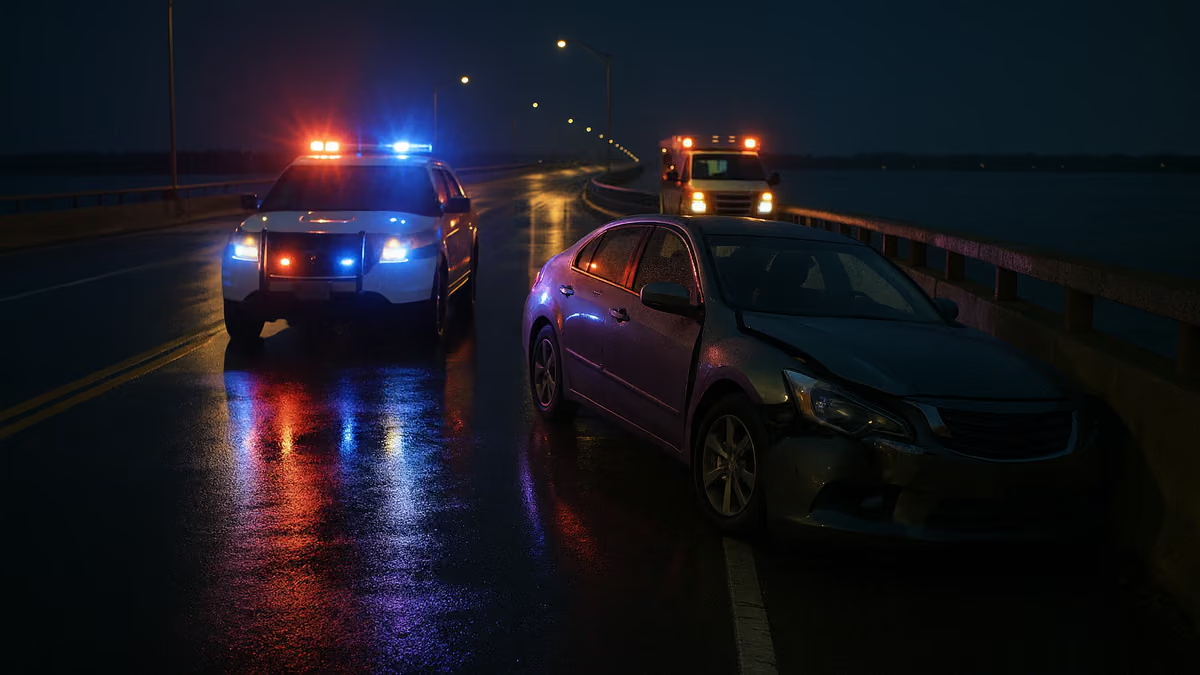
A man walking home along Montauk Highway in Copiague is hit by a car that drifts onto the shoulder; the driver is arrested at the scene and charged with driving while intoxicated. By midnight his wife is in a hospital waiting room, reading about the no-fault intoxication exclusion on her phone and concluding the family gets nothing. She has it backwards.
The two mistakes I hear most often are that the no-fault intoxication exclusion leaves the victim with nothing, and that the 2026 tort reform capped what a drunk driving case is worth at $100,000. Neither is true. Both come from reading a rule written for the driver as if it were written for the person he hit.
The short version
No-fault pays your medical bills and lost wages first; the intoxication exclusion in Insurance Law § 5103(b)(2) reaches the person "operating a motor vehicle while in an intoxicated condition," not the person that driver hit. Your lawsuit still needs a serious injury under Insurance Law § 5102(d), and since May 26, 2026, the jury decides fault first. The $100,000 cap in new Insurance Law § 5104(d) limits what an at-fault, convicted, impaired driver recovers for his own injuries; it says nothing about yours.
Two September stories, both still allegations
On September 19, 2026, News 12 reported that a Suffolk County grand jury had indicted Stephen Aylward, 63, of West Islip, for manslaughter, vehicular manslaughter, driving while intoxicated, driving while ability impaired, and leaving the scene. Prosecutors allege that around 1:30 p.m. on June 25, 2026, near Exit RM 2W-E on the Robert Moses Causeway, his vehicle struck and killed Yusuf Gull, 27, of Bay Shore, a pedestrian on the shoulder; that the driver was “drunk and high”; and that he called police about 30 minutes later. The next court date is October 16, 2026. He has not been convicted.
A day later, News 12 reported that a 31-year-old bicyclist was critically injured around 10 p.m. on September 19, 2026, near the Nassau Expressway and Burnside Avenue in Inwood. Police say the driver, Michael Mayosky, was impaired by drugs; he faces multiple charges and was arraigned in First District Court in Hempstead. None of those charges has been proven.
Free Case Review
Tell us what happened — free case review
Time-sensitive: NY injury claims have strict deadlines
Details received. The fastest next step is a call.
Injury cases are won early. Evidence fades, witnesses move, and New York's no-fault rules can require paperwork within 30 days of a crash. Don't wait for a callback. Call now and a real person takes your information: our office during business hours, and our intake line after hours and on weekends, answered 24/7.
Call (631) 349-3928Free Consultation · Nothing is filed or shared until you decide
Can't call right now? We'll reach out during business hours.
The criminal cases will take months; the victims’ own clocks started at the scene, and the first runs 30 days.
No-fault pays first, and the exclusion is written for the driver
The wife in the waiting room wants to know who pays the hospital. The flow below is the order the money arrives in.
Where your money comes from after a DWI crash
Step 1
No-fault from the striking vehicle's insurer
Pedestrian, cyclist or passenger? Yes: the insurer of the vehicle that hit you, or of the car you were in, pays medical bills, 80 percent of lost wages up to $2,000 a month and $25 a day in other expenses, up to $50,000, plus a $2,000 death benefit (Insurance Law §§ 5102(a), 5103(a)). Nothing for pain and suffering.
Step 2
The lawsuit against the driver
Serious injury under Insurance Law § 5102(d)? Yes: pain and suffering, economic loss above $50,000, and punitive damages if the conduct warrants them. No: economic loss above $50,000 only.
Step 3
SUM coverage on your own policy
Driver's limits too low, or none? Yes: supplementary uninsured/underinsured motorists coverage on your own or a household policy, up to that policy's bodily injury limits (Insurance Law § 3420(f)(2)(A)). Notify that insurer in writing now.
Step 4
MVAIC if he fled or was uninsured
Driver fled unidentified, or uninsured, with no policy of yours to turn to? Yes: MVAIC, up to $25,000 for injury to one person and $50,000 for a death (Insurance Law § 5210(a)), on the conditions in the chart below.
Step 5
Restitution in the criminal case
Driver convicted? Yes: restitution under Penal Law § 60.27: "actual out-of-pocket loss" only, capped by Penal Law § 60.27(5), credited against the civil recovery under Penal Law § 60.27(6).
Insurance Law § 5103(a)(1) requires a vehicle’s insurer to pay first-party benefits to “persons, other than occupants of another motor vehicle or a motorcycle, for loss arising out of the use or operation in this state of such motor vehicle.” A pedestrian or bicyclist is such a person; therefore, the benefits come from the insurer of the vehicle that hit them. The benefits reimburse “basic economic loss,” up to $50,000, and nothing for pain and suffering.
The exclusion is the part callers misread. Insurance Law § 5103(b) says an insurer “may exclude from coverage” a person who:
(2) Is injured as a result of operating a motor vehicle while in an intoxicated condition or while his ability to operate such vehicle is impaired by the use of a drug within the meaning of section eleven hundred ninety-two of the vehicle and traffic law …
Read the verb. The excluded person was injured as a result of “operating a motor vehicle while in an intoxicated condition.” Here, that is the driver. A pedestrian was not operating anything, and a bicyclist was not operating a motor vehicle. The no-fault regulation gives the injured person 30 days from the accident to send the application; a family member can sign it from the hospital.
The adjuster hears DWI, sees the word intoxicated, and sends the denial. You read the same word and decide that is the end of it. It is not. Send the application inside the 30 days, and when the denial comes, make the carrier put the paragraph and the person it names in writing. Then call. A denial aimed at the wrong person is where my work starts.
The lawsuit after May 26, 2026
Pain and suffering come from the lawsuit against the driver, and its conditions changed on May 26, 2026.
The threshold still applies, and fault is tried first
Insurance Law § 5104(a) allows “no right of recovery for non-economic loss, except in the case of a serious injury.” Insurance Law § 5102(d) now lists eight categories: death, dismemberment, significant disfigurement, a fracture, loss of a fetus, and the permanent loss of use, permanent consequential limitation and significant limitation categories; the 90/180-day category was deleted for actions commenced on or after May 26, 2026. The threshold does not care how drunk the driver was; our serious injury threshold guide covers the proof.
The amendment also added to the same subdivision: “the trier of fact shall not determine the question of whether an injury is a serious injury until the trier of fact has determined the party or parties at fault.” Consequently, the jury hears who caused the crash, and the intoxication evidence with it, before anyone argues about your MRI.
Comparative fault, with a new bar
CPLR § 1411(a) reduces damages in proportion to the claimant’s culpable conduct; new subdivision (b) bars recovery in an Article 51 action “if the culpable conduct attributable to the claimant is greater than the culpable conduct of the person against whom recovery is sought.” The driver’s insurer will argue that the pedestrian stood in the wrong place or the cyclist had no lights; that reduces a recovery and bars one only if the victim’s share is the greater. Our June 11, 2026 tort reform post covers the amendment.
Punitive damages, and who pays them
Ordinary negligence does not support punitive damages. Conduct showing wanton or reckless disregard for the safety of others can, and drunk driving is the usual example; each crash is decided on its facts, starting with the blood alcohol content and the speed. A guilty plea or conviction on the same facts can be used in the civil case to establish the intoxication; how much it settles depends on what was pleaded to, and a plea to a traffic infraction carries less than a plea to a crime. A punitive award is not paid by the driver’s liability insurer; it comes from the driver personally, and it is incumbent upon the victim’s lawyer to learn early whether the driver has anything to pay it with.
The cap people misread
New Insurance Law § 5104(d) limits non-economic loss to $100,000, other than in a death case, in “any action by or on behalf of an injured person who is at fault, is not barred from recovery by section fourteen hundred eleven of the civil practice law and rules, and was … (2) operating a motor vehicle while impaired at the time of the accident and convicted of such.” The capped person is the plaintiff: an impaired, at-fault, convicted driver suing over his own injuries. The subdivision says nothing about what the person he hit recovers from him.
The bar that served the driver
That bar may be a second defendant. General Obligations Law § 11-101(1), the Dram Shop Act, gives “any person who shall be injured in person, property, means of support, or otherwise by any intoxicated person, or by reason of the intoxication of any person, whether resulting in his death or not,” a right of action against anyone who “by unlawful selling to or unlawfully assisting in procuring liquor for such intoxicated person” caused or contributed to the intoxication, with “actual and exemplary damages.” Subdivision 2 keeps the action alive after a death.
The sale is unlawful when the bar serves a person who is already visibly intoxicated, and that is the fact these cases turn on. What a bar must put in the record to win summary judgment is before the Court of Appeals in Brown v Z-Live Inc., argued September 16, 2026, and pending; our Brown v Z-Live post explains what is at stake. A driver impaired by drugs alone, as alleged in the Inwood case, presents no Dram Shop claim; the statute is about liquor. Where there was liquor, the video overwrites itself; a preservation letter to every establishment the driver visited that day is among the first things I send.
The criminal case is not your case
You are the victim in the criminal case and probably its main witness, not a party, and the sentence is not your compensation.
Restitution
Penal Law § 60.27(1) directs the sentencing court to “consider restitution or reparation to the victim of the crime” and permits “reparation for the actual out-of-pocket loss caused thereby”; where the victim seeks it, the court “shall require” it “unless the interests of justice dictate otherwise.” Pain and suffering is not an out-of-pocket loss, and subdivision (5) caps the amount. Subdivision (6) then says restitution “shall not limit, preclude or impair any liability for damages in any civil action or proceeding for an amount in excess of such payment.” Consequently, restitution supplements the civil claim and does not replace it.
The plea
Vehicle and Traffic Law § 1192 defines the offenses: driving while ability impaired, subdivision (1); driving while intoxicated per se at .08 of one percent, subdivision (2); driving while intoxicated, subdivision (3); impairment by a drug, subdivision (4). Subdivision (10)(a) provides that where the charge alleges subdivision two, three, four or four-a, any guilty plea “must include at least a plea of guilty to the violation of the provisions of one of the subdivisions of this section,” with an exception the District Attorney must justify on the record. Consequently, the plea usually lands inside the section, and it is an admission of impaired or intoxicated operation your civil case can use.
Your own clock
CPLR § 214(5) gives three years from the accident for “an action to recover damages for a personal injury.” The wrongful death and notice-of-claim clocks are shorter and on the chart below. A 90-day notice does not wait for an indictment, let alone a plea. File on your own clock.
If the driver fled or had no insurance
When a driver flees unidentified, or is uninsured, the Motor Vehicle Accident Indemnification Corporation (MVAIC) stands in, and its deadlines are conditions precedent; each is on the chart below. Insurance Law § 5218 then requires a court order permitting the hit-and-run action on a showing that “all reasonable efforts have been made to ascertain the identity” of the vehicle, owner and operator. Our hit-and-run post explains the application.
The policy on the car in your driveway can matter more than MVAIC. Insurance Law § 3420(f)(2)(A) requires every New York auto policy to provide, at the insured’s option, supplementary uninsured/underinsured motorists coverage “in an amount up to the bodily injury liability insurance limits of coverage provided under such policy.” For the wife of the man from Montauk Highway, that is the family car’s policy, and the notice to that carrier goes out in writing this week.
The clocks
Every deadline after a New York DWI crash
- 24hours Police report, if the driver fledInsurance Law § 5208(a)(2)(A): "within twenty-four hours after the occurrence." Excused under § 5208(a)(2)(B) where a timely report was not reasonably possible or it was made as soon as reasonably possible.
- 30days No-fault application to the insurerThe no-fault regulation, 11 NYCRR 65-1.1. Pedestrian or cyclist: the striking vehicle's insurer. Occupant: the insurer of the car you were in.
- 90days MVAIC affidavit, hit-and-runInsurance Law § 5208(a)(2)(A): "within ninety days of the accrual of the cause of action," a condition precedent.
- 90days Notice of claim, public vehicle or municipal roadGeneral Municipal Law § 50-e(1)(a): "within ninety days after the claim arises." Wrongful death: from the appointment of the estate's representative.
- 180days MVAIC affidavit, known but uninsured driverInsurance Law § 5208(a)(1).
- 2years Wrongful death actionEPTL § 5-4.1.
- 3years Personal injury action; Dram Shop actionCPLR § 214(5); CPLR § 214 for the General Obligations Law § 11-101 claim.
The first two weeks, and the first call
- Get the police accident report number; the driver’s insurer is on it.
- Send the no-fault application to the striking vehicle’s insurer, or the insurer of the car you were in.
- Notify your own auto insurer in writing to preserve SUM coverage.
- Give no recorded statement to the driver’s insurer.
- Photograph the scene, the vehicle and your injuries; keep the bicycle and your clothing as they are.
- Tell the District Attorney’s victim advocate that you seek restitution.
By the end of the second week the wife of the man from Montauk Highway has the report number, the no-fault application in the mail, a written notice to her own carrier, and nothing on record with the driver’s adjuster. Our Long Island drunk driving accident lawyer page explains how the case is built from that file.
Bring what you have of these to the first call:
- The police accident report number.
- The hospital discharge papers.
- The declarations page of any auto policy in your household.
- Every bill and insurer letter so far.
- For a hit-and-run, when you reported it to the police.
If a drunk or drugged driver hit you or someone in your family on Long Island, contact our office or call (516) 750-0595 with the police accident report number; the 30-day no-fault clock started at the scene. Our bicycle accident attorney page covers how those cases are built.
Sources
- News 12, September 19, 2026 (Robert Moses Causeway) and News 12, September 20, 2026 (Inwood)
- Insurance Law § 5102, § 5103, § 5104, § 5208, § 5210, § 5218 and § 3420
- CPLR § 214 and CPLR § 1411
- General Obligations Law § 11-101, General Municipal Law § 50-e, Penal Law § 60.27 and Vehicle and Traffic Law § 1192
Legal Context
Why This Matters for Your Case
Personal injury law in New York is governed by a complex web of statutes, case law, and procedural rules that differ from most other states. The statute of limitations for most personal injury claims is three years under CPLR 214(5), but claims against municipalities require a Notice of Claim within 90 days. Motor vehicle accident victims must meet the serious injury threshold under Insurance Law §5102(d) before they can recover pain and suffering damages.
The Law Office of Jason Tenenbaum has recovered over $100 million for injured clients across Long Island, Nassau County, Suffolk County, Queens, Brooklyn, Manhattan, and the Bronx. With 24+ years of trial and appellate experience, more than 1,000 appeals written, and 2,600+ published legal articles, Jason Tenenbaum provides the authoritative legal analysis that practitioners and injury victims need to understand their rights.
This article reflects real courtroom experience and a deep understanding of how New York courts actually evaluate personal injury claims — from the initial filing through discovery, summary judgment, trial, and appeal.
About This Topic
New York Personal Injury Law
When negligence causes serious injury, New York law entitles victims to compensation for medical bills, lost income, pain and suffering, and more. From car accidents and slip-and-falls to construction injuries and medical malpractice, the Law Office of Jason Tenenbaum has recovered over $100 million for injured Long Islanders and New Yorkers since 2002.
182 published articles in Personal Injury
Keep Reading
More Personal Injury Analysis
NYC's Pending E-Bike Bills: What They Would Change for People Hurt in a Crash
NYC heard 23 e-bike and delivery bills on September 30, 2026. What each text would change for hurt pedestrians and riders, and the law that applies today.
Oct 21, 2026
New York's Scaffold Law in the 2027 Budget: What Happens If Labor Law 240 Changes, and What Happens If It Doesn't
Labor Law 240 and the 2027 New York budget: what each side argues, the bills on file, and what each possible outcome would change.
Oct 19, 2026
Sun Glare Accident Settlements in New York: What Your Case May Be Worth
Sun glare is not a legal excuse for crashing in New York. Learn what factors affect sun glare accident settlement amounts and how VTL §1180 applies to your claim.
Apr 4, 2026
Lawyer Analysis: Amazon Accidents
Expert Amazon accident lawyer legal strategies for victims of van crashes, securing compensation and holding corporations accountable.
Feb 10, 2025
Car Accident Arbitration in New York: What Victims Need to Know
Learn when arbitration applies to New York car accident claims, how no-fault arbitration works, when you can demand arbitration vs.
Apr 5, 2026
Insurance Adjuster Tactics After a Car Accident in New York — What They Do and How to Protect Yourself
Insurance adjusters use specific tactics to minimize car accident payouts.
Apr 4, 2026Frequently Asked Questions
Common Questions About This Topic
4 answers from the firm's New York personal-injury and employment-law practice. Click any question to expand.
Does the no-fault intoxication exclusion apply to me if the other driver was drunk?
No. Insurance Law § 5103(b)(2) excludes a person "injured as a result of operating a motor vehicle while in an intoxicated condition." That is the driver.
Does the 2026 $100,000 cap limit my claim against a drunk driver?
No. Insurance Law § 5104(d) caps non-economic loss for "an injured person who is at fault" who was driving impaired and convicted, uninsured, or committing a felony. It limits that driver's own recovery.
How long do I have to sue a drunk driver on Long Island?
Three years for the injury suit and two for a wrongful death; 90 days for a notice of claim where a public vehicle or a municipal road is involved; 30 days for the no-fault application. The sections are on the chart above.
Should I wait for the criminal case to finish before I sue?
No. The injury deadlines above do not wait for it, and a plea or conviction, when it comes, can be used in your case. A wrongful death claim has its own rule in EPTL § 5-4.1 for the time while a criminal action against the same defendant is pending; ask about it on the first call.
Was this article helpful?
Disclaimer: This article is published by the Law Office of Jason Tenenbaum, P.C. for informational and educational purposes only. It does not constitute legal advice, and no attorney-client relationship is formed by reading this content. The legal principles discussed may not apply to your specific situation, and the law may have changed since this article was last updated.
New York law varies by jurisdiction — court decisions in one Appellate Division department may not be followed in another, and local court rules in Nassau County Supreme Court differ from those in Suffolk County Supreme Court, Kings County Civil Court, or Queens County Supreme Court. The Appellate Division, Second Department (which covers Long Island, Brooklyn, Queens, and Staten Island) and the Appellate Term (which hears appeals from lower courts) each have distinct procedural requirements and precedents that affect litigation strategy.
If you need legal help with a personal injury matter, contact our office at (516) 750-0595 for a free consultation. We serve clients throughout Long Island (Huntington, Babylon, Islip, Brookhaven, Smithtown, Riverhead, Southampton, East Hampton), Nassau County (Hempstead, Garden City, Mineola, Great Neck, Manhasset, Freeport, Long Beach, Rockville Centre, Valley Stream, Westbury, Hicksville, Massapequa), Suffolk County (Hauppauge, Deer Park, Bay Shore, Central Islip, Patchogue, Brentwood), Queens, Brooklyn, Manhattan, the Bronx, Staten Island, and Westchester County. Prior results do not guarantee a similar outcome.
