Key Takeaway
Hit by an ATV or dirt bike on Long Island? Why no-fault may not cover it, when MVAIC pays, and the 24-hour and 90-day deadlines if the rider flees.
This article is part of our ongoing personal injury coverage, with 180 published articles analyzing personal injury issues across New York State. Attorney Jason Tenenbaum brings 24+ years of hands-on experience to this analysis, drawing from his work on more than 1,000 appeals, over 100,000 no-fault cases, and recovery of over $100 million for clients throughout Nassau County, Suffolk County, Queens, Brooklyn, Manhattan, and the Bronx. For personalized legal advice about how these principles apply to your specific situation, contact our Long Island office at (516) 750-0595 for a free consultation.
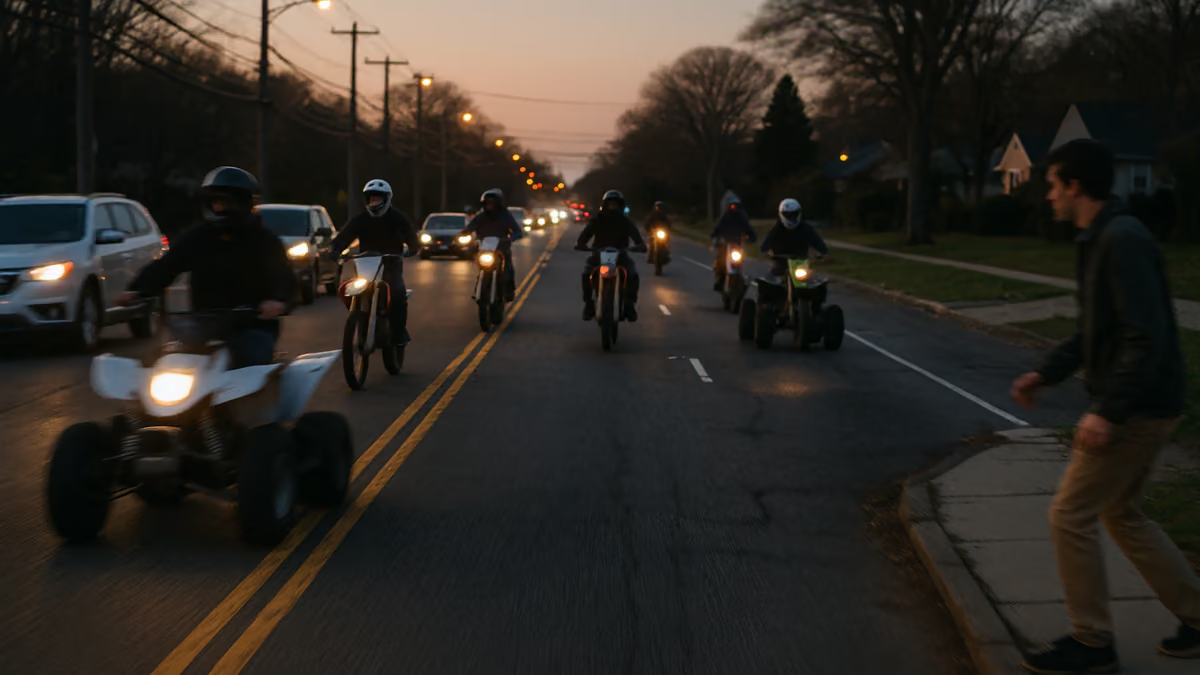
On the night of July 25, 2026, a pack of roughly 200 ATVs, dirt bikes and motorcycles rode from Route 347 in Hauppauge through Lake Grove and Brentwood into Bay Shore. Suffolk County police say they arrested three riders, impounded ten vehicles and found a loaded gun on one of the people they stopped. Those are police allegations. News 12 and NBC New York covered the ride.
Nobody in that story was reported hurt. Take a woman crossing Main Street in Bay Shore at the light when a pack like that one comes through. A quad clips her in the crosswalk, the rider does not stop, and the machine carried no plate. There is no car in her household.
Vehicle and Traffic Law § 2403(1) says: “No person shall operate an ATV on a highway except as provided herein.” A ride from Hauppauge to Bay Shore is not among the exceptions. For her, that settles nothing. I handle pedestrian cases like hers on Long Island, and the first question in her file is never fault. It is who pays.
The short version
Vehicle and Traffic Law § 125 excludes ATVs from "motor vehicle," and the no-fault law is built on that definition. If an uninsured ATV or dirt bike hit you, the first party benefits a car crash victim expects may not exist. The routes are a household auto policy, the Motor Vehicle Accident Indemnification Corporation (MVAIC), and a negligence suit against the rider and the owner. If the rider fled: 24 hours to report to police, 90 days to file the MVAIC affidavit (Insurance Law § 5208(a)(2)). MVAIC pays no more than $25,000 for injury to one person (Insurance Law § 5210(a)). Tonight: get the police report number, and send the no-fault application to whichever payer the flow below points to.
Is an ATV a “motor vehicle” for no-fault?
Everything turns on one definition, and it is not the one a car crash victim expects. Vehicle and Traffic Law § 125 lists all terrain vehicles among the exceptions to “motor vehicle,” and the no-fault law builds on that definition. The seven rules that decide the case are set out below in the statutes’ own words.
Free Case Review
Tell us what happened — free case review
Time-sensitive: NY injury claims have strict deadlines
Details received. The fastest next step is a call.
Injury cases are won early. Evidence fades, witnesses move, and New York's no-fault rules can require paperwork within 30 days of a crash. Don't wait for a callback. Call now and a real person takes your information: our office during business hours, and our intake line after hours and on weekends, answered 24/7.
Call (631) 349-3928Free Consultation · Nothing is filed or shared until you decide
Can't call right now? We'll reach out during business hours.
The same definition decides an e-bike or e-scooter crash, where a lawful machine is outside it and an illegal one is inside it; our guide to Suffolk’s e-bike rules and who pays covers that case.
Statute at a glance
Seven rules that decide who pays, and how much, when an ATV hits you
- "Motor vehicle" (Vehicle and Traffic Law § 125)
- "every vehicle operated or driven upon a public highway which is propelled by any power other than muscular power," then a list of exceptions. Exception (d) is "all terrain vehicles as defined in article forty-eight-B of this chapter." Motorcycles are not carved out.
- "ATV" (Vehicle and Traffic Law § 2281(1)(a))
- "any self-propelled vehicle which is manufactured for sale for operation primarily on off-highway trails or off-highway competitions and only incidentally operated on public highways." The test is how the machine was built and sold.
- "Motor vehicle" for no-fault (Insurance Law § 5102(f))
- "a motor vehicle as defined in section three hundred eleven of the vehicle and traffic law and also includes fire and police vehicles. It shall not include any motor vehicle not required to carry financial security pursuant to article six, eight or forty-eight-A of the vehicle and traffic law or a motorcycle, as defined in subsection (m) hereof."
- "Motorcycle" for no-fault (Insurance Law § 5102(m))
- A motorcycle under Vehicle and Traffic Law § 123 "which is required to carry financial security." A two-wheeled dirt bike can fall on either side of this line and the ATV line; the make, model and VIN decide.
- The machine's own policy (Insurance Law § 5103(f))
- Every owner's policy "issued on a motorcycle or an all terrain vehicle" pays first party benefits "to persons, other than the occupants of such motorcycle or all terrain vehicle, another motorcycle or all terrain vehicle, or any motor vehicle, for loss arising out of the use or operation of the motorcycle or all terrain vehicle within this state." It pays the pedestrian. It pays the rider nothing.
- "Motor vehicle" for MVAIC (Insurance Law § 5202(a))
- "a motor vehicle as defined in section one hundred twenty-five of the vehicle and traffic law and also includes trailers, semi-trailers, motorcycles, tractors and snowmobiles." Motorcycles are added back. ATVs are not.
- The MVAIC cap (Insurance Law § 5210(a))
- A judgment "exclusive of interest and costs shall not exceed: (1) twenty-five thousand dollars on account of injury to one person in any one accident, and (2) fifty thousand dollars on account of death to one person in any one accident, and (3) fifty thousand dollars on account of injury to more than one person in any one accident subject to the limit of twenty-five thousand dollars for any one person, and (4) one hundred thousand dollars on account of death to more than one person in any one accident subject to the limit of fifty thousand dollars for any one person." The same subsection allows no recovery "for non-economic loss unless such person has incurred a serious injury."
Read together, those texts put a four-wheeled ATV outside the no-fault “motor vehicle” and inside a rule it shares with motorcycles: the machine’s own policy, if any, pays a pedestrian and pays the rider nothing. A dirt bike can fall on either side of that line. Consequently, get the make, model and VIN before anything else. The label decides which insurer, if any, owes the first $50,000.
Where the medical bills go
Who pays the first $50,000 depends on where you were when the machine hit you. A car occupant’s own carrier pays, and the rider usually has none; both are on the flow below, and the no-fault versus lawsuit guide covers the ordinary car case. The two pedestrian cases are the hard ones.
On foot or on a bicycle, with an insured car in the household
Insurance Law § 5103(a)(2) makes that policy pay first party benefits to “the named insured and members of his household, other than occupants of a motorcycle, for loss arising out of the use or operation of (i) an uninsured motor vehicle or motorcycle.” A parent’s or spouse’s policy counts if you regularly reside there (Insurance Law § 5102(h)). A machine treated as a motorcycle is named in those words; a machine treated as an ATV is not. File regardless.
On foot, with no auto policy in the household
That is the woman in the Bay Shore crosswalk, and MVAIC is her payer. It pays a “qualified person,” which Insurance Law § 5202(b) defines as “a resident of this state, other than an insured or the owner of an uninsured motor vehicle,” and subsection (i) defines “insured” by an auto policy’s uninsured motorist coverage. Here, the definition bites a second time. The MVAIC definition on the card above adds motorcycles and says nothing about ATVs; therefore a dirt bike that qualifies as a motorcycle is inside it and a quad is not. File anyway. A denial can be fought; a missed filing has to be excused first.
The flow below is the same analysis in the order I run it.
Who pays your medical bills after an ATV hits you
Basic economic loss, "up to fifty thousand dollars per person" under Insurance Law § 5102(a). Stop at the first "yes."
Step 1
Were you inside a car?
Yes: that car's policy pays under § 5103(a)(1). Apply within 30 days. No: go to step 2.
Step 2
Is there an auto policy in your household?
Yes: it pays under § 5103(a)(2) if the machine is an "uninsured motor vehicle or motorcycle." Apply within 30 days. No: go to step 3.
Step 3
Motorcycle (§ 5102(m)) or ATV (Vehicle and Traffic Law § 2281)?
Motorcycle: MVAIC's § 5202(a) lists motorcycles; file as a "qualified person" under § 5202(b). ATV: § 5202(a) does not list ATVs. File anyway and litigate the denial.
Step 4
Were you on the machine?
Rider: § 5103(f) pays no "occupants of such motorcycle or all terrain vehicle," and § 5202(b) excludes "the owner of an uninsured motor vehicle." Usually no first party payer. Everyone else, if the rider fled: police report in 24 hours, MVAIC affidavit in 90 days (§ 5208(a)(2)).
Whichever box the flow lands on, file within 30 days, and make a carrier that says the machine is the wrong kind of vehicle say so in writing.
When the rider flees: MVAIC, step by step
Plan for the rider never being identified. The woman in the crosswalk has a police report and no plate; her file runs on the hit-and-run rules in Insurance Law § 5208.
Report it within 24 hours
Section 5208(a)(2)(A) covers an accident “reported within twenty-four hours after the occurrence to a police, peace or judicial officer in the vicinity or to the commissioner.” A 911 call from the scene satisfies the rule.
File the affidavit within 90 days
The same paragraph requires an affidavit filed with MVAIC “within ninety days of the accrual of the cause of action, as a condition precedent to the right to apply for payment from the corporation.” What it must state, and the one-year window for a court to excuse a late one, are on the clocks below.
In my experience the 24-hour report takes care of itself, because someone calls 911. The affidavit is the filing that gets missed. Nobody at the hospital mentions MVAIC, and an auto carrier has no reason to. Do not wait for the police to find the rider or for the impound list. Get the report number and write down what you saw while it is fresh. Then file. If the rider is gone, assume from day one that the rider stays gone, and build the file that way.
Get the court’s permission to sue MVAIC
Insurance Law § 5218(a) requires a court order permitting the action against the corporation. Under subsection (b) the court must be satisfied that the notice of claim section was complied with, that the injured person “was not at the time of the accident operating an uninsured motor vehicle,” and that “all reasonable efforts have been made to ascertain the identity of the motor vehicle and of the owner and operator.” It is incumbent upon the applicant to make that last showing, and it is where these applications are won and lost.
Know which limit applies
No-fault benefits through MVAIC run up to $50,000. The bodily injury judgment is separate, and Insurance Law § 5210(a) caps it at $25,000 for injury to one person; the full schedule and the serious injury condition are on the card above. A household policy’s uninsured motorist endorsement under Insurance Law § 3420(f)(1) must carry at least $25,000 in uninsured motorist coverage for injury to one person; the hit-and-run settlement guide covers that coverage.
The clocks, in the order they run:
The clocks
Every deadline after an ATV or dirt bike hit-and-run in New York
- 24hours Report the accident to policeInsurance Law § 5208(a)(2)(A). Excused under § 5208(a)(2)(B) only where it was not reasonably possible to report in time, or the report was made as soon as reasonably possible.
- 30days No-fault application to the first party insurerThe no-fault regulation. File with the household carrier, or MVAIC if there is none (Insurance Law § 5201(b)), even if the label is disputed.
- 90days MVAIC affidavit, rider unidentifiedInsurance Law § 5208(a)(2), "as a condition precedent to the right to apply for payment from the corporation." It states that "the person has the cause of action for damages arising out of the accident and setting forth the supporting facts," that "the cause of action is against a person whose identity is unascertainable," and that "the person is making a claim for those damages."
- 180days MVAIC affidavit, rider identified but uninsuredInsurance Law § 5208(a)(1): the claim is "against the owner or operator of a designated uninsured motor vehicle."
- 1year Court application for leave to file a late affidavitInsurance Law § 5208(c), "within one year from the beginning of the period for filing the affidavit," on proof under § 5208(b) that filing in time "was not reasonably possible."
- 3years Negligence action against the rider and the ownerCPLR § 214(5). A suit against MVAIC itself needs the § 5218(a) court order first.
Miss the affidavit and MVAIC holds a defense before the police have finished looking for the rider.
Suing the rider, and the owner
An identified rider is personally liable for negligence, and CPLR § 214(5) gives three years to commence “an action to recover damages for a personal injury.” A rider on an unregistered machine rarely has a policy behind him; therefore, the owner matters.
Vehicle and Traffic Law § 388(1) makes an owner liable for negligent operation “by any person using or operating the same with the permission, express or implied, of such owner.” However, subdivision 2 defines “vehicle” for that section as “a ‘motor vehicle’, as defined in section one hundred twenty-five of this chapter,” and that definition, as the card above shows, excludes ATVs. The section reaches the owner of a lent motorcycle and not the owner of a lent ATV.
The ATV article has its own rule. Vehicle and Traffic Law § 2411 provides that “[n]egligence in the use or operation of an ATV shall be attributable to the owner,” and that every owner of an ATV used or operated in this state “shall be liable and responsible for death or injury to person or damage to property resulting from negligence in the use or operation of such ATV by any person using or operating the same with the permission, express or implied, of such owner.” Consequently, the owner of a lent ATV answers for the rider’s negligence the same way a car owner does, and the fight is over permission.
For a dirt bike that is neither an ATV under that definition nor a registered motorcycle, the claim against the owner rests on what the owner did: whom the owner handed the machine to and what the owner knew. Nothing in these statutes makes a parent pay because of the relationship alone. A homeowner’s policy may or may not respond; its motor vehicle exclusion controls, so demand the policy in discovery.
A claim that Suffolk or Nassau police should have stopped the takeover does not lie against the county without a special relationship between the police and the injured person; police protection is owed to the public at large. Spend the effort on the rider and the owner.
The 2026 threshold and fault rules
Part EE of S9008-C, signed May 26, 2026, applies to motor vehicle actions commenced on or after May 26, 2026. Insurance Law § 5104(a) bars recovery for non-economic loss “except in the case of a serious injury” in “any action by or on behalf of a covered person against another covered person.” The 90/180-day category is gone from the serious injury definition in Insurance Law § 5102(d), which now lists eight categories; the serious injury threshold guide covers the proof each takes.
Whether that governs a suit against the rider turns on “covered person.” Insurance Law § 5102(j) defines one as “any pedestrian injured through the use or operation of, or any owner, operator or occupant of, a motor vehicle which has in effect the financial security required by article six or eight of the vehicle and traffic law,” or “any other person entitled to first party benefits.” A rider on an uninsured, unregistered machine fits neither clause on the face of that text, and the threshold rule, by its words, governs suits between covered persons.
Section 5104(a) now also sequences the trial: “the trier of fact shall not determine the question of whether an injury is a serious injury until the trier of fact has determined the party or parties at fault.” CPLR § 1411(b) bars recovery in an action “subject to article fifty-one of the insurance law” where the claimant’s culpable conduct “is greater than the culpable conduct of the person against whom recovery is sought.” Expect that argument if the rider’s side can put the woman in the crosswalk against the signal; the tort reform summary covers the rest. Consequently, who had the light is as much a part of the first month’s work as the search for the plate.
Evidence, and the first 30 days
Your file will be judged against Insurance Law § 5218(b)(5): all reasonable efforts to identify the machine, the owner and the operator. Store and doorbell cameras overwrite themselves in days. Riders post their own footage, and the 911 recording holds the first description. The police impound list, ten entries on July 25, 2026, is the closest thing to a registry these rides produce.
The first 30 days, in order
- Get treated the same day and tell the emergency room it was an ATV or dirt bike.
- Report it to police within 24 hours; get the report number and ask whether the machine was impounded.
- Save every photo and video to a second device, and send preservation letters to every camera owner along the route.
- File the no-fault application within 30 days and put the uninsured motorist carrier on written notice. With no household policy, file the MVAIC affidavit inside 90 days.
- Give no recorded statement to any insurer. The CPLR § 1411(b) argument is built from those.
The cameras go first, so the preservation letters go out before the police report is even typed.
Before you call
By the end of her first month the woman in the Bay Shore crosswalk has a police report number, an emergency room record that names the machine, two doorbell clips from Main Street, and an affidavit on file with MVAIC. That is the file the court reads when she asks for leave to sue the corporation. If the impound list puts a name on the quad, the suit runs against that owner under the ATV article; if it does not, the affidavit is the whole claim. The hit-and-run settlement guide covers each path in more detail.
Bring what you have of these to the first call:
- The police report number.
- Every photo and video from the scene, and who was filming.
- The emergency room discharge papers.
- The declarations page of any auto policy in your household.
If an ATV, dirt bike or motorcycle hit you on Long Island, call (516) 750-0595 or request a free case review with the police report number in hand; the 90-day MVAIC clock does not wait for the rider to be found. Our pedestrian accident and motorcycle accident pages go deeper on liability.
Sources
Legal Context
Why This Matters for Your Case
Personal injury law in New York is governed by a complex web of statutes, case law, and procedural rules that differ from most other states. The statute of limitations for most personal injury claims is three years under CPLR 214(5), but claims against municipalities require a Notice of Claim within 90 days. Motor vehicle accident victims must meet the serious injury threshold under Insurance Law §5102(d) before they can recover pain and suffering damages.
The Law Office of Jason Tenenbaum has recovered over $100 million for injured clients across Long Island, Nassau County, Suffolk County, Queens, Brooklyn, Manhattan, and the Bronx. With 24+ years of trial and appellate experience, more than 1,000 appeals written, and 2,600+ published legal articles, Jason Tenenbaum provides the authoritative legal analysis that practitioners and injury victims need to understand their rights.
This article reflects real courtroom experience and a deep understanding of how New York courts actually evaluate personal injury claims — from the initial filing through discovery, summary judgment, trial, and appeal.
About This Topic
New York Personal Injury Law
When negligence causes serious injury, New York law entitles victims to compensation for medical bills, lost income, pain and suffering, and more. From car accidents and slip-and-falls to construction injuries and medical malpractice, the Law Office of Jason Tenenbaum has recovered over $100 million for injured Long Islanders and New Yorkers since 2002.
180 published articles in Personal Injury
Keep Reading
More Personal Injury Analysis

Nassau Police Ordered to Pay $34,690.50 in FOIL Fees: What Meyer Means After a Crash
The Second Department raised a FOIL fee award against the Nassau County Police Department from $12,000 to $34,690.50. The statute, the math, and the FOIL clock.
Oct 8, 2026
Long Island Pedestrian Crashes After Dark: State Data Before the Clocks Change
From November through January, 485 of 520 evening pedestrian crashes in Nassau and Suffolk happened in the dark. State and federal data, with the CSV files.
Oct 8, 2026
Umbrella Insurance and Car Accident Claims in New York
Umbrella insurance policies provide liability coverage above the standard auto policy limits — often $1 million or more.
Apr 5, 2026
How Long Does a Car Accident Settlement Take in New York? A Realistic Timeline
Learn how long car accident settlements typically take in New York, from the no-fault application deadline to trial, and what factors speed up or delay your case.
Apr 4, 2026How Long Do You Have to File a Motorcycle Accident Claim in NY?
Learn about New York's 3-year statute of limitations for motorcycle accident claims, exceptions for government cases, and critical filing deadlines.
Jun 6, 2025
Patterson v. Meta: Is a Social Media App a Product?
Court of Appeals, September 15: is a social media platform a product, and does Section 230 end the case? What Patterson v. Meta means for New York families.
Sep 11, 2026Frequently Asked Questions
Common Questions About This Topic
4 answers from the firm's New York personal-injury and employment-law practice. Click any question to expand.
Does no-fault cover a pedestrian hit by an ATV on Long Island?
Not the way it covers a pedestrian hit by a car. The Vehicle and Traffic Law excludes ATVs from "motor vehicle," so a household policy or MVAIC pays only if the machine counts as an "uninsured motor vehicle or motorcycle." Apply within 30 days regardless.
How long do I have to file a MVAIC claim if the rider fled?
Ninety days from the accident for the affidavit, and 24 hours for the police report, under Insurance Law § 5208(a)(2); 180 days if the rider is identified but uninsured.
How much does MVAIC pay?
At most $25,000 for injury to one person and $50,000 for more than one, and $50,000 and $100,000 for death, under Insurance Law § 5210(a). No-fault benefits through MVAIC are separate, up to $50,000.
Can I sue the parents of the minor who hit me?
Only on what the parent, as owner or lender of the machine, knew and did. The ATV article makes the owner of a lent ATV answer for the rider's negligence; the general owner-liability statute does not reach ATVs. A homeowner's policy may or may not respond; its motor vehicle exclusion controls.
Was this article helpful?
Disclaimer: This article is published by the Law Office of Jason Tenenbaum, P.C. for informational and educational purposes only. It does not constitute legal advice, and no attorney-client relationship is formed by reading this content. The legal principles discussed may not apply to your specific situation, and the law may have changed since this article was last updated.
New York law varies by jurisdiction — court decisions in one Appellate Division department may not be followed in another, and local court rules in Nassau County Supreme Court differ from those in Suffolk County Supreme Court, Kings County Civil Court, or Queens County Supreme Court. The Appellate Division, Second Department (which covers Long Island, Brooklyn, Queens, and Staten Island) and the Appellate Term (which hears appeals from lower courts) each have distinct procedural requirements and precedents that affect litigation strategy.
If you need legal help with a personal injury matter, contact our office at (516) 750-0595 for a free consultation. We serve clients throughout Long Island (Huntington, Babylon, Islip, Brookhaven, Smithtown, Riverhead, Southampton, East Hampton), Nassau County (Hempstead, Garden City, Mineola, Great Neck, Manhasset, Freeport, Long Beach, Rockville Centre, Valley Stream, Westbury, Hicksville, Massapequa), Suffolk County (Hauppauge, Deer Park, Bay Shore, Central Islip, Patchogue, Brentwood), Queens, Brooklyn, Manhattan, the Bronx, Staten Island, and Westchester County. Prior results do not guarantee a similar outcome.