
Why Trust This Analysis
This article is part of our ongoing personal injury coverage, with 180 published articles analyzing personal injury issues across New York State. Attorney Jason Tenenbaum brings 24+ years of hands-on experience to this analysis, drawing from his work on more than 1,000 appeals, over 100,000 no-fault cases, and recovery of over $100 million for clients throughout Nassau County, Suffolk County, Queens, Brooklyn, Manhattan, and the Bronx. For personalized legal advice about how these principles apply to your specific situation, contact our Long Island office at (516) 750-0595 for a free consultation.
Editor’s note: This news analysis is based on public budget materials, the final S9008-C/A10008-C bill text, and an in-room transcript of remarks by DFS Acting Superintendent Kaitlin Asrow at the New York Insurance Association’s 2026 Annual Conference in Bolton Landing. Transcript quotations are lightly cleaned for readability without changing substance.
Less than twenty-four hours after New York announced its most consequential auto-insurance litigation reforms in decades, the law moved from political slogan to industry operating manual.
At the New York Insurance Association’s 2026 Annual Conference at The Sagamore Resort in Bolton Landing, DFS Acting Superintendent Kaitlin Asrow addressed the insurers who will now price, defend, deny, reserve, settle, and rate-file under the new regime. The public message from Albany was affordability: Governor Hochul’s office said the reforms were designed to reduce fraud, curb litigation costs, and lower premiums for New Yorkers. The industry-room message was more concrete: carriers and DFS now have to build expected reductions in claims, litigation, and fraud costs into the rate process.
That matters. Accident victims face narrower rules immediately. Drivers get premium relief only if insurers pass through the savings.
Free Consultation · No Fee Unless We Win
Does this apply to your situation?
Every case is different. Get a free, confidential case review from an experienced attorney who can tell you exactly where you stand.
“DFS and carriers are the front lines in communicating with consumers about what this budget means,” Asrow said, according to the transcript.
The Public Message Was Premium Relief. The Industry Message Was Claims Control.
Governor Hochul’s May 27 announcement framed the reforms as a consumer-affordability package. The Governor said outdated laws, loopholes, and large payouts to bad actors had forced New Yorkers to pay some of the highest car insurance rates in the country. The promise: fight fraud, control costs, and make sure drivers — not insurance companies — benefit.
The DFS remarks at NYIA show how that promise becomes insurance machinery: projections, filings, claims handling, SIU reports, fraud assumptions, litigation-cost assumptions, consumer notices, and regulatory guidance.
Asrow also said DFS needs plain-English consumer communication. That matters, because the tradeoff must not be hidden: New York made some car accident claims harder to bring, and regulators expect insurers to account for reduced litigation and fraud costs in rate filings.
The quote that should get every policyholder’s attention is this one:
“Ideally, litigation and fraud costs [are] coming down,” Asrow said. “So that component of claims will come down and we need to project that. We need to incorporate that now as it’s signed into law.”
That is the headline. DFS is telling the industry that projected lower costs have to be incorporated now that the law is signed.
What Actually Changed in New York’s Auto Tort Reform
The final reform package is technical, but the major pieces are straightforward.
First, the law removes the 90/180 category from New York’s serious-injury definition in Insurance Law §5102(d). Before this reform, a person with a non-permanent injury could still qualify to sue for pain and suffering if the injury prevented them from performing substantially all usual daily activities for at least 90 of the first 180 days after the crash. That category mattered for real people with serious but not necessarily permanent injuries.
Second, the law changes sequencing under Insurance Law §5104. Fault comes first. Serious injury comes next. Damages come after that. That gives insurers and defense lawyers a cleaner path to attack a case before the full damages story is heard.
Third, the law adds a modified comparative-fault rule for motor-vehicle personal-injury actions subject to Insurance Law Article 51. If the claimant’s fault is greater than the defendant’s, or greater than the combined fault of the defendants, recovery can be barred.
Fourth, the law caps non-economic damages at $100,000 for certain at-fault bad actors, including specified uninsured operators, impaired drivers convicted of impaired driving, and drivers convicted of felony conduct connected to the crash. That is not a universal damages cap.
Fifth — and this is the piece many summaries got wrong, including an earlier version of our own coverage — the joint-and-several change did not pass. Neither the broad CPLR §1601 rewrite nor the narrower repeal of CPLR §1602(6) (the motor-vehicle exception to Article 16) appears in the final enacted text. §1602(6) remains in force: low-fault motor-vehicle defendants remain subject to joint-and-several liability exactly as before.
For the full statutory breakdown, see our companion analysis: NY auto tort reform passed: serious injury, 50% fault bar, and Article 16 changes.
The 90/180 Deletion Is What Ordinary Crash Victims Will Feel First
The 50% fault bar will get the headlines because it is easy to understand. But the elimination of the 90/180 serious-injury category may hit more ordinary accident victims. Many injured people are in everyday crashes — rear-end collisions, sideswipes, intersection impacts, rideshare crashes, delivery-vehicle crashes, and multi-car chain collisions. Their injuries may disrupt work, sleep, childcare, commuting, and basic daily activities, but still fall short of a clean “permanent” injury label early in the case.
Under the old rule, a well-documented 90/180 claim gave those people a path to pain-and-suffering recovery. Under the new law, that path is gone.
That means the medical record matters more than ever: objective findings, range-of-motion measurements, specialist opinions, imaging correlation, and consistent treatment. A pain journal may help tell the story, but it will not replace serious medical proof under the remaining categories.
DFS Is Telling Insurers to Put Savings Into the Rate Process
The newsworthy part of the NYIA remarks is that DFS is already talking about how reduced litigation and fraud costs should move through current rate filings.
According to the transcript, Asrow told the industry that DFS will issue detailed guidance on how it expects insurers to project reduced claims, litigation, and fraud costs in current filings.
“We will put out detailed guidance on how we expect that projection of reduced claims in litigation and fraud [to] come in current filings,” she said.
That sentence should become the measuring stick for the entire reform.
If insurers say the law reduces claim costs, those reductions should be visible in rate filings. If carriers get new litigation defenses, narrower threshold rules, more no-fault fraud tools, and Article 16 protection, the public should not have to wait years to find out whether any of that saved them money.
DFS appears to understand that political risk. Asrow said DFS has been criticized over rate review and rejected the idea that the Department rubber-stamps insurer requests.
“Were we rubber-stamping things? You all know we are not,” she said.
She also described the unhealthy cycle created when rate filings sit too long: an insurer asks for a larger increase because it does not know when the next approval will come. That dynamic, she said, is “not leading to a healthy market” and is “not good politically” as DFS implements the budget.
This is the ledge DFS now has to walk. Push claim costs down without visible premium relief and the reform becomes exactly what critics warned about: a rights cut for crash victims with no corresponding benefit for drivers.
Fraud Is the Shared Justification — and the Next Fight
Fraud is the through-line connecting Hochul’s public message and DFS’s industry message. Fraud is real: staged accidents, fraudulent medical billing, fake treatment, and organized no-fault abuse increase costs for everyone.
Asrow said DFS has seen an “80% increase” over the last five years in reports carriers send through their special investigation units. She also pointed to DFS work with the State Police and the National Insurance Crime Bureau, and emphasized that carrier SIUs are the front line.
“Your special investigation units are the front lines,” she said.
But fraud is also the word that can swallow legitimate claims if implementation is not watched carefully. Every denied medical bill is not fraud. Every soft-tissue injury is not fake. Every plaintiff with disputed fault is not a bad actor. The budget also changes no-fault denial timing, creating new fights over what counts as a reasonable fraud basis for a post-30-day denial.
The Accountability Question: Where Are the Savings?
Here is the question every driver should ask over the next year:
If crash victims lose legal pathways immediately, and if insurers can project lower litigation and fraud costs immediately, when do policyholders see the money?
The public should watch:
- DFS guidance on how insurers must project reduced claim costs;
- private-passenger auto rate filings after the reform;
- commercial auto, taxi, and rideshare-related filings;
- whether carriers reduce requested increases or merely slow the pace of hikes;
- no-fault fraud-denial litigation under the new language;
- threshold motions after the 90/180 category disappears;
- early Article 51 fault-bar test cases; and
- whether Long Island, NYC, and high-cost commercial markets see different effects.
Asrow’s remarks made clear that DFS wants carriers in New York and wants a competitive market. She said the Department must focus on “affordability and access,” adding: “I need carriers here in New York. I need a competitive marketplace.” New Yorkers also need those carriers to pay legitimate claims and pass through savings when the law gives them new tools to reduce claim costs.
What Accident Victims Should Do Now
For injured New Yorkers, the practical advice is immediate:
- Preserve liability evidence fast. Dashcam video, intersection cameras, police bodycam, witness names, 911 records, black-box data, and rideshare telemetry matter more under the new fault bar.
- Get medical care immediately. Treatment gaps will be weaponized.
- Get objective documentation. Specialist exams, range-of-motion testing, imaging, and functional assessments matter more after the 90/180 deletion.
- Do not accept an adjuster’s summary of the new law. The statute is technical, and the difference between equal fault and “greater than” fault can matter.
- Move quickly on unfiled claims. The effective-date language applies to actions and proceedings commenced on or after the effective date, which may create hard fights over pending but unfiled claims.
For the current status of each reform provision — what is in effect today, what is being challenged, and what courts have said so far — see our continuously updated NY 50% fault bar status tracker.
If you were injured in a New York car accident and are being told the new law limits your claim, call the Law Office of Jason Tenenbaum at 516-750-0595 for a free consultation. These reforms make early investigation and medical documentation more important than ever.
Bottom Line
New York sold auto tort reform as premium relief. At NYIA, DFS explained the machinery that is supposed to make that happen: lower projected litigation costs, lower projected fraud costs, updated filings, new guidance, and continued rate oversight. Insurers get new tools now. Crash victims face narrower rules now. Consumers are promised savings next. The next story is whether those savings actually show up.
Legal Context
Why This Matters for Your Case
Personal injury law in New York is governed by a complex web of statutes, case law, and procedural rules that differ from most other states. The statute of limitations for most personal injury claims is three years under CPLR 214(5), but claims against municipalities require a Notice of Claim within 90 days. Motor vehicle accident victims must meet the serious injury threshold under Insurance Law §5102(d) before they can recover pain and suffering damages.
The Law Office of Jason Tenenbaum has recovered over $100 million for injured clients across Long Island, Nassau County, Suffolk County, Queens, Brooklyn, Manhattan, and the Bronx. With 24+ years of trial and appellate experience, more than 1,000 appeals written, and 2,600+ published legal articles, Jason Tenenbaum provides the authoritative legal analysis that practitioners and injury victims need to understand their rights.
This article reflects real courtroom experience and a deep understanding of how New York courts actually evaluate personal injury claims — from the initial filing through discovery, summary judgment, trial, and appeal.
About This Topic
New York Personal Injury Law
When negligence causes serious injury, New York law entitles victims to compensation for medical bills, lost income, pain and suffering, and more. From car accidents and slip-and-falls to construction injuries and medical malpractice, the Law Office of Jason Tenenbaum has recovered over $100 million for injured Long Islanders and New Yorkers since 2002.
180 published articles in Personal Injury
Keep Reading
More Personal Injury Analysis

Nassau Police Ordered to Pay $34,690.50 in FOIL Fees: What Meyer Means After a Crash
The Second Department raised a FOIL fee award against the Nassau County Police Department from $12,000 to $34,690.50. The statute, the math, and the FOIL clock.
Oct 8, 2026
Long Island Pedestrian Crashes After Dark: State Data Before the Clocks Change
From November through January, 485 of 520 evening pedestrian crashes in Nassau and Suffolk happened in the dark. State and federal data, with the CSV files.
Oct 8, 2026
Lost Wages After a Car Accident in New York: How to Claim What You're Owed
New York no-fault wage benefits, the $2,000/month PIP cap, and how to recover full lost earnings through a personal injury lawsuit after a car accident.
Apr 4, 2026
Uninsured Driver Car Accidents
Learn about uninsured driver car accidents in NY. Understand UM/UIM coverage, when to file claims, and how to protect yourself when at-fault drivers lack insurance.
May 21, 2025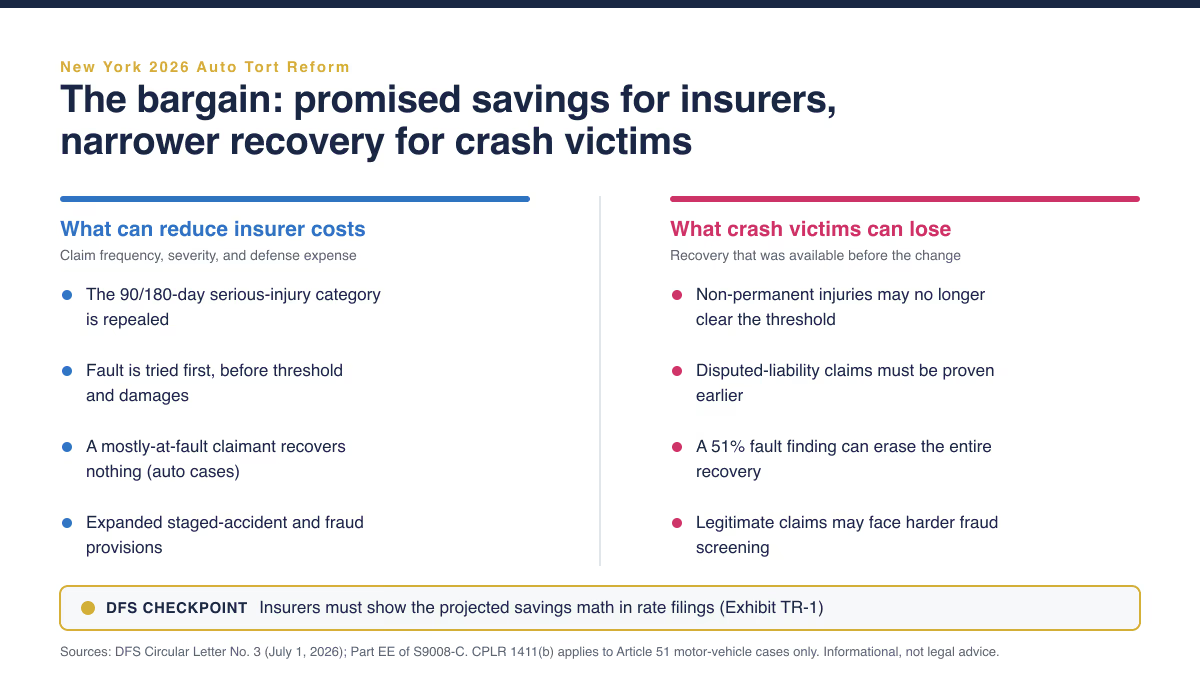
Will NY Auto Insurance Rates Go Down After Tort Reform? What Crash Victims Give Up
DFS Circular Letter No. 3 orders NY auto insurers to show their tort-reform savings math by Aug. 31, 2026. Here is what crash victims traded for it.
Aug 13, 2026
Rental Car Accident Settlements in New York: Who Pays When Enterprise, Hertz, or Budget Is Involved
Rental car accident settlements in New York are complicated by the Graves Amendment, optional SLI/LDW coverage, and stacked policy layers.
Apr 5, 2026Frequently Asked Questions
Common Questions About This Topic
6 answers from the firm's New York personal-injury and employment-law practice. Click any question to expand.
What did DFS say about New York auto tort reform at NYIA?
According to an in-room transcript reviewed by JTNY, DFS Acting Superintendent Kaitlin Asrow told insurers that DFS and carriers are on the front lines of explaining the budget to consumers, and that reduced litigation and fraud costs must be projected into filings now that the law is signed.
Did New York eliminate the 90/180 serious-injury category?
Yes. The 2026 reform removes the 90/180 category from Insurance Law §5102(d). Before the change, a non-permanent injury could qualify as serious if it prevented the injured person from performing substantially all usual daily activities for at least 90 of the first 180 days after the crash.
Does New York now have a 50% fault bar for car accident cases?
New York added a modified comparative-fault rule for personal-injury actions subject to Insurance Law Article 51. If the claimant’s fault is greater than the defendant’s fault, or greater than the combined fault of the defendants, recovery can be barred.
Did joint-and-several liability reform pass?
No. The joint-and-several change did not pass — neither the broad CPLR §1601 rewrite nor the narrower CPLR §1602(6) repeal appears in the final enacted text. The motor-vehicle exception to Article 16 remains in force, and low-fault motor-vehicle defendants remain subject to joint-and-several liability exactly as before May 26, 2026.
Will these reforms lower my auto insurance premium?
Supporters say the reforms should lower premiums by reducing fraud and litigation costs. DFS’s NYIA remarks indicate that insurers will be expected to project reduced claims, fraud, and litigation costs into filings. Whether that produces actual premium relief depends on rate filings, DFS review, market conditions, and enforcement.
What should I do if I was injured in a crash after the reform passed?
Get medical care immediately, preserve evidence, avoid recorded statements without legal advice, and speak with a New York car accident attorney quickly. The new rules make early liability investigation and objective medical documentation more important.
Was this article helpful?
Disclaimer: This article is published by the Law Office of Jason Tenenbaum, P.C. for informational and educational purposes only. It does not constitute legal advice, and no attorney-client relationship is formed by reading this content. The legal principles discussed may not apply to your specific situation, and the law may have changed since this article was last updated.
New York law varies by jurisdiction — court decisions in one Appellate Division department may not be followed in another, and local court rules in Nassau County Supreme Court differ from those in Suffolk County Supreme Court, Kings County Civil Court, or Queens County Supreme Court. The Appellate Division, Second Department (which covers Long Island, Brooklyn, Queens, and Staten Island) and the Appellate Term (which hears appeals from lower courts) each have distinct procedural requirements and precedents that affect litigation strategy.
If you need legal help with a personal injury matter, contact our office at (516) 750-0595 for a free consultation. We serve clients throughout Long Island (Huntington, Babylon, Islip, Brookhaven, Smithtown, Riverhead, Southampton, East Hampton), Nassau County (Hempstead, Garden City, Mineola, Great Neck, Manhasset, Freeport, Long Beach, Rockville Centre, Valley Stream, Westbury, Hicksville, Massapequa), Suffolk County (Hauppauge, Deer Park, Bay Shore, Central Islip, Patchogue, Brentwood), Queens, Brooklyn, Manhattan, the Bronx, Staten Island, and Westchester County. Prior results do not guarantee a similar outcome.
