Key Takeaway
Insurance Law §2341 (Nov. 23, 2026) limits NY auto insurers' use of job, education, homeownership, and tiny zip-style rating units. What changes for drivers.
This article is part of our ongoing personal injury coverage, with 180 published articles analyzing personal injury issues across New York State. Attorney Jason Tenenbaum brings 24+ years of hands-on experience to this analysis, drawing from his work on more than 1,000 appeals, over 100,000 no-fault cases, and recovery of over $100 million for clients throughout Nassau County, Suffolk County, Queens, Brooklyn, Manhattan, and the Bronx. For personalized legal advice about how these principles apply to your specific situation, contact our Long Island office at (516) 750-0595 for a free consultation.
New York is about to change how auto insurers are allowed to price a private-passenger policy. That is a different project from the May 2026 tort-reform package that changed how hard it is to sue after a crash.
The rating statute is Insurance Law §2341. It takes effect November 23, 2026. It does not ban zip codes. It does not promise that Long Island or NYC premiums will fall. It restricts a short list of rating inputs that consumer advocates have argued punish people for who they are, not how they drive.
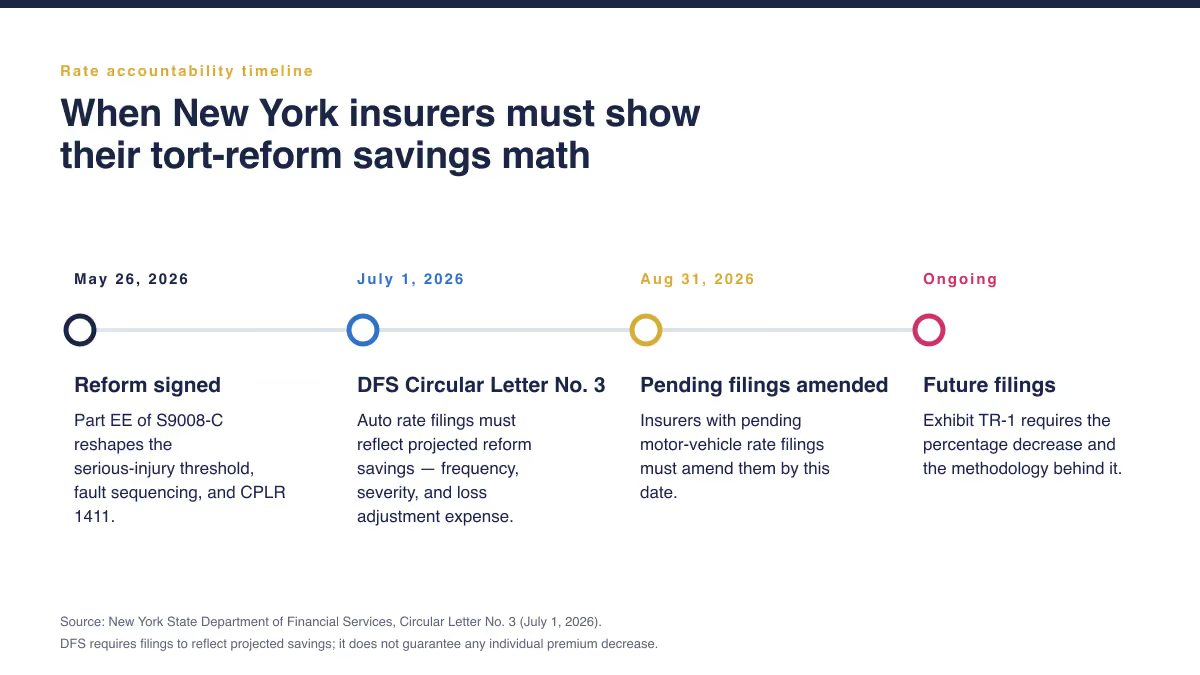
If you are comparing this to the DFS rate-filing follow-up on tort reform, keep the two calendars separate. Tort-reform savings math is due in insurer filings by August 31, 2026. Section 2341 is a November rule about which facts an insurer may feed into the price.
What §2341 actually restricts
For private-passenger auto insurance written in New York, the statute limits an insurer’s use of:
Free Consultation · No Fee Unless We Win
Does this apply to your situation?
Every case is different. Get a free, confidential case review from an experienced attorney who can tell you exactly where you stand.
| Factor | What the statute is aiming at | What it is not |
|---|---|---|
| Occupation | Pricing you as a “higher risk” because of your job title | A ban on asking what you do for a living on an application |
| Education | Using degree status as a discount / surcharge proxy | A ban on all demographic questions |
| Homeownership | Giving owners a break that renters do not get | A change to homeowners insurance |
| Lack of prior insurance | Punishing a gap in coverage as if it were a crash | Forgiving a real lapse that leaves you uninsured today |
| Tiny geographic units | Rating territories so small they function like a zip-code or census-block surcharge | A statewide flat rate |
The last row is the one circulating as a “zip-code ban.” Read it as a minimum-territory rule, not an abolition of geography. Insurers may still rate by territory. They may not slice the map so fine that a three-block difference in Hempstead or Flushing becomes the whole price.
I will not pretend the Department of Financial Services has published the last word on every implementing regulation. Between now and November 23, DFS can still issue circular letters that tell carriers how to file the new rating plans. Treat this article as the statute’s direction of travel, not a guarantee of your renewal number.
What does not change on November 23
- Driving record still matters. Accidents, convictions, and how long you have been licensed remain ordinary rating inputs.
- The car still matters. Make, model, safety equipment, and annual mileage are not what §2341 is about.
- Tort reform already happened. The May 26, 2026 changes to the serious-injury threshold and the 50% fault bar are in force now. They are a lawsuit story. This is a pricing-input story.
- No-fault benefits do not get richer. Section 2341 does not raise PIP medical limits or lost-wage benefits.
- Your current policy does not automatically re-rate on November 23. The new restrictions apply to rating plans going forward. A renewal that was priced under the old plan stays the old plan until the carrier files and uses a compliant one.
If a social post tells you “New York banned zip-code insurance,” it is wrong. If it tells you “your premium drops in November because of Hochul,” it is also wrong. The honest version is: some non-driving proxies get harder to use, and geography has to be drawn in larger strokes.
Why Long Island and NYC drivers should care anyway
Territory rating is how a Huntington Station commute and a two-garage driveway in eastern Suffolk end up in different price buckets. Occupation and education discounts are how a schoolteacher and a warehouse lead with the same clean record pay different numbers. Homeownership is how a renter in the same building as an owner gets treated as a different risk.
Those proxies are popular with carriers because they correlate — loosely — with loss costs. They are unpopular with drivers because they price identity instead of behavior. Section 2341 is the legislature telling DFS and the companies to lean less on the identity proxies.
Will that show up as a lower bill in Nassau or Queens? Maybe, for some books, if the carrier’s new plan actually reallocates premium instead of rebuilding the same price with other variables. Maybe not, if the company just thickens the remaining legal factors (credit-adjacent scores where still allowed, vehicle, mileage, prior claims). I will believe a reduction when it is on a declarations page, not in a press release.
The companion question from the tort-reform rates article still stands: if the state also narrowed crash victims’ lawsuit rights to “pay for” cheaper insurance, you are entitled to ask whether either reform is visible on the bill. DFS Circular Letter No. 3 is the tort-reform half of that ask. Section 2341 is the rating-factor half.
What to do before November 23
- Keep your declarations page and the last two renewals. If a carrier claims §2341 “already” cut your rate, you want the before-and-after math.
- Do not drop coverage to game a “no prior insurance” rule. A lapse still leaves you exposed, and the statute is not a safe-harbor for driving uninsured.
- Shop with the same facts, not a cleaned-up story. Misrepresenting occupation, education, or address is still a material misrepresentation problem under New York law.
- If you were hurt in a crash, this statute does not decide your case. Liability, the serious-injury threshold, no-fault deadlines, and comparative fault do. Start with a Long Island car accident lawyer who reads both the insurance file and the lawsuit file.
- Use the settlement calculator only as a thinking tool after you know whether the threshold and coverage are real. It is not a quote and not a promise.
How this fits the 2026 auto-insurance year
New York stacked three consumer-facing insurance stories on top of each other in 2026:
- May 26 — tort reform for motor-vehicle cases (threshold, fault sequencing, Article 51 bar). Already live. See the Hochul cornerstone.
- August 31 — DFS wants insurers with pending rate filings to show the tort-reform savings arithmetic (Circular Letter No. 3 / Exhibit TR-1).
- November 23 — §2341 rating-factor limits take effect.
They get mashed together in headlines because they all say “auto insurance” and “Hochul.” They are not the same lever. One changes the courtroom. One changes a filing exhibit. One changes which facts may go into the price.
If you want the courtroom half, read the cornerstone and the rates follow-up. If you want the price-input half, you are in the right article. If you want both applied to a real crash — coverage, threshold, and what the carrier is allowed to do with your file — that is a personal injury consultation, not a blog comment.
Related reading
Legal Context
Why This Matters for Your Case
Personal injury law in New York is governed by a complex web of statutes, case law, and procedural rules that differ from most other states. The statute of limitations for most personal injury claims is three years under CPLR 214(5), but claims against municipalities require a Notice of Claim within 90 days. Motor vehicle accident victims must meet the serious injury threshold under Insurance Law §5102(d) before they can recover pain and suffering damages.
The Law Office of Jason Tenenbaum has recovered over $100 million for injured clients across Long Island, Nassau County, Suffolk County, Queens, Brooklyn, Manhattan, and the Bronx. With 24+ years of trial and appellate experience, more than 1,000 appeals written, and 2,600+ published legal articles, Jason Tenenbaum provides the authoritative legal analysis that practitioners and injury victims need to understand their rights.
This article reflects real courtroom experience and a deep understanding of how New York courts actually evaluate personal injury claims — from the initial filing through discovery, summary judgment, trial, and appeal.
About This Topic
New York Personal Injury Law
When negligence causes serious injury, New York law entitles victims to compensation for medical bills, lost income, pain and suffering, and more. From car accidents and slip-and-falls to construction injuries and medical malpractice, the Law Office of Jason Tenenbaum has recovered over $100 million for injured Long Islanders and New Yorkers since 2002.
180 published articles in Personal Injury
Keep Reading
More Personal Injury Analysis

Nassau Police Ordered to Pay $34,690.50 in FOIL Fees: What Meyer Means After a Crash
The Second Department raised a FOIL fee award against the Nassau County Police Department from $12,000 to $34,690.50. The statute, the math, and the FOIL clock.
Oct 8, 2026
Long Island Pedestrian Crashes After Dark: State Data Before the Clocks Change
From November through January, 485 of 520 evening pedestrian crashes in Nassau and Suffolk happened in the dark. State and federal data, with the CSV files.
Oct 8, 2026
Honda Subframe Rust Recall: 880,514 Vehicles, New York at the Center — Owner Checklist and Legal Rights
Honda recalled 880,514 Pilots, Ridgelines, Passports & Acura MDXs for rear subframe rust. NY VIN-check steps, crash risks, and your legal rights explained.
Jun 12, 2026
Burn Injury Car Accident Settlement Amounts in New York
How much is a burn injury car accident settlement worth in New York?
Apr 4, 2026
Pedestrian Accident Settlements in New York: What Crosswalk and Sidewalk Injury Victims Need to Know
Learn how pedestrian accident settlements work in New York, including no-fault coverage for non-drivers, typical settlement ranges, and how comparative negligence affects...
Apr 4, 2026
NY Chest Injury Car Accident Settlements (2026 Guide)
Rib fractures, sternal fractures, pneumothorax & traumatic aortic injury settlement ranges in NY car accidents. §5102(d) analysis. Call 516-750-0595.
Apr 4, 2025Frequently Asked Questions
Common Questions About This Topic
7 answers from the firm's New York personal-injury and employment-law practice. Click any question to expand.
Did New York ban zip-code auto insurance rating?
No. Section 2341 restricts *too-small* geographic rating units. Insurers may still use territories. They may not treat a micro-slice of a zip code as the whole risk story.
Does §2341 lower my premium on November 23, 2026?
Not automatically. It changes which inputs a compliant rating plan may use. Your renewal price still depends on the plan your carrier files and on ordinary driving and vehicle factors.
Can my insurer still ask my job or education?
Asking is not the same as rating. The statute targets *use in the price*. Application questions can still appear. What matters is whether the answer is allowed to move the premium.
Is this the same as the May 2026 tort reform?
No. Tort reform changed lawsuit rules for many motor-vehicle cases effective May 26, 2026. Section 2341 is a November rating-factor statute. Do not let a headline collapse them.
I rent. Do I get a discount when homeownership breaks go away?
Possibly, if your carrier's new plan actually reallocates that difference. There is no statutory coupon for renters. Compare the new declarations page to the old one.
I was in a crash. Does §2341 help my claim?
It does not prove liability, serious injury, or damages. It may matter later if a coverage or premium dispute is mixed into the file. The claim itself still runs through no-fault, the threshold, and fault.
Where do I start if I was hurt on Long Island?
Call (516) 750-0595 or use the car accident page. Bring the police report, no-fault application, and your declarations page.
Was this article helpful?
Disclaimer: This article is published by the Law Office of Jason Tenenbaum, P.C. for informational and educational purposes only. It does not constitute legal advice, and no attorney-client relationship is formed by reading this content. The legal principles discussed may not apply to your specific situation, and the law may have changed since this article was last updated.
New York law varies by jurisdiction — court decisions in one Appellate Division department may not be followed in another, and local court rules in Nassau County Supreme Court differ from those in Suffolk County Supreme Court, Kings County Civil Court, or Queens County Supreme Court. The Appellate Division, Second Department (which covers Long Island, Brooklyn, Queens, and Staten Island) and the Appellate Term (which hears appeals from lower courts) each have distinct procedural requirements and precedents that affect litigation strategy.
If you need legal help with a personal injury matter, contact our office at (516) 750-0595 for a free consultation. We serve clients throughout Long Island (Huntington, Babylon, Islip, Brookhaven, Smithtown, Riverhead, Southampton, East Hampton), Nassau County (Hempstead, Garden City, Mineola, Great Neck, Manhasset, Freeport, Long Beach, Rockville Centre, Valley Stream, Westbury, Hicksville, Massapequa), Suffolk County (Hauppauge, Deer Park, Bay Shore, Central Islip, Patchogue, Brentwood), Queens, Brooklyn, Manhattan, the Bronx, Staten Island, and Westchester County. Prior results do not guarantee a similar outcome.