
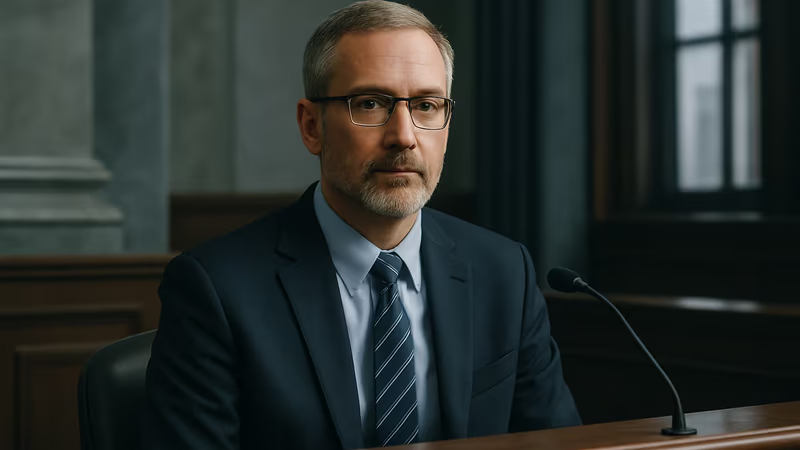
Expert opinion
Court reminds attorneys that expert opinions must address specific assertions with cited evidence, not just conclusory statements, in personal injury litigation.
Expert opinion — Read Article →In-depth legal analysis from Attorney Jason Tenenbaum — covering court rulings, legal standards, and practical guidance on experts under New York law.
Expert Analysis
Expert testimony is essential in most personal injury and no-fault cases — from medical experts establishing causation and damages to accident reconstructionists and economic experts calculating lost earnings. New York courts apply specific rules governing expert qualifications, the foundation for expert opinions, the use of medical journals and treatises, and the sufficiency of expert evidence on summary judgment. These articles analyze the legal standards for expert testimony and practical strategies for presenting and challenging expert evidence.
Read Our Experts Articles
Frequently Asked Questions
Expert witnesses provide specialized opinion testimony that helps the court or jury understand complex issues like medical causation, injury severity, future care needs, economic losses, and engineering defects. Under New York law, expert testimony must be based on facts in evidence, the expert's professional knowledge, or a combination of both. The expert must be qualified by training, education, or experience in the relevant field. Expert disclosure requirements under CPLR 3101(d)(1)(i) require parties to identify their experts and provide detailed summaries before trial.
Court reminds attorneys that expert opinions must address specific assertions with cited evidence, not just conclusory statements, in personal injury litigation.
Expert opinion — Read Article →
Court reverses trial judge's incorrect application of CPLR 3101(d) to treating physicians, reaffirming that disclosure rules only apply to retained experts, not doctors who treated...
3101(d) never applies to — Read Article →
Learn NY expert witness requirements for medical malpractice. Analysis of Perez decision & qualification standards. Call 516-750-0595.
Wrong expert — Read Article →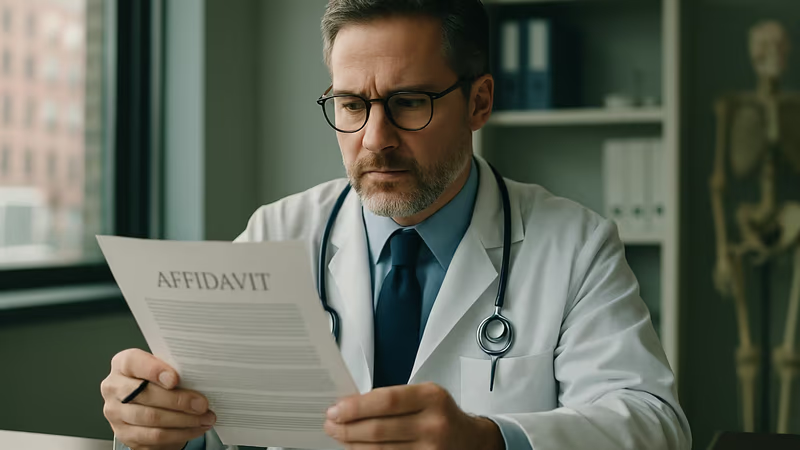
Master medical expert affidavit requirements in NY personal injury cases. Expert analysis of qualification standards. Call 516-750-0595 for help.
Medical Expert Affidavit Requirements: New York Personal Injury Defense Guide — Read Article →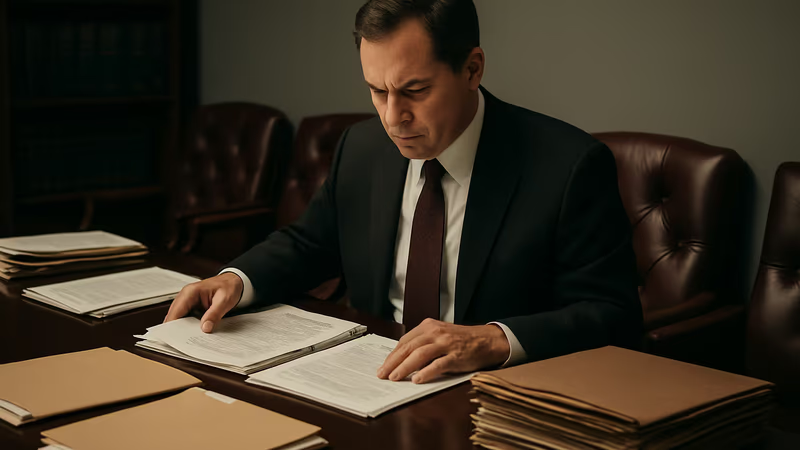
Court precludes psychiatric expert testimony due to willful late disclosure, demonstrating how strategic gamesmanship in expert witness disclosure can backfire and harm your case.
Example of a tardy CPLR 3101(d) that is unacceptable — Read Article →Need Legal Guidance?
Get a Free Case Evaluation
No fees unless we win. Available 24/7.
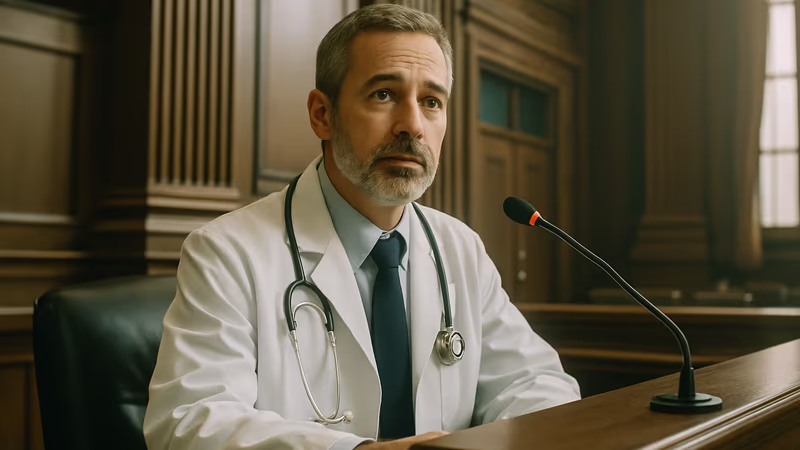
Court ruling clarifies that insurance companies can use different expert witnesses to testify about peer review reports in no-fault cases, expanding defense flexibility.
Different peer doctor's testimony acceptable — Read Article →
New trial ordered when treating physician expert arrived without required original medical file and was unavailable for rescheduled testimony dates.
New trial ordered due to physician unavailability — Read Article →
New York court reinforces that expert opinions must be based on properly admitted evidence, not unfounded photographs or materials.
Ouch — Read Article →
New York medical malpractice case highlights the critical requirement for expert witnesses to establish proper foundation when testifying outside their area of specialization.
Out of scope – need foundation — Read Article →
Queens Village Medical case examines when physical medicine experts can testify about orthopedic peer reviews in NY no-fault insurance disputes and expert witness competency rules.
Out of scope peer: it is okay — Read Article →
Court allows subpoena of expert witness billing records to show bias in personal injury case. Plaintiff entitled to cross-examination materials about doctor's financial interests.
Subpoena the records — Read Article →
Court limits treating physician's testimony when doctor crosses into biomechanical engineering expertise without proper disclosure under CPLR 3101(d).
When a doctor crosses the line — Read Article →
Court rules insurers must request additional documentation for "By Report" CPT codes before denying no-fault claims, addressing proper claim procedures.
By-Report — Read Article →
New York no-fault medical necessity denial case where insurer's peer review expert failed to consider all medical records, highlighting common arbitration challenges.
It was not proven that the surgery was not medically necessary — Read Article →
Court case where electrodiagnostic testing deemed medically unnecessary due to lack of diagnostic dilemma, with credible expert testimony shifting burden to plaintiff.
The electrodiagnostic service was not medically appropriate — Read Article →
First Department allows cross-examination about expert's 30-year-old misconduct in New York personal injury case. Key ruling on expert credibility.
Attacking Expert Credibility: When Past Misconduct Becomes Fair Game in New York — Read Article →
New York court rules on expert witness testimony limits for non-treating physicians in personal injury cases involving spine and knee injuries.
An expert who saw plaintiff once may testify — Read Article →
Dovberg v Laubach case analysis: Second Department precludes biomechanical expert testimony lacking proper foundation in peer-reviewed literature and empirical data.
Preclusion of bio-mechanical opinion — Read Article →
Court rules that late expert disclosure doesn't automatically bar expert evidence in summary judgment motions when failure wasn't willful and no prejudice shown.
CPLR 3101(d)(1) — Read Article →
New York Court of Appeals case on expert witness qualifications in medical malpractice - when specialists lack competent opinion for summary judgment motions.
Competent opinion of a specialist — Read Article →
New York courts clarify when medical experts can testify outside their specialty area and the foundation required for reliable expert testimony in personal injury cases.
The expert opinion — Read Article →
Court rejects cardiovascular surgeon's expert opinion on visual impairment, emphasizing that medical experts must have specialized knowledge in the relevant field to testify.
Qualification of an expert — Read Article →
New York medical malpractice case law on expert testimony requirements, causation standards, and triable issues of fact for summary judgment motions.
Triable issues of fact on a medical malpractice case? — Read Article →
Expert opinions based on incorrect medical records are inadmissible and insufficient for summary judgment. Court rejects defense experts who relied on switched notes.
Wrong records? Inadmissible opinion — Read Article →
Analysis of CPLR 3101(d) expert disclosure requirements in Tate-Mitros v MTA case, covering minimal disclosure standards and timing issues for expert testimony.
A discussion on CPLR 3101(d) — Read Article →
Court of Appeals clarifies CPLR 3101(d) expert witness disclosure requirements, timing objections, and trial court discretion in Rivera v Montefiore Medical Center.
3101(d) from the Court of Appeals — Read Article →
Frye hearing required when experts present conflicting literature on novel medical theories. Court analysis of prenatal neuroblastoma detection standards.
A Frye hearing is required where two sides have opposing literature on a contested novel service — Read Article →
New Horizon Surgical v Allstate: Court analysis of MUA medical necessity burden of proof and expert witness testimony in New York no-fault insurance disputes.
MUA with Straniere: Part 2 — Read Article →
NY court explains how to lay foundation for the professional reliability exception when expert witnesses rely on out-of-court information. Long Island trial guidance.
How to Establish Foundation for the Professional Reliability Exception to the Hearsay Rule — Read Article →
New York courts differ on CPLR 3101(d) violations - First Department focuses on surprise factor when precluding expert testimony served days before trial.
3101(d) preclusion — Read Article →
Legal analysis of expert witness qualifications in medical malpractice cases, examining when physicians can testify outside their specialization and foundation requirements.
Expert witnesses again — Read Article →
Expert witness qualifications and CPLR 2106 objection requirements in NY medical malpractice cases — Lopez v Gramuglia analysis of cross-specialty testimony standards.
Expert Qualifications and CPLR 2106 Compliance in NY Medical Malpractice Cases — Read Article →
Court ruling expands use of biomechanical expert testimony in personal injury cases, establishing qualifications needed for engineers to opine on accident causation.
Biomechanical evidence allowed — Read Article →
New York courts allow learned treatises as evidence when experts recognize publications as standards of care, even without using "authoritative" language.
The learned treatise exception to the hearsay rule — Read Article →
New York court ruling on expert witness qualification requirements - what must be included in expert affidavits and CVs to establish admissibility in personal injury cases.
Failed to adduce that (s)he was an expert — Read Article →
New York appellate court reinforces strict compliance with CPLR 3101(d) expert disclosure rules, precluding witnesses disclosed after trial began without explanation.
Another 3101(d) case — Read Article →
NY court rules CPLR 3101(d) expert disclosure violation doesn't require automatic preclusion without showing willfulness or significant prejudice to opposing party.
CPLR 3101(d) not violated — Read Article →
NYC Civil Court judge refuses expert testimony on hearsay grounds despite Appellate Term precedent requiring such testimony in no-fault medical necessity cases.
Jules said he is not bound by the Appellate Term’s holdings — Read Article →
New York court ruling: Plaintiff failed to prove causation in motor vehicle accident case without expert medical testimony establishing causal connection.
The absence of an expert is fatal to prove causation — Read Article →
Court ruling establishes that plaintiff's uncertified medical records are admissible when accuracy isn't disputed, offering cleaner evidentiary approach than current hearsay...
Plaintiff’s medical records are admissible by defendant absent dispute regarding accuracy or veracity — Read Article →
Landmark 2014 Vargas v Sabri case allows biomechanical engineers to testify on motor vehicle accident causation without medical credentials in New York courts.
Biomechanical Engineer allowed to testify — Read Article →![Peer report is sufficient to prima facie prove lack of serious injury (Ins Law Sec. 5102[d])](https://cdn.jtnylaw.com/blog/peer-report-is-sufficient-to-prima-facie-prove-lack-of-serious-injury-ins-law-sec-5102d.avif)
Fourth Department ruling confirms peer review expert reports can establish prima facie defense against serious injury claims under NY Insurance Law Section 5102(d).
Peer report is sufficient to prima facie prove lack of serious injury (Ins Law Sec. 5102[d]) — Read Article →
First Department Court rejects attorney-drafted expert disclosure in medical malpractice case, highlighting the need for proper evidentiary foundation in summary judgment motions.
Attorney drafted 3101(d) in malpractice action insufficient to defeat summary judgment — Read Article →
Court dismisses expert affidavit lacking credentials and objective testing in personal injury case, highlighting foundation requirements for expert testimony.
No credentials? No issue of fact — Read Article →
New York appellate court rules that medical experts can testify about peer review findings based on medical records, reversing trial court's erroneous hearsay exclusion.
Peer hearsay — Read Article →
Court grants oral application accepting untimely expert papers and physician affirmation from different specialty in Buffalo General Hospital case.
Oral application granted (untimely papers accepted) and the deeming acceptable of an affirmation of a physician in a different specialty — Read Article →
Civil Court overturns Appellate Term precedent on no-fault peer review expert testimony, ruling original peer reviewer must testify at trial
Civil Court overturns Appellate Term precedent — Read Article →
Court dismisses no-fault case after plaintiff objects to inadmissible proof, highlighting importance of sworn medical reports and hearsay rules in New York.
Objected to inadmissible proof spells doom — Read Article →
New York court reverses personal injury verdict due to defense attorney's abusive summation and improper cross-examination that denigrated medical experts.
Abusive Summation and Cross-Examination Causes New Trial in New York Personal Injury Case — Read Article →
Expert psychologist testimony based on unsworn peer review reports is admissible when witness can explain factual basis and be cross-examined in no-fault insurance cases.
An psychologist can base his testimony off his own unsworn report – are you really surprised? — Read Article →
NY court rules expert impeachment with DVD improper when expert rejects it as authoritative. Key evidence foundation rules for Long Island & NYC trials.
Expert Witness Impeachment Rules: When Authoritative Materials Can Be Used in New York — Read Article →
Article 10 case limits peer hearsay in expert testimony, impacting no-fault insurance and threshold injury cases in New York courts.
Another Article 10 case wittles away peer hearsay — Read Article →
Court rules psychologist from Ukraine incompetent to testify as expert witness due to lack of proper credentials in New York no-fault insurance case.
Dr. Grinsberg is incompetent to testify as a matter of law — Read Article →
Court of Appeals reverses civil commitment case where prosecutor attacked expert witness based on religious beliefs during cross-examination, violating fair trial standards.
Attacking an expert based upon his religion leads to reversal — Read Article →
Expert analysis of Rowe v Fisher on medical literature requirements for expert testimony. Personal injury case insights for Long Island and NYC. Call 516-750-0595.
The Critical Role of Medical Literature in Expert Testimony — Read Article →
Critical analysis of Consolidated Imaging v Travelers Indemnity Co. - examining flawed Civil Court reasoning in Long Island and NYC no-fault insurance cases.
Civil Court Decisions in No-Fault Insurance: When Legal Reasoning Goes Wrong | Long Island Attorney — Read Article →
Learn about Article 10 evidentiary issues and expert witness testimony rules in New York courts. Get expert legal help from experienced Long Island attorneys. Call 516-750-0595.
Understanding Article 10 Evidentiary Issues: Expert Witness Testimony and Hearsay Rules in New York Courts — Read Article →
Appellate Division ruling on nurse malpractice expert qualifications - home infusion therapy standard of care requires specialized experience for competent testimony.
Very interesting discussion involving a nurse’s standard of care in the medical malpractice realm — Read Article →
NY appellate court rules motions to strike expert witness disclosures are evidentiary rulings not appealable until final judgment, affecting biomechanical engineer testimony.
Interesting procedural case involing the ability to appeal motions to strike 3101(d) disclosures in advance of trial — Read Article →
Analysis of Active Imaging v Progressive case where Appellate Term rejected challenge to medical necessity motion based on peer report without underlying medical records.
I was wrong about the necessity of annexing the reports that the peer doctor relied upon — Read Article →
Court ruling allows expert psychologist testimony based on hearsay in Mental Health Law Article 10 proceedings when used to explain opinion basis, not truth.
An expert's opinion based upon hearsay is allowable in an Article 10 Mental Health Hearing — Read Article →
New York Court of Appeals ruling demonstrates that expert testimony in toxic exposure cases requires scientific data and analysis, not mere speculation, to establish causation.
Analysis or reference to scientific data is necessary to defeat a motion based upon the lack of causal connection between lead paint and attendant poisoning — Read Article →
Examining peer hearsay exceptions in NY no-fault cases, medical record admissibility, and verification procedures in Urban Radiology v Tri-State Consumer.
The destruction of peer hearsay: It is not hearsay – and much more — Read Article →
Court finds peer doctor testimony with medical rationale sufficient to prove lack of medical necessity, reversing trial court in no-fault case.
Peer doctor's testimony is sufficient to prima facie demonstrate a service's lack of medical necessity — Read Article →
Family court case examining CPLR 4518(a) business records rule for medical documents - distinguishing admissible physician office records from inadmissible expert opinions.
A family court non-payment of child support petition spurs an interesting 4518(a) case — Read Article →
Medical malpractice claims require expert evidence to establish departure from standard of care and causation. McKenzie v Abrahams case highlights need for comprehensive expert...
Expert evidence necessary to address malpractice claim — Read Article →
Second Department ruling on when juries can reject expert testimony in NY personal injury cases. Long Island attorneys analyze standards for disregarding medical opinions.
When Can a New York Jury Reject Expert Testimony? Guidelines from Williams v City of New York — Read Article →
Complete guide to medical malpractice expert witness standards in NY. Diel v Bryan case analysis shows cross-specialty options. Call (516) 750-0595.
An expert can testify about the standard of care of a "sub-specialist" in appropriate cases — Read Article →
Learn about NY civil court evidence rules including CPLR 3101(d) demands and peer review report foundations. Expert legal analysis from Long Island personal injury attorney.
New York Civil Court Evidence Rules: CPLR 3101(d) and Peer Review Reports — Read Article →
Learn how New York courts determine expert qualifications in no-fault insurance cases. Essential guide for Long Island and NYC attorneys handling medical expert testimony...
Expert Qualification Standards in New York No-Fault Cases: Understanding Professional Sufficiency Requirements — Read Article →
Expert analysis of Gilmonio v Toussaint 5102(d) case involving knee surgery. Learn how incomplete medical history can defeat serious injury threshold claims in NY.
An interesting 5102(d) case involving a knee surgery — Read Article →
New York court guidance on expert competency and medical literature use in medical malpractice and no-fault cases. Essential reading for Long Island attorneys.
Expert Competency and Medical Literature in New York Medical Malpractice and No-Fault Cases — Read Article →
Learn how medical necessity defenses fail in NY no-fault cases. Expert analysis of Progressive Med v Allstate reveals key evidentiary pitfalls & hearsay issues.
Understanding Medical Necessity Defense Failures in New York No-Fault Insurance Cases — Read Article →
New York courts limit physical therapist testimony in personal injury cases — they cannot diagnose, make prognoses, or determine permanency. Long Island & NYC analysis.
Physical Therapist Expert Testimony Limitations in New York Personal Injury Cases — Read Article →
Court affirms opposing expert affidavit sufficient to defeat summary judgment in medical malpractice when expert has proper credentials and specialty certification.
Affirmation of opposing expert sufficient to thwart summary judgment in a malpractice case — Read Article →
Learn how internist qualifications meet NY expert witness standards for personal injury cases. Nassau & Suffolk County medical malpractice lawyer insights. Call 516-750-0595
Proof That Physician Was Internist Sufficient for Expert Medical Testimony in NY Personal Injury Cases — Read Article →
Learn NY medical expert testimony standards from Shectman v Wilson case. Expert qualification requirements for medical malpractice cases in NYC and Long Island.
How Medical Experts Become Qualified to Testify in New York Courts — Read Article →
New York medical malpractice expert testimony foundation requirements. Learn critical standards for expert witness preparation in Nassau and Suffolk County cases.
Understanding Foundation Requirements in Medical Malpractice Expert Testimony — Read Article →
New York medical necessity summary judgment motions are evolving with stricter expert testimony standards, creating opportunities for skilled no-fault insurance attorneys.
The Future is Bright for Medical Necessity Summary Judgment Motions in New York — Read Article →The Law Office of Jason Tenenbaum publishes detailed legal analysis on experts and related topics as part of an ongoing commitment to legal education and transparency. Since 2008, Attorney Tenenbaum has written over 2,353 articles examining how New York courts decide cases involving personal injury, no-fault insurance, employment discrimination, and complex litigation matters. Each article is based on an actual court decision and provides the kind of substantive analysis that practitioners and clients need to understand the current state of the law.
Attorney Tenenbaum brings over 24 years of New York litigation experience to every article. His practice spans Nassau County, Suffolk County, Queens, Brooklyn, Manhattan, the Bronx, and Staten Island. He has handled thousands of cases involving insurance disputes, personal injury claims, and employment law matters, giving him a practical perspective that academic commentators often lack. The articles in this collection reflect that experience, offering readers insight into how judges actually apply legal standards in contested cases.
If you are dealing with a legal issue related to experts or any topic covered on this blog, the firm offers free initial consultations by phone or in person. Call (516) 750-0595 to speak with an attorney, or visit the contact page to submit a case review request online. No fee is charged unless the firm recovers compensation on your behalf. The firm's six attorneys bring over 112 combined years of legal experience and speak English, Spanish, Italian, Japanese, and Russian, ensuring clients can communicate in the language they are most comfortable with. Attorney Tenenbaum is admitted to practice in New York, New Jersey, Florida, Texas, Georgia, and Michigan state courts, as well as multiple federal courts, and he has authored more than 2,353 published legal articles that attorneys, judges, and insurance professionals across the state rely on for guidance.
New York's legal framework for experts matters involves an intricate web of statutes, regulations, and case law that has developed over decades. The state's court system — including the Civil Court, District Courts, Supreme Court, Appellate Term, Appellate Division, and Court of Appeals — each plays a distinct role in shaping how experts cases are litigated and decided. Trial-level decisions in Nassau County Supreme Court, Suffolk County Supreme Court, and the New York City Civil Courts establish important factual precedents, while appellate rulings create binding legal standards that all lower courts must follow.
The Civil Practice Law and Rules (CPLR) governs procedure in New York civil litigation and contains provisions that directly impact experts cases. CPLR Article 31 establishes the scope and methods of disclosure, including depositions under CPLR 3107, interrogatories under CPLR 3130, and document demands under CPLR 3120. CPLR 3212 provides the standard for summary judgment, requiring the movant to establish a prima facie case through admissible evidence and shifting the burden to the opponent to raise a triable issue of fact. CPLR 3215 governs default judgments, which require proof of service, proof of the facts constituting the claim, and proof of the amount due. Understanding these procedural tools is essential for anyone involved in experts litigation in New York.
Statutes of limitations vary significantly depending on the type of claim. General negligence and personal injury claims carry a three-year deadline under CPLR 214(5). Medical malpractice claims have a shortened two-and-a-half-year deadline under CPLR 214-a. Claims against municipalities require a Notice of Claim within 90 days under General Municipal Law Section 50-e. No-fault insurance claims have their own regulatory deadlines, including the 30-day filing window for applications and the 45-day submission period for provider claims. Employment discrimination claims under the New York State Human Rights Law generally have a three-year statute of limitations, while federal Title VII claims require EEOC filing within 300 days.
The Appellate Term and Appellate Division regularly issue decisions that clarify and refine the legal standards applicable to experts cases. The Second Department, which covers Long Island and parts of New York City, is particularly active in this area. Its decisions on evidentiary standards, burden-shifting frameworks, and procedural requirements directly affect how trial courts evaluate motions and how attorneys prepare their cases. Attorney Tenenbaum monitors these decisions and analyzes them in the articles on this page, providing practitioners with the timely legal commentary they need to stay current.
The Law Office of Jason Tenenbaum, P.C. is located at 326 Walt Whitman Road, Suite C, Huntington Station, New York 11746, centrally situated on Long Island to serve clients throughout Nassau County, Suffolk County, and the five boroughs of New York City. With over 24 years of experience and more than 1,000 appeals written, Attorney Tenenbaum combines deep legal knowledge with practical courtroom experience. If you need help with a experts matter, call (516) 750-0595 for a free consultation.
Successful outcomes in experts cases often depend on procedural compliance as much as substantive merit. In no-fault insurance litigation, the prima facie case standard requires the plaintiff to submit admissible evidence establishing the claim was properly submitted, overdue, and unpaid. If the defendant raises a defense — such as an IME no-show, EUO non-appearance, lack of medical necessity, or fee schedule dispute — the burden shifts to the plaintiff to present evidence creating a triable issue of fact. Summary judgment motions under CPLR 3212 require the movant to make a prima facie showing through affidavits, deposition testimony, or documentary evidence, and the opposition must raise a genuine factual dispute to avoid dismissal.
In personal injury cases, the discovery process is governed by CPLR Article 31 and involves depositions of parties and witnesses, exchange of medical records under CPLR 3121 authorizations, physical and mental examinations, and expert disclosure. Once discovery is complete, either party may file a note of issue certifying readiness for trial, after which a 120-day deadline applies for filing summary judgment motions under CPLR 3212(a). Motion practice often determines the outcome of cases before trial, and understanding the specific evidentiary standards applied by courts in your jurisdiction is essential. The articles on this page analyze these standards in detail, drawing on real cases litigated by Attorney Tenenbaum and decisions from courts across the state.
The firm serves clients throughout Long Island, including the towns and villages of Huntington, Babylon, Islip, Brookhaven, Smithtown, Hempstead, Garden City, Mineola, Great Neck, Freeport, Long Beach, Rockville Centre, Valley Stream, Westbury, Hicksville, and Massapequa, as well as all five boroughs of New York City. Attorney Tenenbaum regularly appears in Nassau County Supreme Court, Suffolk County Supreme Court, the New York City Civil Court, the American Arbitration Association, the Workers' Compensation Board, and the Appellate Term and Appellate Division of the Second Department. If you need legal assistance with a experts matter or any topic discussed in these articles, call (516) 750-0595 for a free, confidential case evaluation.
The Law Office of Jason Tenenbaum, P.C. was founded in 2002 and has grown into one of Long Island's most respected personal injury, employment law, and insurance litigation firms. The firm's six attorneys — led by founding partner Jason Tenenbaum — bring over 112 combined years of legal experience to every case. The team speaks English, Spanish, Italian, Japanese, and Russian, ensuring that clients from diverse backgrounds can communicate in the language they are most comfortable with during what is often one of the most stressful periods of their lives.
Attorney Tenenbaum earned his Juris Doctor from Syracuse University College of Law and is admitted to practice in New York, New Jersey, Florida, Texas, Georgia, and Michigan state courts, as well as the United States District Courts for the Eastern and Southern Districts of New York. He has written more than 1,000 appellate briefs, handled over 100,000 no-fault insurance cases, and recovered over $100 million in verdicts and settlements for injured individuals and workers throughout Long Island and New York City. His 2,353+ published legal articles on New York case law make him one of the most prolific legal commentators in the state, and his analysis is relied upon by attorneys, judges, and insurance professionals across all four Appellate Division departments.
The firm operates on a contingency fee basis for personal injury and employment discrimination cases, which means clients pay no attorney fees unless the firm recovers compensation on their behalf. Every consultation is free, confidential, and without obligation. The firm's centrally located Huntington Station office provides convenient access to Nassau County Supreme Court in Mineola, Suffolk County Supreme Court in Riverhead, the Nassau County District Court, Suffolk County courts in Central Islip, and the New York City Civil Court. Whether you need help with a car accident claim, a workplace discrimination complaint, a no-fault insurance denial, a workers' compensation dispute, or any other legal matter, the Law Office of Jason Tenenbaum, P.C. is ready to fight for your rights.
Questions About Experts?
Attorney Jason Tenenbaum has been writing about experts since 2008, drawing on 24+ years of practice. Get a free, confidential case evaluation.
No fees unless we win · Available 24/7 · Hablamos Español
Injured? Don't Wait.
Get Your Free Case Evaluation Today
No fees unless we win — available 24/7 for emergencies.