Key Takeaway
Learn how expert witnesses in New York car accident lawsuits help establish fault, causation, and damages through accident reconstruction, medical testimony, and economic analysis.
This article is part of our ongoing car accidents coverage, with 234 published articles analyzing car accidents issues across New York State. Attorney Jason Tenenbaum brings 24+ years of hands-on experience to this analysis, drawing from his work on more than 1,000 appeals, over 100,000 no-fault cases, and recovery of over $100 million for clients throughout Nassau County, Suffolk County, Queens, Brooklyn, Manhattan, and the Bronx. For personalized legal advice about how these principles apply to your specific situation, contact our Long Island office at (516) 750-0595 for a free consultation.

Car accident lawsuits in New York often hinge on technical details that confuse most people. Expert witnesses fill this gap. They explain complex information in ways judges and juries can grasp. Eyewitnesses describe what they saw. Experts examine evidence and give professional opinions based on specialized knowledge. Learn more about expert witness roles on the SEAK, Inc. website, a leading resource for expert witness education and training.
The Law Office of Jason Tenenbaum, P.C. knows how these specialists can make or break a case. Picking the right expert often decides the outcome. Recent cases show just how important expert witnesses are. For example, accident reconstruction experts can prove that speeding caused a crash and the injuries that followed. Medical and economic experts look at long-term effects. They project future medical costs and lost income, which is key to fair compensation.
Common Expert Witness Categories
New York car accident cases typically rely on several types of specialists:
- Accident reconstruction professionals analyze physical evidence including skid marks, vehicle damage, and road conditions. They develop simulations demonstrating probable crash sequences, which helps clarify responsibility. Their findings often reveal whether speeding, distraction, or other factors contributed to the collision. You can find standards for accident reconstruction on the National Highway Traffic Safety Administration (NHTSA) website.
- Medical experts fulfill various functions. Treating doctors discuss injuries they’ve personally treated, while independent medical evaluators might assess long-term recovery prospects. Neurologists frequently testify in brain injury cases, and orthopedic surgeons explain bone fractures and joint damage.
- Economic damage specialists calculate financial losses with accuracy. They estimate future medical costs, lost income potential, and other monetary impacts. For catastrophic injuries, these projections may cover several decades.
- Additional specialists sometimes participate when needed. Engineers could examine vehicle defects, while mental health professionals might evaluate psychological trauma. Infrastructure experts occasionally testify about hazardous road designs or insufficient traffic controls.
Free Consultation · No Fee Unless We Win
Does this apply to your situation?
Every case is different. Get a free, confidential case review from an experienced attorney who can tell you exactly where you stand.
New York’s Expert Witness Requirements
New York holds experts to high standards. Witnesses must prove their skills through education, licenses, or hands-on experience. Judges decide whether the expert’s methods meet industry standards.
Recent rulings show how courts assess experts. In Gonzalez v City of New York (2025), the court stressed the need to follow discovery orders. Delays or missing disclosures can hurt a defendant’s ability to fight claims. In Englander v State of New York (2025), the focus was on the weight of evidence. The claimant argued that the defendant’s negligence and breach of duty were clear.
Timing matters a lot. Lawyers must name their experts and share reports during discovery. Missing deadlines can block experts from testifying—especially risky under New York’s strict statute of limitations, which can throw out a case if filing is late.
Working Productively With Experts
Successful attorney-expert partnerships demand thoughtful preparation. Lawyers help experts communicate complex ideas clearly without losing important details. This often involves multiple rehearsal sessions before depositions or court appearances.
Effective experts minimize technical language. An accident specialist might explain how a truck’s tall design increases rollover risks during sharp turns, rather than discussing “center of gravity.” Medical professionals describe injuries using relatable comparisons instead of medical terminology.
Visual tools frequently improve expert testimony. Diagrams illustrating crash angles or medical images showing spinal damage help juries understand critical information. The Law Office of Jason Tenenbaum, P.C. collaborates with experts to create clear, persuasive demonstrative materials.
The Testimony Process Explained
Expert testimony follows a predictable structure:
- In depositions, opposing lawyers test the expert’s knowledge and look for weak spots. Prepared experts answer directly and avoid giving extra information. They admit the limits of their analysis while standing firm on their main conclusions.
- At trial, direct examination lets experts lay out their findings step by step. Skilled attorneys ask open questions that allow natural explanations. Cross-examination then challenges the expert’s methods or credibility. Good experts stay calm under pressure. They accept small corrections but defend their key conclusions.
Recent cases show testimony’s real-world impact. In Englander v State of New York, a road design expert’s analysis of drainage problems causing hydroplaning led to a significant jury award. Conversely, a medical expert in Liu v. Park damaged credibility by dismissing alternative explanations for symptoms.
How Experts Affect Case Results
Strong expert testimony often pushes cases toward settlement. Insurance companies rethink their position when faced with solid analysis from respected specialists. Medical proof of permanent disabilities can raise settlement amounts by a large margin. This is especially true under New York’s “serious injury” rule. Injuries must meet specific criteria—such as fractures, permanent scarring, or loss of bodily function—to pursue non-economic damages.
Conflicting expert opinions can create problems. When two accident specialists disagree about fault, jurors must decide whom to trust. Attorneys can point to an expert’s publication record or experience with similar cases to tip the balance.
While expert services increase costs, they usually produce better outcomes. The Law Office of Jason Tenenbaum, P.C. weighs this balance carefully, recommending experts when their likely contribution warrants the investment.
Final Thoughts
Expert witnesses turn technical theories into real evidence that New York courts can weigh. Their testimony makes clear what happened, who is at fault, and what compensation is needed. The Law Office of Jason Tenenbaum, P.C. uses these specialists to build strong cases. Learn more about the role of expert witnesses from the National Association of Legal Professionals.
Car accident victims need comprehensive representation that includes proper expert consultation. Contact The Law Office of Jason Tenenbaum, P.C. at to discuss how expert analysis might benefit your case. Our team can guide you through New York’s legal process and help pursue appropriate compensation.
Legal Context
Why This Matters for Your Case
Personal injury law in New York is governed by a complex web of statutes, case law, and procedural rules that differ from most other states. The statute of limitations for most personal injury claims is three years under CPLR 214(5), but claims against municipalities require a Notice of Claim within 90 days. Motor vehicle accident victims must meet the serious injury threshold under Insurance Law §5102(d) before they can recover pain and suffering damages.
The Law Office of Jason Tenenbaum has recovered over $100 million for injured clients across Long Island, Nassau County, Suffolk County, Queens, Brooklyn, Manhattan, and the Bronx. With 24+ years of trial and appellate experience, more than 1,000 appeals written, and 2,600+ published legal articles, Jason Tenenbaum provides the authoritative legal analysis that practitioners and injury victims need to understand their rights.
This article reflects real courtroom experience and a deep understanding of how New York courts actually evaluate personal injury claims — from the initial filing through discovery, summary judgment, trial, and appeal.
About This Topic
Car Accident Law in New York
Car accidents in New York involve both no-fault insurance claims for immediate medical coverage and potential third-party lawsuits for pain and suffering — but only if the injured person meets the serious injury threshold under Insurance Law 5102(d). Understanding the interplay between first-party benefits and third-party litigation, police reports, comparative fault rules, and damages calculations is critical. These articles analyze the legal issues that arise in New York car accident cases across Long Island and NYC.
234 published articles in Car Accidents
Keep Reading
More Car Accidents Analysis

Nassau Police Ordered to Pay $34,690.50 in FOIL Fees: What Meyer Means After a Crash
The Second Department raised a FOIL fee award against the Nassau County Police Department from $12,000 to $34,690.50. The statute, the math, and the FOIL clock.
Oct 8, 2026
Long Island Pedestrian Crashes After Dark: State Data Before the Clocks Change
From November through January, 485 of 520 evening pedestrian crashes in Nassau and Suffolk happened in the dark. State and federal data, with the CSV files.
Oct 8, 2026
Wrong Lane Car Accident Settlements in New York: Center Line Crossing and Negligence Per Se
Crossing a double-yellow line or drifting into oncoming traffic violates VTL §1120 and is negligence per se in New York.
Apr 4, 2026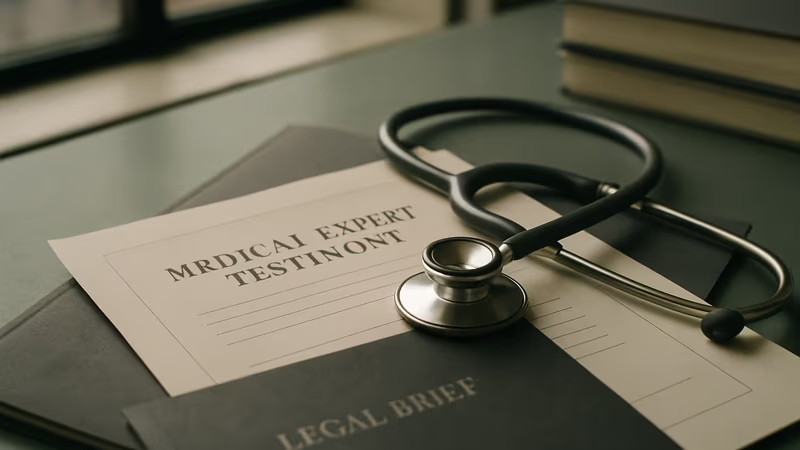
What a line
When medical expert opinions conflict with facts, the facts must prevail in NY personal injury cases. Protect your claim. Call 516-750-0595.
Jun 15, 2019
Social Media Harmed Your Child in NY: Can Your Family Sue?
A practical guide for New York parents: when social media harm to a child is actionable, what evidence to save now, deadlines for minors, and how to start.
Jul 19, 2026
How Contingency Fees Work for Car Accident Lawyers in New York
Understand how contingency fees work for New York car accident lawyers — including the 33⅓% standard, what expenses are separate, what happens if you.
Apr 4, 2026Was this article helpful?
Disclaimer: This article is published by the Law Office of Jason Tenenbaum, P.C. for informational and educational purposes only. It does not constitute legal advice, and no attorney-client relationship is formed by reading this content. The legal principles discussed may not apply to your specific situation, and the law may have changed since this article was last updated.
New York law varies by jurisdiction — court decisions in one Appellate Division department may not be followed in another, and local court rules in Nassau County Supreme Court differ from those in Suffolk County Supreme Court, Kings County Civil Court, or Queens County Supreme Court. The Appellate Division, Second Department (which covers Long Island, Brooklyn, Queens, and Staten Island) and the Appellate Term (which hears appeals from lower courts) each have distinct procedural requirements and precedents that affect litigation strategy.
If you need legal help with a car accidents matter, contact our office at (516) 750-0595 for a free consultation. We serve clients throughout Long Island (Huntington, Babylon, Islip, Brookhaven, Smithtown, Riverhead, Southampton, East Hampton), Nassau County (Hempstead, Garden City, Mineola, Great Neck, Manhasset, Freeport, Long Beach, Rockville Centre, Valley Stream, Westbury, Hicksville, Massapequa), Suffolk County (Hauppauge, Deer Park, Bay Shore, Central Islip, Patchogue, Brentwood), Queens, Brooklyn, Manhattan, the Bronx, Staten Island, and Westchester County. Prior results do not guarantee a similar outcome.