Why Trust This Analysis
This article is part of our ongoing evidence coverage, with 126 published articles analyzing evidence issues across New York State. Attorney Jason Tenenbaum brings 24+ years of hands-on experience to this analysis, drawing from his work on more than 1,000 appeals, over 100,000 no-fault cases, and recovery of over $100 million for clients throughout Nassau County, Suffolk County, Queens, Brooklyn, Manhattan, and the Bronx. For personalized legal advice about how these principles apply to your specific situation, contact our Long Island office at (516) 750-0595 for a free consultation.
Expert Testimony and Peer Review Reports in No-fault Insurance Cases
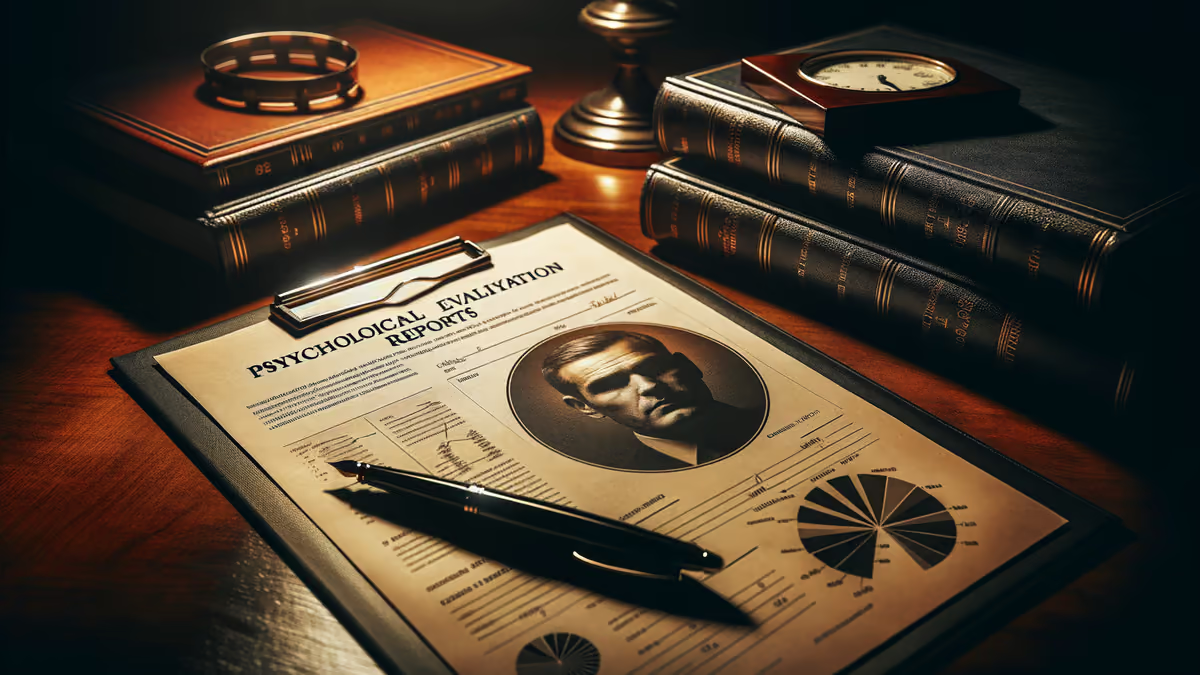
In no-fault insurance litigation, the admissibility of expert testimony often becomes a contentious issue, particularly when insurance companies rely on peer review reports to deny claims. The case of Psychology YM, P.C. v Geico Gen. Ins. Co. illustrates a fundamental principle about expert witness testimony and the foundation required for admitting professional opinions in court.
The lower court’s decision to exclude the psychologist’s testimony based solely on the format of his peer review report reflects a misunderstanding of evidence rules. When an expert witness is available to testify about the factual basis for their professional opinion and can be subjected to cross-examination, the technical form of their underlying report becomes less significant. This principle applies broadly across various types of expert testimony in personal injury and insurance cases.
Jason Tenenbaum’s Analysis:
Psychology YM, P.C. v Geico Gen. Ins. Co., 2011 NY Slip Op 51316(U)(App. Term 2d Dept. 2011)
Free Consultation · No Fee Unless We Win
Does this apply to your situation?
Every case is different. Get a free, confidential case review from an experienced attorney who can tell you exactly where you stand.
Why this objection was even considered is crazy. It does not pass the smell test, let alone the laugh test. Yet, I cannot say I am the least bit surprised. Luckily, the order was reversed. Unfortunately, a new trial was ordered. The complaint should have been dismissed with prejudice.
“At a nonjury trial, the Civil Court granted plaintiff’s motion to preclude the testimony of defendant’s witness, the psychologist who had prepared the peer review report upon which defendant’s claim denial was predicated, because his peer review report was not in admissible form. The Civil Court thereupon awarded judgment in favor of plaintiff in the principal sum of $1,078.48. In view of the fact that defendant sought to call as a witness its psychologist, who was prepared to testify about the factual basis and medical rationale for his opinion, as set forth in his peer review report, that there was a lack of medical necessity for the services rendered, and since he was subject to cross-examination, it was error for the Civil Court to have precluded him from testifying”
Key Takeaway
The appellate court correctly recognized that expert testimony should not be excluded merely because the underlying report lacks proper certification. When an expert can explain their methodology and conclusions under oath and face cross-examination, the foundational requirements for admissibility are satisfied, regardless of the report’s technical format.
Related Articles
Legal Context
Why This Matters for Your Case
New York law is among the most complex and nuanced in the country, with distinct procedural rules, substantive doctrines, and court systems that differ significantly from other jurisdictions. The Civil Practice Law and Rules (CPLR) governs every stage of civil litigation, from service of process through trial and appeal. The Appellate Division, Appellate Term, and Court of Appeals create a rich and ever-evolving body of case law that practitioners must follow.
Attorney Jason Tenenbaum has practiced across these areas for over 24 years, writing more than 1,000 appellate briefs and publishing over 2,600 legal articles that attorneys and clients rely on for guidance. The analysis in this article reflects real courtroom experience — from motion practice in Civil Court and Supreme Court to oral arguments before the Appellate Division — and a deep understanding of how New York courts actually apply the law in practice.
About This Topic
Evidentiary Issues in New York Litigation
The rules of evidence determine what information a court or arbitrator may consider in deciding a case. In New York no-fault and personal injury practice, evidentiary issues arise constantly — from the admissibility of business records and medical reports to the foundation requirements for expert testimony and the application of hearsay exceptions. These articles examine how New York courts apply evidentiary rules in insurance and injury litigation, with practical guidance for building admissible evidence at every stage of a case.
126 published articles in Evidence
Keep Reading
More Evidence Analysis

Defense Engineer Says Your Injury Is Degenerative? Bonilla-Acosta v Max Services (2026)
A NY appeals court held a defense engineer was qualified on crash force but not shown qualified to call spine injuries degenerative. What it means for you.
Oct 23, 2026
CPLR § 2106 Amendment Eliminates Affidavit Notarization Requirement: What This Means for New York Litigation
New York's CPLR 2106 permits affirmations in place of many sworn documents. See the 2024 and 2025 changes, exceptions, and historical case notes.
Feb 18, 2026
An interesting discovery case involving the right to obtain alcohol treatment records
Expert analysis of medical records discovery rights in NY personal injury cases. L.T. v Teva Pharms case study. Call (516) 750-0595 for consultation.
Mar 24, 2010
When the trial court in a bench trial does not assess credibility
Learn when NY appellate courts can review bench trial credibility findings. Expert legal analysis of appellate standards. Call 516-750-0595 for consultation.
Nov 3, 2019
CPLR 3101 Disclosure: When an Undisclosed Witness Can Still Testify at Trial
Cruz v City of New York and CPLR 3101: when an undisclosed witness can testify and an unproduced statement can be admitted at trial in New York courts.
Oct 30, 2015
Business record rule applies to hospitals also
Court ruling shows hospitals must prove their records qualify as business records for summary judgment in no-fault cases, adding procedural hurdle.
Mar 12, 2012Was this article helpful?
Disclaimer: This article is published by the Law Office of Jason Tenenbaum, P.C. for informational and educational purposes only. It does not constitute legal advice, and no attorney-client relationship is formed by reading this content. The legal principles discussed may not apply to your specific situation, and the law may have changed since this article was last updated.
New York law varies by jurisdiction — court decisions in one Appellate Division department may not be followed in another, and local court rules in Nassau County Supreme Court differ from those in Suffolk County Supreme Court, Kings County Civil Court, or Queens County Supreme Court. The Appellate Division, Second Department (which covers Long Island, Brooklyn, Queens, and Staten Island) and the Appellate Term (which hears appeals from lower courts) each have distinct procedural requirements and precedents that affect litigation strategy.
If you need legal help with a evidence matter, contact our office at (516) 750-0595 for a free consultation. We serve clients throughout Long Island (Huntington, Babylon, Islip, Brookhaven, Smithtown, Riverhead, Southampton, East Hampton), Nassau County (Hempstead, Garden City, Mineola, Great Neck, Manhasset, Freeport, Long Beach, Rockville Centre, Valley Stream, Westbury, Hicksville, Massapequa), Suffolk County (Hauppauge, Deer Park, Bay Shore, Central Islip, Patchogue, Brentwood), Queens, Brooklyn, Manhattan, the Bronx, Staten Island, and Westchester County. Prior results do not guarantee a similar outcome.