
Why Trust This Analysis
This article is part of our ongoing fee schedule coverage, with 118 published articles analyzing fee schedule issues across New York State. Attorney Jason Tenenbaum brings 24+ years of hands-on experience to this analysis, drawing from his work on more than 1,000 appeals, over 100,000 no-fault cases, and recovery of over $100 million for clients throughout Nassau County, Suffolk County, Queens, Brooklyn, Manhattan, and the Bronx. For personalized legal advice about how these principles apply to your specific situation, contact our Long Island office at (516) 750-0595 for a free consultation.
Civil Court Ruling on CPM Reimbursement Creates New Precedent
Continuous Passive Motion (CPM) equipment represents a critical component of post-surgical rehabilitation, particularly following orthopedic procedures. In New York’s no-fault insurance system, disputes over reimbursement for medical equipment and supplies frequently arise between healthcare providers and insurance carriers. The pricing and reimbursement structure for such equipment has become increasingly complex, especially as fee schedule regulations continue to evolve.
A recent Civil Court decision has added another layer to this ongoing dispute, aligning with arbitration trends that favor medical providers seeking appropriate compensation for CPM equipment. This development occurs against a backdrop where surgical reimbursement rates have faced downward pressure through regulatory changes, making equipment reimbursement disputes even more significant for healthcare providers’ financial viability.
Jason Tenenbaum’s Analysis:
Advanced Recovery Equip. & Supplies, LLC v Maya Assur. Co., 2018 NY Slip Op 50022(U)(App. Term 2d Dept. 2018)
Free Consultation · No Fee Unless We Win
Does this apply to your situation?
Every case is different. Get a free, confidential case review from an experienced attorney who can tell you exactly where you stand.
The CPM story has been a terrific coup for the medical providers. The American Arbitration Association has consistently ruled in favor of the medical providers. The Courts have generally confirmed arbitration awards. A Civil Court has now taken the AAA position. All that is now left is to see what the Appellate Courts will do.
This is one area where I think both DFS and WCB have dropped the ball. Reimbursement rates have once again declined for surgeries and associated providers through regulation. Yet, this piece of the surgery puzzle now has a larger price tag attached to it than the facility fee and the surgery fee.
Eventually, the regulators will do something…
Key Takeaway
The convergence of arbitration decisions and Civil Court rulings in favor of medical providers regarding CPM equipment reimbursement creates a compelling trend. While surgical and facility fees face regulatory reductions, CPM equipment costs have emerged as a significant expense component, potentially exceeding traditional surgery-related fees and highlighting regulatory gaps in New York no-fault insurance law.
Legal Update (February 2026): Since this 2018 post, New York’s no-fault fee schedule regulations have undergone multiple amendments, potentially affecting CPM equipment reimbursement rates and billing procedures. The regulatory landscape for medical equipment and supplies has evolved significantly, and practitioners should verify current provisions of the fee schedule and any recent court decisions or arbitration trends that may have modified the precedential value discussed.
Related Articles
Legal Context
Why This Matters for Your Case
New York law is among the most complex and nuanced in the country, with distinct procedural rules, substantive doctrines, and court systems that differ significantly from other jurisdictions. The Civil Practice Law and Rules (CPLR) governs every stage of civil litigation, from service of process through trial and appeal. The Appellate Division, Appellate Term, and Court of Appeals create a rich and ever-evolving body of case law that practitioners must follow.
Attorney Jason Tenenbaum has practiced across these areas for over 24 years, writing more than 1,000 appellate briefs and publishing over 2,600 legal articles that attorneys and clients rely on for guidance. The analysis in this article reflects real courtroom experience — from motion practice in Civil Court and Supreme Court to oral arguments before the Appellate Division — and a deep understanding of how New York courts actually apply the law in practice.
About This Topic
Fee Schedule Issues in No-Fault Insurance
The New York no-fault fee schedule establishes the maximum reimbursement rates for medical treatment provided to injured motorists. Disputes over fee schedule calculations, coding, usual and customary charges, and the applicability of workers compensation fee schedules to no-fault claims are common. These articles analyze fee schedule regulations, court decisions on reimbursement disputes, and the practical challenges providers face in obtaining appropriate payment under the no-fault system.
118 published articles in Fee Schedule
Keep Reading
More Fee Schedule Analysis

Acupuncture Reimbursements and Insurance Legalities Explained
Explore the Forrest Chen v. GEICO case and its impact on acupuncture insurance reimbursements in NY. Key insights for providers and patients.
Dec 11, 2024
Simple addition is insufficient
Jodi Jacobs's 2021 mixed appeal: four claims dismissed, one fee balance unresolved, and why the schedule alone did not prove correct code use.
May 22, 2021
Amendment of 11 NYCRR 68.6 coming soon
The 2016 out-of-state no-fault fee proposal became a different rule in 2018. Service dates, emergency care and the final payment comparison explained.
Sep 30, 2016
8 units applies to billing medical providers only?
Suffolk County District Court rules on 8-unit billing limit for medical providers under NY no-fault insurance fee schedule, allowing reimbursement despite multiple claims.
Oct 27, 2013
Another case where the Appellate Term seems to hold that a triable issue of fact is raised regarding the compensability of range of motion testing
First Aid left a bundling dispute for trial in 2010. The opinion did not identify range-of-motion codes or establish a right to separate payment.
Apr 13, 2010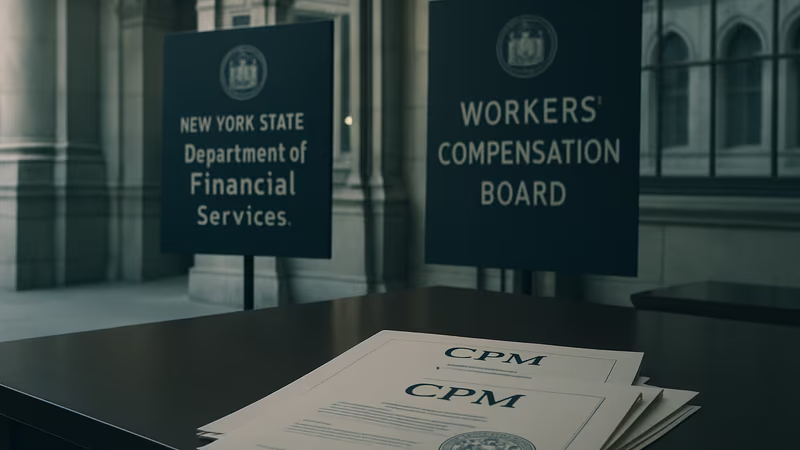
CPM – now it is up to DFS and WCB to address the problem
Appellate Division rules CPM reimbursement must be at general public rental value.
Jul 7, 2018Was this article helpful?
Disclaimer: This article is published by the Law Office of Jason Tenenbaum, P.C. for informational and educational purposes only. It does not constitute legal advice, and no attorney-client relationship is formed by reading this content. The legal principles discussed may not apply to your specific situation, and the law may have changed since this article was last updated.
New York law varies by jurisdiction — court decisions in one Appellate Division department may not be followed in another, and local court rules in Nassau County Supreme Court differ from those in Suffolk County Supreme Court, Kings County Civil Court, or Queens County Supreme Court. The Appellate Division, Second Department (which covers Long Island, Brooklyn, Queens, and Staten Island) and the Appellate Term (which hears appeals from lower courts) each have distinct procedural requirements and precedents that affect litigation strategy.
If you need legal help with a fee schedule matter, contact our office at (516) 750-0595 for a free consultation. We serve clients throughout Long Island (Huntington, Babylon, Islip, Brookhaven, Smithtown, Riverhead, Southampton, East Hampton), Nassau County (Hempstead, Garden City, Mineola, Great Neck, Manhasset, Freeport, Long Beach, Rockville Centre, Valley Stream, Westbury, Hicksville, Massapequa), Suffolk County (Hauppauge, Deer Park, Bay Shore, Central Islip, Patchogue, Brentwood), Queens, Brooklyn, Manhattan, the Bronx, Staten Island, and Westchester County. Prior results do not guarantee a similar outcome.