Why Trust This Analysis
This article is part of our ongoing affidavits coverage, with 19 published articles analyzing affidavits issues across New York State. Attorney Jason Tenenbaum brings 24+ years of hands-on experience to this analysis, drawing from his work on more than 1,000 appeals, over 100,000 no-fault cases, and recovery of over $100 million for clients throughout Nassau County, Suffolk County, Queens, Brooklyn, Manhattan, and the Bronx. For personalized legal advice about how these principles apply to your specific situation, contact our Long Island office at (516) 750-0595 for a free consultation.
Understanding When Courts Accept Second Affidavits
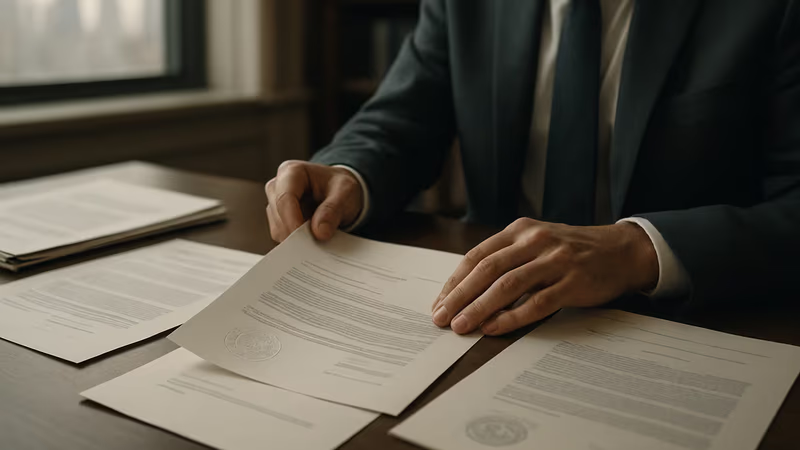
Affidavits serve as crucial sworn statements in legal proceedings, but what happens when the initial affidavit lacks important details or creates ambiguity? A recent New York appellate court decision provides important guidance on when courts will accept a second, clarifying affidavit from the same witness.
The fundamental question centers on whether additional sworn testimony constitutes proper clarification or impermissible contradiction of earlier statements. Courts must balance the need for complete factual records against concerns about manufactured evidence or defective notarization issues that could compromise the integrity of proceedings.
This distinction becomes particularly important when the original affidavit was prepared by opposing counsel, potentially omitting key details that favor the other side. The legal system recognizes that witnesses should have opportunities to provide complete accounts of events, especially when initial statements were incomplete rather than inaccurate.
Jason Tenenbaum’s Analysis:
Free Consultation · No Fee Unless We Win
Does this apply to your situation?
Every case is different. Get a free, confidential case review from an experienced attorney who can tell you exactly where you stand.
Cuevas v Baruti Constr. Corp., 2018 NY Slip Op 05905 (1st Dept. 2018)
“The motion court properly accepted Veras’s second, clarifying affidavit in plaintiff’s submission on reply. The second affidavit merely amplified the factual recitation set forth in Veras’s initial affidavit, which had been procured and drafted by the defense and omitted the pertinent detail that the workers were actually in the process of lowering the machine from the roof, and not engaged in pushing it across the flat roof, when the accident occurred. Veras’s second affidavit was a proper response to defendant’s submission, and did not contradict the statement in his first affidavit (see Cox v McCormick Farms, 144 AD3d 1533 ; Severino v 157 Broadway Assoc., LLC, 84 AD3d 505 ). Nor could Veras’s second affidavit be rejected as raising a feigned issue of fact (see Sutin v Pawlus, 105 AD3d 1293 ; Kalt v Ritman, 21 AD3d 321 ), especially since it comported with all of the other eyewitness testimony in the case, as well as with Veras’s own early unsworn statement, and explained the ambiguity arising from the omission of additional details in his first affidavit.”
Key Takeaway
Courts will accept second affidavits when they clarify and amplify original testimony without contradiction. The key factors include whether the additional details are consistent with other evidence, explain ambiguities from the first affidavit, and respond appropriately to opposing submissions. Remember that an affidavit really is not an affidavit without proper execution requirements.
Related Articles
Legal Context
Why This Matters for Your Case
New York law is among the most complex and nuanced in the country, with distinct procedural rules, substantive doctrines, and court systems that differ significantly from other jurisdictions. The Civil Practice Law and Rules (CPLR) governs every stage of civil litigation, from service of process through trial and appeal. The Appellate Division, Appellate Term, and Court of Appeals create a rich and ever-evolving body of case law that practitioners must follow.
Attorney Jason Tenenbaum has practiced across these areas for over 24 years, writing more than 1,000 appellate briefs and publishing over 2,600 legal articles that attorneys and clients rely on for guidance. The analysis in this article reflects real courtroom experience — from motion practice in Civil Court and Supreme Court to oral arguments before the Appellate Division — and a deep understanding of how New York courts actually apply the law in practice.
Keep Reading
More Affidavits Analysis
Who is the attorney?
Civil Kings court case on attorney representation requirements and default judgment appeals in no-fault insurance litigation.
Feb 1, 2020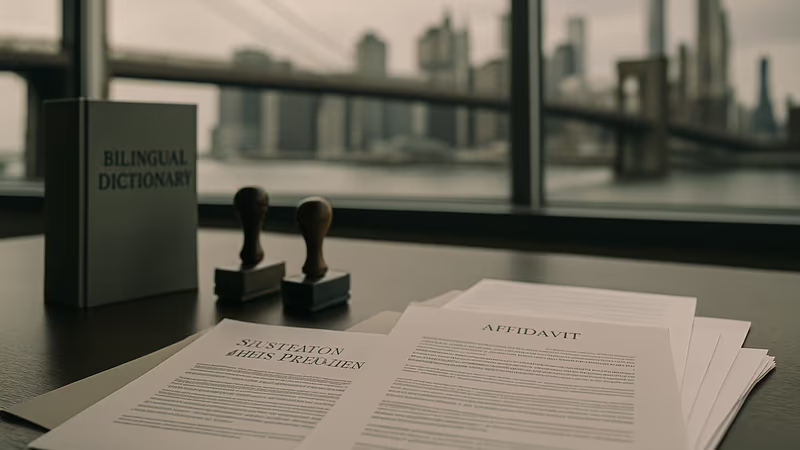
Understanding Affidavit and Translation Requirements in NY Employment Law Cases
Watabe accepted English affidavits after Japanese-interpreted depositions. See what it decided and what CPLR 2101(b) still requires for translations.
Jan 17, 2019
The Minimum That an Affidavit Must Contain in New York
Furtow accepted the affidavit's oath recital and jurat on its record. See the decision, current CPLR 2106 alternatives and related New York cases.
Jul 8, 2010
Putting the Cart Before the Horse: When an Affidavit Is Notarized Before It Is Signed
New Way Acupuncture: an apparently premature notarization defeated the insurer's motion, but the provider's judgment was reversed too.
Oct 27, 2016
Affidavit Notarized on a Different Date Than Drafted? Still Admissible in New York
New York appellate ruling holds an affidavit need not be signed and notarized the same day it was drafted — what proper notarization requires for admissibility.
Feb 15, 2013
A signature placed at the direction of the signor
Court ruling clarifies that electronic signatures placed at the direction of the signor are legally valid, even when appearing as facsimile stamps on peer review reports.
Mar 12, 2012Was this article helpful?
Disclaimer: This article is published by the Law Office of Jason Tenenbaum, P.C. for informational and educational purposes only. It does not constitute legal advice, and no attorney-client relationship is formed by reading this content. The legal principles discussed may not apply to your specific situation, and the law may have changed since this article was last updated.
New York law varies by jurisdiction — court decisions in one Appellate Division department may not be followed in another, and local court rules in Nassau County Supreme Court differ from those in Suffolk County Supreme Court, Kings County Civil Court, or Queens County Supreme Court. The Appellate Division, Second Department (which covers Long Island, Brooklyn, Queens, and Staten Island) and the Appellate Term (which hears appeals from lower courts) each have distinct procedural requirements and precedents that affect litigation strategy.
If you need legal help with a affidavits matter, contact our office at (516) 750-0595 for a free consultation. We serve clients throughout Long Island (Huntington, Babylon, Islip, Brookhaven, Smithtown, Riverhead, Southampton, East Hampton), Nassau County (Hempstead, Garden City, Mineola, Great Neck, Manhasset, Freeport, Long Beach, Rockville Centre, Valley Stream, Westbury, Hicksville, Massapequa), Suffolk County (Hauppauge, Deer Park, Bay Shore, Central Islip, Patchogue, Brentwood), Queens, Brooklyn, Manhattan, the Bronx, Staten Island, and Westchester County. Prior results do not guarantee a similar outcome.