
Key Takeaway
When stock or a display falls on a shopper in New York: notice, res ipsa loquitur and exclusive control, the item you reached for, and the store's video.
This article is part of our ongoing premises liability coverage, with 15 published articles analyzing premises liability issues across New York State. Attorney Jason Tenenbaum brings 24+ years of hands-on experience to this analysis, drawing from his work on more than 1,000 appeals, over 100,000 no-fault cases, and recovery of over $100 million for clients throughout Nassau County, Suffolk County, Queens, Brooklyn, Manhattan, and the Bronx. For personalized legal advice about how these principles apply to your specific situation, contact our Long Island office at (516) 750-0595 for a free consultation.
On September 16, 2026, the Second Department affirmed the dismissal of a supermarket case in which soda bottles fell from a display and struck a shopper who was taking a bottle from it. The decision, Abdelrahman v Stop & Shop Supermarket Co., LLC, is short. It still shows where most falling merchandise cases are won or lost: on proof that the display was dangerous, and on an expert who can say why.
Take an invented example. A shopper in a Hicksville home goods store reaches for a lamp on a middle shelf. A carton stacked on the top shelf, well above anyone’s reach, slides off and strikes the shopper’s shoulder. Our post on proving a premises liability case in New York covers falls on floors and stairs; this one covers the case where the store’s stock comes down on you.
The short version
A store is liable for merchandise that falls on a customer when the display was in a dangerous condition and the store created that condition or had actual or constructive notice of it. Res ipsa loquitur can fill the gap when nobody knows why the item fell, but only if the store's control was exclusive enough to rule out other customers; New York courts have allowed it for stock stored high and out of shoppers' reach, and refused it for shelves the public could freely handle. If you were taking the item when it fell, expect that to be argued; your share of fault reduces the damages and does not bar the claim. Ask the store in writing, right away, to preserve its video. The lawsuit must be started within three years under CPLR 214(5).
What the Second Department decided in Abdelrahman
The case came up from the Supreme Court, Kings County. In the court’s words, “while retrieving a bottle of soda from a store display created by the defendant Coca-Cola Refreshments USA, Inc.,” other bottles “fell from the display and struck the plaintiff.” He sued Stop & Shop, a second defendant named Cross Path Rlty, and Coca-Cola. The Supreme Court granted each defendant summary judgment, and the Second Department affirmed.
The ruling turned on the condition itself. The defendants “established their prima facie entitlement to judgment as a matter of law … by demonstrating that no dangerous condition existed.” The plaintiff’s safety expert did not change that: the affidavit “was speculative and insufficient to defeat summary judgment.”
Free Case Review
Tell us what happened — free case review
Time-sensitive: NY injury claims have strict deadlines
Details received. The fastest next step is a call.
Injury cases are won early. Evidence fades, witnesses move, and New York's no-fault rules can require paperwork within 30 days of a crash. Don't wait for a callback. Call now and a real person takes your information: our office during business hours, and our intake line after hours and on weekends, answered 24/7.
Call (631) 349-3928Free Consultation · Nothing is filed or shared until you decide
Can't call right now? We'll reach out during business hours.
The decision does not hold that a store is never liable when a display gives way; on this record nobody showed what was wrong with it. Consequently, the first job in your case is to find out, and keep the proof, before the display is restocked.
What you have to prove when merchandise falls on you
In Ingram v Costco Wholesale Corp. (2014), a case of iced tea fell on a shopper as he went to take it from a display he called dangerously high. The court wrote that “the plaintiff must establish the existence of a defective condition and that the defendant either created or had actual or constructive notice of the defect.” Costco showed there was no dangerous condition, and the complaint was dismissed.
There are three ways to meet that rule. The store created the condition when its own employees stacked, overloaded or set up the display. It had actual notice when someone told it about the problem, or an employee saw it, before the item fell. Constructive notice is the third: the condition “must be visible and apparent and it must exist for a sufficient length of time prior to the accident to permit defendant’s employees to discover and remedy it” (Gordon v American Museum of Natural History, as quoted in Eksarko v Associated Supermarket, 2d Dept 2017).
Constructive notice is where the store’s records matter. A store moving for summary judgment “must offer some evidence as to when the area in question was last cleaned or inspected relative to the time when the plaintiff fell,” and “reference to general cleaning practices is insufficient.” In Eksarko the store’s manager offered only general cleaning practices, and the store lost its motion.
The other side of that coin is Fontanelli v Price Chopper Operating Co. (3d Dept 2011). Three gallon water bottles fell from a top shelf onto a shopper, who testified that the bottles had been hanging over the edge. A manager had inspected the area five minutes before. The shopper’s testimony established “only that the bottles were placed on the shelf by someone in an unsafe manner”; the claim that the store necessarily did it was “wholly speculative,” and a customer was equally likely to have done it.
Write down where the item was, how it was stacked, whether it was within reach, and which employees were nearby, while you remember it.
Res ipsa loquitur and the exclusive control problem
Sometimes nobody can say why the item fell. Res ipsa loquitur lets a jury infer negligence from the event itself, and the Court of Appeals calls it “nothing more than a brand of circumstantial evidence” (Morejon v Rais Construction Co., 2006). The Court restated the three conditions from Corcoran v Banner Super Market (1967): “(1) the event must be of a kind which ordinarily does not occur in the absence of someone’s negligence; (2) it must be caused by an agency or instrumentality within the exclusive control of the defendant; (3) it must not have been due to any voluntary action or contribution on the part of the plaintiff.”
In a self-service store, the second condition is the fight. Exclusivity “does not mean that ‘the possibility of other causes must be altogether eliminated, but only that their likelihood must be so reduced that the greater probability lies at defendant’s door’” (Durso v Wal-Mart Stores, 4th Dept 2000, quoting Dermatossian). The cases below show where the courts have drawn that line.
Side by side
When res ipsa loquitur reaches falling merchandise in New York stores
Allowed or left for the jury
Stock the public could not reach
- Fields v King Kullen Grocery Co., 28 AD3d 513 (2d Dept 2006), Suffolk County. A metal grill displayed on a shelf 6½ feet up, no ladders or step stools for customers, no other sale merchandise on the shelf or within five feet. Summary judgment for the store reversed: a triable issue on exclusive control.
- Durso v Wal-Mart Stores, 270 AD2d 877 (4th Dept 2000). Boxes on an overhead riser six feet up, for restocking only, signs telling customers to ask for help, a special ladder for employees. Liability on res ipsa affirmed after a nonjury trial.
- Ciciarelli v Ames Dept. Stores, 162 AD2d 996 (4th Dept 1990). A TV tray that was part of a display, "not a sale item," five feet above the floor, no proof of tampering. The res ipsa charge was proper.
Refused
Shelves the public could freely handle
- Meegan v Westbury Prop. Inv. Co., 234 AD2d 433 (2d Dept 1996), Nassau County. The top shelf of a three-tier display gondola came loose and fell on a shopper crouched at the bottom shelf. "[W]here the general public had unfettered access to the display, it was not within the exclusive control" of the store.
- Fontanelli v Price Chopper Operating Co., 89 AD3d 1176 (3d Dept 2011). Water bottles overhanging a top shelf. Anyone entering the store "had unfettered access to the water bottles," so it was "equally likely that a customer caused" the condition.
- What the cases turn on: height, whether the item was for sale or for restocking, ladders and signs, other merchandise nearby, and any proof that a customer touched it.
Res ipsa loquitur creates an inference the jury may draw, not a presumption; only in "the rarest" cases does it win summary judgment for the plaintiff (Morejon v Rais Construction Co., 7 NY3d 203 [2006]).
Res ipsa does not have to be pleaded by name: in Ciciarelli the plaintiff “did not plead res ipsa loquitur,” and the charge was still proper, and in O’Connor v Circuit City Stores (2d Dept 2005) the plaintiff should have been allowed to add it by a supplemental bill of particulars. It usually gets you to a jury, not past one.
Who can be sued: the store, the landlord and the display vendor
A falling display can bring in three defendants. The store runs the aisle. The landlord owns the building. A vendor may have built the display, as Coca-Cola did in Abdelrahman. In Meegan, the claim against the property owner was dismissed because it was “merely an out-of-possession landowner” and the store “was solely responsible for the maintenance and repair” of its retail operations and equipment.
You sue everybody. You sue the store that runs the aisle, you sue the landlord if it kept control of the building and you sue the company that built the display if a vendor put it there. The store is on the hook if they created the condition, if they knew about it or should have known about it, which means it was there for so long that they should have found it and fixed it. A landlord that gave up control of the building and left the store responsible for its own shelves and equipment generally gets out.
Consequently, the lease and any vendor display agreement are among the first documents a lawyer asks for. They show who stocked the display and who was supposed to inspect it.
Expert proof: what a safety affidavit has to do
Experts decide many of these motions. In Devoe v Nostrand II Meat Corp. (2d Dept 2023), an entryway case, the store’s expert showed that the door and saddle were not defective, and the plaintiff’s expert relied on industry standards that were “inapplicable to the entryway of the store.” The case was dismissed.
An affidavit that says a display was “unsafe” or “too high” is a conclusion. What survives is an opinion tied to the actual display: its height, how it was loaded, what held the stock in place, the store’s or vendor’s own stocking rules and how they were broken, all built from photographs, the store’s records and testimony. Consequently, the expert should work from the photographs and the stocking records. An opinion built on the plaintiff’s description alone risks the word the court used in Abdelrahman: speculative.
When you were reaching for the item yourself
Many of these cases begin with the shopper’s own hand on the merchandise. In Abdelrahman the bottles fell while the plaintiff was retrieving one. In Ingram the shopper was going for the case that fell. The third res ipsa condition asks whether the accident was due to “any voluntary action or contribution on the part of the plaintiff.”
So tell your lawyer exactly what you touched and if the item fell because you pulled on it that is going to come up since res ipsa requires that the accident was not caused by anything that you did. That does not end the case though, because under CPLR 1411, your share of fault doesn’t bar recovery; it reduces the damages by your percentage.
The statute is direct: the claimant’s culpable conduct “shall not bar recovery,” and damages are “diminished in the proportion” that conduct bears to the conduct that caused the damages. The 2026 rule barring a plaintiff who is mostly at fault, CPLR 1411(b), applies only to actions “subject to article fifty-one of the insurance law,” the motor vehicle insurance article. A shopper hurt in a store is under the comparative fault rule of CPLR 1411(a).
Preserve the video before it records over itself
On September 16, 2026, the same day as Abdelrahman, the Second Department decided Alvarez v 100-10 67th Rd. Condominium, a stairway fall in an apartment building whose cameras “captured three weeks of video before being automatically overwritten.” The plaintiff’s lawyer sent a preservation letter less than two weeks after the fall. The building produced only a 67-second cell phone recording of the moments after the fall.
The court held that the owners “had an obligation to preserve the subject surveillance videos and were at least negligent in failing to preserve them.” A party seeking sanctions must show an obligation to preserve when the evidence was destroyed, “a culpable state of mind,” and relevance to the claim. The trial court had barred the owners from offering any defense on liability; the Second Department changed that to an adverse inference charge at trial. Eksarko came out the same way for a supermarket that lost its video when a store computer was damaged during renovations.
The first thing that you do is you write a letter to the store telling them to preserve the video. You need to do this immediately in writing. A lot of these camera systems keep a few weeks of footage and then they just start recording over it automatically, so if you don’t write a letter, the video may disappear. If the video disappears, especially after the store gets your letter, then a court can sanction them, and the usual sanction is an adverse inference. So what that means is that the jury is told that it can assume that the video would not have helped the store.
The timeline below sets out what to do and when.
The clocks
After merchandise falls on you in a store
- Day 0at the store Photograph the display and the item, and report itThe height, the stacking, the shelf edge, any sign or ladder. Ask that an incident report be made and get the names of the employees who came over.
- Daysnot weeks Written request to preserve the video and the display recordsIn Alvarez (2d Dept 2026) the cameras kept three weeks of video. Ask for footage before and after the incident, the incident report, the stocking and inspection records, and the vendor's display paperwork.
- If lostin the case Motion for spoliation sanctionsObligation to preserve, culpable state of mind (negligence can be enough), relevance (Pegasus Aviation I v Varig Logistica, 26 NY3d 543 [2015]). Usual result in these cases: an adverse inference charge.
- 3years Start the lawsuitCPLR 214(5): an action to recover damages for a personal injury against a private store, landlord or vendor.
Back to the shopper in Hicksville
The shopper reached for a lamp, not the carton, and the carton sat above anyone’s reach. The store will say another customer moved it; the answer is the height, whether the top shelf held overstock for employees, and whether customers had a ladder. That is the Fields and Durso pattern, and it can put res ipsa in front of a jury. The shopper should still prove notice the ordinary way, with the inspection records, the photographs and the video the store was asked to keep. If the reach jostled the shelf, that goes to the shopper’s percentage. The clock is three years.
Our premises liability practice explains how these cases are built, and our page on injuries at a Home Depot covers the warehouse-store version with overhead racking.
Bring these to the first call
After you were hit by falling merchandise
- 1. Your photographs of the display, the shelf and the itemTaken that day if you have them, with something that shows the height.
- 2. The store name, address, aisle, date and timeAnd the shopping center or building it is in.
- 3. The incident report number and the names of employees who respondedIncluding anyone who said the display had come down before.
- 4. Any letter you sent the store, and its replyEspecially about the video.
- 5. Your emergency room and doctor recordsFrom the day of the injury and every visit after.
Sources
- Abdelrahman v Stop & Shop Supermarket Co., LLC, 2026 NY Slip Op 05259 (2d Dept September 16, 2026)
- Alvarez v 100-10 67th Rd. Condominium, 2026 NY Slip Op 05261 (2d Dept September 16, 2026)
- Devoe v Nostrand II Meat Corp., 216 AD3d 738 (2d Dept 2023)
- Eksarko v Associated Supermarket, 155 AD3d 826 (2d Dept 2017)
- Ingram v Costco Wholesale Corp., 117 AD3d 685 (2d Dept 2014)
- Fields v King Kullen Grocery Co., 28 AD3d 513 (2d Dept 2006)
- O’Connor v Circuit City Stores, Inc., 14 AD3d 676 (2d Dept 2005)
- Meegan v Westbury Prop. Inv. Co., 234 AD2d 433 (2d Dept 1996)
- Fontanelli v Price Chopper Operating Co., 89 AD3d 1176 (3d Dept 2011)
- Durso v Wal-Mart Stores, 270 AD2d 877 (4th Dept 2000)
- Ciciarelli v Ames Dept. Stores, 162 AD2d 996 (4th Dept 1990)
- Morejon v Rais Construction Co., 7 NY3d 203 (2006)
- Pegasus Aviation I, Inc. v Varig Logistica S.A., 26 NY3d 543 (2015)
- CPLR 214, CPLR 1411 and CPLR 3126
If merchandise or a display fell on you in a store on Long Island, call (516) 750-0595 with your photographs of the display and the store’s incident report number, or request a free case review.
Legal Context
Why This Matters for Your Case
Personal injury law in New York is governed by a complex web of statutes, case law, and procedural rules that differ from most other states. The statute of limitations for most personal injury claims is three years under CPLR 214(5), but claims against municipalities require a Notice of Claim within 90 days. Motor vehicle accident victims must meet the serious injury threshold under Insurance Law §5102(d) before they can recover pain and suffering damages.
The Law Office of Jason Tenenbaum has recovered over $100 million for injured clients across Long Island, Nassau County, Suffolk County, Queens, Brooklyn, Manhattan, and the Bronx. With 24+ years of trial and appellate experience, more than 1,000 appeals written, and 2,600+ published legal articles, Jason Tenenbaum provides the authoritative legal analysis that practitioners and injury victims need to understand their rights.
This article reflects real courtroom experience and a deep understanding of how New York courts actually evaluate personal injury claims — from the initial filing through discovery, summary judgment, trial, and appeal.
Keep Reading
More Premises Liability Analysis

Fell From an Unsecured Ladder on a New York School Job: Who Is Liable?
Hurt in a ladder fall on a New York school roofing job? Who can be sued under Labor Law 240, why your employer is out, and the 90-day notice of claim.
Nov 1, 2026Carbon Monoxide Poisoning at a Restaurant or Mall: Who Can Be Liable in New York?
A Second Department ruling on a fatal Walt Whitman Mall leak shows when a repair contractor answers for carbon monoxide, and how owners and tenants are judged.
Oct 29, 2026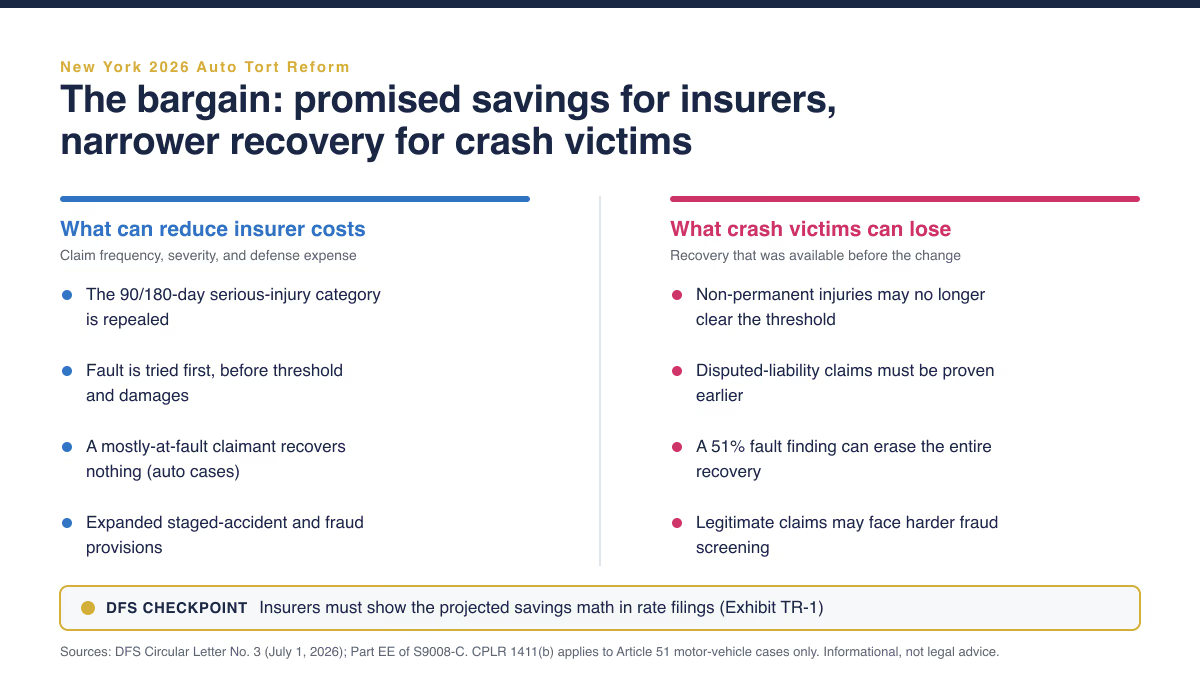
Will NY Auto Insurance Rates Go Down After Tort Reform? What Crash Victims Give Up
DFS Circular Letter No. 3 orders NY auto insurers to show their tort-reform savings math by Aug. 31, 2026. Here is what crash victims traded for it.
Aug 13, 2026
Hit and Run Accident Settlement in New York: Your Rights When the Driver Flees
If you were injured in a hit and run accident in New York, you still have legal options — through uninsured motorist coverage, MVAIC, and police.
Apr 4, 2026
How Long Do You Have to File a Motorcycle Accident Claim in NY?
Learn about New York's 3-year statute of limitations for motorcycle accident claims, exceptions for government cases, and critical filing deadlines.
Jun 6, 2025
Distracted Driving: When a Glance Becomes a Claim
Discover legal rights after a distracted driving accident. Learn evidence needed, common challenges, and how to build a strong injury claim.
Jan 22, 2025Frequently Asked Questions
Common Questions About This Topic
5 answers from the firm's New York personal-injury and employment-law practice. Click any question to expand.
Can you sue a store if merchandise falls on you in New York?
Yes, if the store was negligent: the display was dangerous and the store created the condition or had actual or constructive notice of it, or res ipsa loquitur applies. In *Abdelrahman v Stop & Shop* (2d Dept 2026) the claim failed because no dangerous condition was shown.
Does res ipsa loquitur apply when something falls off a store shelf?
Sometimes, if the store's control was exclusive enough to make another customer an unlikely cause. It survived summary judgment, as a triable issue on exclusive control, for stock kept out of shoppers' reach in *Fields v King Kullen* (2d Dept 2006) and was refused for a display the public could freely handle in *Meegan v Westbury Prop. Inv. Co.* (2d Dept 1996).
What if the item fell while I was taking it off the shelf?
The claim is not over. Under CPLR 1411(a), your own fault does not bar recovery; it reduces the damages in proportion. It can defeat res ipsa, which requires that the accident was not due to your own action, so the case would rest on proof of a dangerous display and notice.
How do I get the store's surveillance video?
Ask in writing right away for the store to preserve it, then demand it in discovery. If the store loses video it was obliged to keep, the court can impose sanctions; in *Alvarez* and *Eksarko* the Second Department directed an adverse inference charge at trial.
How long do I have to sue a store on Long Island for a falling merchandise injury?
Three years from the injury, under CPLR 214(5), for a suit against a private store, landlord or display vendor in Nassau, Suffolk or anywhere else in New York.
Was this article helpful?
Disclaimer: This article is published by the Law Office of Jason Tenenbaum, P.C. for informational and educational purposes only. It does not constitute legal advice, and no attorney-client relationship is formed by reading this content. The legal principles discussed may not apply to your specific situation, and the law may have changed since this article was last updated.
New York law varies by jurisdiction — court decisions in one Appellate Division department may not be followed in another, and local court rules in Nassau County Supreme Court differ from those in Suffolk County Supreme Court, Kings County Civil Court, or Queens County Supreme Court. The Appellate Division, Second Department (which covers Long Island, Brooklyn, Queens, and Staten Island) and the Appellate Term (which hears appeals from lower courts) each have distinct procedural requirements and precedents that affect litigation strategy.
If you need legal help with a premises liability matter, contact our office at (516) 750-0595 for a free consultation. We serve clients throughout Long Island (Huntington, Babylon, Islip, Brookhaven, Smithtown, Riverhead, Southampton, East Hampton), Nassau County (Hempstead, Garden City, Mineola, Great Neck, Manhasset, Freeport, Long Beach, Rockville Centre, Valley Stream, Westbury, Hicksville, Massapequa), Suffolk County (Hauppauge, Deer Park, Bay Shore, Central Islip, Patchogue, Brentwood), Queens, Brooklyn, Manhattan, the Bronx, Staten Island, and Westchester County. Prior results do not guarantee a similar outcome.