Key Takeaway
New York abolished most of the firefighter rule. How General Obligations Law § 11-106 and General Municipal Law § 205-a and § 205-e let injured officers sue.
This article is part of our ongoing personal injury coverage, with 189 published articles analyzing personal injury issues across New York State. Attorney Jason Tenenbaum brings 24+ years of hands-on experience to this analysis, drawing from his work on more than 1,000 appeals, over 100,000 no-fault cases, and recovery of over $100 million for clients throughout Nassau County, Suffolk County, Queens, Brooklyn, Manhattan, and the Bronx. For personalized legal advice about how these principles apply to your specific situation, contact our Long Island office at (516) 750-0595 for a free consultation.
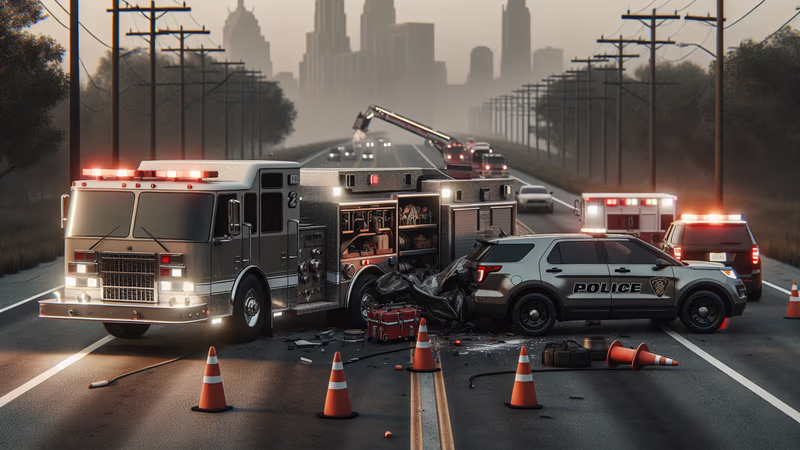
Yes, in most cases. For a long time the answer in New York was no. The Legislature has taken that rule apart in stages since 1935, and today an injured officer often has two claims against an outside party and, in narrower cases, one against the department itself.
Take an invented example. A Nassau County police officer answers a night alarm at an office building in Hicksville. The stairwell lights are out, and the officer falls down a flight of stairs and tears a knee. Months earlier the town had issued the owner a violation order for the stairwell lighting, and nobody fixed it. Our post on carbon monoxide at a restaurant or mall touched these statutes for the officers who answered that call; this one is about the officer’s own claim.
The short version
The common-law "firefighter rule" barred police officers and firefighters from suing in negligence for line-of-duty injuries. General Obligations Law § 11-106 now lets them sue anyone other than their employer or a co-employee whose neglect caused the injury. General Municipal Law § 205-a (firefighters) and § 205-e (police officers) add a separate claim when the injury results "directly or indirectly" from someone's failure to comply with a statute, ordinance, rule or order, and for a police officer § 205-e is the only route against the employer or a fellow officer. The violated rule must come from "a well-developed body of law and regulation that imposes clear duties" (Williams v City of New York, 2004), and only a "practical or reasonable connection" to the injury is required (Giuffrida v Citibank Corp., 2003). Volunteer firefighters are limited to Volunteer Firefighters' Benefit Law benefits against their own fire district and village. Three years to sue a private party; 90 days to serve a notice of claim on a town, village, county or fire district.
Where the firefighter rule came from
The firefighter rule is judge-made. The Court of Appeals gave the modern reason in Santangelo v State of New York (1988): “as a matter of public policy firefighters trained and compensated to confront such dangers must be precluded from recovering damages for the very situations that create a need for their services.”
Santangelo is a Long Island case. Two Suffolk County police officers were hurt trying to subdue a man who had escaped from Kings Park Psychiatric Center. The Court of Claims found the State negligent in letting him escape, and the officers still recovered nothing, because the policy behind the rule applied “as well to police officers injured in the line of duty.”
Free Case Review
Tell us what happened — free case review
Time-sensitive: NY injury claims have strict deadlines
Details received. The fastest next step is a call.
Injury cases are won early. Evidence fades, witnesses move, and New York's no-fault rules can require paperwork within 30 days of a crash. Don't wait for a callback. Call now and a real person takes your information: our office during business hours, and our intake line after hours and on weekends, answered 24/7.
Call (631) 349-3928Free Consultation · Nothing is filed or shared until you decide
Can't call right now? We'll reach out during business hours.
Consequently, every claim an officer has today comes from a statute. Without one, the common-law rule still controls.
How New York took the rule apart
The Court of Appeals traced the history in Giuffrida v Citibank Corp. (2003). General Municipal Law § 205-a, enacted in 1935, gave firefighters a claim when a violated statute or regulation caused a line-of-duty injury. In 1989, as “a direct response to Santangelo,” the Legislature enacted § 205-e to give police officers the same claim. Amendments in 1992 and 1996 made both claims apply wherever the violation happens and even when the violated provision “codifies a common-law duty.”
The 1996 law also enacted General Obligations Law § 11-106, the broad one. It gives an officer hurt “while in the lawful discharge of his official duties” a claim against “any person or entity, other than that police officer’s or firefighter’s employer or co-employee,” whose neglect or culpable conduct proximately caused the injury. The Court in Giuffrida said it “largely abolishes the firefighter’s rule.”
Here is how Jason Tenenbaum explains what these statutes did to the old rule:
They abrogate the firefighter rule. The old rule stated that a firefighter or police officer could not sue for getting hurt doing their job because dealing with danger is part of the job. That’s out the door now. Under General Obligations Law section 11-106 an officer has a cause of action for ordinary negligence against anyone other than the employer or a co-worker, like the owner of the building. And under 205-a for firefighters and 205-e for police officers, if you can show that there was a violation of a statute, ordinance or rule regarding the premises or activity that is causally related to your injury, then you have a cause of action.
For the officer in Hicksville, that means two claims against the building owner: negligence, and a statutory claim built on the uncured violation order. The card below sets out both.
At a glance
Line-of-duty injury claims for New York police officers and firefighters
- Negligence claim
- General Obligations Law § 11-106(1): against "any person or entity, other than that police officer's or firefighter's employer or co-employee," whose "neglect, willful omission, or intentional, willful or culpable conduct" proximately caused the injury, disease or death.
- Statutory claim
- General Municipal Law § 205-a (any "officer, member, agent or employee of any fire department") and § 205-e (any "officer, member, agent or employee of any police department"): injury that "occurs directly or indirectly as a result of any neglect, omission, willful or culpable negligence of any person or persons in failing to comply with the requirements of any of the statutes, ordinances, rules, orders and requirements of the federal, state, county, village, town or city governments or of any and all their departments, divisions and bureaus."
- What the plaintiff must plead
- "[1] identify the statute or ordinance with which the defendant failed to comply, [2] describe the manner in which the firefighter was injured, and [3] set forth those facts from which it may be inferred that the defendant's negligence directly or indirectly caused the harm" (Giuffrida, quoting Zanghi; applied to police officers in Williams).
- Which rules count
- "a requirement found in a well-developed body of law and regulation that imposes clear duties" (Williams, quoting Galapo and Desmond). Not the NYPD Patrol Guide (Galapo, 2000). Yes: Penal Law sections that prohibit specific acts (Williams, 2004); the PESHA general duty clause, Labor Law § 27-a(3)(a)(1) (Gammons, 2014).
- Causation
- A "practical or reasonable connection" between the violation and the injury; "indirect" causes count (Giuffrida, 2003). Comparative fault "cannot be applied in defense of a General Municipal Law § 205-a action" (Giuffrida, citing Mullen v Zoebe).
- The employer and fellow officers
- Not reachable under § 11-106. For police, "liability against a fellow officer or employer can only be based on the statutory right of action in General Municipal Law § 205-e" (Williams). Volunteer firefighters: Volunteer Firefighters' Benefit Law § 19 makes its benefits the exclusive remedy against the political subdivision and the fire company's governmental parties (Brady v Village of Malverne, 2d Dept 2010).
- Floor written into the statute
- § 205-a: "not less than ten thousand dollars" for injury, "not less than forty thousand dollars" for death. § 205-e: "not less than one thousand dollars" for injury, "not less than five thousand dollars" for death.
Which violations count
Read literally, the two statutes reach a violation of any requirement of any government body. The Court of Appeals has refused to read them that way. In Williams v City of New York (2004), quoting Galapo, it said the statute “cannot reasonably be applied literally in accordance with its broad language,” and that the officer “must demonstrate injury resulting from negligent noncompliance with a requirement found in a well-developed body of law and regulation that imposes clear duties.”
The cases sort the rules into two piles. The NYPD Patrol Guide does not count, because it is not “a duly-enacted body of law or regulation” (Galapo v City of New York, 2000), and neither does a department guideline that leaves the risk to each officer’s “individual judgment” (Desmond v City of New York, 1996). The emergency-driver statute in the Vehicle and Traffic Law counts (Gonzalez v Iocovello, as described in Williams), as do Penal Law sections that prohibit specific acts, with no conviction required (Williams). So does the general duty clause of the Public Employee Safety and Health Act (Gammons v City of New York, 2014).
A proper rule is not enough; it must actually have been broken. Where no criminal charges were brought, Williams held that “a rebuttable presumption exists that the Penal Law has not been violated,” and the Court affirmed the dismissal of both cases before it.
The practical question comes first:
So the first question is which rule they broke. You got to find out what statute or ordinance they violated. It has to be from a well-developed body of law that imposes clear duties, like a building code or a fire code. The department’s own patrol guide doesn’t count. The best proof is generally going to be a violation order from the town or the fire marshal that was never cured and someone who saw it that day.
In Hicksville, that is the town’s order on the stairwell lights. Get a copy of it, and of any order that came before it.
How close the connection must be
The statutory claim reaches an injury that happens “directly or indirectly” because of the violation. In Giuffrida, a New York City firefighter fought a fire in a doughnut shop the Fire Department had cited twice for an altered fire suppression system that was never fixed. He stayed inside working the last hose so the others could get out, his air ran out, and he was burned and overcome by smoke. The Appellate Division blamed the empty air tank. The Court of Appeals reversed.
A plaintiff “need only establish a ‘practical or reasonable connection’ between the statutory or regulatory violation and the claimed injury,” the Court held. The empty tank “was not a superseding cause”; it was “the result of an act of courage.” Two uncured violations and a fellow firefighter who saw no sign the system had gone off were enough to defeat summary judgment. The Court also repeated that comparative fault principles cannot be used to defend a firefighter’s claim under the statute. The link still has to be shown: the plaintiff “will always be required to raise a question of fact” that the violation was a direct or indirect cause.
Who can be sued, and who cannot
Outside parties are the main defendants: the building owner, a store or tenant, a driver, a contractor. The negligence statute was written for them, and the statutory claim applies too when they broke a qualifying rule.
The officer’s employer and fellow officers are different. The negligence statute keeps the old bar for them. For police, Williams put it plainly: liability against a fellow officer or the employer “can only be based on the statutory right of action in General Municipal Law § 205-e.” Those cases are hard, though Gammons let an officer proceed against the NYPD over a fall from a police truck. Williams held the safety act’s general duty clause does not reach “the special risks faced by police officers because of the nature of police work,” such as how prisoners are held and weapons are stored.
Volunteer firefighters face one more limit. The firefighter statute covers any “member” of a fire department, but Volunteer Firefighters’ Benefit Law § 19 makes that law’s benefits “the exclusive remedy” against the political subdivision and others acting under governmental authority. In Brady v Village of Malverne (2010), the Second Department held that a Malverne volunteer’s widow could not use the firefighter statute to recover from the village and the fire company after he was pinned against the firehouse ceiling while working on top of a fire truck another firefighter was driving out. Section 19 protects only the listed political subdivisions and those “acting under governmental or statutory authority”; a private owner or driver is not on that list.
Consequently, for most officers the real case is against the outside party. The decision flow below follows the three doors.
Which claim fits a line-of-duty injury
Step 1
Did someone outside your department cause it?
Yes: negligence claim under General Obligations Law § 11-106 against that owner, driver, tenant or contractor. No: go to step 3.
Step 2
Did that party break a code, statute or ordinance?
Yes: add a claim under § 205-a (firefighters) or § 205-e (police officers), with only a "practical or reasonable connection" to prove. No: the negligence claim stands alone.
Step 3
Was it your own department or a fellow officer?
Paid police officer: only § 205-e, on a clear statutory duty. Paid firefighter: § 11-106 leaves the department's existing § 205-a liability as it was. Volunteer firefighter: Volunteer Firefighters' Benefit Law benefits are the exclusive remedy against the district and village.
Salary and medical benefits, and the employer’s claim
General Municipal Law § 207-c covers “any member of a police force of any county,” town, village or city of under one million people, which by its terms reaches a county police force such as Nassau’s or Suffolk’s. The employer pays “the full amount of his or her regular salary or wages” until the disability ends and is liable “for all medical treatment and hospital care.” Section 207-a gives paid firefighters of a town, village, fire district or smaller city the same protection. Volunteers are covered by their own benefit law instead.
The county, village or fire district that paid has its own “cause of action” for reimbursement against any third party the officer can sue. Consequently, most settlement conversations include the employer’s claim, and it is better to raise it early than to find it at the closing.
The deadlines
Against a public body the clock is much shorter than the three years a private defendant gets: a notice of claim within 90 days under General Municipal Law § 50-e, and suit within one year and ninety days. Before suit, the municipality has the right to demand an examination of the claimant under § 50-h; our post on the 50-h hearing walks through it, and our statute of limitations guide has the general chart.
The clocks
The main deadlines after a line-of-duty injury
- 90days Notice of claim on a public defendantGeneral Municipal Law §§ 50-e(1)(a), 50-i(1). Applies when a city, county, town, village, fire district or school district is the defendant. In a death case the 90 days run from appointment of the estate's representative.
- 1 yr 90days Lawsuit against the public defendantGeneral Municipal Law § 50-i(1)(c). At least thirty days must pass after the notice is served before suit.
- 2years Wrongful deathEPTL 5-4.1, from the date of death; § 50-i(1) sets the same two years against a public defendant.
- 3years Lawsuit against a private owner, driver or contractorCPLR 214(5), personal injury; CPLR 214(2), a liability created by statute.
The first days after the injury are when the proof is easiest to get:
So write down the address, the owner, the conditions you saw, the names of people who were there. If it’s a private building, a private car, you have three years to sue. If it’s a town, village, county or school district, you have 90 days to serve a notice of claim. And remember that the county or village paying your salary and medical bills under 207-c or 207-a has its own claim against the same party for what they paid.
Bring these to the first call
- The police or fire department incident report number, and the date, time and address.
- Any violation order, summons or inspection record on the building, vehicle or site, and the agency that issued it.
- Names of the officers, firefighters and witnesses who saw the condition.
- Photographs of the scene and the condition, taken that day if you have them.
- Your salary-and-medical benefits determination or volunteer benefits claim number.
Back to Hicksville
The officer is paid by the County while the knee heals. The building owner is a private party, so the officer has three years to sue it, in negligence and on the uncured lighting violation, and the County has its own claim against the same owner for what it paid. Our premises liability practice covers how an owner’s notice of a condition is proved, and our wrongful death practice covers the claims a family brings when an officer does not come home.
Sources
- General Obligations Law § 11-106
- General Municipal Law § 205-a and § 205-e
- General Municipal Law § 207-a and § 207-c
- General Municipal Law § 50-e, § 50-h and § 50-i
- Volunteer Firefighters’ Benefit Law § 19
- CPLR 214 and EPTL 5-4.1
- Santangelo v State of New York, 71 NY2d 393 (1988)
- Desmond v City of New York, 88 NY2d 455 (1996)
- Galapo v City of New York, 95 NY2d 568 (2000)
- Giuffrida v Citibank Corp., 100 NY2d 72 (2003)
- Williams v City of New York, 2 NY3d 352 (2004)
- Brady v Village of Malverne, 76 AD3d 691 (2d Dept 2010)
- Gammons v City of New York, 24 NY3d 562 (2014)
If you are a police officer or firefighter hurt on a call on Long Island, call (516) 750-0595 with the incident report number and any violation order on the property, or request a free case review.
Legal Context
Why This Matters for Your Case
Personal injury law in New York is governed by a complex web of statutes, case law, and procedural rules that differ from most other states. The statute of limitations for most personal injury claims is three years under CPLR 214(5), but claims against municipalities require a Notice of Claim within 90 days. Motor vehicle accident victims must meet the serious injury threshold under Insurance Law §5102(d) before they can recover pain and suffering damages.
The Law Office of Jason Tenenbaum has recovered over $100 million for injured clients across Long Island, Nassau County, Suffolk County, Queens, Brooklyn, Manhattan, and the Bronx. With 24+ years of trial and appellate experience, more than 1,000 appeals written, and 2,600+ published legal articles, Jason Tenenbaum provides the authoritative legal analysis that practitioners and injury victims need to understand their rights.
This article reflects real courtroom experience and a deep understanding of how New York courts actually evaluate personal injury claims — from the initial filing through discovery, summary judgment, trial, and appeal.
About This Topic
New York Personal Injury Law
When negligence causes serious injury, New York law entitles victims to compensation for medical bills, lost income, pain and suffering, and more. From car accidents and slip-and-falls to construction injuries and medical malpractice, the Law Office of Jason Tenenbaum has recovered over $100 million for injured Long Islanders and New Yorkers since 2002.
189 published articles in Personal Injury
Keep Reading
More Personal Injury Analysis

Child Hurt in School Gym Class or Sports in New York: When Is the School Liable?
Child hurt in gym class or school sports in New York? When a school is liable for poor supervision, how assumption of risk works, and the 90-day notice.
Nov 9, 2026
Store or Restaurant Ceiling Collapsed on You in New York? Who Is Liable
When a ceiling falls on a customer in a New York store or restaurant: the owner, the tenant or the landlord, notice of the leak, res ipsa and the contractor.
Nov 8, 2026
How Much Is a Car Accident Settlement Worth in New York?
Car accident settlements in New York range from $15,000 to over $5 million.
Apr 4, 2026
NY CRPS & Chronic Pain Car Accident Settlements (2026)
CRPS/RSD settlement ranges in NY car accidents: Budapest Criteria, spinal cord stimulator costs, §5102(d) threshold analysis. Call 516-750-0595.
Apr 4, 2025
Cashing in on old settlements
Insurance companies must pay interest on delayed no-fault settlements in NY. Protect your rights and maximize recovery. Call 516-750-0595 for help.
Jun 14, 2019
Grieving Families Act 2026: The Fourth Veto, the Fifth Attempt, and What Wrongful-Death Families Should Do Right Now
Hochul vetoed the Grieving Families Act a fourth time in December 2025. Where the fifth attempt stands as the 2026 session ends — and why families cannot wait.
Jun 12, 2026Frequently Asked Questions
Common Questions About This Topic
5 answers from the firm's New York personal-injury and employment-law practice. Click any question to expand.
Can a police officer sue for getting hurt on the job in New York?
Yes. General Obligations Law § 11-106 lets an injured officer sue any person or entity other than the employer or a co-employee whose neglect caused the injury. General Municipal Law § 205-e adds a claim when the injury resulted directly or indirectly from someone's failure to comply with a statute, ordinance, rule or order.
What is the firefighter rule in New York?
It was a common-law rule that barred firefighters, and after *Santangelo v State of New York* (1988) police officers, from recovering in negligence for line-of-duty injuries. The Court of Appeals said in *Giuffrida v Citibank Corp.* (2003) that the 1996 statute "largely abolishes" it, except as to claims against the employer and co-employees.
Can a firefighter sue a building owner for a fire code violation?
Yes, under General Municipal Law § 205-a, if the violation directly or indirectly caused the injury. The firefighter must identify the code provision, describe how the injury happened and set forth facts from which it may be inferred that the violation directly or indirectly caused the harm; only a "practical or reasonable connection" is required.
Can a Nassau or Suffolk County police officer sue the county that employs them?
Only under the police statute, and only on a violation of a requirement from "a well-developed body of law and regulation that imposes clear duties." A notice of claim must be served within 90 days and suit started within one year and ninety days.
Can a volunteer firefighter on Long Island sue after a line-of-duty injury?
Not the fire district, village or fire company: Volunteer Firefighters' Benefit Law § 19 makes that law's benefits the exclusive remedy against them, and in *Brady v Village of Malverne* (2010) the Second Department held the firefighter statute does not get around it. A private owner or driver is not on the list of parties § 19 protects.
Was this article helpful?
Disclaimer: This article is published by the Law Office of Jason Tenenbaum, P.C. for informational and educational purposes only. It does not constitute legal advice, and no attorney-client relationship is formed by reading this content. The legal principles discussed may not apply to your specific situation, and the law may have changed since this article was last updated.
New York law varies by jurisdiction — court decisions in one Appellate Division department may not be followed in another, and local court rules in Nassau County Supreme Court differ from those in Suffolk County Supreme Court, Kings County Civil Court, or Queens County Supreme Court. The Appellate Division, Second Department (which covers Long Island, Brooklyn, Queens, and Staten Island) and the Appellate Term (which hears appeals from lower courts) each have distinct procedural requirements and precedents that affect litigation strategy.
If you need legal help with a personal injury matter, contact our office at (516) 750-0595 for a free consultation. We serve clients throughout Long Island (Huntington, Babylon, Islip, Brookhaven, Smithtown, Riverhead, Southampton, East Hampton), Nassau County (Hempstead, Garden City, Mineola, Great Neck, Manhasset, Freeport, Long Beach, Rockville Centre, Valley Stream, Westbury, Hicksville, Massapequa), Suffolk County (Hauppauge, Deer Park, Bay Shore, Central Islip, Patchogue, Brentwood), Queens, Brooklyn, Manhattan, the Bronx, Staten Island, and Westchester County. Prior results do not guarantee a similar outcome.