Key Takeaway
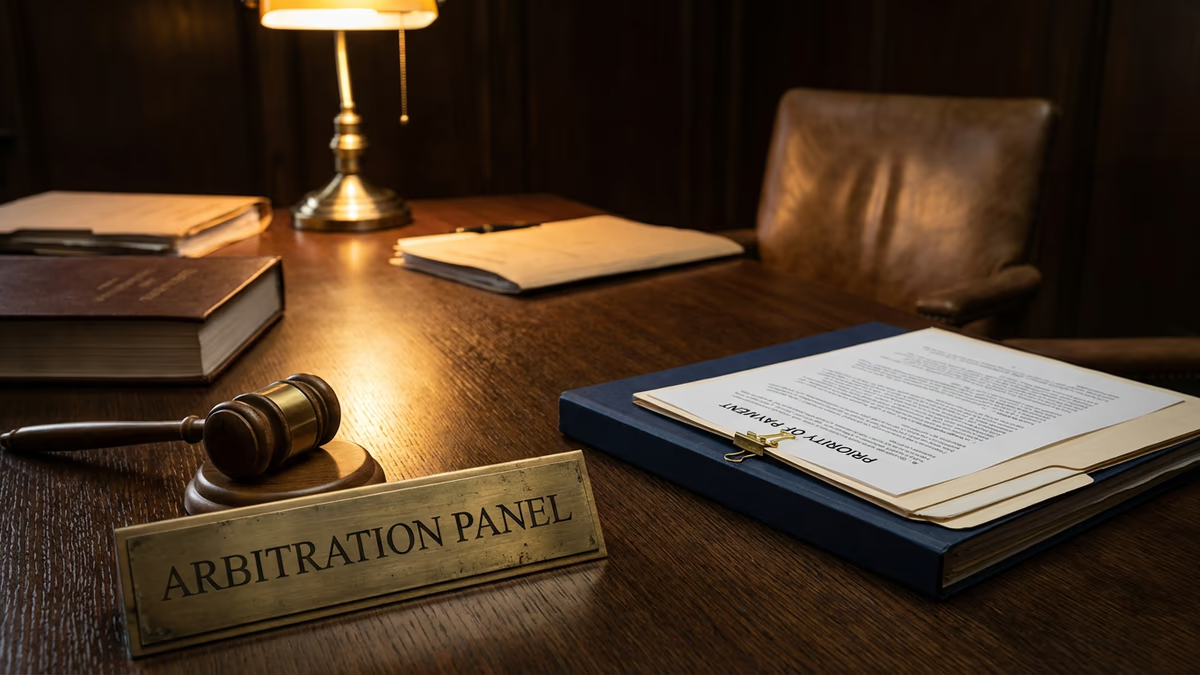
Lenox Hill Radiology v Hereford: MRI copying costs did not end the verification toll, but the court left a separate 120-day denial question open.
This article is part of our ongoing no-fault coverage, with 271 published articles analyzing no-fault issues across New York State. Attorney Jason Tenenbaum brings 24+ years of hands-on experience to this analysis, drawing from his work on more than 1,000 appeals, over 100,000 no-fault cases, and recovery of over $100 million for clients throughout Nassau County, Suffolk County, Queens, Brooklyn, Manhattan, and the Bronx. For personalized legal advice about how these principles apply to your specific situation, contact our Long Island office at (516) 750-0595 for a free consultation.
Legal Update: Lenox Hill Radiology dismissed the suit without prejudice as premature. It did not eliminate reproduction reimbursement or decide whether unpaid fees could support reasonable justification against a 120-day denial; footnote 4 leaves that question open. See the 2026 verification guide for the later Chapa ruling.
Last reviewed: September 2026.
A demand for MRI copying costs did not end the verification toll in Lenox Hill Radiology & MIA v Hereford Insurance Co., decided June 1, 2021. The Civil Court, New York County, dismissed the provider’s action without prejudice because the requested films remained outstanding. That result did not mean that reproduction services were free or that every dispute over advance payment had been resolved.
The dispute was about payment before production
The parties did not dispute that Hereford had timely requested the MRI films. The provider demanded payment of reproduction charges before supplying them. The insurer promised payment but did not pay, and the images were never furnished.
Free Consultation · No Fee Unless We Win
Does this apply to your situation?
Every case is different. Get a free, confidential case review from an experienced attorney who can tell you exactly where you stand.
Some arbitration decisions submitted by the provider treated its payment demand as a sufficient response to verification. Judge Richard Tsai declined to follow that approach. In his view, a demand for copying costs was not the requested verification, and the unfulfilled promise to pay did not end the toll.
That is narrower than saying an insurer’s verification rights defeat every possible objection. The court addressed a production condition based on payment. It did not dispense with timely requests, proper follow-up or the need for the requested material to relate to the claim.
Reimbursement and advance payment are different questions
The decision recognized the provider’s entitlement to reproduction charges while holding that advance payment was not a condition of the carrier’s verification right. Its discussion drew on the insurance regulator’s April 4, 2008 opinion on MRI films.
That agency opinion addressed the reproduction provision then in effect and the handling of original films. It explained that, if the provider requested their return, original films were to be returned within 20 days after receipt. This is historical guidance cited by the court, not a certification of today’s reimbursement rate for every imaging format.
Whether the copying charge is recoverable is one question. Whether withholding the images makes the treatment bill overdue is another. Lenox Hill decided the latter against this provider. It did not award the copying charge, determine a separate collection action or establish that carriers can keep supplied materials without regard to applicable obligations.
Jason’s original comment asks whether small reproduction charges are worth pursuing. That remains his practical question, preserved below. The figures and fee reference in that quotation are not a new statement of current rates, a universal attorney-fee rule or a prediction that collection litigation will succeed.
Footnote 4 is an important limit
The court expressly left another issue undecided: whether, in a case involving a denial after 120 days, the insurer’s failure to pay reproduction charges could supply written reasonable justification for the provider’s failure to produce the films.
This action involved a continuing verification toll and a premature lawsuit, not a merits determination sustaining that kind of denial. It therefore cannot be used to say that nonpayment is never relevant to reasonable justification.
The current provisions in 11 NYCRR 65-3.5(o) and 65-3.8(b)(3) require attention to the warning, the material under the applicant’s control or possession, and any written explanation. The later Chapa decision discussed in the hub below addresses an asserted mandatory denial cutoff; it does not answer the reproduction-fee question reserved here.
What records would let counsel distinguish the issues?
For a dispute like this, the useful file contains the actual verification demand, follow-up, request for reproduction costs, response or promise of payment, and evidence of whether the films were ultimately supplied. A bill for copying is not evidence that the images themselves were sent.
The dates should also identify whether counsel is addressing a premature-action defense or an issued denial. Blending those positions can make the same correspondence appear to decide an issue it never reached. South Nassau Orthopedic illustrates a different timing problem: the clock after a completed EUO when no other verification remained outstanding.
How the older MRI note fits
In Radiology Today, the provider failed to address the particular MRI films that the insurer showed were missing. Lenox Hill adds the advance-payment dispute but does not erase the basic distinction between the report, the images and proof of their delivery.
These are claim-file decisions, not guidance to ignore requests or provide unlimited material without question. A written, item-specific response preserves a clearer record than silence, while the validity and effect of the request still depend on the applicable law and facts.
Jason’s original commentary
The original comments below are retained as historical commentary. The case-specific corrections and later developments are explained above.
Often when I subpoena records, the entity if they charge a copying or professional cost and will provide the records with a bill. I would assume the provider could later sue for the $5.00, yet without threat of an attorney fee (the 20% rule makes these lawsuits untenable), where does this really lead us?
Connect to the Encyclopedia
Start with the no-fault verification hub and 2026 Chapa update for the governing framework and case directory. Related case notes:
- Radiology Today: the requested MRI films were missing.
- South Nassau Orthopedic: the clock after a completed EUO.
- Village Medical Supply: a good reason to request manufacturer invoices.
- Right Aid: reversal over the verification-trial burden.
- St. Barnabas: an insufficient emergency-treatment response.
For review of a particular no-fault verification dispute, request a Free Case Review. Keep the requests, responses and relevant claim dates available for that review.
Legal Context
Why This Matters for Your Case
New York's no-fault insurance system, established under Insurance Law Article 51, is one of the most complex insurance frameworks in the country. Every motorist must carry Personal Injury Protection coverage that pays medical expenses and lost wages regardless of fault, up to $50,000 per person.
But insurers routinely deny valid claims using peer reviews, EUO scheduling tactics, fee schedule reductions, and coverage defenses. The Law Office of Jason Tenenbaum has handled over 100,000 no-fault cases since 2002 — from initial claim submissions through arbitration before the American Arbitration Association, trials in Civil Court and Supreme Court, and appeals to the Appellate Term and Appellate Division. Jason Tenenbaum is one of the few attorneys in the state who both writes his own appellate briefs and tries his own cases.
His 2,600+ published legal articles on no-fault practice are cited by attorneys throughout New York. Whether you are dealing with a medical necessity denial, an EUO no-show defense, a fee schedule dispute, or a coverage question, this article provides the kind of detailed case-law analysis that helps practitioners and claimants understand exactly where the law stands.
About This Topic
New York No-Fault Insurance Law
New York's no-fault insurance system requires every driver to carry Personal Injury Protection (PIP) coverage that pays medical expenses and lost wages regardless of who caused the accident. But insurers routinely deny, delay, and underpay valid claims — using peer reviews, IME no-shows, and fee schedule defenses to avoid paying providers and injured claimants. Attorney Jason Tenenbaum has litigated thousands of no-fault arbitrations and court cases since 2002.
271 published articles in No-Fault
Keep Reading
More No-Fault Analysis
Car Accident Recorded Statement in New York: Should You Give One?
The at-fault driver's adjuster wants a recorded statement within days of a New York car accident — and that call is designed to weaken your case.
Apr 5, 2026
Who Pays Car Accident Medical Bills in New York? A Step-by-Step Guide
New York no-fault PIP, primary health insurance, Medicaid/Medicare, and litigation liens — the full payment ladder for car-accident medical bills.
Apr 5, 2026
The teeth were taken out of CPLR 3408
Wells Fargo v Meyers ruling weakens CPLR 3408 mortgage foreclosure protections, allowing banks to negotiate in bad faith without meaningful consequences.
May 4, 2013
Is Your NY Insurer Acting in Bad Faith?
Learn how insurers commit bad faith under NY's No-Fault Law and how to fight denied claims with legal strategies.
Feb 25, 2025
Unitrin and Lincoln General again
Island Life Chiropractic v 21st Century case review: EUO failure, 30-day denial deadlines, and Unitrin defense preclusion in New York no-fault insurance claims.
Dec 18, 2021
Jurisdiction defenses need to specific
New York court ruling on jurisdiction defenses in no-fault insurance cases - waiver of personal jurisdiction objections under CPLR 3211(e) requirements.
Jul 24, 2019Was this article helpful?
Disclaimer: This article is published by the Law Office of Jason Tenenbaum, P.C. for informational and educational purposes only. It does not constitute legal advice, and no attorney-client relationship is formed by reading this content. The legal principles discussed may not apply to your specific situation, and the law may have changed since this article was last updated.
New York law varies by jurisdiction — court decisions in one Appellate Division department may not be followed in another, and local court rules in Nassau County Supreme Court differ from those in Suffolk County Supreme Court, Kings County Civil Court, or Queens County Supreme Court. The Appellate Division, Second Department (which covers Long Island, Brooklyn, Queens, and Staten Island) and the Appellate Term (which hears appeals from lower courts) each have distinct procedural requirements and precedents that affect litigation strategy.
If you need legal help with a no-fault matter, contact our office at (516) 750-0595 for a free consultation. We serve clients throughout Long Island (Huntington, Babylon, Islip, Brookhaven, Smithtown, Riverhead, Southampton, East Hampton), Nassau County (Hempstead, Garden City, Mineola, Great Neck, Manhasset, Freeport, Long Beach, Rockville Centre, Valley Stream, Westbury, Hicksville, Massapequa), Suffolk County (Hauppauge, Deer Park, Bay Shore, Central Islip, Patchogue, Brentwood), Queens, Brooklyn, Manhattan, the Bronx, Staten Island, and Westchester County. Prior results do not guarantee a similar outcome.