Why Trust This Analysis
This article is part of our ongoing defaults coverage, with 90 published articles analyzing defaults issues across New York State. Attorney Jason Tenenbaum brings 24+ years of hands-on experience to this analysis, drawing from his work on more than 1,000 appeals, over 100,000 no-fault cases, and recovery of over $100 million for clients throughout Nassau County, Suffolk County, Queens, Brooklyn, Manhattan, and the Bronx. For personalized legal advice about how these principles apply to your specific situation, contact our Long Island office at (516) 750-0595 for a free consultation.
When Calendar Services Fail: A Successful Default Vacatur
In litigation, missing deadlines can have devastating consequences, often resulting in default judgments that can be difficult to overturn. However, courts recognize that sometimes failures occur due to circumstances beyond an attorney’s control. The Second Department’s decision in Singh v Sukhu demonstrates how communication breakdowns with calendar services can provide grounds for vacating a default judgment.
This case highlights the critical role that calendar services play in litigation management and what happens when these systems fail. When an attorney’s calendar service failed to transmit crucial scheduling information, the court found this constituted a reasonable excuse for the resulting default. This decision provides important guidance for practitioners who rely on third-party services to manage court deadlines and reinforces that reasonable excuses for defaults can include administrative failures beyond the attorney’s direct control.
Jason Tenenbaum’s Analysis:
Singh v Sukhu, 2020 NY Slip Op 01105 (2d Dept. 2020)
Free Consultation · No Fee Unless We Win
Does this apply to your situation?
Every case is different. Get a free, confidential case review from an experienced attorney who can tell you exactly where you stand.
“The Central Motion Part of the Supreme Court set a briefing schedule requiring that the plaintiff’s opposition papers be served by August 19, 2016. The plaintiff, unaware of the briefing schedule, served her opposition papers seven business days before the September 2, 2016, return date in accordance with CPLR 2214(b). On the return date, the plaintiff’s opposition was rejected as untimely. In an order entered September 20, 2016, the Supreme Court granted the DNJC defendants’ motion for summary judgment, noting that the plaintiff did not oppose the motion…
…
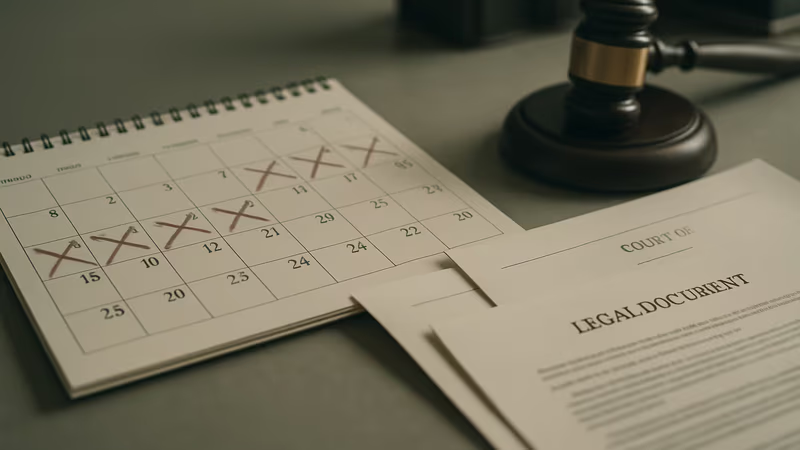
Here, the plaintiff demonstrated a reasonable excuse for her default. The affirmation of her attorney explained that the plaintiff’s default was reasonable and inadvertent due to the fact that the attorney’s “calender service” never communicated the briefing schedule to counsel’s office and that counsel first learned of the August 19, 2016, date when it attempted to file the opposition papers only six days later (see Bank of N.Y. Mellon v Faragalla, 174 AD3d 677).”
Key Takeaway
This decision underscores the importance of reliable case management systems while offering hope for attorneys facing defaults due to administrative failures. Courts will accept calendar service breakdowns as reasonable excuses when attorneys can demonstrate they were unaware of modified deadlines through no fault of their own, emphasizing the need for backup systems to track critical court deadlines.
Related Articles
- Failure to stipulate to an adjournment can be law office failure – sufficient to vacate a summary judgment loss on default
- Failure to check e-mail in e-filed case is a reasonable excuse to a default
- Failure to enter a default excused
Related: CPLR 2214 motion papers and notice — the practitioner’s guide.
Legal Context
Why This Matters for Your Case
New York law is among the most complex and nuanced in the country, with distinct procedural rules, substantive doctrines, and court systems that differ significantly from other jurisdictions. The Civil Practice Law and Rules (CPLR) governs every stage of civil litigation, from service of process through trial and appeal. The Appellate Division, Appellate Term, and Court of Appeals create a rich and ever-evolving body of case law that practitioners must follow.
Attorney Jason Tenenbaum has practiced across these areas for over 24 years, writing more than 1,000 appellate briefs and publishing over 2,600 legal articles that attorneys and clients rely on for guidance. The analysis in this article reflects real courtroom experience — from motion practice in Civil Court and Supreme Court to oral arguments before the Appellate Division — and a deep understanding of how New York courts actually apply the law in practice.
About This Topic
Default Judgments in New York Practice
Default judgments arise when a party fails to answer, appear, or respond within required time limits. Vacating a default under CPLR 5015 requires showing a reasonable excuse for the failure and a meritorious defense or cause of action. In no-fault practice, defaults occur frequently in arbitration and court proceedings, and the standards for granting and vacating defaults have generated substantial case law. These articles analyze default practice, restoration motions, and the circumstances under which courts excuse procedural failures.
90 published articles in Defaults
Keep Reading
More Defaults Analysis
Civil Court shenanigans
Unique Physical Rehab vacated a preclusion order entered during an appellate stay. The opinion distinguished inherent authority from jurisdictional relief.
Apr 24, 2021
Interest of justice vacatur
New York court grants vacatur of default judgment in no-fault insurance case where claim was barred by res judicata, demonstrating interests of justice standard.
Mar 17, 2021
Settlement of a default judgment
Settlement of default judgments in NY: five days notice required when defendant previously appeared. Court jurisdiction and CPLR 3215 requirements explained.
Feb 1, 2020
Interesting decision on insurance carrier fauilure
Gecaj rejected an insurer-reliance excuse on its particular record but ordered a new damages inquest. The dissent read the broker's mistake differently.
May 6, 2017
Misrepresentation based upon failure to serve last known address
Li Xian allowed default relief under CPLR 317 and 5015(a)(3). The sublease disclosed an address omitted from the corporate-service representation.
Mar 23, 2015
CPLR 312-a service was not properly effected: complaint dismissed
Learn how CPLR 312-a service defects can destroy your case. Expert guidance on service of process requirements for healthcare providers in New York.
Mar 15, 2011Was this article helpful?
Disclaimer: This article is published by the Law Office of Jason Tenenbaum, P.C. for informational and educational purposes only. It does not constitute legal advice, and no attorney-client relationship is formed by reading this content. The legal principles discussed may not apply to your specific situation, and the law may have changed since this article was last updated.
New York law varies by jurisdiction — court decisions in one Appellate Division department may not be followed in another, and local court rules in Nassau County Supreme Court differ from those in Suffolk County Supreme Court, Kings County Civil Court, or Queens County Supreme Court. The Appellate Division, Second Department (which covers Long Island, Brooklyn, Queens, and Staten Island) and the Appellate Term (which hears appeals from lower courts) each have distinct procedural requirements and precedents that affect litigation strategy.
If you need legal help with a defaults matter, contact our office at (516) 750-0595 for a free consultation. We serve clients throughout Long Island (Huntington, Babylon, Islip, Brookhaven, Smithtown, Riverhead, Southampton, East Hampton), Nassau County (Hempstead, Garden City, Mineola, Great Neck, Manhasset, Freeport, Long Beach, Rockville Centre, Valley Stream, Westbury, Hicksville, Massapequa), Suffolk County (Hauppauge, Deer Park, Bay Shore, Central Islip, Patchogue, Brentwood), Queens, Brooklyn, Manhattan, the Bronx, Staten Island, and Westchester County. Prior results do not guarantee a similar outcome.