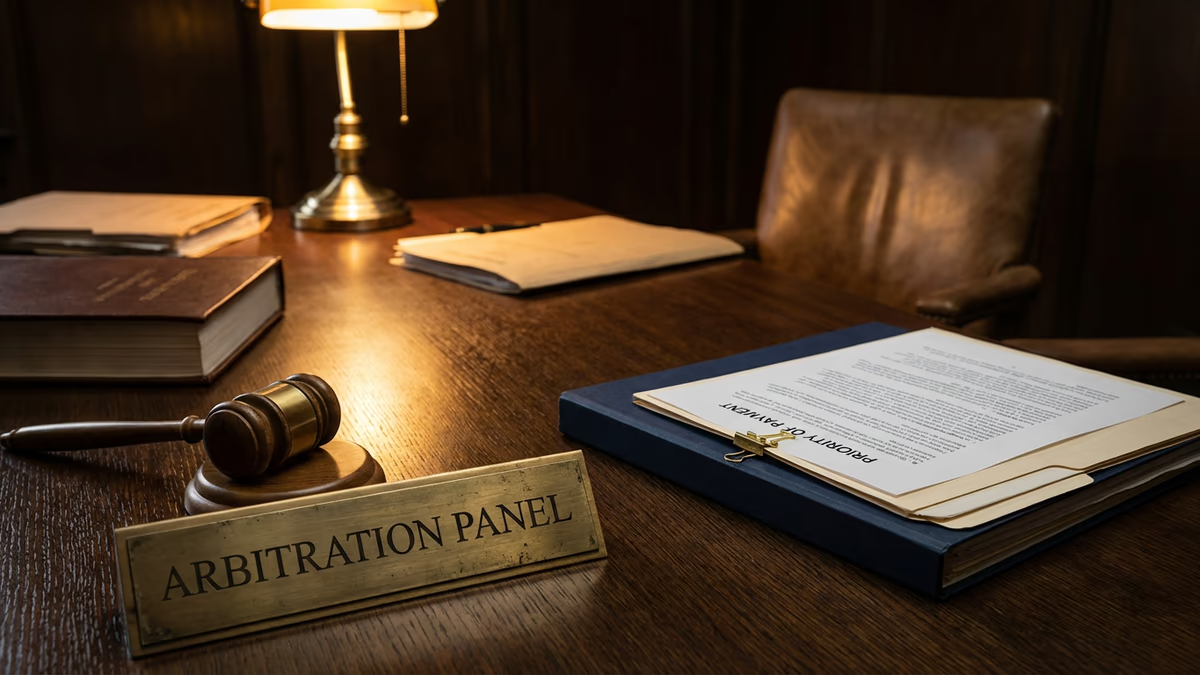
Key Takeaway
Jason's 2016 question about substitute IME testimony, distinguished from later peer-review decisions and Diagne's accident-reconstruction discovery ruling.
This article is part of our ongoing no-fault coverage, with 271 published articles analyzing no-fault issues across New York State. Attorney Jason Tenenbaum brings 24+ years of hands-on experience to this analysis, drawing from his work on more than 1,000 appeals, over 100,000 no-fault cases, and recovery of over $100 million for clients throughout Nassau County, Suffolk County, Queens, Brooklyn, Manhattan, and the Bronx. For personalized legal advice about how these principles apply to your specific situation, contact our Long Island office at (516) 750-0595 for a free consultation.
Jason’s 2016 question was about a doctor repeating another examiner’s physical findings at trial. It was not a report of an appellate ban on substitute experts. The distinction he drew between a hands-on IME and a review of records is the point to preserve.
Historical note: Jason’s March 2016 objection below is his opinion, not a holding; Diagne (2015) concerned accident-reconstruction discovery, while Promed (2017) later permitted substitute peer-review testimony on the trial record before it.
Last reviewed: September 2026.
Two decisions to keep separate
Diagne v J.T.S. Trucking (2015) involved an accident reconstructionist, not a no-fault IME. The First Department allowed a second tractor-trailer inspection after the original expert resigned. It would not assume the new expert could use prior findings whose content and reliability were absent from the record.
Free Consultation · No Fee Unless We Win
Does this apply to your situation?
Every case is different. Get a free, confidential case review from an experienced attorney who can tell you exactly where you stand.
In Promed Orthocare Supply v GEICO (2017), the Appellate Term, Second Department ordered a new trial on the cervical-traction claim. The insurer’s expert could testify despite not having written the peer review. The provider had not made the appropriate objection to testimony exceeding the denial’s basis.
For an IME dispute, identify which findings the new doctor proposes to use and how their reliability will be established. Promed’s peer-review result does not answer every objection to secondhand physical-examination findings.
Jason’s original comment
Jason’s March 2016 request for colleagues’ views follows unchanged. His proposed exceptions and percentages express his own assessment, not a court’s test. The record-only peer-review decisions do not settle every objection involving another doctor’s physical examination.
I am going on record with my personal opinion that an insurance carrier at trial or framed issue hearing should not generally be able to substitute IME doctors, with two caveats. First, if a peer doctor relies upon an IME among other records, then under the professional reliance exception to hearsay, the IME should be considered. Second, if the IME is more of a peer review, then a substitute doctor would be proper. But, if the IME reaches a conclusion based upon 98% evaluation and 2% record review (the normal IME), it seems like blatant hearsay if some other doctor is retained to testify.
What triggered this post? I understand that some firms are using substitute IME doctors and judges are allowing this practice.
What judges and Courts are allowing this? Thanks
-Jason
Connect to the Encyclopedia
- Medical necessity and peer review: topic hub
- PSW Chiropractic: credibility at a nonjury trial
- Amato: the 2010 trial ruling and its 2013 reversal
- Amherst: identify the missing medical information
- Triangle R: defective DME opposition
For review of a particular no-fault dispute, contact our office.
Legal Context
Why This Matters for Your Case
New York's no-fault insurance system, established under Insurance Law Article 51, is one of the most complex insurance frameworks in the country. Every motorist must carry Personal Injury Protection coverage that pays medical expenses and lost wages regardless of fault, up to $50,000 per person.
But insurers routinely deny valid claims using peer reviews, EUO scheduling tactics, fee schedule reductions, and coverage defenses. The Law Office of Jason Tenenbaum has handled over 100,000 no-fault cases since 2002 — from initial claim submissions through arbitration before the American Arbitration Association, trials in Civil Court and Supreme Court, and appeals to the Appellate Term and Appellate Division. Jason Tenenbaum is one of the few attorneys in the state who both writes his own appellate briefs and tries his own cases.
His 2,600+ published legal articles on no-fault practice are cited by attorneys throughout New York. Whether you are dealing with a medical necessity denial, an EUO no-show defense, a fee schedule dispute, or a coverage question, this article provides the kind of detailed case-law analysis that helps practitioners and claimants understand exactly where the law stands.
About This Topic
New York No-Fault Insurance Law
New York's no-fault insurance system requires every driver to carry Personal Injury Protection (PIP) coverage that pays medical expenses and lost wages regardless of who caused the accident. But insurers routinely deny, delay, and underpay valid claims — using peer reviews, IME no-shows, and fee schedule defenses to avoid paying providers and injured claimants. Attorney Jason Tenenbaum has litigated thousands of no-fault arbitrations and court cases since 2002.
271 published articles in No-Fault
Keep Reading
More No-Fault Analysis

Car Accident Recorded Statement in New York: Should You Give One?
The at-fault driver's adjuster wants a recorded statement within days of a New York car accident — and that call is designed to weaken your case.
Apr 5, 2026
Who Pays Car Accident Medical Bills in New York? A Step-by-Step Guide
New York no-fault PIP, primary health insurance, Medicaid/Medicare, and litigation liens — the full payment ladder for car-accident medical bills.
Apr 5, 2026
45-day rule involving MVAIC and CPLR 3212(f)
Learn about the 45-day rule for MVAIC claims and CPLR 3212(f) discovery requirements. Key court case analysis for New York no-fault insurance practitioners.
Nov 14, 2010
Insufficient excuse
Court rules medical provider failed to justify submitting no-fault claim to wrong insurer, despite claim form allegedly bearing correct carrier's information.
Jul 13, 2022
205 toll
Analysis of U.S. Bank N.A. v Jalas ruling on CPLR 3215(c) dismissals and seven-year delays in default judgment motions under New York law.
Jun 4, 2021
Reasonable Excuse and Law Office Failure in New York Practice
When does a busy law practice excuse a missed deadline? A look at reasonable excuse and law office failure in New York courts, plus a candid practice note.
Feb 1, 2016Was this article helpful?
Disclaimer: This article is published by the Law Office of Jason Tenenbaum, P.C. for informational and educational purposes only. It does not constitute legal advice, and no attorney-client relationship is formed by reading this content. The legal principles discussed may not apply to your specific situation, and the law may have changed since this article was last updated.
New York law varies by jurisdiction — court decisions in one Appellate Division department may not be followed in another, and local court rules in Nassau County Supreme Court differ from those in Suffolk County Supreme Court, Kings County Civil Court, or Queens County Supreme Court. The Appellate Division, Second Department (which covers Long Island, Brooklyn, Queens, and Staten Island) and the Appellate Term (which hears appeals from lower courts) each have distinct procedural requirements and precedents that affect litigation strategy.
If you need legal help with a no-fault matter, contact our office at (516) 750-0595 for a free consultation. We serve clients throughout Long Island (Huntington, Babylon, Islip, Brookhaven, Smithtown, Riverhead, Southampton, East Hampton), Nassau County (Hempstead, Garden City, Mineola, Great Neck, Manhasset, Freeport, Long Beach, Rockville Centre, Valley Stream, Westbury, Hicksville, Massapequa), Suffolk County (Hauppauge, Deer Park, Bay Shore, Central Islip, Patchogue, Brentwood), Queens, Brooklyn, Manhattan, the Bronx, Staten Island, and Westchester County. Prior results do not guarantee a similar outcome.