Key Takeaway
Wendover refused a caption amendment after suit against a deceased borrower. Distinguish misnomer, substitution and the representative's legal capacity.
This article is part of our ongoing procedural issues coverage, with 187 published articles analyzing procedural issues issues across New York State. Attorney Jason Tenenbaum brings 24+ years of hands-on experience to this analysis, drawing from his work on more than 1,000 appeals, over 100,000 no-fault cases, and recovery of over $100 million for clients throughout Nassau County, Suffolk County, Queens, Brooklyn, Manhattan, and the Bronx. For personalized legal advice about how these principles apply to your specific situation, contact our Long Island office at (516) 750-0595 for a free consultation.
Last reviewed: September 2026
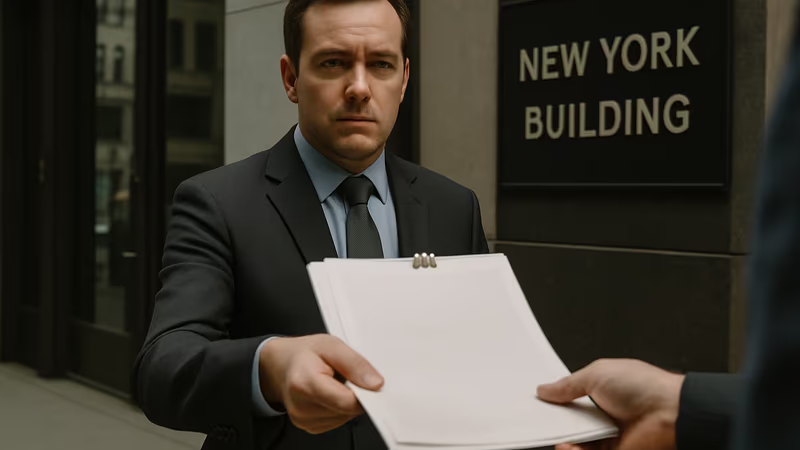
Wendover was not an ordinary spelling correction. The lender sued a person who had died before the foreclosure action began, then tried to use a caption amendment to repair the party problem.
Historical note: Wendover involved a borrower who died before commencement; CPLR 305(c) permits qualifying amendments, but the court would not use it to create a party who had never been properly joined.
Why amendment could not save this action
In Wendover Financial Services v Ridgeway, 93 AD3d 1156 (4th Dept 2012), the borrower had died and letters testamentary had issued before commencement. Nevertheless, the lender named the deceased borrower.
Free Consultation · No Fee Unless We Win
Does this apply to your situation?
Every case is different. Get a free, confidential case review from an experienced attorney who can tell you exactly where you stand.
The court held that the action against her was a nullity. She had never become a party, so there was no party for whom substitution under CPLR 1015(a) could occur. The proposed caption amendment could not solve that problem.
Serving Ridgeway as an alleged heir did not properly make her a party as executrix. The complaint’s Doe descriptions covered tenants, occupants or lien claimants, not the intended estate representative. The court dismissed the complaint; it did not treat the representative’s appearance as a waiver by a properly joined party.
Misnomer, joinder and death are different questions
CPLR 305(c) permits discretionary amendment of a summons or proof of service where a substantial right is not prejudiced. CPLR 1015(a) addresses substitution when a party dies and the claim survives. Neither provision turns every attempted change of defendant into a harmless caption correction.
Read the filed papers, service history, date of death and capacity in which each person was named. Do not infer from this case that every caption correction requires a new action or that all mistakes can be repaired under the existing index number.
Jason’s original no-fault-practice anecdote below is not the foreclosure’s fact pattern. Its filing-fee reference is historical, not a statement of today’s fee, and its criticism of particular motions is not a rule against all amendments.
Jason’s original commentary
Jason’s original March 2012 anecdote follows. The fee and observations concern his historical practice, not the current rule or the facts of Wendover.
I like when I receive a motion from Mr. Five Boro looking to change the caption to Senor (how do I get the spanish n with a tilda on the computer?) Allboro. Those motions, obviously made to save the $45 index number fee, are always defective. Quite a few judges acquiesce to it. The Fourth Department, however, is not impressed.
Connect to the Encyclopedia
Start with the CPLR 2001 mistakes and irregularities hub.
- Buist: proof filed in the wrong office
- Citimortgage: missing attachment, separate merits
- Mount Sinai: substantive judgment changes
- Bacon & Seiler: corrected form and missing proof
For review of a particular motion or no-fault defense record, contact the office.
Legal Context
Why This Matters for Your Case
New York law is among the most complex and nuanced in the country, with distinct procedural rules, substantive doctrines, and court systems that differ significantly from other jurisdictions. The Civil Practice Law and Rules (CPLR) governs every stage of civil litigation, from service of process through trial and appeal. The Appellate Division, Appellate Term, and Court of Appeals create a rich and ever-evolving body of case law that practitioners must follow.
Attorney Jason Tenenbaum has practiced across these areas for over 24 years, writing more than 1,000 appellate briefs and publishing over 2,600 legal articles that attorneys and clients rely on for guidance. The analysis in this article reflects real courtroom experience — from motion practice in Civil Court and Supreme Court to oral arguments before the Appellate Division — and a deep understanding of how New York courts actually apply the law in practice.
About This Topic
Procedural Issues in New York Litigation
New York civil procedure governs every stage of litigation — from pleading requirements and service of process to motion practice, discovery deadlines, and trial procedures. The CPLR creates strict procedural rules that can make or break a case regardless of the underlying merits. These articles examine the procedural pitfalls, timing requirements, and strategic considerations that practitioners face in New York state courts, with a particular focus on no-fault insurance and personal injury practice.
187 published articles in Procedural Issues
Keep Reading
More Procedural Issues Analysis
How to Talk to a Judge in New York: What to Say, What to Avoid, and How to Present Yourself
Address the judge as 'Your Honor,' stand when you speak, wait to be recognized, and keep answers short and honest. A Long Island trial lawyer explains.
Feb 24, 2026
CPLR § 2106 Amendment Eliminates Affidavit Notarization Requirement: What This Means for New York Litigation
New York's CPLR 2106 permits affirmations in place of many sworn documents. See the 2024 and 2025 changes, exceptions, and historical case notes.
Feb 18, 2026
When an Affidavit Really Is Not an Affidavit: Caption and Attestation Defects in New York
New Millennium: an insufficient psychologist affidavit, limits of form-defect waiver, and the current fifteen-day rule under CPLR 2101(f).
Jul 14, 2011
The appellate division grants summary judgment since the loss was not an insured event – UPDATED
Understanding "not an insured event" defenses in no-fault insurance cases.
Feb 6, 2010
Scope of cross-examination
Court of Appeals framework for cross-examining medical professionals on prior bad acts, criminal conduct, and credibility issues in New York litigation.
Jul 18, 2016
Civil Court properly granted motion to stay when DJ action is pending
Civil Court properly grants stay motion when declaratory judgment action pending - avoiding inconsistent adjudications in no-fault insurance cases.
Dec 8, 2013Was this article helpful?
Disclaimer: This article is published by the Law Office of Jason Tenenbaum, P.C. for informational and educational purposes only. It does not constitute legal advice, and no attorney-client relationship is formed by reading this content. The legal principles discussed may not apply to your specific situation, and the law may have changed since this article was last updated.
New York law varies by jurisdiction — court decisions in one Appellate Division department may not be followed in another, and local court rules in Nassau County Supreme Court differ from those in Suffolk County Supreme Court, Kings County Civil Court, or Queens County Supreme Court. The Appellate Division, Second Department (which covers Long Island, Brooklyn, Queens, and Staten Island) and the Appellate Term (which hears appeals from lower courts) each have distinct procedural requirements and precedents that affect litigation strategy.
If you need legal help with a procedural issues matter, contact our office at (516) 750-0595 for a free consultation. We serve clients throughout Long Island (Huntington, Babylon, Islip, Brookhaven, Smithtown, Riverhead, Southampton, East Hampton), Nassau County (Hempstead, Garden City, Mineola, Great Neck, Manhasset, Freeport, Long Beach, Rockville Centre, Valley Stream, Westbury, Hicksville, Massapequa), Suffolk County (Hauppauge, Deer Park, Bay Shore, Central Islip, Patchogue, Brentwood), Queens, Brooklyn, Manhattan, the Bronx, Staten Island, and Westchester County. Prior results do not guarantee a similar outcome.