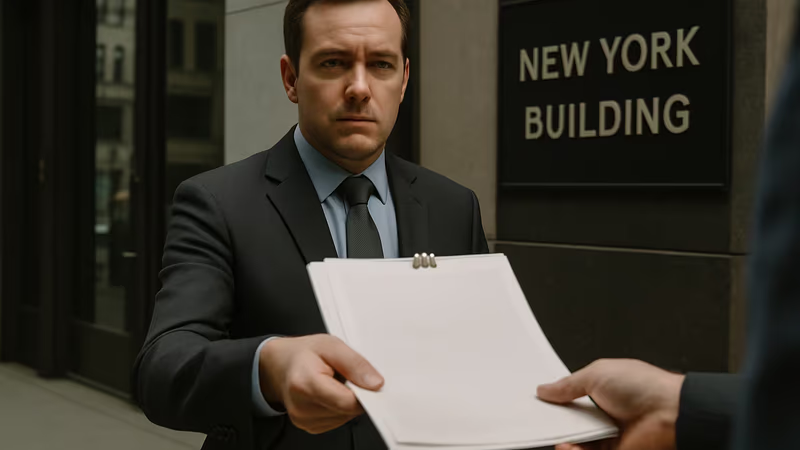
Key Takeaway
Court of Appeals framework for cross-examining medical professionals on prior bad acts, criminal conduct, and credibility issues in New York litigation.
This article is part of our ongoing procedural issues coverage, with 187 published articles analyzing procedural issues issues across New York State. Attorney Jason Tenenbaum brings 24+ years of hands-on experience to this analysis, drawing from his work on more than 1,000 appeals, over 100,000 no-fault cases, and recovery of over $100 million for clients throughout Nassau County, Suffolk County, Queens, Brooklyn, Manhattan, and the Bronx. For personalized legal advice about how these principles apply to your specific situation, contact our Long Island office at (516) 750-0595 for a free consultation.
People v Smith, 2016 NY Slip Op 05061 (2016)
We often cross-examine medical professionals with all sorts of backgrounds. Some have OPMC issues, some have criminal issues, some have been sued in medical malpractice cases. The question has always been how much into what could be considered “collateral” matters can an attorney go into with a witness that has the above issues. My view is as much as the Court allows, and the Court of Appeals has set forth an interesting framework that you should be aware of when you go head to head with a professional witness.
Cross-examining witnesses on prior criminal, vicious or immoral conduct
“Given these central principles, prosecution witnesses — and indeed, even a testifying defendant — may be cross-examined on “prior specific criminal, vicious or immoral conduct,” provided that “the nature of such conduct or the circumstances in which it occurred bear logically and reasonably on the issue of credibility” (People v Sandoval, 34 NY2d 371, 376 ). Of course, where a witness other than the defendant testifies, the court, in considering the parameters of permissible cross-examination, is not focused on protecting the rights of the accused, and on the concern that permitting evidence of bad conduct will serve merely to demonstrate a propensity to commit the crime charged (see People v Ocasio, 47 NY2d 55, 58 ). After all, for a nondefendant witness, “neither conviction nor vindication, imprisonment nor freedom, hangs in the balance” (id. at 59). However, in all cases the trial court retains broad discretion to weigh the probative value of evidence of prior bad acts against the possibility that it “would confuse the main issue and mislead the jury … or create substantial danger of undue prejudice to one of the parties”(People v Corby, 6 NY3d 231, 234-235 ; see also People v Harrell, 209 AD2d 160, 160 , affd 86 NY2d 806 ; see generally People v Dawson, 50 NY2d 311, 322 ; People v Gissendanner, 48 NY2d at 548 ; Sandoval, 34 NY2d at 374 [“(t)he nature and extent of cross-examination have always been subject to the sound discretion of the Trial Judge”]).
In Garrett, we concluded that “civil allegations” of misconduct in a federal lawsuit filed against a law enforcement agent “were favorable to defendant as impeachment evidence” (Garrett, 23 NY3d at 886), thereby necessarily determining that such allegations can bear on a law enforcement officer’s credibility as a witness. The defendant in Garrett argued in his criminal case that one detective in particular “coerced him into making a false confession” and “he federal complaint made similar allegations against : although it did not explicitly allege that the confession procured was false, the complaint described coercive tactics allegedly used to extract a confession against the plaintiff’s will” (id.). This Court noted that the evidence “favored defendant’s false confession theory” in that case (id.). Nonetheless, in Garrett, we noted that the trial judge could have exercised discretion and precluded inquiry into this “favorable” impeachment evidence (id. at 892).
Free Consultation · No Fee Unless We Win
Does this apply to your situation?
Every case is different. Get a free, confidential case review from an experienced attorney who can tell you exactly where you stand.
Our recognition of the relevance of prior bad acts that have been alleged in court filings, but not proven at trial, is consistent with our precedent; we have previously decided that there is no prohibition against cross-examining a witness about bad acts that have never been formally proven at a trial (see People v Sorge, 301 NY 198, 201 ). Likewise, a police witness’s prior bad act that similarly has not been proven in a criminal prosecution or other court proceeding also can be proper fodder for cross-examination. Nor do allegations of police misconduct lose their relevance to a police witness’s credibility simply because the alleged bad acts are not regarded in all cases as criminal or immoral. Indeed, we have approved cross-examination on a defendant’s use of aliases and other suspect, but not criminal, conduct because”even where the proof falls outside the conventional category of immoral, vicious or criminal acts, it may be a proper subject for impeachment questioning where it demonstrates an untruthful bent or significantly reveals a willingness … to place the advancement of his individual self-interest ahead of principle or of the interests of society.” Walker, 83 NY2d at 461 ).
Police witnesses and unproven allegations in civil lawsuits
As we indicated in Garrett, and emphasize here, law enforcement witnesses should be treated in the same manner as any other witness for purposes of cross-examination. The same standard for good faith basis and specific allegations relevant to credibility applies — as does the same broad latitude to preclude or limit cross-examination.
Where a lawsuit has not resulted in an adverse finding against a police officer, as is the case with these three appeals, defendants should not be permitted to ask a witness if he or she has been sued, if the case was settled (unless there was an admission of wrongdoing) or if the criminal charges related to the plaintiffs in those actions were dismissed. However, subject to the trial court’s discretion, defendants should be permitted to ask questions based on the specific allegations of the lawsuit if the allegations are relevant to the credibility of the witness.
The three-step framework for inquiry into lawsuit allegations
From the above, the logical framework for analysis of the issue is clear. First, counsel must present a good faith basis for inquiring, namely the lawsuit relied upon; second, specific allegations that are relevant to the credibility of the law enforcement witness must be identified; and third, the trial judge exercises discretion in assessing whether inquiry into such allegations would confuse or mislead the jury, or create a substantial risk of undue prejudice to the parties (see Delaware v Van Arsdall, 475 US 673, 679 ; see People v Harrell, 209 AD2d 160, 160 ).
A federal lawsuit alleging tortious conduct committed by law enforcement officials testifying as prosecution witnesses, provides an appropriate good faith basis for raising the issue. Even so, the specific allegations must be relevant to that witness’s credibility (see People v Garrett, supra; People v Daley, supra ; People v Jones, supra police witness about allegations in lawsuits of police brutality, false arrest and excessive force]); compare Andrew, supra at 618 detective personally engaged in any specific misconduct or acted with knowledge of the misconduct of other officers.”]).
Trial court discretion and the scope of appellate review
Nevertheless, whether to permit inquiry into such prior bad acts for impeachment purposes are discretionary calls “for the trial courts and fact-reviewing intermediate courts, and … generally no further review by this Court is warranted” (People v Walker, 83 NY2d at 458 ). “Because the trial courts have inherent power to control the scope of cross-examination and the use of prior bad acts is a generically accepted practice in that context, this Court will only intervene where the trial court ha either abused its discretion or exercised none at all (id. at 459 ).
Applying those principles to these cases, we hold that the trial courts in Ingram and McGhee abused their discretion and effectively imposed an improper categorical prohibition against permissible cross-examination, although that error was harmless in McGhee. While it is a closer question with respect to Smith, any error in that case was likewise harmless.”
Related Articles
Legal Context
Why This Matters for Your Case
New York law is among the most complex and nuanced in the country, with distinct procedural rules, substantive doctrines, and court systems that differ significantly from other jurisdictions. The Civil Practice Law and Rules (CPLR) governs every stage of civil litigation, from service of process through trial and appeal. The Appellate Division, Appellate Term, and Court of Appeals create a rich and ever-evolving body of case law that practitioners must follow.
Attorney Jason Tenenbaum has practiced across these areas for over 24 years, writing more than 1,000 appellate briefs and publishing over 2,600 legal articles that attorneys and clients rely on for guidance. The analysis in this article reflects real courtroom experience — from motion practice in Civil Court and Supreme Court to oral arguments before the Appellate Division — and a deep understanding of how New York courts actually apply the law in practice.
About This Topic
Procedural Issues in New York Litigation
New York civil procedure governs every stage of litigation — from pleading requirements and service of process to motion practice, discovery deadlines, and trial procedures. The CPLR creates strict procedural rules that can make or break a case regardless of the underlying merits. These articles examine the procedural pitfalls, timing requirements, and strategic considerations that practitioners face in New York state courts, with a particular focus on no-fault insurance and personal injury practice.
187 published articles in Procedural Issues
Keep Reading
More Procedural Issues Analysis
How to Talk to a Judge in New York: What to Say, What to Avoid, and How to Present Yourself
Address the judge as 'Your Honor,' stand when you speak, wait to be recognized, and keep answers short and honest. A Long Island trial lawyer explains.
Feb 24, 2026
CPLR § 2106 Amendment Eliminates Affidavit Notarization Requirement: What This Means for New York Litigation
New York's CPLR 2106 permits affirmations in place of many sworn documents. See the 2024 and 2025 changes, exceptions, and historical case notes.
Feb 18, 2026
New evidence used in reply – an angry court appears
Court permits new evidence in reply papers despite opponent's objections in New York no-fault insurance coverage dispute, highlighting procedural tactics.
Feb 10, 2018
The vague and conclusory denial again
Court ruling on no-fault insurance denial defects: minor errors in claim amounts don't invalidate NF-10 denials, peer review reports not required at time of denial.
Feb 21, 2014
Understanding Res Judicata in No-Fault Insurance: When Past Decisions Bar Future Claims
Learn how res judicata doctrine affects no-fault insurance litigation in NY. Expert analysis of declaratory judgments and legal barriers for medical providers.
Feb 17, 2012
A less than credible Plaintiff sinks his own case
Learn how credibility issues can destroy personal injury cases in NY. Analysis of Bennice v Randall shows why honesty with your attorney is crucial for success.
Mar 24, 2010Was this article helpful?
Disclaimer: This article is published by the Law Office of Jason Tenenbaum, P.C. for informational and educational purposes only. It does not constitute legal advice, and no attorney-client relationship is formed by reading this content. The legal principles discussed may not apply to your specific situation, and the law may have changed since this article was last updated.
New York law varies by jurisdiction — court decisions in one Appellate Division department may not be followed in another, and local court rules in Nassau County Supreme Court differ from those in Suffolk County Supreme Court, Kings County Civil Court, or Queens County Supreme Court. The Appellate Division, Second Department (which covers Long Island, Brooklyn, Queens, and Staten Island) and the Appellate Term (which hears appeals from lower courts) each have distinct procedural requirements and precedents that affect litigation strategy.
If you need legal help with a procedural issues matter, contact our office at (516) 750-0595 for a free consultation. We serve clients throughout Long Island (Huntington, Babylon, Islip, Brookhaven, Smithtown, Riverhead, Southampton, East Hampton), Nassau County (Hempstead, Garden City, Mineola, Great Neck, Manhasset, Freeport, Long Beach, Rockville Centre, Valley Stream, Westbury, Hicksville, Massapequa), Suffolk County (Hauppauge, Deer Park, Bay Shore, Central Islip, Patchogue, Brentwood), Queens, Brooklyn, Manhattan, the Bronx, Staten Island, and Westchester County. Prior results do not guarantee a similar outcome.