Key Takeaway
Citimortgage treated a missing judgment attachment as correctable but still denied relief. The paper defect and the merits of vacatur were separate.
This article is part of our ongoing procedural issues coverage, with 187 published articles analyzing procedural issues issues across New York State. Attorney Jason Tenenbaum brings 24+ years of hands-on experience to this analysis, drawing from his work on more than 1,000 appeals, over 100,000 no-fault cases, and recovery of over $100 million for clients throughout Nassau County, Suffolk County, Queens, Brooklyn, Manhattan, and the Bronx. For personalized legal advice about how these principles apply to your specific situation, contact our Long Island office at (516) 750-0595 for a free consultation.
Last reviewed: September 2026
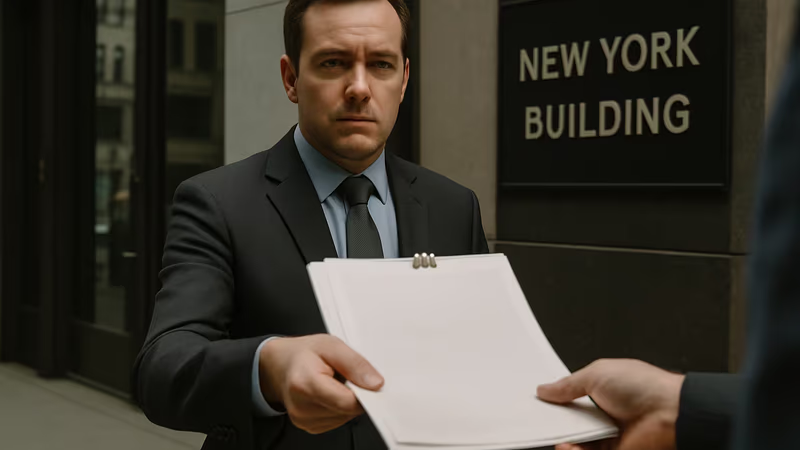
West Fork omitted the foreclosure judgment from its motion papers. Citimortgage v Dulgeroff said that omission could be corrected, then affirmed denial of the motion for a different reason.
Historical note: Citimortgage v Dulgeroff rejected a fatal-attachment theory but affirmed denial of intervention and vacatur on other grounds; correction did not establish entitlement to relief.
The omission and the result
In Citimortgage, Inc. v Dulgeroff, 138 AD3d 419 (1st Dept 2016), nonparty West Fork sought to intervene and vacate a foreclosure judgment. It did not attach the judgment. The First Department said the motion court should have allowed supplementation or resubmission rather than treating that omission as fatal.
Free Consultation · No Fee Unless We Win
Does this apply to your situation?
Every case is different. Get a free, confidential case review from an experienced attorney who can tell you exactly where you stand.
But the appellate court affirmed denial. West Fork acquired its interest after the notice of pendency and was bound by the foreclosure’s outcome. Neither that fact alone nor the postjudgment timing categorically barred intervention. The problem was the absence of a showing that leaving the judgment intact would produce an injustice: the record showed no fraud or collusion, and West Fork had delayed despite notice that its interest was at risk.
A corrected submission still needs grounds for relief
The decision did not order the judgment vacated or give every movant a right to supplement deficient papers. It identified an error in the lower court’s procedural reasoning while sustaining the result on other grounds.
When a required attachment is missing, identify the document and request an appropriate correction. Then address the grounds for the motion itself. CPLR 2001 concerns qualifying mistakes and irregularities; it is not a substitute for the proof supporting intervention or vacatur.
Jason’s reference below to Kings County was commentary about briefing practice. The reported appeal came from Supreme Court, Bronx County.
Jason’s original commentary
Jason’s original April 2016 introductory comment follows. Kings County was his comparison, not the location of the reported foreclosure.
The Civil Court, Kings County briefing schedule notwithstanding:
Connect to the Encyclopedia
Start with the CPLR 2001 mistakes and irregularities hub.
- Buist: proof filed in the wrong office
- Bacon & Seiler: corrected form and missing proof
- Mount Sinai: substantive judgment changes
- Wendover: caption amendment and a deceased defendant
For review of a particular motion or no-fault defense record, contact the office.
Legal Context
Why This Matters for Your Case
New York law is among the most complex and nuanced in the country, with distinct procedural rules, substantive doctrines, and court systems that differ significantly from other jurisdictions. The Civil Practice Law and Rules (CPLR) governs every stage of civil litigation, from service of process through trial and appeal. The Appellate Division, Appellate Term, and Court of Appeals create a rich and ever-evolving body of case law that practitioners must follow.
Attorney Jason Tenenbaum has practiced across these areas for over 24 years, writing more than 1,000 appellate briefs and publishing over 2,600 legal articles that attorneys and clients rely on for guidance. The analysis in this article reflects real courtroom experience — from motion practice in Civil Court and Supreme Court to oral arguments before the Appellate Division — and a deep understanding of how New York courts actually apply the law in practice.
About This Topic
Procedural Issues in New York Litigation
New York civil procedure governs every stage of litigation — from pleading requirements and service of process to motion practice, discovery deadlines, and trial procedures. The CPLR creates strict procedural rules that can make or break a case regardless of the underlying merits. These articles examine the procedural pitfalls, timing requirements, and strategic considerations that practitioners face in New York state courts, with a particular focus on no-fault insurance and personal injury practice.
187 published articles in Procedural Issues
Keep Reading
More Procedural Issues Analysis
How to Talk to a Judge in New York: What to Say, What to Avoid, and How to Present Yourself
Address the judge as 'Your Honor,' stand when you speak, wait to be recognized, and keep answers short and honest. A Long Island trial lawyer explains.
Feb 24, 2026
CPLR § 2106 Amendment Eliminates Affidavit Notarization Requirement: What This Means for New York Litigation
New York's CPLR 2106 permits affirmations in place of many sworn documents. See the 2024 and 2025 changes, exceptions, and historical case notes.
Feb 18, 2026
3404 and 3216 collide – well somewhat
Court ruling on CPLR 3404 vs 3216 dismissal motions in no-fault insurance breach of contract case, discussing procedural requirements and litigation delays.
May 5, 2012
Does this make sense?
New York appellate court ruling reveals surprising disparity between complaint dismissal sanctions and preclusion orders under CPLR 3126, raising constitutional questions.
Apr 25, 2010
CPLR 3211(a) – you may cure pleadings in opposition to a preanswer motion
Learn how CPLR 3211(a) allows defendants to cure pleadings when opposing pre-answer motions in New York civil litigation.
Jan 25, 2009
Motion to strike “3212(g) findings” denied
Court denies motion to strike CPLR 3212(g) findings in no-fault case, but leaves open question about plaintiff's appeal rights when judges refuse to make such findings.
May 26, 2014Was this article helpful?
Disclaimer: This article is published by the Law Office of Jason Tenenbaum, P.C. for informational and educational purposes only. It does not constitute legal advice, and no attorney-client relationship is formed by reading this content. The legal principles discussed may not apply to your specific situation, and the law may have changed since this article was last updated.
New York law varies by jurisdiction — court decisions in one Appellate Division department may not be followed in another, and local court rules in Nassau County Supreme Court differ from those in Suffolk County Supreme Court, Kings County Civil Court, or Queens County Supreme Court. The Appellate Division, Second Department (which covers Long Island, Brooklyn, Queens, and Staten Island) and the Appellate Term (which hears appeals from lower courts) each have distinct procedural requirements and precedents that affect litigation strategy.
If you need legal help with a procedural issues matter, contact our office at (516) 750-0595 for a free consultation. We serve clients throughout Long Island (Huntington, Babylon, Islip, Brookhaven, Smithtown, Riverhead, Southampton, East Hampton), Nassau County (Hempstead, Garden City, Mineola, Great Neck, Manhasset, Freeport, Long Beach, Rockville Centre, Valley Stream, Westbury, Hicksville, Massapequa), Suffolk County (Hauppauge, Deer Park, Bay Shore, Central Islip, Patchogue, Brentwood), Queens, Brooklyn, Manhattan, the Bronx, Staten Island, and Westchester County. Prior results do not guarantee a similar outcome.