Key Takeaway
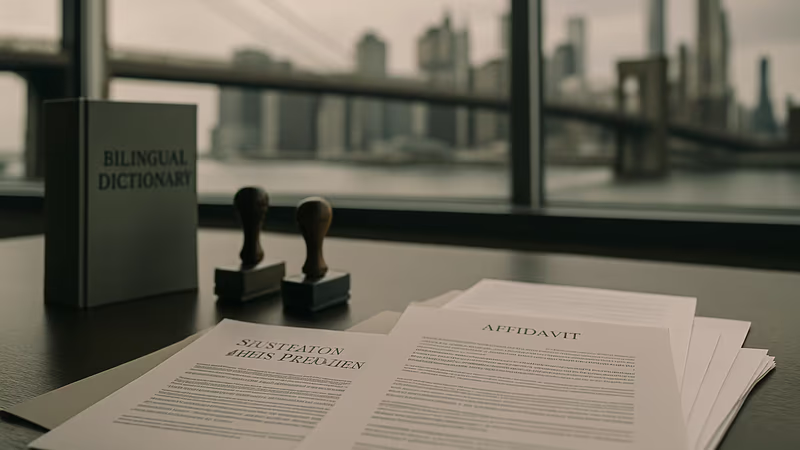
Learn the legal standards for proving document forgery in New York courts. Expert analysis of JPMorgan Chase Bank v. Bauer case and evidentiary requirements.
This article is part of our ongoing affidavits coverage, with 19 published articles analyzing affidavits issues across New York State. Attorney Jason Tenenbaum brings 24+ years of hands-on experience to this analysis, drawing from his work on more than 1,000 appeals, over 100,000 no-fault cases, and recovery of over $100 million for clients throughout Nassau County, Suffolk County, Queens, Brooklyn, Manhattan, and the Bronx. For personalized legal advice about how these principles apply to your specific situation, contact our Long Island office at (516) 750-0595 for a free consultation.
Understanding Document Forgery Standards in New York Legal Proceedings
When navigating the complex world of legal documentation in Long Island and New York City courts, understanding the burden of proof required to challenge document authenticity becomes crucial for both attorneys and their clients. The recent case analysis from JPMorgan Chase Bank, N.A. v Bauer, 2012 NY Slip Op 00932 (2d Dept. 2012), provides critical insight into what courts require when alleging document forgery.
For residents and businesses throughout Nassau County, Suffolk County, and the broader New York metropolitan area, this legal precedent establishes important guidelines for challenging the authenticity of signatures and documents in court proceedings. Whether you’re dealing with contract disputes, banking litigation, or other matters involving questioned documents, understanding these standards can significantly impact your case strategy.
The Legal Standard for Proving Document Forgery
The core principle established in this case centers on the fundamental requirement that allegations of forgery must be supported by substantial evidence rather than mere assertions. The court’s ruling makes clear that “omething more than a bald assertion of forgery is required to create an issue of fact contesting the authenticity of a signature,” and Bauer’s “affidavit was alone inadequate to raise an issue of fact necessitating a trial” (Banco Popular N.A. v Victory Taxi Mgt., 1 NY3d 381, 384; see Seaboard Sur. Co. v Nigro Bros., 222 AD2d 574).
This precedent has far-reaching implications for anyone involved in legal disputes throughout the New York area, particularly in commercial litigation where document authenticity frequently becomes a contested issue.
Free Consultation · No Fee Unless We Win
Does this apply to your situation?
Every case is different. Get a free, confidential case review from an experienced attorney who can tell you exactly where you stand.
What Constitutes Sufficient Evidence in Document Authentication Cases
Beyond Simple Denials
New York courts require substantially more than a simple denial or unsupported claim when challenging document authenticity. The legal system demands concrete evidence that can create genuine questions of fact worthy of trial consideration. This might include:
- Handwriting analysis by qualified experts
- Testimony from witnesses who observed the purported signing
- Documentation showing the alleged signatory was elsewhere when the signing purportedly occurred
- Medical evidence demonstrating physical inability to sign at the relevant time
- Comparative analysis with authenticated signature samples
The Role of Expert Testimony
In document authentication disputes, expert testimony often becomes the cornerstone of successful challenges. Qualified handwriting experts, forensic document examiners, and other specialists can provide the technical analysis courts require to move beyond mere allegations toward substantive evidence.
Practical Implications for Long Island and NYC Legal Practice
Banking and Financial Litigation
This precedent particularly impacts banking litigation throughout the New York area. Financial institutions regularly rely on signed documents – from loan agreements to account opening documents – and borrowers or account holders who wish to challenge these signatures must meet the elevated standard established in JPMorgan Chase Bank v. Bauer.
Real Estate Transactions
Real estate transactions in Nassau and Suffolk Counties often involve substantial documentation, making document authentication issues particularly relevant. Whether dealing with deeds, mortgages, or purchase agreements, parties challenging document authenticity must present concrete evidence rather than unsupported allegations.
Commercial Contract Disputes
Business disputes involving contracts, partnership agreements, and other commercial documents must similarly meet these heightened evidentiary standards when signature authenticity becomes contested.
Strategic Considerations for Legal Professionals
Early Case Assessment
Attorneys representing clients in document authentication disputes must carefully evaluate the strength of available evidence early in the litigation process. The JPMorgan Chase Bank v. Bauer standard requires substantial preparation and evidence gathering before raising forgery claims.
Discovery Planning
Effective discovery planning becomes crucial when document authenticity issues arise. Legal teams must identify potential expert witnesses, locate comparative signature samples, and develop comprehensive timelines that might support or refute authenticity claims.
Cost-Benefit Analysis
Given the elevated evidentiary requirements, legal professionals must carefully weigh the costs of developing sufficient evidence against the potential benefits of successful authentication challenges.
Historical Context and Related Cases
The JPMorgan Chase Bank v. Bauer decision builds upon established New York precedent, including the foundational Banco Popular N.A. v Victory Taxi Mgt. case and Seaboard Sur. Co. v Nigro Bros. These cases collectively establish a consistent approach to document authentication throughout New York’s court system.
This body of law reflects the courts’ recognition that document authentication challenges can significantly impact legitimate business transactions and legal proceedings. By requiring substantial evidence rather than mere allegations, the legal system maintains balance between protecting against genuine forgery while preventing frivolous challenges to valid documents.
Impact on Different Types of Legal Proceedings
Summary Judgment Motions
In summary judgment contexts, the heightened standard for document authentication challenges can significantly impact case outcomes. Parties relying on allegedly forged documents may successfully obtain summary judgment when opposing parties fail to meet the evidentiary threshold established in JPMorgan Chase Bank v. Bauer.
Default Judgment Proceedings
Document authentication issues also arise in default judgment scenarios, where courts must evaluate the sufficiency of evidence supporting claims based on signed agreements or other documentation.
Get Expert Legal Assistance
Document authentication issues require sophisticated legal analysis and strategic planning. Whether you’re dealing with banking disputes, real estate transactions, commercial contracts, or other matters involving questioned documents, having experienced legal representation makes the difference between success and failure.
Our legal team understands the complexities of New York’s document authentication standards and can provide the expert guidance needed to navigate these challenging waters. We serve clients throughout Long Island, Nassau County, Suffolk County, and the greater New York City area.
Don’t let document authentication issues derail your case. Contact us today at 516-750-0595 for a consultation with experienced attorneys who understand New York’s authentication standards and can protect your interests.
Related Articles
Legal Context
Why This Matters for Your Case
New York law is among the most complex and nuanced in the country, with distinct procedural rules, substantive doctrines, and court systems that differ significantly from other jurisdictions. The Civil Practice Law and Rules (CPLR) governs every stage of civil litigation, from service of process through trial and appeal. The Appellate Division, Appellate Term, and Court of Appeals create a rich and ever-evolving body of case law that practitioners must follow.
Attorney Jason Tenenbaum has practiced across these areas for over 24 years, writing more than 1,000 appellate briefs and publishing over 2,600 legal articles that attorneys and clients rely on for guidance. The analysis in this article reflects real courtroom experience — from motion practice in Civil Court and Supreme Court to oral arguments before the Appellate Division — and a deep understanding of how New York courts actually apply the law in practice.
Keep Reading
More Affidavits Analysis
How to Talk to a Judge in New York: What to Say, What to Avoid, and How to Present Yourself
Address the judge as 'Your Honor,' stand when you speak, wait to be recognized, and keep answers short and honest. A Long Island trial lawyer explains.
Feb 24, 2026
CPLR § 2106 Amendment Eliminates Affidavit Notarization Requirement: What This Means for New York Litigation
New York's CPLR 2106 permits affirmations in place of many sworn documents. See the 2024 and 2025 changes, exceptions, and historical case notes.
Feb 18, 2026
EBT Transcript Invalid Because It Was Not Mailed to Plaintiff (CPLR 3116)
Second Department rules unsigned EBT transcript inadmissible under CPLR 3116(a), but decision conflicts with prior party deposition precedent in New York.
May 15, 2010
2106 again…
St. Vincent's 2009 no-fault appeal separates record foundation, mailing and medical proof. Current CPLR 2106 and appeal-deadline distinctions are explained.
Apr 30, 2009
Submit order?
Court rules on 60-day submission deadline for proposed orders in NY litigation, explaining when 22 NYCRR 202.48 applies and procedural requirements.
Sep 17, 2014
Electronic signatures unconditionally accepted
New York First Department rules electronic signatures have same validity as handwritten signatures under State Technology Law § 304(2) for legal affidavits and court documents.
Jun 27, 2012Frequently Asked Questions
Common Questions About This Topic
5 answers from the firm's New York personal-injury and employment-law practice. Click any question to expand.
Q: What specific evidence do I need to challenge a signature’s authenticity in New York courts?
A: You need substantial evidence beyond mere denial – this could include expert handwriting analysis, witness testimony, alibi evidence, medical documentation, or other concrete proof that creates genuine questions of fact about the signature’s authenticity.
Q: Can I simply state in an affidavit that I didn’t sign a document?
A: No, the JPMorgan Chase Bank v. Bauer case specifically holds that a “bald assertion of forgery” in an affidavit alone is inadequate to raise issues of fact requiring trial.
Q: How does this standard apply to electronic signatures?
A: While this case involved physical signatures, similar evidentiary standards would likely apply to electronic signature challenges, requiring substantial evidence rather than mere allegations.
Q: What should I do if I suspect a document was forged but lack concrete evidence?
A: Consult with experienced legal counsel who can help evaluate your situation, identify potential evidence sources, and determine whether sufficient proof exists to meet New York’s authentication challenge standards.
Q: Does this standard apply to all types of documents?
A: Yes, the principle established in JPMorgan Chase Bank v. Bauer applies broadly to document authentication challenges across different types of legal proceedings and document types.
Was this article helpful?
Disclaimer: This article is published by the Law Office of Jason Tenenbaum, P.C. for informational and educational purposes only. It does not constitute legal advice, and no attorney-client relationship is formed by reading this content. The legal principles discussed may not apply to your specific situation, and the law may have changed since this article was last updated.
New York law varies by jurisdiction — court decisions in one Appellate Division department may not be followed in another, and local court rules in Nassau County Supreme Court differ from those in Suffolk County Supreme Court, Kings County Civil Court, or Queens County Supreme Court. The Appellate Division, Second Department (which covers Long Island, Brooklyn, Queens, and Staten Island) and the Appellate Term (which hears appeals from lower courts) each have distinct procedural requirements and precedents that affect litigation strategy.
If you need legal help with a affidavits matter, contact our office at (516) 750-0595 for a free consultation. We serve clients throughout Long Island (Huntington, Babylon, Islip, Brookhaven, Smithtown, Riverhead, Southampton, East Hampton), Nassau County (Hempstead, Garden City, Mineola, Great Neck, Manhasset, Freeport, Long Beach, Rockville Centre, Valley Stream, Westbury, Hicksville, Massapequa), Suffolk County (Hauppauge, Deer Park, Bay Shore, Central Islip, Patchogue, Brentwood), Queens, Brooklyn, Manhattan, the Bronx, Staten Island, and Westchester County. Prior results do not guarantee a similar outcome.