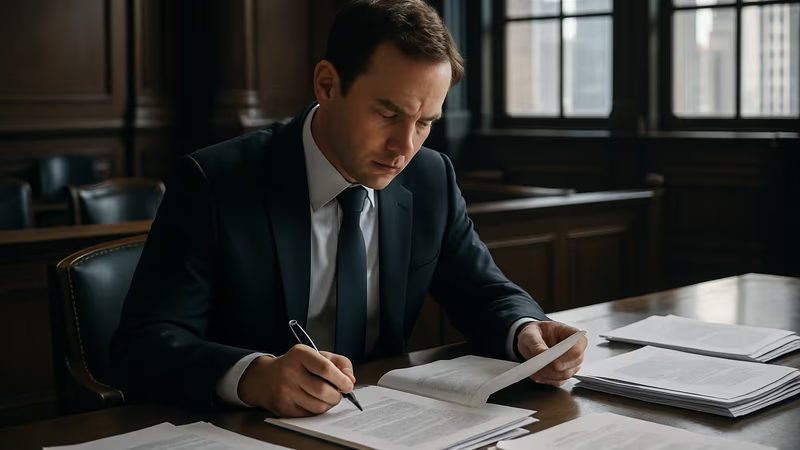
Key Takeaway
Abrams reversed a grant of post-appeal renewal. Read the majority's diligence and proof findings, the dissent, and related CPLR 2221 cases.
This article is part of our ongoing procedural issues coverage, with 187 published articles analyzing procedural issues issues across New York State. Attorney Jason Tenenbaum brings 24+ years of hands-on experience to this analysis, drawing from his work on more than 1,000 appeals, over 100,000 no-fault cases, and recovery of over $100 million for clients throughout Nassau County, Suffolk County, Queens, Brooklyn, Manhattan, and the Bronx. For personalized legal advice about how these principles apply to your specific situation, contact our Long Island office at (516) 750-0595 for a free consultation.
Last reviewed: September 2026
The plaintiffs found Torres, obtained his affidavit and persuaded the motion court to reopen the case. They lost that relief on appeal. Abrams is a divided decision about diligence and whether the new account would change the result.
Historical note: Abrams rejected post-appeal renewal on its record; Tapia v Van Rossum confirms that additional proof still needs a reasonable explanation for its earlier omission.
The majority reversed renewal
Abrams v Berelson, 94 AD3d 782 (2d Dept 2012), reversed the order granting renewal and left the defendant’s earlier summary-judgment victory in place. The application came more than nine years after the original dismissal; it renewed opposition to the defendant’s motion, not a failed motion by the plaintiffs.
Free Consultation · No Fee Unless We Win
Does this apply to your situation?
Every case is different. Get a free, confidential case review from an experienced attorney who can tell you exactly where you stand.
The majority found insufficient justification for the missing proof on the original motion and insufficient diligence in the six months after Torres was located. It also concluded that the new affidavit would not change the result on constructive notice. Both grounds mattered.
The dissent reached the opposite conclusion
Justices Dickerson and Leventhal would have affirmed renewal. They viewed the search efforts and the new evidence differently. Read that reasoning as a dissent, not as the court’s holding.
Tapia, cited above, supplies a current comparison on explaining omitted proof. It is not a ruling on Abrams’s unusual post-appeal history. Finding the witness was only part of the plaintiffs’ problem. The timing of the search and the content of his account still had to support reopening the case.
Jason’s original comment
Jason’s original comment introduces the dissent, not the majority’s holding. The dissent would have left the grant of renewal in place.
The dissent is interesting, and even held that Plaintiff satisfied the following:
Connect to the Encyclopedia
- CPLR 2221: governing rule and related decisions
- Dookhie: answering an opponent’s new reply argument
- Provek: explaining an employment-date mistake
- Ashraf Ashour: replacing companion-case papers
- Terio: late reargument while an appeal was pending
- Budoff: reargument granted without a different result
For review of a particular motion record or an attorney referral, contact the Law Office of Jason Tenenbaum.
Legal Context
Why This Matters for Your Case
New York law is among the most complex and nuanced in the country, with distinct procedural rules, substantive doctrines, and court systems that differ significantly from other jurisdictions. The Civil Practice Law and Rules (CPLR) governs every stage of civil litigation, from service of process through trial and appeal. The Appellate Division, Appellate Term, and Court of Appeals create a rich and ever-evolving body of case law that practitioners must follow.
Attorney Jason Tenenbaum has practiced across these areas for over 24 years, writing more than 1,000 appellate briefs and publishing over 2,600 legal articles that attorneys and clients rely on for guidance. The analysis in this article reflects real courtroom experience — from motion practice in Civil Court and Supreme Court to oral arguments before the Appellate Division — and a deep understanding of how New York courts actually apply the law in practice.
About This Topic
Procedural Issues in New York Litigation
New York civil procedure governs every stage of litigation — from pleading requirements and service of process to motion practice, discovery deadlines, and trial procedures. The CPLR creates strict procedural rules that can make or break a case regardless of the underlying merits. These articles examine the procedural pitfalls, timing requirements, and strategic considerations that practitioners face in New York state courts, with a particular focus on no-fault insurance and personal injury practice.
187 published articles in Procedural Issues
Keep Reading
More Procedural Issues Analysis
How to Talk to a Judge in New York: What to Say, What to Avoid, and How to Present Yourself
Address the judge as 'Your Honor,' stand when you speak, wait to be recognized, and keep answers short and honest. A Long Island trial lawyer explains.
Feb 24, 2026
CPLR § 2106 Amendment Eliminates Affidavit Notarization Requirement: What This Means for New York Litigation
New York's CPLR 2106 permits affirmations in place of many sworn documents. See the 2024 and 2025 changes, exceptions, and historical case notes.
Feb 18, 2026
2106 again…
St. Vincent's 2009 no-fault appeal separates record foundation, mailing and medical proof. Current CPLR 2106 and appeal-deadline distinctions are explained.
Apr 30, 2009
Walking out of an EUO leads to a disclaimer and a whole lot more
Walking out of an EUO leads to disclaimer and coverage denial. Court rules insured who departed mid-examination breached policy conditions in NY no-fault case.
Jul 17, 2014
Court Reverses $10,000 Sanctions Against Defense Firm: Comparative Negligence Defense Had Merit
Fourth Department reverses $10,000 sanctions against law firm for pursuing comparative negligence defense in New York personal injury case.
Jun 18, 2012
The destruction of peer hearsay: It is not hearsay – and much more
Examining peer hearsay exceptions in NY no-fault cases, medical record admissibility, and verification procedures in Urban Radiology v Tri-State Consumer.
Jun 10, 2010Was this article helpful?
Disclaimer: This article is published by the Law Office of Jason Tenenbaum, P.C. for informational and educational purposes only. It does not constitute legal advice, and no attorney-client relationship is formed by reading this content. The legal principles discussed may not apply to your specific situation, and the law may have changed since this article was last updated.
New York law varies by jurisdiction — court decisions in one Appellate Division department may not be followed in another, and local court rules in Nassau County Supreme Court differ from those in Suffolk County Supreme Court, Kings County Civil Court, or Queens County Supreme Court. The Appellate Division, Second Department (which covers Long Island, Brooklyn, Queens, and Staten Island) and the Appellate Term (which hears appeals from lower courts) each have distinct procedural requirements and precedents that affect litigation strategy.
If you need legal help with a procedural issues matter, contact our office at (516) 750-0595 for a free consultation. We serve clients throughout Long Island (Huntington, Babylon, Islip, Brookhaven, Smithtown, Riverhead, Southampton, East Hampton), Nassau County (Hempstead, Garden City, Mineola, Great Neck, Manhasset, Freeport, Long Beach, Rockville Centre, Valley Stream, Westbury, Hicksville, Massapequa), Suffolk County (Hauppauge, Deer Park, Bay Shore, Central Islip, Patchogue, Brentwood), Queens, Brooklyn, Manhattan, the Bronx, Staten Island, and Westchester County. Prior results do not guarantee a similar outcome.