Key Takeaway
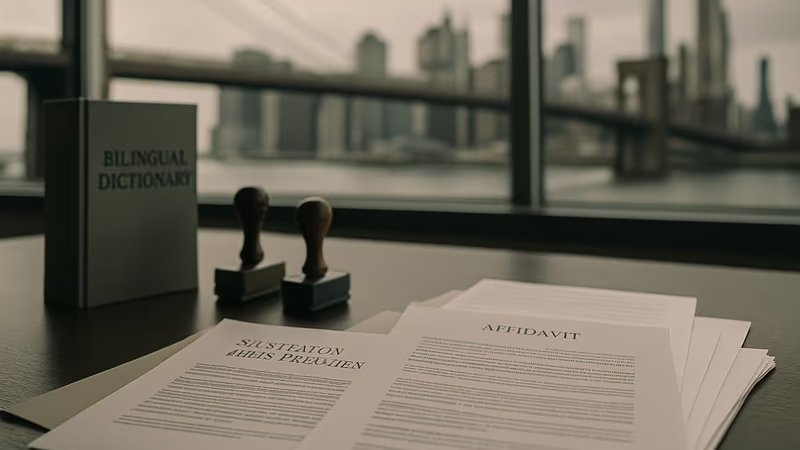
New York First Department rules electronic signatures have same validity as handwritten signatures under State Technology Law § 304(2) for legal affidavits and court documents.
This article is part of our ongoing affidavits coverage, with 19 published articles analyzing affidavits issues across New York State. Attorney Jason Tenenbaum brings 24+ years of hands-on experience to this analysis, drawing from his work on more than 1,000 appeals, over 100,000 no-fault cases, and recovery of over $100 million for clients throughout Nassau County, Suffolk County, Queens, Brooklyn, Manhattan, and the Bronx. For personalized legal advice about how these principles apply to your specific situation, contact our Long Island office at (516) 750-0595 for a free consultation.
Martin v Portexit Corp., 2012 NY Slip Op 05088 (1st Dept. 2012)
Interestingly, my view of the law when I handled Rogy v. Mercury became the law in the First Department. Perhaps, this is more of an academic issue in light of the fact that most of these electronic signatures now contain the appropriate language stating that it was placed at the request of the signor.
Here are the highlights:
“State Technology Law § 304(2) provides that “unless specifically provided otherwise by law, an electronic signature may be used by a person in lieu of a signature affixed by hand. The use of an electronic signature shall have the same validity and effect as the use of a signature affixed by hand” (see Wen Zong Yu v Charles Schwab & Co., Inc., 34 Misc 3d 32 ; People v Johnson, 31 Misc 3d 145; Alpha Capital Anstalt v Qtrax, Inc., 26 Misc 3d 1234). CPLR 2106, which provides for affirmations by attorneys, physicians, osteopaths and dentists does not specifically provide that an electronic signature may not be used and that the signature may only be affixed by hand.
Free Consultation · No Fee Unless We Win
Does this apply to your situation?
Every case is different. Get a free, confidential case review from an experienced attorney who can tell you exactly where you stand.
In Naldi v Grunberg (80 AD3d 1,12 , lv denied 16 NY3d 711 ), we held that the Legislature “appear to have chosen to incorporate the substantive terms of E-SIGN into New York state law.” Notably, E-SIGN provides that where a statute requires a signature to be notarized, acknowledged, verified, or made under oath, “that requirement is satisfied if the electronic signature of the person authorized to perform those acts, together with all other information required to be included … is attached to or logically associated with the signature or record” (15 USC § 7001). In Naldi, we concluded that “E-SIGN’S requirement that an electronically memorialized and subscribed contract be given the same legal effect as a contract memorialized and subscribed on paper” is New York law. We therefore held that the terms “writing” and “subscribed” in General Obligations Law § 5-703 should be construed to include, respectively, electronic communications and signatures (80 AD3d at 12).
There is no sound reason to treat the term “subscribed” as used in CPLR 2106 any differently than it is used in the statute of frauds. The Second Department’s decision in Vista Surgical Supplies, Inc. v Travelers Ins. Co. (50 AD3d 778 ), upon which the motion court relied in concluding that the doctors’ reports were inadmissible, is unpersuasive, and we decline to follow it. In that case, the Court held that the reports containing the computerized, affixed or stamped facsimiles of the physician’s signature failed to comply with CPLR 2106 in that there was no indication as to who placed them on the reports, or any indicia that the signatures were authorized (see also Rogy Med. P.C. v Mercury Cas. Co., 23 Misc 3d 132). However, requiring such additional information imports a requirement not contemplated or included in either E-SIGN’s provision for signatures made under oath (see 15 USC § 7001), or State Technology Law § 304(2). Additionally, State Technology Law § 306 provides that in any legal proceeding where the CPLR applies, an electronic record or signature may be admitted into evidence pursuant to article 45 of the CPLR. Based upon the foregoing, we conclude that the electronic signatures complied with CPLR 2106, that the affirmations of defendants’ medical experts were admissible and that the affirmations should have been considered by the motion court.”
Related Articles
- Peer hearsay and electronic signatures
- A signature placed at the direction of the signor
- Proof in opposition was insufficient to show a forgery
- Defective notarization
- New York No-Fault Insurance Law
Legal Update (February 2026): Since this 2012 post, New York’s electronic signature laws and procedural requirements under both State Technology Law § 304 and CPLR 2106 may have been subject to legislative amendments or regulatory updates, particularly given evolving digital authentication standards and court procedural reforms. Practitioners should verify current electronic signature requirements and any recent court rules addressing digital affirmation procedures in litigation contexts.
Legal Context
Why This Matters for Your Case
New York law is among the most complex and nuanced in the country, with distinct procedural rules, substantive doctrines, and court systems that differ significantly from other jurisdictions. The Civil Practice Law and Rules (CPLR) governs every stage of civil litigation, from service of process through trial and appeal. The Appellate Division, Appellate Term, and Court of Appeals create a rich and ever-evolving body of case law that practitioners must follow.
Attorney Jason Tenenbaum has practiced across these areas for over 24 years, writing more than 1,000 appellate briefs and publishing over 2,600 legal articles that attorneys and clients rely on for guidance. The analysis in this article reflects real courtroom experience — from motion practice in Civil Court and Supreme Court to oral arguments before the Appellate Division — and a deep understanding of how New York courts actually apply the law in practice.
Keep Reading
More Affidavits Analysis
How to Talk to a Judge in New York: What to Say, What to Avoid, and How to Present Yourself
Address the judge as 'Your Honor,' stand when you speak, wait to be recognized, and keep answers short and honest. A Long Island trial lawyer explains.
Feb 24, 2026
CPLR § 2106 Amendment Eliminates Affidavit Notarization Requirement: What This Means for New York Litigation
New York's CPLR 2106 permits affirmations in place of many sworn documents. See the 2024 and 2025 changes, exceptions, and historical case notes.
Feb 18, 2026
A party that really blew it gets not only a second but a third chance to correct his mistake
Mallards Dairy on late expert affidavits: permission, an excuse and a reply opportunity. Distinguish motion deadlines from the current expert-exchange rule.
Mar 24, 2010
An unsigned OSC on appeal – procedure.
Appeals court procedure when a trial court declines to sign a proposed order to show cause, including when leave to appeal is required versus direct appellate review.
Aug 23, 2018
The 60-day rule that was never published in the law journal
Court applies unpublished 60-day summary judgment rule in Civil Court case, raising procedural questions about timing limits and Second Department review needed.
Apr 2, 2014
CPLR § 2221 Motions to Reargue, Renew, and Vacate: The New York Practitioner's Guide
CPLR 2221 practitioner's guide: motions to reargue under 2221(d), renew under 2221(e), and vacate sua sponte orders under 2221(a) — deadlines, leading New York cases, and practice...
Feb 17, 2012Was this article helpful?
Disclaimer: This article is published by the Law Office of Jason Tenenbaum, P.C. for informational and educational purposes only. It does not constitute legal advice, and no attorney-client relationship is formed by reading this content. The legal principles discussed may not apply to your specific situation, and the law may have changed since this article was last updated.
New York law varies by jurisdiction — court decisions in one Appellate Division department may not be followed in another, and local court rules in Nassau County Supreme Court differ from those in Suffolk County Supreme Court, Kings County Civil Court, or Queens County Supreme Court. The Appellate Division, Second Department (which covers Long Island, Brooklyn, Queens, and Staten Island) and the Appellate Term (which hears appeals from lower courts) each have distinct procedural requirements and precedents that affect litigation strategy.
If you need legal help with a affidavits matter, contact our office at (516) 750-0595 for a free consultation. We serve clients throughout Long Island (Huntington, Babylon, Islip, Brookhaven, Smithtown, Riverhead, Southampton, East Hampton), Nassau County (Hempstead, Garden City, Mineola, Great Neck, Manhasset, Freeport, Long Beach, Rockville Centre, Valley Stream, Westbury, Hicksville, Massapequa), Suffolk County (Hauppauge, Deer Park, Bay Shore, Central Islip, Patchogue, Brentwood), Queens, Brooklyn, Manhattan, the Bronx, Staten Island, and Westchester County. Prior results do not guarantee a similar outcome.