Key Takeaway
Hit by an e-bike or e-scooter on Long Island? Suffolk's 2026 rules, why a lawful e-bike carries no no-fault policy, when MVAIC pays, and what to photograph.
This article is part of our ongoing personal injury coverage, with 180 published articles analyzing personal injury issues across New York State. Attorney Jason Tenenbaum brings 24+ years of hands-on experience to this analysis, drawing from his work on more than 1,000 appeals, over 100,000 no-fault cases, and recovery of over $100 million for clients throughout Nassau County, Suffolk County, Queens, Brooklyn, Manhattan, and the Bronx. For personalized legal advice about how these principles apply to your specific situation, contact our Long Island office at (516) 750-0595 for a free consultation.
This article was published September 24, 2026. Corrected October 5, 2026: The card on devices with no exception cited Vehicle and Traffic Law § 121-b for the 750-watt, 20 mph and 100-pound limits; those limits come from § 102-c and § 114-e, and § 121-b only defines the limited use motorcycle. The text below states the rule as verified.
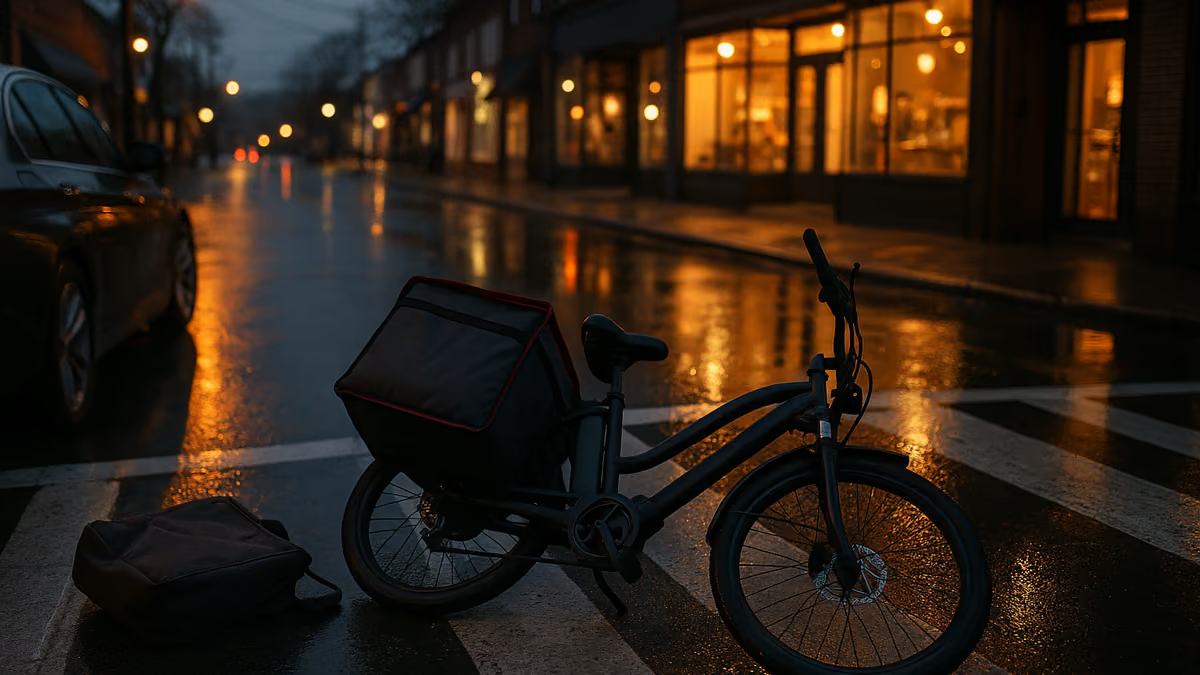
Take a woman crossing Main Street in Patchogue at the signal when a delivery e-bike with an insulated bag comes through the crosswalk and puts her on the pavement. The rider is working for an app. The bike carries no plate. There is no car in her household.
Suffolk County has four new local laws on e-bikes and e-scooters this year, and the New York City Council has bills pending on the same devices. None of them answers the question her family asks in the emergency room, which is who pays. That answer comes from one definition in the Vehicle and Traffic Law. I handle pedestrian cases like hers on Long Island, and the first thing I ask for is a photograph of the bike.
The short version
Vehicle and Traffic Law § 125 excludes a lawful "bicycle with electric assist" and a lawful "electric scooter" from "motor vehicle," and the no-fault law, the MVAIC law and the owner-liability statute all borrow that definition. A pedestrian hit by a lawful e-bike has no first-party benefits and no MVAIC claim; the claim is negligence against the rider, and against the rider's employer where the rider was working. An illegal, over-spec device flips every one of those answers: it is a motor vehicle, its owner is liable for a permissive rider, and MVAIC is open to the pedestrian. An e-bike rider struck by a car collects first-party benefits from the car's insurer under Insurance Law § 5103(a)(1). Suffolk's rules (a helmet at any age, nobody 15 or under, no sidewalks, no roads posted over 30 mph) have been in force since January 23, 2026 and are evidence of fault either way. Tonight: photograph the device, its motor label, and the place where a plate should be.
Is an e-bike a motor vehicle in New York?
Not when it is lawful, and everything else follows from that. Vehicle and Traffic Law § 125 defines “motor vehicle” as every vehicle “propelled by any power other than muscular power” and then lists exceptions; a compliant bicycle with electric assist is exception (e) and a compliant electric scooter is exception (f). The card below sets out that text and the three statutes that borrow it.
Statute at a glance
One definition, three statutes: why a lawful e-bike has no insurer behind it
- "Motor vehicle" (Vehicle and Traffic Law § 125)
- "Every vehicle operated or driven upon a public highway which is propelled by any power other than muscular power, except ... (e) bicycles with electric assist as defined in section one hundred two-c of this article, and (f) electric scooters as defined in section one hundred fourteen-e of this article." A device that fits (e) or (f) is not a motor vehicle. A device that fits neither has no exception.
- "Bicycle with electric assist" (Vehicle and Traffic Law § 102-c)
- "A bicycle which is no more than thirty-six inches wide and has an electric motor of less than seven hundred fifty watts, equipped with operable pedals," in one of three classes. Class one is pedal-assist only and "ceases to provide assistance when such bicycle reaches a speed of twenty miles per hour." Class two has a throttle and is "not capable of providing assistance when such bicycle reaches a speed of twenty miles per hour." Class three exists "Solely within a city having a population of one million or more," to twenty-five miles per hour.
- "Electric scooter" (Vehicle and Traffic Law § 114-e)
- "Every device weighing less than one hundred pounds that (a) has handlebars, a floorboard or a seat that can be stood or sat upon by the operator, and an electric motor, (b) can be powered by the electric motor and/or human power, and (c) has a maximum speed of no more than twenty miles per hour on a paved level surface when powered solely by the electric motor."
- No-fault's "motor vehicle" (Insurance Law § 5102(f), through Vehicle and Traffic Law § 311(2))
- Section 5102(f): "a motor vehicle as defined in section three hundred eleven of the vehicle and traffic law." Section 311(2): "The term 'motor vehicle' shall be defined as in section one hundred twenty-five of this chapter." No owner's policy is issued on a lawful e-bike or e-scooter, so no first-party benefits flow from the device.
- MVAIC's "motor vehicle" (Insurance Law § 5202(a))
- "a motor vehicle as defined in section one hundred twenty-five of the vehicle and traffic law and also includes trailers, semi-trailers, motorcycles, tractors and snowmobiles." Motorcycles are added back. E-bikes and e-scooters are not.
- Owner liability (Vehicle and Traffic Law § 388(2))
- "As used in this section, 'vehicle' means a 'motor vehicle', as defined in section one hundred twenty-five of this chapter." The owner of a lent lawful e-bike is outside the statute. The owner of a lent over-spec device is inside it.
- The device with no exception (Vehicle and Traffic Law §§ 102-c, 114-e)
- A motor of 750 watts or more, a throttle that works past 20 miles per hour (25 in the city), or a scooter of 100 pounds or more or faster than 20 miles per hour under motor alone fits neither definition and is a motor vehicle. With a seat and two or three wheels it is usually a "limited use motorcycle" (§ 121-b): class C at "not more than twenty miles per hour," class B "more than twenty miles per hour but not more than thirty," class A "more than thirty miles per hour but not more than forty."
Read together, those texts leave the woman in the Patchogue crosswalk with no first-party benefits, no MVAIC claim, and no claim against the bike’s owner if the rider borrowed it. Consequently, her claim is negligence against the rider, and the label on the motor decides whether that is the whole answer.
Free Case Review
Tell us what happened — free case review
Time-sensitive: NY injury claims have strict deadlines
Details received. The fastest next step is a call.
Injury cases are won early. Evidence fades, witnesses move, and New York's no-fault rules can require paperwork within 30 days of a crash. Don't wait for a callback. Call now and a real person takes your information: our office during business hours, and our intake line after hours and on weekends, answered 24/7.
Call (631) 349-3928Free Consultation · Nothing is filed or shared until you decide
Can't call right now? We'll reach out during business hours.
Who pays, in the order I check it
Which payer is yours depends on what hit you and what you were on. The flow below is the order I run in a new file.
Who pays after an e-bike or e-scooter crash on Long Island
Start at step 1 and stop at the first answer that fits.
Step 1
Was a car, truck or other insured motor vehicle involved?
Yes, and you were on foot, on a bicycle or on a lawful e-bike or e-scooter: its insurer pays first-party benefits to you (Insurance Law § 5103(a)(1)); the serious-injury threshold, the fault-first trial and the CPLR 1411(b) bar then govern the lawsuit. Yes, but you were on an over-spec device: you are the occupant of "another motor vehicle," and the car's policy does not pay you first-party benefits. No: go to step 2.
Step 2
Was the device a lawful e-bike or e-scooter?
Check the label: under 750 watts, motor cuts out at 20 mph, under 100 pounds for a scooter (Vehicle and Traffic Law §§ 102-c, 114-e). Yes: no no-fault carrier and no MVAIC; the claim is negligence against the rider, and against the rider's employer if the rider was working, under pure comparative fault (CPLR 1411(a)). No, or no label: go to step 3.
Step 3
The device was over-spec and carried no policy
Pedestrian or cyclist: it is an "uninsured motor vehicle" (Insurance Law § 5202(d)) and MVAIC is open: police report within 24 hours and affidavit within 90 days if the rider fled (§ 5208(a)(2)); affidavit within 180 days if the rider is identified (§ 5208(a)(1)); $25,000 cap for injury to one person (§ 5210(a)). The owner is liable for a permissive rider (Vehicle and Traffic Law § 388). The rider who owns it: excluded from MVAIC as "the owner of an uninsured motor vehicle" (§ 5202(b)).
Step 4
Were you the rider, with nobody else involved?
Lawful device: no policy is issued on it, so there is no first-party payer; your health plan pays the bills. Road or path defect: a claim against the county, town or village, with a notice of claim within 90 days (General Municipal Law § 50-e(1)(a)). Defective device: a product claim against the maker and seller.
On the statute’s text, the pedestrian hit by a lawful device is outside article 51 of the Insurance Law altogether: no first-party benefits, but no serious-injury threshold either. Where the rider was working, the general rule is that an employer answers for an employee’s negligence within the scope of the employment. Whether an app rider is an employee is contested, and our guide to the 2026 crackdown covers that fight.
In my judgment the first question in every e-bike file is the device: wattage, throttle, plate, class sticker. Fault comes second. The photograph of the motor label decides which insurer, if any, is in the case.
The second question is the rider’s employment. A delivery rider working at the time of the crash brings the app into the case; on Long Island no rule requires the app to carry insurance for that. In practice the rider’s own homeowner’s or renter’s liability policy, where one exists, is the source I look for first, and whether it responds turns on its motor-vehicle exclusion, which I demand in discovery. That is practice, not statute. The woman in the crosswalk therefore has a defendant on day one; whether he has an insurer behind him is the first month’s work.
An illegal device flips every answer
The bike in the Patchogue crosswalk carried no plate and no policy. If it falls outside the two definitions on the card above, it has no exception in § 125 and is a motor vehicle. With a seat and two or three wheels it is usually a “limited use motorcycle” under Vehicle and Traffic Law § 121-b.
The owner is then liable under Vehicle and Traffic Law § 388 for negligent operation “by any person using or operating the same with the permission, express or implied, of such owner.” The pedestrian may claim against MVAIC as the victim of an “uninsured motor vehicle,” on the report and affidavit clocks in the flow above; the hit-and-run settlement guide covers the filing. The rider who owns the device is excluded, since a “qualified person” does not include “the owner of an uninsured motor vehicle.”
In Suffolk the same device is an “ATV” under Chapter 822 as amended through Local Law 8 of 2026, and operating it on a public highway is a criminal violation. Indeed, for the woman in the Patchogue crosswalk the over-spec bike is the better case, because it opens the owner and MVAIC. The wattage on the label is the first fact to establish.
The rider hit by a car
When a car strikes a lawful e-bike rider, the car’s insurer pays first. Insurance Law § 5103(a)(1) makes the policy on a motor vehicle pay first-party benefits to “persons, other than occupants of another motor vehicle or a motorcycle, for loss arising out of the use or operation in this state of such motor vehicle.” An e-bike rider is neither; therefore, the car’s insurer owes basic economic loss, up to $50,000, without regard to fault.
That entitlement makes the rider a “covered person,” and article 51 then governs the lawsuit. Pain and suffering requires a “serious injury” under Insurance Law § 5102(d), eight categories since the 90/180-day category was deleted for actions commenced on or after May 26, 2026; the serious injury threshold guide covers the proof. Under Insurance Law § 5104(a) the trier of fact “shall not determine the question of whether an injury is a serious injury until the trier of fact has determined the party or parties at fault,” and CPLR 1411(b) bars recovery where the claimant’s culpable conduct “is greater than the culpable conduct of the person against whom recovery is sought.”
Here, Suffolk’s rules work against the rider: a helmet left at home, a sidewalk, a road posted at 40 miles per hour, a rider under 16, each conduct the county code forbids and each argued as fault. A rider whose share of the fault exceeds the driver’s recovers nothing; the settlement guide covers what these claims have resolved for.
Suffolk’s rules, and how a violation feeds fault
Suffolk wrote the standard of care into the county code this year. The state lets a Nassau or Suffolk town or village regulate these devices “only after adoption of a local law or ordinance by the governing body of the county,” and Suffolk supplied that step in Suffolk County Code § 319-44. The card below carries the operative text.
Suffolk County Code, as amended in 2026
Suffolk's four 2026 e-bike and e-scooter laws: what is prohibited, where, and what it costs
- Local Law 6 of 2026 (Chapter 319, Article IX; effective January 23, 2026)
- A helmet for every operator and passenger of an e-bike or e-scooter, at any age (§ 319-52(D)). "No person aged 15 years or younger may lawfully operate an electric scooter or bicycle with electric assist on public property or on roadways" (E). No sidewalks (B), no county off-highway property (A), no road with "a posted speed limit of more than thirty miles per hour" (C), no reckless or impaired riding (F, G). Penalties, § 319-53: up to $500 for a violation; a second conviction within five years an unclassified misdemeanor, "not less than $1,500"; a third up to $5,000 and/or a year. A parent pays a minor's fine, and supervision is no defense.
- Local Law 7 of 2026 (Chapter 319, Article II; effective January 23, 2026)
- Motorized scooters are banned on "any sidewalk within the County of Suffolk" (§ 319-11(B)) and on roads posted over 30 miles per hour (C). The old ban on every public area was narrowed to those two places, and the fine rose from $150 to $500 (§ 319-12).
- Local Law 8 of 2026 (Chapter 822; effective January 23, 2026)
- "ATV" under § 822-2, as amended through this law, "also includes any motorized bicycle, motorized scooter, or other motorized vehicle which does not conform to New York State laws." None may be operated "on a public highway or on public property in the County of Suffolk except in accordance with New York State Vehicle and Traffic Law § 2403" (§ 822-3(A)). Penalties, § 822-5: a criminal violation, "a minimum fine of $500, with a maximum fine of $1,000" on a first conviction, $1,500 to $3,000 on a second within five years, and on a third "a fine of $7,500 and/or a term of imprisonment not to exceed 30 days."
- Local Law 14 of 2026 (Chapter 319, § 319-52(H), Fire Island; effective April 9, 2026)
- On Fire Island's pedestrian walks an e-bike's motor is "prohibited on pedestrian walks from May 15 through the Monday of Columbus Day weekend of each year, inclusive." The rest of the year: riders "15 (fifteen) years of age and older" only, "Passengers are prohibited," and no faster than "eight (8) miles per hour." "The operation of electric scooters on Fire Island shall be prohibited at all times."
- Effective dates
- Each "shall apply to all actions occurring on or after the effective date."
In a civil case either side can use that card. A county-ordinance violation is evidence a jury may weigh in deciding negligence, and where no motor vehicle was involved CPLR 1411(a) governs, so the claimant’s culpable conduct “shall not bar recovery” and the damages are “diminished in the proportion” of that conduct.
One rule the county cannot touch runs the other way. Vehicle and Traffic Law § 1242(2) bars anyone under 16 from operating an e-bike and then provides that the failure to comply “shall not constitute contributory negligence or assumption of risk, and shall not in any way bar, preclude or foreclose an action for personal injury or wrongful death by or on behalf of such person, nor in any way diminish or reduce the damages recoverable in any such action.” Consequently, a rider under 16 hit by a car in Suffolk is not charged with the age violation in the rider’s own case, and the claim against the driver is unaffected.
NYC’s bills are introductions, not law
Every New York City item here is an introduction: none has had a committee hearing or been enacted, and none would apply on Long Island if it were.
Int 0994-2026, by Council Members Brewer, Abreu, Epstein, Hudson, Restler and Morano, was introduced August 13, 2026 and referred that day to the Committee on Consumer and Worker Protection. It would require a licensed third-party food delivery service to “maintain an insurance policy providing liability coverage for injury or death of any person” arising from a worker’s use of a delivery device on a trip or on call, at a minimum of $100,000 per person, $300,000 per accident and $50,000 for property damage. It is an introduction, and it is the insurer the woman in the crosswalk does not have.
Three more are pre-filed for the Council’s October 8, 2026 stated meeting before the Committee on Transportation and Infrastructure, all introductions: T2026-2361 (Hudson, Abreu, Wong), a class 3 e-bike ban with warnings only until April 1, 2029; T2026-2587 (Restler, Maloney), delivery-app tracking of speeding, wrong-way and sidewalk riding; and T2026-2590 (Abreu), sidewalk-riding detection on shared fleets. A Long Island pedestrian hit by a delivery rider therefore has no app policy to claim against today.
The clocks
Three clocks run alongside the MVAIC deadlines above. The negligence action must be commenced within three years under CPLR 214(5). If a county, town or village is a defendant, a notice of claim must be served “within ninety days after the claim arises” under General Municipal Law § 50-e(1)(a), and only a court can extend that time. Where a car was involved, the no-fault regulation, 11 NYCRR 65-1.1, gives 30 days for the first-party application. File the MVAIC affidavit as if the rider will never be found, and serve the notice of claim as if the road will be blamed.
What to save this week
The file is built in the first week, and most of it is a photograph. Every e-bike and e-scooter sold in New York since June 1, 2022 must carry a manufacturer’s label with its top motor-assisted speed and its wattage, and on an e-bike its class.
Do not wait for the police report to tell you what the bike was. Photograph it before it is picked up: the motor, the label on the frame, the throttle, the spot where a plate should be. If nobody could do that at the scene, go back the next morning anyway; the bike will be gone, and you will be proving what it was from the report and the witnesses.
Bring what you have of these to the first call:
- The photograph of the device, its motor label, and its plate or the place where a plate should be.
- The police report number.
- The name of the app or employer the rider was working for, if any.
- The emergency room discharge papers.
- The declarations page of any auto policy in your household.
Ask for the intersection footage before the week is out; nothing else on the list expires as fast.
Before you call
By the end of her first week the woman in the Patchogue crosswalk has a photograph of the bike on its side, a close-up of the motor label, the name of the app on the rider’s phone mount, a police report number and an emergency room record that says “e-bike.” If the label reads 500 watts and class two, her case is negligence against the rider and a demand for the rider’s renter’s policy. If it reads 1,500 watts, or there is no label and the bike kept pulling past 20 miles per hour under throttle, the owner is in the case, MVAIC is open, and the 90-day affidavit is the first filing. Our bicycle accident and electric scooter accident pages cover the rider’s side.
If an e-bike or e-scooter hit you on Long Island, or a car hit you while you were riding one, call (516) 750-0595 or request a free case review with the photograph of the device in hand; the 90-day clocks do not wait for the rider to be found.
Sources
- Vehicle and Traffic Law § 125, § 102-c, § 114-e, § 121-b, § 311, § 388, § 1242, § 1281, § 1282
- Insurance Law § 5102, § 5103, § 5104, § 5202, § 5208, § 5210
- CPLR § 214, § 1411; General Municipal Law § 50-e
- Suffolk County Legislature, Local Laws index, and the certified copies as filed with the Secretary of State: Local Law 6 of 2026 (IR 1835-2025), Local Law 7 of 2026 (IR 1836-2025), Local Law 8 of 2026 (IR 1787-2025), Local Law 14 of 2026 (IR 1044-2026)
- Suffolk County Code Chapter 319, Bicycles, Skates, Skateboards and Scooters and Chapter 822, All-Terrain Vehicles
- New York City Council, Legistar: Int 0994-2026, T2026-2361, T2026-2587, T2026-2590
Legal Context
Why This Matters for Your Case
Personal injury law in New York is governed by a complex web of statutes, case law, and procedural rules that differ from most other states. The statute of limitations for most personal injury claims is three years under CPLR 214(5), but claims against municipalities require a Notice of Claim within 90 days. Motor vehicle accident victims must meet the serious injury threshold under Insurance Law §5102(d) before they can recover pain and suffering damages.
The Law Office of Jason Tenenbaum has recovered over $100 million for injured clients across Long Island, Nassau County, Suffolk County, Queens, Brooklyn, Manhattan, and the Bronx. With 24+ years of trial and appellate experience, more than 1,000 appeals written, and 2,600+ published legal articles, Jason Tenenbaum provides the authoritative legal analysis that practitioners and injury victims need to understand their rights.
This article reflects real courtroom experience and a deep understanding of how New York courts actually evaluate personal injury claims — from the initial filing through discovery, summary judgment, trial, and appeal.
About This Topic
New York Personal Injury Law
When negligence causes serious injury, New York law entitles victims to compensation for medical bills, lost income, pain and suffering, and more. From car accidents and slip-and-falls to construction injuries and medical malpractice, the Law Office of Jason Tenenbaum has recovered over $100 million for injured Long Islanders and New Yorkers since 2002.
180 published articles in Personal Injury
Keep Reading
More Personal Injury Analysis

Nassau Police Ordered to Pay $34,690.50 in FOIL Fees: What Meyer Means After a Crash
The Second Department raised a FOIL fee award against the Nassau County Police Department from $12,000 to $34,690.50. The statute, the math, and the FOIL clock.
Oct 8, 2026
Long Island Pedestrian Crashes After Dark: State Data Before the Clocks Change
From November through January, 485 of 520 evening pedestrian crashes in Nassau and Suffolk happened in the dark. State and federal data, with the CSV files.
Oct 8, 2026
How Long Do You Have to File a Motorcycle Accident Claim in NY?
Learn about New York's 3-year statute of limitations for motorcycle accident claims, exceptions for government cases, and critical filing deadlines.
Jun 6, 2025
How to Handle Insurers After an Accident
Learn how to handle insurance companies after an accident. Expert tips on documentation, adjuster tactics, and protecting your claim from experienced Long Island attorneys.
Jan 30, 2025
NY Auto Insurance Rating Rules 2026: Job, Education, Homeownership and Zip Code Limits
Insurance Law §2341, effective Nov. 23, 2026, limits NY auto insurers' use of occupation, education, homeownership, prior-insurance gaps, and tiny.
Aug 17, 2026
NY Commercial Vehicle Accident Settlements (2026)
Commercial vehicle crash in NY: $750K–$5M insurance minimums, employer liability, FMCSR violations. Delivery truck & van accident attorney. 516-750-0595.
Apr 4, 2026Frequently Asked Questions
Common Questions About This Topic
4 answers from the firm's New York personal-injury and employment-law practice. Click any question to expand.
Is an e-bike a motor vehicle in New York?
Not when it is lawful. The Vehicle and Traffic Law excludes a compliant bicycle with electric assist and a compliant electric scooter from "motor vehicle," and the no-fault, MVAIC and owner-liability statutes borrow that definition. A device of 750 watts or more, faster than 20 miles per hour under throttle outside the city, or a scooter of 100 pounds or more is a motor vehicle.
Does no-fault cover a pedestrian hit by an e-bike in Suffolk County?
No, not when the e-bike was lawful: no policy is issued on it, so there are no first-party benefits and no MVAIC claim, and the claim is negligence against the rider and, where the rider was working, the employer. If the device was over-spec and uninsured, MVAIC is open.
Who pays if a delivery rider hit me on Long Island?
The rider, and the employer if the rider was an employee acting within the scope of the job. No Long Island rule requires a delivery app to insure its riders; Int 0994-2026, which would require it in New York City, is an introduction, not law.
Can Suffolk's helmet and age rules be used against me if I was the rider?
Yes, as evidence of fault, with one exception: under Vehicle and Traffic Law § 1242(2), a rider under 16 is not charged with the age violation in the rider's own case. In an action against a driver commenced on or after May 26, 2026, a rider whose share of the fault exceeds the driver's is barred by CPLR 1411(b).
Was this article helpful?
Disclaimer: This article is published by the Law Office of Jason Tenenbaum, P.C. for informational and educational purposes only. It does not constitute legal advice, and no attorney-client relationship is formed by reading this content. The legal principles discussed may not apply to your specific situation, and the law may have changed since this article was last updated.
New York law varies by jurisdiction — court decisions in one Appellate Division department may not be followed in another, and local court rules in Nassau County Supreme Court differ from those in Suffolk County Supreme Court, Kings County Civil Court, or Queens County Supreme Court. The Appellate Division, Second Department (which covers Long Island, Brooklyn, Queens, and Staten Island) and the Appellate Term (which hears appeals from lower courts) each have distinct procedural requirements and precedents that affect litigation strategy.
If you need legal help with a personal injury matter, contact our office at (516) 750-0595 for a free consultation. We serve clients throughout Long Island (Huntington, Babylon, Islip, Brookhaven, Smithtown, Riverhead, Southampton, East Hampton), Nassau County (Hempstead, Garden City, Mineola, Great Neck, Manhasset, Freeport, Long Beach, Rockville Centre, Valley Stream, Westbury, Hicksville, Massapequa), Suffolk County (Hauppauge, Deer Park, Bay Shore, Central Islip, Patchogue, Brentwood), Queens, Brooklyn, Manhattan, the Bronx, Staten Island, and Westchester County. Prior results do not guarantee a similar outcome.