
Key Takeaway
Your examination before trial (EBT) is one of the most important parts of your car accident case.
This article is part of our ongoing car accidents coverage, with 234 published articles analyzing car accidents issues across New York State. Attorney Jason Tenenbaum brings 24+ years of hands-on experience to this analysis, drawing from his work on more than 1,000 appeals, over 100,000 no-fault cases, and recovery of over $100 million for clients throughout Nassau County, Suffolk County, Queens, Brooklyn, Manhattan, and the Bronx. For personalized legal advice about how these principles apply to your specific situation, contact our Long Island office at (516) 750-0595 for a free consultation.
If you have filed a car accident lawsuit in New York, you will almost certainly be required to give testimony at an examination before trial — commonly referred to as an EBT or deposition. For many plaintiffs, the EBT is the most stressful event in the litigation process: a defense attorney asks you detailed questions under oath while a court reporter transcribes every word. Your testimony at the EBT can make or break your case.
This guide explains what a New York car accident EBT is, how it works, how to prepare, and what mistakes to avoid.
What Is a Deposition (EBT) in a New York Car Accident Case?
An examination before trial is a formal pretrial discovery proceeding governed by New York CPLR §§ 3107 through 3116. At the EBT, a party or witness gives sworn oral testimony in response to questions from opposing counsel. The testimony is taken under oath — the same oath administered at trial — and transcribed verbatim by a licensed court reporter. Some EBTs are also videotaped.
The transcript of your EBT testimony becomes a permanent part of the litigation record. Defense counsel can use the transcript at trial to cross-examine you and to impeach you if your trial testimony differs from what you said at the deposition. Any inconsistency — no matter how minor — will be flagged by the defense and used to suggest you are not credible.
Free Consultation · No Fee Unless We Win
Does this apply to your situation?
Every case is different. Get a free, confidential case review from an experienced attorney who can tell you exactly where you stand.
Both the plaintiff (you) and the defendants (the at-fault driver, vehicle owner, and any other parties) are generally deposed. Your attorney will depose the defendant driver about the accident, their driving history, phone use at the time of impact, traffic control compliance, and any prior accidents. The defense attorney will depose you about your account of the accident, your injuries, your medical history, and your daily functional limitations.
Who Conducts the EBT and What Are the Rules?
At your deposition, the defense attorney — counsel for the at-fault driver and their insurance carrier — will ask the questions. Your own attorney will be present throughout and may object to questions that are improper in form under CPLR § 3115. However, New York rules differ importantly from what you might expect from courtroom dramas: at an EBT, your attorney generally cannot coach your answers or instruct you not to answer on grounds of relevance. Objections at a deposition are mostly to form (the way the question is phrased) rather than substance, and you are typically required to answer even over a form objection so the record is preserved for the court’s later determination.
Your attorney may instruct you not to answer only in limited circumstances: questions seeking privileged information (such as attorney-client communications), questions that are palpably improper, or to enforce a prior court order. If you are unsure whether to answer a particular question, look to your attorney for guidance rather than refusing on your own initiative.
Nassau County and Suffolk County EBTs are typically scheduled at your attorney’s office, at the defense law firm’s office, or at a commercial deposition facility in the county where the lawsuit was filed. Under CPLR § 3113(a), each side has the right to adjourn and continue the deposition if necessary — which means your deposition may be continued to a second session if defense counsel runs out of time or if new issues arise.
How to Prepare for Your Car Accident EBT
Review the Accident Details Thoroughly
Before your EBT, you need to know the accident facts as precisely as possible. You should be prepared to testify without hesitation about:
- The exact date, time, and location of the accident
- The weather and road conditions at the time
- What you were doing immediately before the impact (direction of travel, speed, lane position, reason for being at that location)
- The sequence of events leading to the collision from your perspective
- What you observed of the other vehicle before, during, and immediately after impact
- The point of contact and the direction of force
- What happened to your body at the moment of impact
If you are unsure about the time or exact address, review your cell phone records, the police report (MV-104), and any photographs taken at the scene. Saying “I’m not sure of the exact time but it was mid-morning” is perfectly acceptable; guessing a specific time and getting it wrong creates an inconsistency the defense will exploit.
Review Your Complete Medical History
Defense counsel will probe your entire medical history — not just the injuries from this accident. Before your EBT, you should compile a list of every healthcare provider you have seen before and after the accident, every injury or condition involving any body part claimed in the lawsuit, every surgery, and every prior accident. This includes childhood sports injuries, prior workers’ compensation claims, prior no-fault claims, and any prior litigation.
Your attorney needs to know this history before the EBT, not for the first time at the deposition. Defense counsel will have already subpoenaed your prior medical records, obtained your prior lawsuit history through database searches, and reviewed your insurance claim history. They will know about prior treatment you have forgotten or minimized. Being caught in an inconsistency about prior injuries — even innocent ones from years earlier — is one of the most damaging things that can happen at a deposition.
You should be prepared to testify specifically about:
- Every doctor, chiropractor, physical therapist, acupuncturist, and specialist you have seen for the claimed injuries, with approximate dates
- The treatment you received at each provider
- Whether your symptoms improved, worsened, or plateaued over time
- Any gaps in treatment and the reason for each gap
- Any prior injuries to the same body parts claimed in this case, and how those prior injuries resolved before this accident
- All current medications, including over-the-counter medications
Review All Prior Statements
Before your deposition, review every statement you have previously given about the accident:
Police report (MV-104): Obtain a copy and read it carefully. The police report reflects what you told the officer at the scene. If the report contains an error about your account of the accident, you should discuss it with your attorney in advance so you can explain any discrepancy at the deposition rather than appearing to change your story.
Recorded statement to the no-fault insurer: After a car accident in New York, the no-fault carrier may have taken a recorded statement before your attorney was retained. Review a transcript of that statement if one is available. Recorded statements taken shortly after an accident when you were stressed, in pain, and possibly medicated often contain minimizations of injury (“I’m fine, just a little sore”) that defense counsel will use aggressively to challenge the severity of your injuries at trial.
Social media: Defense investigators routinely research every social media platform — Facebook, Instagram, TikTok, X (formerly Twitter), LinkedIn — for posts, photographs, and check-ins that suggest physical activity inconsistent with claimed limitations. A photograph of you at a hiking trail, carrying luggage, holding a child overhead, or participating in a sport taken after the accident date will be used to challenge your credibility. Before your EBT, review and audit your social media presence. Discuss with your attorney whether any posts present potential issues. Do not delete posts after litigation has commenced — that constitutes spoliation of evidence.
Conduct a Mock EBT Preparation Session With Your Attorney
Your attorney should conduct a thorough preparation session before your deposition in which they walk through the anticipated lines of questioning, review your answers, and identify any inconsistencies or areas of concern. This preparation session is protected by attorney-client privilege. The preparation session is not coaching — you are not learning what to say, you are learning how to say truthfully what you know, clearly and without over-explanation.
Key Rules at Your New York Car Accident EBT
Tell the Truth
This is the cardinal rule. You are testifying under oath, and false testimony at a deposition constitutes perjury under New York Penal Law § 210.10 — a class E felony. Beyond the legal risk, false testimony is almost always discovered. Defense counsel has access to medical records, insurance databases, surveillance footage, social media, and witness testimony that will expose fabrications. A plaintiff caught in a lie loses all credibility and, in many cases, loses the case.
Listen to the Complete Question Before Answering
Do not begin formulating your answer until the question is fully asked. Defense attorneys sometimes trail off mid-question or rephrase mid-sentence to see whether you will fill in the blanks. Pause briefly after each question before answering — this also gives your attorney time to interpose an objection if one is warranted.
Answer Only What Was Asked
The most common mistake at depositions is volunteering information beyond what the question requires. If the question is “What color was the light when you entered the intersection?” the answer is the color of the light — not an explanation of why you were at that intersection, what you saw on the adjacent street, or your theory of why the accident happened. Answer the specific question asked and stop. If the defense attorney wants more information, they will ask a follow-up question. Every additional word you volunteer is an additional opportunity for inconsistency.
Say “I Don’t Know” or “I Don’t Remember” When Genuinely Applicable
If you do not know the answer to a question, say so. If you do not remember, say so. These are complete, truthful, and acceptable answers. Defense counsel may follow up with “Can you estimate?” or “Do you have any recollection at all?” — at which point you can offer an estimate if you have one, or confirm that you have no recollection. What you must never do is guess at a specific fact when you genuinely do not know it. A specific but incorrect answer is far more damaging than an honest acknowledgment of limited recollection.
Correct Mischaracterizations Immediately
Defense attorneys sometimes rephrase your prior testimony in follow-up questions in a way that subtly shifts the meaning — for example, asking “So you told me you were going approximately 40 miles per hour?” when you actually said “I was going between 30 and 35 miles per hour.” Correct this immediately and politely: “Actually, I said I was going between 30 and 35 miles per hour.” Do not accept a mischaracterization of your own testimony by answering “yes” or “right” to a restatement that is not accurate.
Ask for Clarification
If a question is confusing, compound (two questions in one), assumes a fact you dispute, or uses terminology you do not understand, ask for clarification before answering: “Could you rephrase that?” or “I’m not sure I understand the question — can you explain what you mean by [term]?” You are entitled to understand what you are being asked before you answer.
Never Guess
There is an important distinction between an estimate and a guess. An estimate is a good-faith approximation based on actual perception: “I was traveling at approximately 30 miles per hour.” A guess is speculation about something you have no basis to assess: “I guess the light had been red for about 20 seconds.” Estimates are entirely appropriate and expected. Guesses are not — and if a specific guess turns out to be wrong, it becomes an inconsistency defense counsel will use against you.
Topics Defense Counsel Will Probe
Understanding what defense counsel is looking for helps you prepare:
Liability: Who had the right of way? What traffic controls were present? What did you see of the other vehicle before impact? How fast were you going? Did you brake before impact? Did you attempt to avoid the collision?
Prior accidents and injuries: Have you ever been in a prior car accident? Have you ever made a prior no-fault or workers’ compensation claim? Have you ever treated for injuries to your neck, back, shoulders, or any other body part claimed in this case? This is the most dangerous area for plaintiffs who have forgotten or minimized prior treatment.
Medical treatment: Every provider you saw after the accident. Every complaint you reported. Every gap in treatment and why. Defense counsel will use any treatment gap of more than 3 to 4 weeks as evidence that your injuries are not as serious as claimed.
Functional limitations: What activities can you no longer perform or perform with difficulty? Can you still cook, clean, dress yourself, drive, climb stairs, do yard work, lift groceries, carry children, exercise? The defense will compare your testimony about limitations to your social media activity.
Employment: Did you miss work? How many days? Do you have a lost wage claim? What are your job duties? Can you still perform them? Have you been promoted, transferred, or disciplined since the accident?
Daily activities: What does a typical day look like since your injuries? What time do you wake up? How do you spend your day? What activities did you used to do that you can no longer do?
Common Mistakes to Avoid at Your EBT
Over-explaining: Plaintiffs who volunteer extensive explanations for every answer appear defensive and create additional fodder for cross-examination. Answer the question asked and wait for the next question.
Arguing with defense counsel: The defense attorney is not your opponent in the room — they are doing their job. Becoming argumentative, sarcastic, or hostile makes you appear angry and difficult, which damages your credibility with the jury if the transcript is read at trial.
Minimizing your pain to seem credible: Some plaintiffs instinctively minimize their symptoms at the EBT because they do not want to seem like they are exaggerating. This is a significant tactical error. Your EBT testimony about your symptoms and limitations is part of your damages record. If you say at the EBT that your neck pain is “not that bad” and then testify at trial that it has been debilitating, the defense will use the EBT transcript to impeach you.
Inaccurate timeline statements: Stating a specific date, time, or sequence of events with false precision is dangerous. If you say “I started treating with Dr. Smith on March 15th” and the records show it was March 22nd, you have an inconsistency. Approximate timelines — “I started treatment about two weeks after the accident” — are more accurate and less vulnerable to impeachment.
After the EBT: Reviewing and Correcting Your Transcript
After your deposition is completed, the court reporter will prepare a written transcript of your testimony. Under CPLR § 3116(a), you have the right to review the transcript and submit a signed errata sheet with corrections within 60 days of the transcript being delivered to you or your attorney. The errata sheet allows you to correct transcription errors (the reporter misheard “right turn” as “right lane”) and clarify ambiguous answers.
However, substantive corrections — changing “I was traveling at 30 miles per hour” to “I was traveling at 20 miles per hour” — are treated with suspicion by defense counsel. Under CPLR § 3116, the original answer remains part of the record even after an errata correction; the correction does not replace the original testimony, it supplements it. Defense counsel will use substantive errata corrections at trial to argue that the original testimony was your spontaneous, uncoached recollection and the errata correction reflects post-deposition coaching. Corrections of genuine transcription errors are appropriate; substantive changes to your testimony on the errata sheet should be approached carefully with your attorney.
The EBT in the Context of Your Overall Car Accident Case
Your EBT is one chapter in a longer litigation process. For context on Long Island car accident cases from initial claim filing through settlement or trial, see our Long Island car accident lawyer page, which covers the full claim lifecycle including no-fault benefits, the serious injury threshold under Insurance Law § 5102(d), and the Nassau and Suffolk County court systems.
The most important thing you can do to prepare for your EBT is to work closely with your attorney in the weeks before the scheduled date. Preparation, honesty, and discipline — answering only what is asked, correcting mischaracterizations, and acknowledging the limits of your recollection — produce the strongest possible deposition testimony and set your case up for the best possible result at settlement or trial.
Legal Context
Why This Matters for Your Case
New York law is among the most complex and nuanced in the country, with distinct procedural rules, substantive doctrines, and court systems that differ significantly from other jurisdictions. The Civil Practice Law and Rules (CPLR) governs every stage of civil litigation, from service of process through trial and appeal. The Appellate Division, Appellate Term, and Court of Appeals create a rich and ever-evolving body of case law that practitioners must follow.
Attorney Jason Tenenbaum has practiced across these areas for over 24 years, writing more than 1,000 appellate briefs and publishing over 2,600 legal articles that attorneys and clients rely on for guidance. The analysis in this article reflects real courtroom experience — from motion practice in Civil Court and Supreme Court to oral arguments before the Appellate Division — and a deep understanding of how New York courts actually apply the law in practice.
About This Topic
Car Accident Law in New York
Car accidents in New York involve both no-fault insurance claims for immediate medical coverage and potential third-party lawsuits for pain and suffering — but only if the injured person meets the serious injury threshold under Insurance Law 5102(d). Understanding the interplay between first-party benefits and third-party litigation, police reports, comparative fault rules, and damages calculations is critical. These articles analyze the legal issues that arise in New York car accident cases across Long Island and NYC.
234 published articles in Car Accidents
Keep Reading
More Car Accidents Analysis

Long Island Pedestrian Crashes After Dark: State Data Before the Clocks Change
From November through January, 485 of 520 evening pedestrian crashes in Nassau and Suffolk happened in the dark. State and federal data, with the CSV files.
Oct 8, 2026
Can New York Be Liable for a Parkway Crash Where There Was No Median Barrier?
A Patchogue family says a Bethpage Parkway crossover crash was preventable. What a claim against the State needs: notice, design immunity, and the 90-day clock.
Oct 2, 2026
Reckless Driving Accident Settlements in New York: VTL §1212 and Punitive Damages
Reckless driving under VTL §1212 is a misdemeanor in New York and constitutes negligence per se in civil cases.
Apr 4, 2026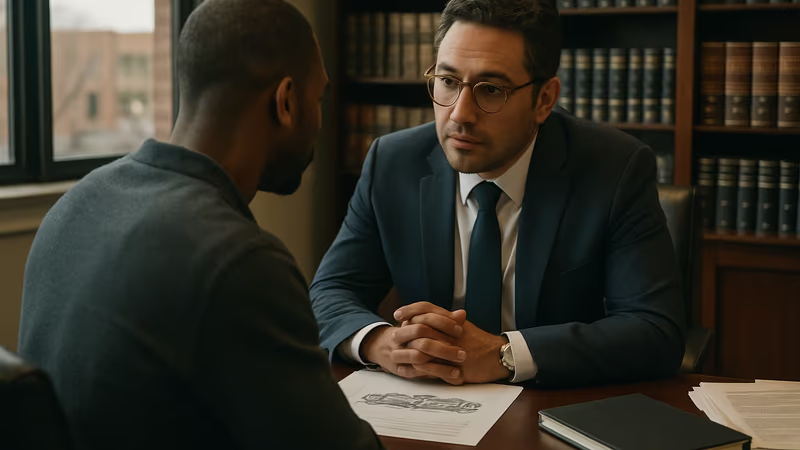
Cómo elegir un abogado de accidentes de tráfico
Guía completa para elegir un abogado de accidentes automovilísticos en Long Island.
Sep 12, 2024
NY Car Accident Post-Traumatic Arthritis Claims (2026)
Car accident joint injuries cause post-traumatic arthritis leading to joint replacement. NY law lets you claim future TKR costs — Long Island attorney.
Apr 5, 2026
Getting a Rental Car After a Car Accident in New York: Who Pays?
After a car accident in New York, who pays for your rental car?
Apr 4, 2026Was this article helpful?
Disclaimer: This article is published by the Law Office of Jason Tenenbaum, P.C. for informational and educational purposes only. It does not constitute legal advice, and no attorney-client relationship is formed by reading this content. The legal principles discussed may not apply to your specific situation, and the law may have changed since this article was last updated.
New York law varies by jurisdiction — court decisions in one Appellate Division department may not be followed in another, and local court rules in Nassau County Supreme Court differ from those in Suffolk County Supreme Court, Kings County Civil Court, or Queens County Supreme Court. The Appellate Division, Second Department (which covers Long Island, Brooklyn, Queens, and Staten Island) and the Appellate Term (which hears appeals from lower courts) each have distinct procedural requirements and precedents that affect litigation strategy.
If you need legal help with a car accidents matter, contact our office at (516) 750-0595 for a free consultation. We serve clients throughout Long Island (Huntington, Babylon, Islip, Brookhaven, Smithtown, Riverhead, Southampton, East Hampton), Nassau County (Hempstead, Garden City, Mineola, Great Neck, Manhasset, Freeport, Long Beach, Rockville Centre, Valley Stream, Westbury, Hicksville, Massapequa), Suffolk County (Hauppauge, Deer Park, Bay Shore, Central Islip, Patchogue, Brentwood), Queens, Brooklyn, Manhattan, the Bronx, Staten Island, and Westchester County. Prior results do not guarantee a similar outcome.