
Key Takeaway
How New York workers’ compensation and no-fault benefits interact after a work-related car accident, including notices, offsets and third-party claims.
This article is part of our ongoing no-fault coverage, with 271 published articles analyzing no-fault issues across New York State. Attorney Jason Tenenbaum brings 24+ years of hands-on experience to this analysis, drawing from his work on more than 1,000 appeals, over 100,000 no-fault cases, and recovery of over $100 million for clients throughout Nassau County, Suffolk County, Queens, Brooklyn, Manhattan, and the Bronx. For personalized legal advice about how these principles apply to your specific situation, contact our Long Island office at (516) 750-0595 for a free consultation.
A car crash during work can involve both workers’ compensation and no-fault insurance. The question is which benefits apply and how they coordinate—not which system lets you collect twice for the same loss.
This guide concerns work-related motor-vehicle injuries in New York. Wage-and-hour disputes and employment discrimination are separate subjects.
Which coverage pays first?
When workers’ compensation applies, it is generally the primary source of benefits for the work-related injury. No-fault may supplement eligible losses within its own limits and requirements.
Insurance Law § 5102(b)(2) deducts workers’ compensation benefits recovered or recoverable for the injury when determining first-party benefits.
Free Consultation · No Fee Unless We Win
Does this apply to your situation?
Every case is different. Get a free, confidential case review from an experienced attorney who can tell you exactly where you stand.
That is not a blanket rule that every worker loses all possible no-fault rights. Nor does an auto policy promise a second payment for expenses already covered by workers’ compensation.
Was the trip part of the job?
Record the purpose of the trip, who directed it, the work being performed and any personal detour. Vehicle ownership alone does not settle the employment question.
Coverage disputes may require a Workers’ Compensation Board determination. An employer’s label or an insurer’s assertion is not the same as a final finding.
The firm’s 2019 Workers Comp case note illustrates the Board’s role in a disputed no-fault claim. Read it as a historical procedural example, not a ruling about your employment.
Give notice to the right people
The notices are separate. Reporting a crash to an auto insurer does not notify the Board, and telling a supervisor does not complete a no-fault application.
The Board’s claim-filing instructions call for notice to the employer within 30 days and filing Form C-3 within two years of an accident.
Act promptly rather than treating those periods as waiting periods. Occupational-disease rules and exceptions need their own analysis.
DFS’s no-fault instructions generally require written accident notice within 30 days, with a stated exception for clear and reasonable justification for lateness.
Ask counsel which notices are needed where work status or coverage is disputed. Do not wait for one insurer to resolve the dispute before preserving the other claim.
Keep the two claims coordinated
Maintain a separate entry for each insurer and claim number. For each medical bill or period of lost wages, record:
- The date or period involved.
- The amount claimed and supporting document.
- The insurer receiving it and submission date.
- What was paid, denied or requested as verification.
- Any Board decision or pending coverage issue.
Give providers accurate work-injury information. The Board’s treatment guidance explains authorized-provider requirements and payment through workers’ compensation.
If benefits stop, get the written reason. A contested work connection, unpaid verification request and exhausted PIP limit require different responses. See what happens when no-fault runs out.
Can there also be a claim against another driver?
A claim against a responsible third party may exist alongside workers’ compensation. It is different from suing an employer or coworker and requires its own liability and deadline review.
Workers’ Compensation Law § 29 governs third-party remedies and includes lien, credit and settlement-consent provisions.
Subsection (1-a) contains an important exception for payments made in lieu of first-party no-fault benefits. It is inaccurate to describe every compensation payment as a lien on an auto-injury recovery.
Have counsel address any consent or court-approval requirement before signing a third-party release. Resolving the accident lawsuit can affect compensation rights; the systems should not be negotiated in isolation.
Getting the right review
A useful consultation starts with the accident facts, policy documents, employer information, claim correspondence, wage records and any Board papers.
The firm’s workers’ compensation practice and car-accident practice address different parts of that review.
For insurer-side coverage litigation, see no-fault defense. These links identify services, not a guarantee that a particular claim qualifies or can be accepted.
Legal Context
Why This Matters for Your Case
New York's no-fault insurance system, established under Insurance Law Article 51, is one of the most complex insurance frameworks in the country. Every motorist must carry Personal Injury Protection coverage that pays medical expenses and lost wages regardless of fault, up to $50,000 per person.
But insurers routinely deny valid claims using peer reviews, EUO scheduling tactics, fee schedule reductions, and coverage defenses. The Law Office of Jason Tenenbaum has handled over 100,000 no-fault cases since 2002 — from initial claim submissions through arbitration before the American Arbitration Association, trials in Civil Court and Supreme Court, and appeals to the Appellate Term and Appellate Division. Jason Tenenbaum is one of the few attorneys in the state who both writes his own appellate briefs and tries his own cases.
His 2,600+ published legal articles on no-fault practice are cited by attorneys throughout New York. Whether you are dealing with a medical necessity denial, an EUO no-show defense, a fee schedule dispute, or a coverage question, this article provides the kind of detailed case-law analysis that helps practitioners and claimants understand exactly where the law stands.
About This Topic
New York No-Fault Insurance Law
New York's no-fault insurance system requires every driver to carry Personal Injury Protection (PIP) coverage that pays medical expenses and lost wages regardless of who caused the accident. But insurers routinely deny, delay, and underpay valid claims — using peer reviews, IME no-shows, and fee schedule defenses to avoid paying providers and injured claimants. Attorney Jason Tenenbaum has litigated thousands of no-fault arbitrations and court cases since 2002.
271 published articles in No-Fault
Keep Reading
More No-Fault Analysis
Heat Stroke at Work in New York? You May Have a Claim
New York workers injured by heat stroke on construction sites or outdoor jobs may be entitled to compensation beyond workers' comp. Know your rights.
Jul 6, 2026
Car Accident Recorded Statement in New York: Should You Give One?
The at-fault driver's adjuster wants a recorded statement within days of a New York car accident — and that call is designed to weaken your case.
Apr 5, 2026
Illogical
New York appellate court highlights inconsistencies in no-fault insurance law regarding IME request timing and policy voiding procedures in healthcare provider billing disputes.
Mar 19, 2015
Reasonable excuse satisfied despite claim of lack of personal jurisdiction
Understanding reasonable excuse requirements for opening default judgments in New York courts. Expert legal guidance on CPLR procedure. Call (516) 750-0595.
Jan 26, 2010
Untimely 4404(a) motion
Court reinstated $1.2M verdict after defendants' untimely CPLR 4404(a) motion failed due to missing 15-day deadline without good cause shown for delay.
Apr 18, 2022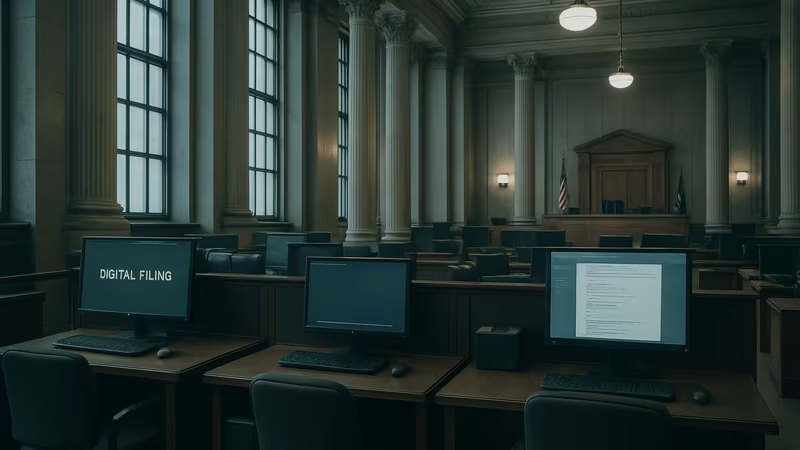
Opening Courts with an e-filing system in place? Nope.
New York courts resist e-filing despite pandemic push for modernization. Personal injury attorney critiques antiquated paper system and court inefficiencies.
May 26, 2020Was this article helpful?
Disclaimer: This article is published by the Law Office of Jason Tenenbaum, P.C. for informational and educational purposes only. It does not constitute legal advice, and no attorney-client relationship is formed by reading this content. The legal principles discussed may not apply to your specific situation, and the law may have changed since this article was last updated.
New York law varies by jurisdiction — court decisions in one Appellate Division department may not be followed in another, and local court rules in Nassau County Supreme Court differ from those in Suffolk County Supreme Court, Kings County Civil Court, or Queens County Supreme Court. The Appellate Division, Second Department (which covers Long Island, Brooklyn, Queens, and Staten Island) and the Appellate Term (which hears appeals from lower courts) each have distinct procedural requirements and precedents that affect litigation strategy.
If you need legal help with a no-fault matter, contact our office at (516) 750-0595 for a free consultation. We serve clients throughout Long Island (Huntington, Babylon, Islip, Brookhaven, Smithtown, Riverhead, Southampton, East Hampton), Nassau County (Hempstead, Garden City, Mineola, Great Neck, Manhasset, Freeport, Long Beach, Rockville Centre, Valley Stream, Westbury, Hicksville, Massapequa), Suffolk County (Hauppauge, Deer Park, Bay Shore, Central Islip, Patchogue, Brentwood), Queens, Brooklyn, Manhattan, the Bronx, Staten Island, and Westchester County. Prior results do not guarantee a similar outcome.