Key Takeaway
The Board rewrote its decision mid-appeal and the Third Department dismissed the appeal as moot. What it means for injured workers.
This article is part of our ongoing workers' compensation coverage, with 5 published articles analyzing workers' compensation issues across New York State. Attorney Jason Tenenbaum brings 24+ years of hands-on experience to this analysis, drawing from his work on more than 1,000 appeals, over 100,000 no-fault cases, and recovery of over $100 million for clients throughout Nassau County, Suffolk County, Queens, Brooklyn, Manhattan, and the Bronx. For personalized legal advice about how these principles apply to your specific situation, contact our Long Island office at (516) 750-0595 for a free consultation.
On September 10, 2026, the Appellate Division, Third Department, disposed of an employer’s appeal in a bus operator’s workers’ compensation case without saying a word about whether the operator deserved benefits.
The case is Matter of Parkinson v Manhattan & Bronx Surface Tr. Operating Auth., 2026 NY Slip Op 05246. The appeal was dismissed as moot because the Workers’ Compensation Board rewrote its own decision while the appeal was pending.
I handle workers’ compensation claims on Long Island, and this short decision matters for two reasons.
It shows how a Board amendment can end an appeal before any judge reaches the merits. And it points at why the Board rewrote its analysis: New York rewrote the law on psychological injury claims in 2025, and the change took effect June 4, 2025.
Free Consultation · No Fee Unless We Win
Does this apply to your situation?
Every case is different. Get a free, confidential case review from an experienced attorney who can tell you exactly where you stand.
The short version
A bus operator watched a cyclist killed in front of his bus and was awarded benefits for a psychological injury. The employer appealed. Before the court ruled, the Board issued an amended decision under a new legal analysis and established the claim again. The Third Department held the appeal moot: the amended decision superseded the one on appeal, and its merits can only be tested by a new appeal. The claim stands.
What happened in Parkinson
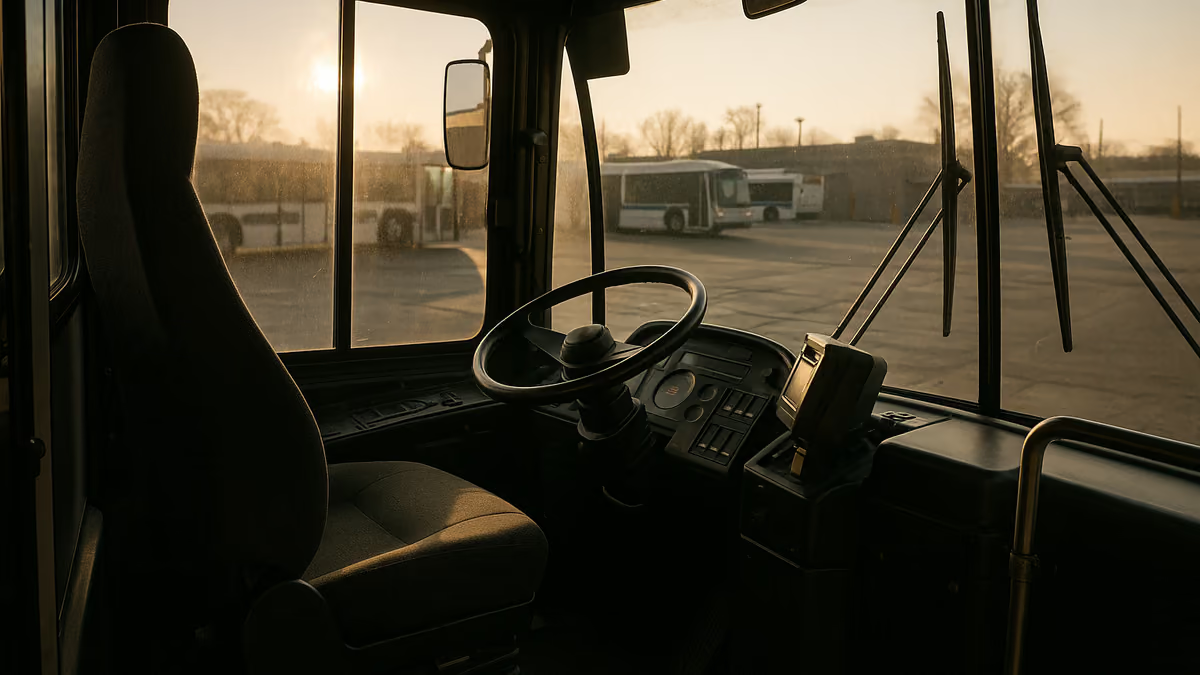
The claimant drove a bus for MaBSTOA, the MTA subsidiary that runs surface transit in Manhattan and the Bronx. Stopped at a traffic light, he watched a box truck run over and kill a bicyclist. He filed a claim for a psychological injury.
A Workers’ Compensation Law Judge established the claim. A Board panel affirmed in a decision filed March 26, 2025. The employer appealed to the Third Department, which hears every workers’ compensation appeal in the state.
The employer also asked for full Board review. On March 16, 2026, with the appeal still pending, the Board denied that request but amended and superseded its March 2025 decision.
The Board said it did so “to include additional relevant facts and clarify the [l]egal [a]nalysis that currently applies to” psychological injury claims. Under the new analysis, it established the claim again.
In an opinion by Justice Corcoran for a unanimous panel, the Third Department dismissed the appeal as moot. Both Board decisions reached the same result, but the 2026 decision “is not substantially similar to the one on appeal.”
The employer argued that the court should review the March 2026 decision anyway. The court declined: its merits “are not reviewable in this appeal,” citing CPLR 5517 and a 1966 case, Matter of Rubino v City of New York.
How an amended Board decision moots an appeal
An appeal is a challenge to one specific decision. When the body that issued it withdraws it and puts a different decision in its place, there is nothing left for the court to reverse.
The Board’s power to do that comes from Workers’ Compensation Law 123, which gives it continuing jurisdiction over every case and lets it modify its former findings and decisions.
The Third Department has treated the resulting appeals as moot before, in Matter of Loper v Suffolk County Water Auth. earlier this year and Matter of Djukanovic v Metropolitan Cleaning LLC in 2019.
CPLR 5517 is the civil-practice rule the court pointed to. Its first subdivision lists the later orders that do not affect a pending appeal, and the key one is an order on reargument that makes “the same or substantially the same determination” as the order under appeal.
That is where the opinion’s phrase comes from. A redecision that is substantially the same leaves the appeal alive, and the court can review both together. One built on a different legal analysis falls outside the rule, so the appeal from the old decision has nothing left to bite on, and the new decision can be reviewed only on an appeal from it.
An amendment that changes nothing of substance would not, by the court’s phrasing, moot an appeal. One that rests on a different legal analysis does, even when the bottom line is identical.
So what does the appellant do? Under Workers’ Compensation Law 23, an appeal from a Board decision must be taken within 30 days after notice of the decision is served. An amended decision starts that clock again.
The employer’s remedy was a new appeal from the March 2026 decision. Nothing in the September opinion says whether it filed one.
What this means for injured workers and for carriers
For a claimant, the lesson is reassuring. The claim in Parkinson is established, and the appeal that sought to unwind it is gone without any court examining the evidence.
An appeal also does not, by itself, stop payment under an award. Section 23 says so. A carrier that wants payments held has to ask for a stay.
For employers and carriers, Parkinson is a warning about chasing a moving target. The Board can amend while the appeal is pending, and when it does, a year of briefing evaporates.
The only safe response is to treat every amended decision as a new event, calendar the 30 days, and appeal it. The employer here ran both tracks at once, an appeal to the court and a request for full Board review. That is common practice, and this case shows the risk in it: the Board answered the request by rewriting the decision.
Why the Board rewrote its analysis: the 2026 change to WCL 10(3)
The Board’s amended decision is not published in the official reporter, and the Third Department quoted only one phrase of it. So I cannot tell you what it says.
But the phrase the court quoted, “the legal analysis that currently applies to” psychological injury claims, points at a statute that changed while the case was pending. Paragraph (c) of Workers’ Compensation Law 10(3) took effect June 4, 2025, after the Board’s first decision and before its second. The amended decision is presumably keyed to it.
New York has recognized mental injury from work trauma for fifty years. In Matter of Wolfe v Sibley, Lindsay & Curr Co. (1975), the Court of Appeals held that a secretary who found her supervisor dead by suicide had a compensable injury.
What followed was a limiting test. For most workers, a mental injury claim could be disallowed on a finding that the stress was not greater than what usually occurs in the normal work environment.
Police officers, firefighters, EMTs, paramedics and dispatchers were carved out first: under WCL 10(3)(b), that finding cannot defeat their claims for mental injury from extraordinary stress in a work-related emergency.
Then came S.6635/A.5745, signed December 6, 2024 as Chapter 546, which the Governor’s office described as extending PTSD protection beyond first responders to all workers.
A negotiated chapter amendment, S.755 (Chapter 79 of 2025, signed February 14, 2025), named the covered diagnoses, added the DSM and distinct-event requirements, and moved the effective date to the 180th day after the original signing: June 4, 2025. The result is paragraph (c) of section 10(3).
Mental injury claims: before and after June 4, 2025
| Question | Before June 4, 2025 (non-first-responders) | WCL 10(3)(c), from June 4, 2025 |
|---|---|---|
| Is mental injury compensable? | Yes, since Wolfe v Sibley (1975) | Yes, unchanged |
| Can the Board disallow because the stress was no greater than the normal work environment? | Yes; the usual defense | No, for PTSD, acute stress disorder or major depressive disorder |
| Medical proof | Causally related diagnosis | Medical evidence based on the DSM criteria in effect on the date of accident |
| What the worker must show | Stress beyond what similarly situated workers face | Extraordinary stress attributable to a distinct work-related event during job duties |
| Mental injury caused by a physical injury | Consequential injury, ordinary rules | Same; paragraph (d) keeps (b) and (c) out of those claims |
Two limits stay. Paragraph (d) keeps (b) and (c) away from mental injury that flows from a physical injury; those are consequential-injury claims under the ordinary rules.
And Workers’ Compensation Law 2(7) still excludes a purely mental injury caused by a good-faith personnel decision such as discipline, evaluation, transfer, demotion or termination.
A bus operator who watches a cyclist die in front of him is the template paragraph (c) was written for: a distinct event, during his duties, extraordinary by any measure.
The claim in Parkinson was established twice, in March 2025 before paragraph (c) took effect and in March 2026 after. The Board’s own amended decision shows it applying the current analysis to a claim that predates the change. Whether that is right is exactly the question the court did not reach.
If you witnessed something traumatic on the job
The workers I see with these claims are bus operators, construction crews who watched a fall, nurses and aides after an assault, retail and restaurant workers after a robbery.
- Tell your employer in writing within 30 days. Workers' Compensation Law 18 requires written notice; the Board can excuse a late one, but do not test it. Keep a copy.
- Get the incident report. Transit operators file one the same shift; construction sites keep a log; hospitals have an event report. Keep a copy.
- See a psychiatrist or psychologist promptly and ask for a DSM-based diagnosis. Paragraph (c) is keyed to PTSD, acute stress disorder and major depressive disorder. A primary-care note that says "stress" is not enough.
- File the C-3 with the Board within two years of the accident (Workers' Compensation Law 28). Do not wait for the employer or the carrier to do it.
- Expect an independent medical examination by a carrier-selected psychiatrist. Go, be consistent with what you told your own provider, and do not minimize.
- Disclose prior mental health treatment. The carrier will find it, and an omission is the fastest route to a section 114-a fraud finding. Our post on prior injury disclosure explains where that line sits.
- Understand that the employer can appeal within 30 days at each stage, and that an award keeps paying during the appeal unless a stay is granted.
Two footnotes for Long Island readers. LIRR train crews are railroad employees; their injury claims run under the federal FELA statute, not New York workers’ compensation, with different deadlines and proof.
And if you work out of a western Suffolk depot, our Babylon workers’ compensation page covers the local side of the process.
Deadlines in this system are unforgiving in both directions. The WTC-12 registration deadline is the example I point clients to most often.
The cyclist’s family and any passengers on that bus have claims of their own against the truck driver and, depending on the facts, the transit authority. Our MTA bus accident guide covers that side.
What to watch
Accidents before June 4, 2025. The Board appears to be applying paragraph (c) to claims that were already pending, and Parkinson is an example. No appellate court has said whether that is correct.
“Distinct work-related event.” Expect carriers to litigate this phrase and the diagnosis. A discrete traumatic event fits; burnout or a difficult supervisor may not, and an adjustment-disorder diagnosis may fall back under the old test.
Parkinson’s merits. If the employer appealed the March 2026 decision, the Third Department will eventually say something about paragraph (c). That would be an early appellate word on the new statute.
Sources
- Matter of Parkinson v Manhattan & Bronx Surface Tr. Operating Auth., 2026 NY Slip Op 05246 (3d Dept Sept. 10, 2026): full text on Justia
- Workers’ Compensation Law 10, subdivision 3: nysenate.gov
- Workers’ Compensation Law 23, appeals: nysenate.gov
- CPLR 5517, subsequent orders: nysenate.gov
- S.6635/A.5745 (Chapter 546 of 2024): nysenate.gov; chapter amendment S.755 (Chapter 79 of 2025, effective-date change): nysenate.gov
- Governor Hochul’s December 6, 2024 release on the PTSD legislation: governor.ny.gov
The employer in Parkinson spent a year and a half appealing a decision that no longer exists. The bus operator’s claim never stopped being established. Sometimes the procedure is the whole case.
Call 516-750-0595 or request a free case review if you were hurt, or saw something you cannot shake, on the job in New York.
Legal Context
Why This Matters for Your Case
Personal injury law in New York is governed by a complex web of statutes, case law, and procedural rules that differ from most other states. The statute of limitations for most personal injury claims is three years under CPLR 214(5), but claims against municipalities require a Notice of Claim within 90 days. Motor vehicle accident victims must meet the serious injury threshold under Insurance Law §5102(d) before they can recover pain and suffering damages.
The Law Office of Jason Tenenbaum has recovered over $100 million for injured clients across Long Island, Nassau County, Suffolk County, Queens, Brooklyn, Manhattan, and the Bronx. With 24+ years of trial and appellate experience, more than 1,000 appeals written, and 2,600+ published legal articles, Jason Tenenbaum provides the authoritative legal analysis that practitioners and injury victims need to understand their rights.
This article reflects real courtroom experience and a deep understanding of how New York courts actually evaluate personal injury claims — from the initial filing through discovery, summary judgment, trial, and appeal.
About This Topic
Workers Compensation Law in New York
New York's workers compensation system provides benefits for employees injured on the job, covering medical treatment, lost wages, and disability payments regardless of fault. But navigating the Workers Compensation Board process, understanding benefit calculations, and overcoming employer and insurer challenges requires experienced legal guidance. These articles analyze workers compensation case law, the intersection of workers comp with personal injury claims, and the procedural requirements that govern the system.
5 published articles in Workers' Compensation
Keep Reading
More Workers' Compensation Analysis

Long Island Pedestrian Crashes After Dark: State Data Before the Clocks Change
From November through January, 485 of 520 evening pedestrian crashes in Nassau and Suffolk happened in the dark. State and federal data, with the CSV files.
Oct 8, 2026
Can New York Be Liable for a Parkway Crash Where There Was No Median Barrier?
A Patchogue family says a Bethpage Parkway crossover crash was preventable. What a claim against the State needs: notice, design immunity, and the 90-day clock.
Oct 2, 2026
Rear-End Accident Settlement in New York: What Your Case Is Worth
Rear-ended on Long Island? The rear driver is almost always liable under New York law.
Apr 4, 2026
Expert Witness in Car Accident Lawsuits
Learn how expert witnesses in New York car accident lawsuits help establish fault, causation, and damages through accident reconstruction, medical testimony, and economic analysis.
May 14, 2025
From Medical Error to Legal Action: Your Guide to Malpractice Claims
Learn about medical malpractice causes, legal steps, and patient rights. Expert guide from a trusted NY law firm. Free case review.
Jan 13, 2025Suing Your Building for Legionnaires' Disease in NY
Can you sue a building for Legionnaires' disease in New York? How cooling-tower outbreaks are traced, who is liable, what you must prove, and the deadlines.
Jul 15, 2026Frequently Asked Questions
Common Questions About This Topic
7 answers from the firm's New York personal-injury and employment-law practice. Click any question to expand.
What does it mean when a workers' comp appeal is dismissed as moot?
The decision under appeal was replaced, so there was nothing left to review. In *Parkinson* the Board amended and superseded its decision, the appeal was dismissed without reaching the merits, and the claim stayed established.
Can my employer appeal after the Board establishes my claim?
Yes. Under Workers' Compensation Law 23, any party can appeal a Board decision to the Appellate Division, Third Department, within 30 days after notice of the decision is served.
Does an employer's appeal stop my benefits?
Not by itself. Section 23 provides that an appeal does not operate as a stay of the compensation required by the award. A carrier that wants payments held has to apply for a stay.
What is CPLR 5517?
The civil-practice rule on how later orders affect a pending appeal. A later order that makes the same or substantially the same determination leaves the appeal intact and can be reviewed with it. A superseding decision built on a different analysis does not fit that rule, so it can be reviewed only on its own appeal. The Third Department applied that logic here.
Can I get workers' compensation for PTSD after witnessing a death at work in New York?
Yes, with proof. Since June 4, 2025, WCL 10(3)(c) bars the Board from rejecting a PTSD, acute stress disorder or major depressive disorder claim as ordinary job stress, given DSM-based medical evidence and a distinct work-related event.
What counts as a "distinct work-related event"?
The statute requires an event or events directly related to the employment and occurring during job duties, nothing more. A fatal crash, an assault or a fall are clear cases; cumulative stress with no identifiable event is contested ground.
I work for the LIRR. Does this apply to me?
Probably not. Railroad workers' injury claims, including psychological ones, fall under the federal FELA statute, not New York workers' compensation. MTA bus operators, including MaBSTOA's, are in the workers' compensation system.
Was this article helpful?
Disclaimer: This article is published by the Law Office of Jason Tenenbaum, P.C. for informational and educational purposes only. It does not constitute legal advice, and no attorney-client relationship is formed by reading this content. The legal principles discussed may not apply to your specific situation, and the law may have changed since this article was last updated.
New York law varies by jurisdiction — court decisions in one Appellate Division department may not be followed in another, and local court rules in Nassau County Supreme Court differ from those in Suffolk County Supreme Court, Kings County Civil Court, or Queens County Supreme Court. The Appellate Division, Second Department (which covers Long Island, Brooklyn, Queens, and Staten Island) and the Appellate Term (which hears appeals from lower courts) each have distinct procedural requirements and precedents that affect litigation strategy.
If you need legal help with a workers' compensation matter, contact our office at (516) 750-0595 for a free consultation. We serve clients throughout Long Island (Huntington, Babylon, Islip, Brookhaven, Smithtown, Riverhead, Southampton, East Hampton), Nassau County (Hempstead, Garden City, Mineola, Great Neck, Manhasset, Freeport, Long Beach, Rockville Centre, Valley Stream, Westbury, Hicksville, Massapequa), Suffolk County (Hauppauge, Deer Park, Bay Shore, Central Islip, Patchogue, Brentwood), Queens, Brooklyn, Manhattan, the Bronx, Staten Island, and Westchester County. Prior results do not guarantee a similar outcome.