Key Takeaway
New York workers injured by heat illness on construction sites or outdoor jobs may be entitled to compensation.
This article is part of our ongoing personal injury coverage, with 180 published articles analyzing personal injury issues across New York State. Attorney Jason Tenenbaum brings 24+ years of hands-on experience to this analysis, drawing from his work on more than 1,000 appeals, over 100,000 no-fault cases, and recovery of over $100 million for clients throughout Nassau County, Suffolk County, Queens, Brooklyn, Manhattan, and the Bronx. For personalized legal advice about how these principles apply to your specific situation, contact our Long Island office at (516) 750-0595 for a free consultation.
It happens every July and August on Long Island and throughout New York City: workers on construction sites, delivery routes, rooftops, and outdoor worksites are pushed past their physical limits in dangerous heat — and some of them don’t make it home the same way they left.
Heat stroke, heat exhaustion, and heat illness are entirely preventable. When they happen on a New York job site, they are often the result of employer negligence — a failure to provide shade, water, rest breaks, or proper safety training. And in New York, employer negligence on a job site can mean legal liability that goes far beyond a standard workers’ compensation claim.
If you or a family member was seriously injured — or killed — due to heat exposure while working in New York, here is what you need to understand about your rights.
Why Summer 2026 Is Particularly Dangerous for New York Workers
Extreme heat events in the Northeast have become more frequent and more severe. The first week of July 2026 is already tracking above historical averages across Long Island, Queens, Brooklyn, and the Bronx. Heat index readings — combining temperature and humidity — are reaching dangerous levels that exceed the human body’s ability to cool itself through sweating.
Free Consultation · No Fee Unless We Win
Does this apply to your situation?
Every case is different. Get a free, confidential case review from an experienced attorney who can tell you exactly where you stand.
For outdoor workers, this is not an inconvenience. It is a life-threatening hazard.
The workers most at risk include:
- Construction laborers working on rooftops, in direct sun, and in areas without shade
- Delivery workers making multiple stops throughout the day, often without access to air conditioning between stops
- Landscaping and agricultural workers in Nassau and Suffolk Counties
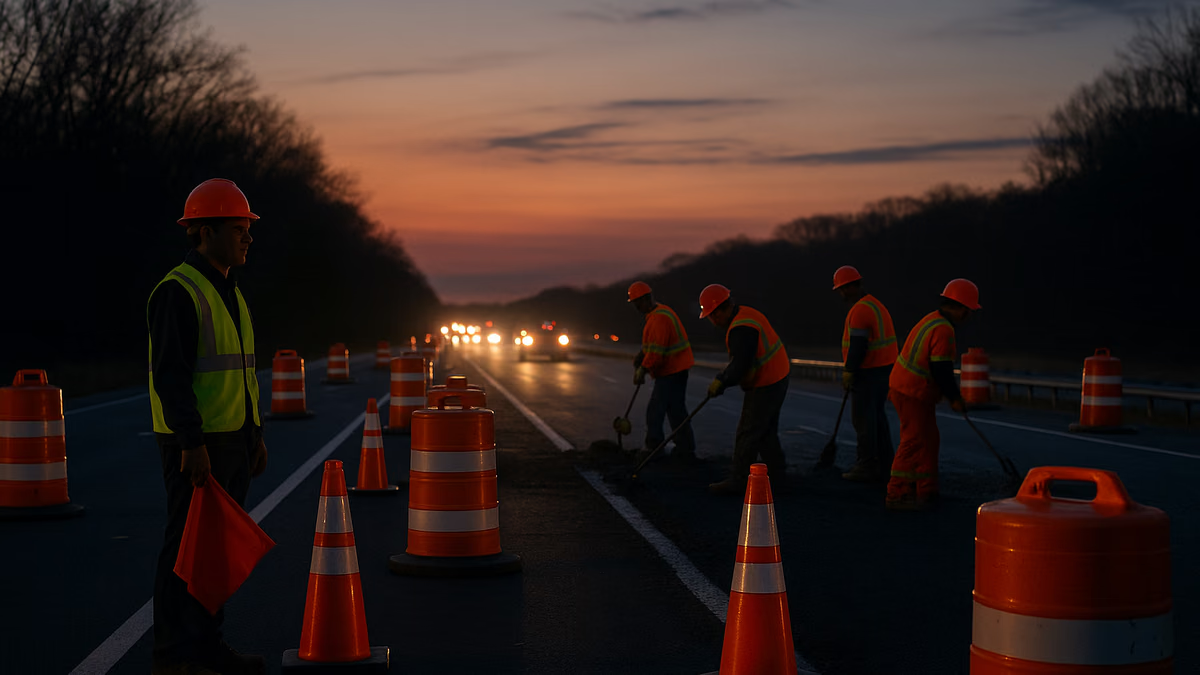
- Road and utility workers on asphalt surfaces that can exceed 140°F on hot days
- Warehouse workers in facilities without adequate ventilation or cooling
- Home care aides who may work in residences without functioning air conditioning
What Is Heat Stroke — and Why It’s a Medical Emergency
Heat illness exists on a spectrum. Understanding the difference matters for both your health and your legal claim.
Heat Cramps
Muscle pain and spasms caused by heavy sweating and electrolyte loss. Usually the first sign that your body is struggling to cope with heat.
Heat Exhaustion
Heavy sweating, pale skin, fast and weak pulse, nausea or vomiting, and possible fainting. Heat exhaustion is serious and requires immediate treatment — move to a cool area, hydrate, and rest. Untreated, it rapidly progresses to heat stroke.
Heat Stroke
Heat stroke is a medical emergency. It occurs when your body temperature rises above 103°F and your body’s cooling mechanisms fail. Symptoms include:
- High body temperature (103°F or above)
- Hot, red, dry, or damp skin
- Rapid, strong pulse
- Confusion, disorientation, loss of consciousness
Heat stroke can cause permanent organ damage and death. It requires immediate emergency medical attention. Call 911.
If you or a coworker show signs of heat stroke at a job site, do not wait and see — call for emergency help immediately.
OSHA Requirements and New York State Employer Duties
Under federal OSHA’s General Duty Clause, employers are required to provide a workplace free from recognized hazards — and extreme heat is absolutely a recognized hazard. While federal OSHA has been working toward a specific heat illness prevention standard, New York State has additional protections in place.
New York State OSHA requires outdoor employers to:
- Provide cool drinking water — at least one quart per worker per hour during high heat conditions
- Allow rest breaks in a cool or shaded area during high heat periods (heat index above 80°F triggers heightened requirements)
- Provide acclimatization — gradually introducing new or returning workers to heat over a period of days, not immediately throwing them into full work schedules in dangerous conditions
- Train supervisors and workers to recognize signs of heat illness and take appropriate action
- Have emergency procedures in place, including knowing when to call 911
When an employer fails any of these duties and a worker is seriously injured, the employer may face not only OSHA citations and fines — but civil liability for the injuries caused.
New York Labor Law: More Than Just Workers’ Comp
Workers’ compensation is often the first thing workers think about after a job site injury — and it’s an important protection. Workers’ comp pays for medical expenses and a portion of lost wages regardless of fault. But workers’ compensation has significant limitations: it doesn’t cover full lost wages, pain and suffering, or your family’s losses if you’re killed.
In New York, construction workers and workers at certain job sites have additional legal rights that go beyond workers’ comp. These include:
Labor Law § 200
New York Labor Law Section 200 is a codification of the common law duty of owners and general contractors to maintain a safe workplace. If a property owner, general contractor, or construction manager knew or should have known about dangerous heat conditions and failed to address them, they may be liable under Labor Law § 200 for your injuries — even if you were employed by a subcontractor.
Labor Law § 241(6)
Labor Law § 241(6) provides that owners and general contractors are liable for injuries to construction workers caused by violations of specific safety regulations. New York Industrial Code Rule 23 (governing construction site safety) contains provisions that may be implicated by heat-related injuries, particularly when combined with physical exertion and inadequate safety planning.
Third-Party Claims
If your injury was caused in whole or in part by the negligence of someone other than your direct employer — such as a property owner, general contractor, site safety manager, or equipment manufacturer — you may have a third-party personal injury claim in addition to your workers’ compensation claim. A successful third-party lawsuit can recover damages that workers’ comp does not cover, including:
- Full lost wages (not just two-thirds)
- Pain and suffering
- Loss of enjoyment of life
- Medical expenses not covered by workers’ comp
- Damages to your family (if your injury affects your ability to care for or be present with them)
- Wrongful death damages if the injury was fatal
What Steps Should You Take After a Heat Illness Injury at Work?
1. Seek Emergency Medical Attention Immediately
Heat stroke is life-threatening. Get emergency help. Don’t let a supervisor convince you to “wait and see” or “drink some water.” This is a 911 situation.
2. Report the Injury to Your Employer
As soon as you are medically stable, report the injury in writing to your employer. Under New York workers’ compensation law, you must notify your employer within 30 days of a work injury.
3. Document the Conditions
If possible before leaving the scene — or as soon as you can afterward — document the conditions that contributed to your illness:
- Was shade available? Was it accessible?
- Was cool water provided? Was it close to your work area?
- Had you or coworkers complained about the heat that day?
- Were there any work slowdowns or rest breaks offered?
- What was the temperature and heat index that day? (Weather data can be retrieved later)
- Did any supervisor direct you to keep working despite the heat?
Photographs and witness statements can be powerful evidence later.
4. File a Workers’ Compensation Claim
File a C-3 Employee Claim with the New York State Workers’ Compensation Board. You have two years from the date of injury to file, but don’t wait — file as soon as possible.
5. Consult a Personal Injury Attorney About a Third-Party Claim
If your injury was serious and involved a construction site, property owner, or general contractor other than your direct employer, speak with a personal injury attorney immediately. The statute of limitations for a Labor Law personal injury claim in New York is generally three years — but evidence can disappear quickly, witnesses move on, and OSHA inspection reports may only be available for a limited time.
Can I Sue if I Was on a Construction Site and Got Heat Stroke?
If you were working at a construction site in New York, the answer is often yes — you may have claims against the property owner and general contractor in addition to your workers’ comp claim. New York’s Labor Law is among the strongest in the country in this regard.
Construction workers are not limited to the exclusive remedy of workers’ compensation when third parties (owners, GCs) contributed to their injuries. An experienced construction accident attorney can analyze the parties involved, the specific site conditions, and the applicable regulations to determine whether a third-party claim is viable.
Contact a New York Construction Accident and Personal Injury Attorney
Summer heat kills and seriously injures New York workers every year. In many of these cases, the employers and property owners responsible for providing a safe working environment simply did not take the steps required by law.
If you or someone you love suffered heat stroke, heat exhaustion, or another serious heat illness while working on Long Island or in New York City, the Law Offices of Jason Tenenbaum is here to help.
Our team represents injured workers throughout Nassau County, Suffolk County, Queens, Brooklyn, the Bronx, Manhattan, and Staten Island. We handle construction accidents and serious personal injury claims on a contingency fee basis — meaning you pay nothing unless we win.
Call 516-750-0595 for a free, confidential consultation. We will evaluate your claim, explain your rights, and fight to get you the compensation you deserve.
Learn more about our personal injury practice and our construction accident representation.
Related Practice Areas
For a deeper dive into the firm’s coverage of related topics:
Authoritative External Resources
- New York State Department of Motor Vehicles — Crash Reports — accident report retrieval and crash statistics
- New York State Senate — Consolidated Laws — official text of CPLR, EPTL, Labor Law, and Insurance Law
Free Consultation — Talk to a New York Attorney
The Law Office of Jason Tenenbaum, P.C. has recovered more than $100 million for clients across personal injury, employment, and no-fault matters since 2002. We work on contingency — no fee unless we win — and the initial consultation is free.
- Call (516) 750-0595 (Mon–Fri 9am–5pm; 24/7 emergency line)
- Use the secure online contact form
The firm is licensed in New York State only. Nothing in this article constitutes legal advice; everything is provided for informational purposes.
Last reviewed: 2026-07-06.
Legal Context
Why This Matters for Your Case
Personal injury law in New York is governed by a complex web of statutes, case law, and procedural rules that differ from most other states. The statute of limitations for most personal injury claims is three years under CPLR 214(5), but claims against municipalities require a Notice of Claim within 90 days. Motor vehicle accident victims must meet the serious injury threshold under Insurance Law §5102(d) before they can recover pain and suffering damages.
The Law Office of Jason Tenenbaum has recovered over $100 million for injured clients across Long Island, Nassau County, Suffolk County, Queens, Brooklyn, Manhattan, and the Bronx. With 24+ years of trial and appellate experience, more than 1,000 appeals written, and 2,600+ published legal articles, Jason Tenenbaum provides the authoritative legal analysis that practitioners and injury victims need to understand their rights.
This article reflects real courtroom experience and a deep understanding of how New York courts actually evaluate personal injury claims — from the initial filing through discovery, summary judgment, trial, and appeal.
About This Topic
New York Personal Injury Law
When negligence causes serious injury, New York law entitles victims to compensation for medical bills, lost income, pain and suffering, and more. From car accidents and slip-and-falls to construction injuries and medical malpractice, the Law Office of Jason Tenenbaum has recovered over $100 million for injured Long Islanders and New Yorkers since 2002.
180 published articles in Personal Injury
Keep Reading
More Personal Injury Analysis

Nassau Police Ordered to Pay $34,690.50 in FOIL Fees: What Meyer Means After a Crash
The Second Department raised a FOIL fee award against the Nassau County Police Department from $12,000 to $34,690.50. The statute, the math, and the FOIL clock.
Oct 8, 2026
Long Island Pedestrian Crashes After Dark: State Data Before the Clocks Change
From November through January, 485 of 520 evening pedestrian crashes in Nassau and Suffolk happened in the dark. State and federal data, with the CSV files.
Oct 8, 2026
Litigation Funding Disclosure in New York: What Lituma v. Liberty Coca-Cola Means for Both Bars — and for Injured Clients
A NY appellate court allowed defendants to discover third-party litigation funding in a personal injury suit. What Lituma means for both bars and claimants.
Jun 14, 2026
How Much Is a Car Accident Settlement Worth in New York?
Car accident settlements in New York range from $15,000 to over $5 million.
Apr 4, 2026
NY Dental & TMJ Car Accident Settlement Values (2026)
NY car accident dental injuries, TMJ disorders & jaw fractures — settlement values, §5102(d) threshold, and implant costs. Long Island attorney.
Apr 4, 2025
The existence of a workers compensation award is lack of coverage
Court rules workers compensation award creates coverage defense in no-fault cases, changing how insurers can challenge medical billing claims under NY law.
Nov 19, 2018Frequently Asked Questions
Common Questions About This Topic
6 answers from the firm's New York personal-injury and employment-law practice. Click any question to expand.
Can I be fired for refusing to work in dangerous heat?
Under New York law, workers may have the right to refuse work that poses an imminent danger to their health or safety. OSHA's regulations also protect workers from retaliation for reporting unsafe conditions. If you were threatened, disciplined, or fired for raising heat safety concerns, speak with an employment attorney — this may constitute unlawful retaliation.
What if I wasn't on a construction site — can I still make a claim?
Yes. Any New York worker seriously injured due to heat exposure may have a workers' compensation claim. And depending on the circumstances — for example, if your employer was negligent in a way that went beyond ordinary employment risk — additional claims may be available. An attorney can evaluate your specific situation.
Does workers' comp cover heat stroke in New York?
Yes. Heat stroke and heat illness suffered on the job are covered workplace injuries under New York workers' compensation law. Medical treatment and partial wage replacement are available through the workers' comp system regardless of fault.
What if a coworker died from heat stroke on our job site?
Your family may have a wrongful death claim. New York's wrongful death statute allows the estate and surviving family members to recover damages including medical expenses prior to death, lost financial support the worker would have provided, and funeral and burial costs. An attorney can advise the family on the claims available and the parties who may be liable.
How long do I have to file a heat illness lawsuit in New York?
For a standard personal injury claim against a third party (such as a property owner), the statute of limitations is generally three years from the date of injury. For construction accidents involving Labor Law claims, the same three-year period typically applies. However, if the claim is against a municipality or government entity, the deadline may be as short as 90 days for a notice of claim, so act quickly.
I don't speak English well. Can I still make a claim?
Absolutely. Your immigration status and language do not affect your right to workers' compensation or your right to sue for personal injury in New York. Many law firms, including ours, can communicate with clients in multiple languages or work with interpreters. ---
Was this article helpful?
Disclaimer: This article is published by the Law Office of Jason Tenenbaum, P.C. for informational and educational purposes only. It does not constitute legal advice, and no attorney-client relationship is formed by reading this content. The legal principles discussed may not apply to your specific situation, and the law may have changed since this article was last updated.
New York law varies by jurisdiction — court decisions in one Appellate Division department may not be followed in another, and local court rules in Nassau County Supreme Court differ from those in Suffolk County Supreme Court, Kings County Civil Court, or Queens County Supreme Court. The Appellate Division, Second Department (which covers Long Island, Brooklyn, Queens, and Staten Island) and the Appellate Term (which hears appeals from lower courts) each have distinct procedural requirements and precedents that affect litigation strategy.
If you need legal help with a personal injury matter, contact our office at (516) 750-0595 for a free consultation. We serve clients throughout Long Island (Huntington, Babylon, Islip, Brookhaven, Smithtown, Riverhead, Southampton, East Hampton), Nassau County (Hempstead, Garden City, Mineola, Great Neck, Manhasset, Freeport, Long Beach, Rockville Centre, Valley Stream, Westbury, Hicksville, Massapequa), Suffolk County (Hauppauge, Deer Park, Bay Shore, Central Islip, Patchogue, Brentwood), Queens, Brooklyn, Manhattan, the Bronx, Staten Island, and Westchester County. Prior results do not guarantee a similar outcome.