Key Takeaway
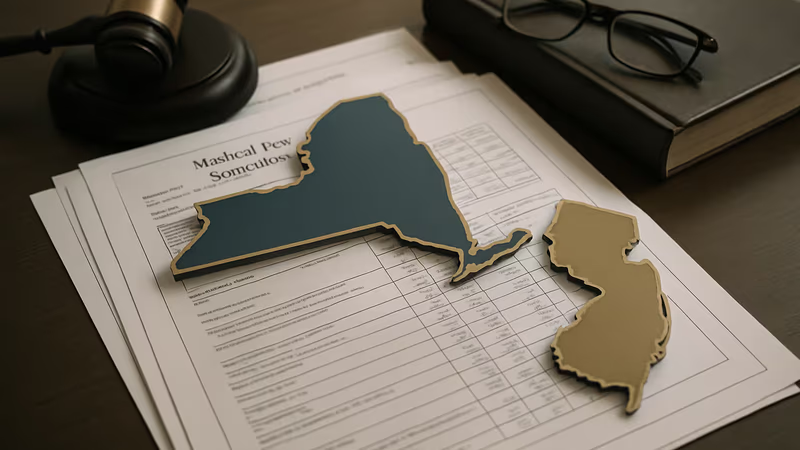
Excel Surgery v Metropolitan: a 2015 New Jersey treatment bill, coder proof and why the 2018 out-of-state amendment changes the current comparison.
This article is part of our ongoing fee schedule coverage, with 118 published articles analyzing fee schedule issues across New York State. Attorney Jason Tenenbaum brings 24+ years of hands-on experience to this analysis, drawing from his work on more than 1,000 appeals, over 100,000 no-fault cases, and recovery of over $100 million for clients throughout Nassau County, Suffolk County, Queens, Brooklyn, Manhattan, and the Bronx. For personalized legal advice about how these principles apply to your specific situation, contact our Long Island office at (516) 750-0595 for a free consultation.
The treatment date is the detail to keep in view: February 9, 2015. Excel Surgery Center v Metropolitan, 2019 NY Slip Op 51843(U), decided November 15, 2019, concerned that New Jersey service, not treatment governed by every later version of the out-of-state reimbursement rule.
Historical note: Excel Surgery concerns 2015 services; the January 23, 2018 out-of-state amendment described by DFS adds a comparison and exceptions that must be considered for later treatment.
Last reviewed: September 2026.
What supported the insurer’s judgment
The insurer’s certified coder explained payment under New Jersey’s automobile medical fee schedule. The provider’s opposing attorney affirmation did not establish personal knowledge or raise a triable factual issue. The Appellate Term, Second Department, affirmed summary judgment for the insurer.
Free Consultation · No Fee Unless We Win
Does this apply to your situation?
Every case is different. Get a free, confidential case review from an experienced attorney who can tell you exactly where you stand.
Because the services followed April 1, 2013, the court held that proof of a timely denial was not required to preserve this excessive-fee defense. That conclusion did not dispense with proof of the correct charge or extend to every other denial ground.
The later out-of-state rule
The DFS Regulation 83 FAQ identifies the amendment effective January 23, 2018. Its general comparison uses the lowest of the highest applicable New York regional schedule amount, the billed charge and the provider’s local prevailing fee.
DFS also identifies exceptions for emergency care, non-New York residents and New York residents living out of state for reasons unrelated to treatment. Those exceptions compare the bill with the local prevailing fee. The facts therefore matter; “New Jersey treatment always means the New Jersey schedule” is too broad.
This is an assigned no-fault reimbursement case, not an award valuing an injured person’s tort claim. The use of a workers’ compensation schedule does not turn it into a workers’ compensation proceeding.
Connect to the Encyclopedia
Start with the fee-schedule defense hub. Related case notes:
- Urban Well: coding corrections and separate necessity proof.
- OS Tigris: an unsupported fee-schedule defense.
- Great Wall: the split result in the August 2009 appeal.
- Precious Acupuncture: coder proof and post-2013 preclusion.
- Quality Comprehensive: fee proof supported only partial dismissal.
For review of a particular no-fault billing dispute, contact the Law Office of Jason Tenenbaum. Bring the bill, service dates, denial and payment calculation.
Legal Context
Why This Matters for Your Case
New York law is among the most complex and nuanced in the country, with distinct procedural rules, substantive doctrines, and court systems that differ significantly from other jurisdictions. The Civil Practice Law and Rules (CPLR) governs every stage of civil litigation, from service of process through trial and appeal. The Appellate Division, Appellate Term, and Court of Appeals create a rich and ever-evolving body of case law that practitioners must follow.
Attorney Jason Tenenbaum has practiced across these areas for over 24 years, writing more than 1,000 appellate briefs and publishing over 2,600 legal articles that attorneys and clients rely on for guidance. The analysis in this article reflects real courtroom experience — from motion practice in Civil Court and Supreme Court to oral arguments before the Appellate Division — and a deep understanding of how New York courts actually apply the law in practice.
About This Topic
Fee Schedule Issues in No-Fault Insurance
The New York no-fault fee schedule establishes the maximum reimbursement rates for medical treatment provided to injured motorists. Disputes over fee schedule calculations, coding, usual and customary charges, and the applicability of workers compensation fee schedules to no-fault claims are common. These articles analyze fee schedule regulations, court decisions on reimbursement disputes, and the practical challenges providers face in obtaining appropriate payment under the no-fault system.
118 published articles in Fee Schedule
Keep Reading
More Fee Schedule Analysis

Acupuncture Reimbursements and Insurance Legalities Explained
Explore the Forrest Chen v. GEICO case and its impact on acupuncture insurance reimbursements in NY. Key insights for providers and patients.
Dec 11, 2024
Simple addition is insufficient
Jodi Jacobs's 2021 mixed appeal: four claims dismissed, one fee balance unresolved, and why the schedule alone did not prove correct code use.
May 22, 2021
PT Fee schedule denial not substantiated
New York court ruling highlights insurance carriers must properly authenticate documents when denying physical therapy claims under fee schedule limits.
Mar 17, 2021
A new 68.6 is coming next year
New Jersey implements crucial no-fault insurance fee schedule regulation 68.6 in 2018, addressing long-standing billing inconsistencies and overbilling practices.
Oct 10, 2017
First application of 11 NYCRR 65-3.8(g)(1)(ii)
Saddle Brook Surgicenter: a late fee-schedule denial survived in 2015. Follow the appellate history, payment proof and later out-of-state billing rule.
Apr 8, 2015
Denial and EOB is sufficient to preserve fee schedule defense
New York court rules that denial letters with EOB forms adequately preserve fee schedule defenses in no-fault insurance disputes, even without explicit notice requirements.
May 5, 2012Frequently Asked Questions
Common Questions About This Topic
5 answers from the firm's New York personal-injury and employment-law practice. Click any question to expand.
Can New York accident victims be treated by out-of-state medical providers?
The location alone does not establish or defeat coverage. Excel Surgery involved an assigned no-fault claim for New Jersey services; coverage and permitted reimbursement remain separate questions.
Which fee schedule applies when a New York resident receives treatment in New Jersey?
Do not automatically select New Jersey's schedule. DFS describes a three-way comparison under the 2018 amendment and exceptions based on emergency treatment and residency circumstances.
Do insurance companies have to timely deny out-of-state medical claims?
Excel Surgery applied post-April-2013 excessive-fee nonpreclusion. That holding is not permission to ignore deadlines applicable to other defenses or to omit proof of the allowable payment.
What documentation is required for cross-border medical billing?
Start with the service date, treatment location, bill, payment calculation and documents explaining any applicable residency or emergency exception. In Excel Surgery the coder's affidavit supported the insurer's calculation.
How do cross-border treatments affect personal injury settlements?
This opinion did not value a personal injury settlement. It decided reimbursement of an assigned medical bill; it supplies no settlement multiplier or prediction.
Was this article helpful?
Disclaimer: This article is published by the Law Office of Jason Tenenbaum, P.C. for informational and educational purposes only. It does not constitute legal advice, and no attorney-client relationship is formed by reading this content. The legal principles discussed may not apply to your specific situation, and the law may have changed since this article was last updated.
New York law varies by jurisdiction — court decisions in one Appellate Division department may not be followed in another, and local court rules in Nassau County Supreme Court differ from those in Suffolk County Supreme Court, Kings County Civil Court, or Queens County Supreme Court. The Appellate Division, Second Department (which covers Long Island, Brooklyn, Queens, and Staten Island) and the Appellate Term (which hears appeals from lower courts) each have distinct procedural requirements and precedents that affect litigation strategy.
If you need legal help with a fee schedule matter, contact our office at (516) 750-0595 for a free consultation. We serve clients throughout Long Island (Huntington, Babylon, Islip, Brookhaven, Smithtown, Riverhead, Southampton, East Hampton), Nassau County (Hempstead, Garden City, Mineola, Great Neck, Manhasset, Freeport, Long Beach, Rockville Centre, Valley Stream, Westbury, Hicksville, Massapequa), Suffolk County (Hauppauge, Deer Park, Bay Shore, Central Islip, Patchogue, Brentwood), Queens, Brooklyn, Manhattan, the Bronx, Staten Island, and Westchester County. Prior results do not guarantee a similar outcome.