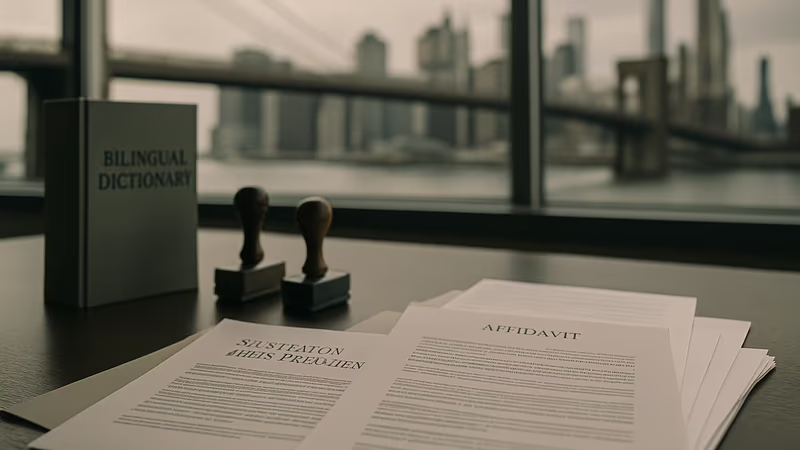
Key Takeaway
NY court holds an affidavit need not be signed and notarized the same day it was drafted. What the law actually requires for an admissible affidavit.
This article is part of our ongoing affidavits coverage, with 19 published articles analyzing affidavits issues across New York State. Attorney Jason Tenenbaum brings 24+ years of hands-on experience to this analysis, drawing from his work on more than 1,000 appeals, over 100,000 no-fault cases, and recovery of over $100 million for clients throughout Nassau County, Suffolk County, Queens, Brooklyn, Manhattan, and the Bronx. For personalized legal advice about how these principles apply to your specific situation, contact our Long Island office at (516) 750-0595 for a free consultation.
Proper notarization is a critical component of legal proceedings, particularly in no-fault insurance cases where affidavits and procedural compliance can make or break a case. A recent appellate decision provides important clarification about the timing requirements for notarial acts, addressing a common source of confusion for practitioners and parties alike.
The question of whether documents must be signed and notarized on the same date they are drafted has practical implications for attorneys managing multiple cases and tight deadlines. This ruling offers welcome flexibility while maintaining the integrity of the notarization process.
The Decision
Jason Tenenbaum’s Analysis:
Bonavera Acupuncture, P.C. v GEICO Indem. Co, 2013 NY Slip Op 50200(U)(App. Term 2d Dept. 2013)
Free Consultation · No Fee Unless We Win
Does this apply to your situation?
Every case is different. Get a free, confidential case review from an experienced attorney who can tell you exactly where you stand.
“The affidavit recited that the affiant was “duly sworn … under an awareness of the penalties of perjury” and stated that the affidavit was “sworn to before” the notary, who signed and stamped the document.. The law does not require that a document drafted on one date be signed and notarized on that date. Accordingly, on the record presented, we find that the affidavit was in admissible form and should have been considered by the Civil Court”
The world of notarial acts. It was sworn to and executed on a day different than when it was drafted. This is sufficient under the law.
What Makes an Affidavit Admissible
An affidavit is a written statement of fact sworn to before a person authorized to administer an oath — almost always a notary public. The notary’s role is to administer the oath and to attest, through the jurat (“sworn to before me this ___ day of ___”), that the affiant personally appeared and swore to the truth of the contents. It is the oath, administered at the moment of signing, that converts a piece of paper into competent evidence.
What the law cares about, in other words, is the swearing, not the drafting. Affidavits are routinely prepared by counsel days or weeks before the witness is available to sign. Nothing in New York law requires the affiant to sign on the day the document was typed. As the Appellate Term held here, an affidavit that recites that the affiant was duly sworn under penalty of perjury and was sworn to before a notary who signed and stamped it is in admissible form, even if the drafting date and the execution date do not match.
This matters most in motion practice. Summary judgment motions — in no-fault collection cases and everywhere else — rise and fall on affidavits. CPLR 2309 governs oaths and the form of affidavits (including the certificate of conformity requirement for out-of-state oaths), and opponents of a motion will scour the papers for any defect in form: a missing jurat, a missing notary stamp, an out-of-state affidavit without a certificate of conformity, or — as the carrier’s opponent argued here — a mismatch between dates. The Bonavera decision takes one of those formal objections off the table.
Why This Matters
For no-fault practitioners on both sides, the practical reality is that affidavits of merit, mailing affidavits, and peer review affirmations are generated in volume. Billing departments draft; affiants sign when they can. If a date mismatch rendered an affidavit inadmissible, an enormous amount of routine motion practice would be vulnerable to a purely technical attack having nothing to do with the truth of the statements.
For medical providers and carriers litigating in Civil Court, the decision is also a reminder of how outcome-determinative evidentiary form can be. In this case, the Civil Court refused to consider the affidavit at all; the Appellate Term reversed course and held it should have been considered. Whole motions are won and lost on whether the supporting proof is “in admissible form” — before anyone reaches the merits.
That said, the flexibility has limits. The notarization itself must be genuine: the affiant must actually appear before the notary and take the oath on the execution date. A jurat reciting an oath that was never administered is a defect of substance, not form — and courts treat defective notarization very differently from a benign date discrepancy.
Practical Takeaways
- An affidavit drafted on one date may be signed and notarized on a later date; New York law does not require the dates to match.
- The operative event is the oath: the affiant must personally appear and swear before the notary at execution.
- Ensure every affidavit contains a proper jurat, the notary’s signature and stamp, and — for out-of-state affidavits — a certificate of conformity under CPLR 2309.
- When opposing a motion, attack substance over form; date-mismatch objections of this kind will not carry the day.
Related Resources
- A formulation of a prima facie case — our cluster hub on proving a prima facie case in New York no-fault litigation
- The firm’s Legal Encyclopedia — plain-language explainers on New York civil practice
- No-Fault Defense practice — how we defend carriers in no-fault litigation and arbitration
- Defective notarization
- Putting the cart before the horse?
- CPLR 2309 Compliance, Navigating Notarization Requirements in New York Litigation
Legal Context
Why This Matters for Your Case
New York law is among the most complex and nuanced in the country, with distinct procedural rules, substantive doctrines, and court systems that differ significantly from other jurisdictions. The Civil Practice Law and Rules (CPLR) governs every stage of civil litigation, from service of process through trial and appeal. The Appellate Division, Appellate Term, and Court of Appeals create a rich and ever-evolving body of case law that practitioners must follow.
Attorney Jason Tenenbaum has practiced across these areas for over 24 years, writing more than 1,000 appellate briefs and publishing over 2,600 legal articles that attorneys and clients rely on for guidance. The analysis in this article reflects real courtroom experience — from motion practice in Civil Court and Supreme Court to oral arguments before the Appellate Division — and a deep understanding of how New York courts actually apply the law in practice.
Keep Reading
More Affidavits Analysis
How to Talk to a Judge in New York: What to Say, What to Avoid, and How to Present Yourself
Address the judge as 'Your Honor,' stand when you speak, wait to be recognized, and keep answers short and honest. A Long Island trial lawyer explains.
Feb 24, 2026
CPLR § 2106 Amendment Eliminates Affidavit Notarization Requirement: What This Means for New York Litigation
New York's CPLR 2106 permits affirmations in place of many sworn documents. See the 2024 and 2025 changes, exceptions, and historical case notes.
Feb 18, 2026
The CPLR 2106 Trap: Why Medical Practice Owners Must Avoid This Critical Procedural Error
The 2010 Doshi affirmation ruling applied an old ownership restriction. Current CPLR 2106 permits any-person affirmations, with form and evidence limits.
Mar 12, 2010
New evidence used in reply – an angry court appears
Court permits new evidence in reply papers despite opponent's objections in New York no-fault insurance coverage dispute, highlighting procedural tactics.
Feb 10, 2018
Declaratory judgment action given preclusive effect
Court ruling demonstrates how declaratory judgments can preclude subsequent no-fault insurance claims arising from the same accident, establishing binding legal precedent.
Mar 25, 2014
Procedural Delays in No-Fault Insurance Litigation: Understanding the Prejudice Standard
Learn about procedural delay standards in NY no-fault insurance litigation. Expert analysis of prejudice requirements for Long Island & NYC medical providers.
Feb 17, 2012Was this article helpful?
Disclaimer: This article is published by the Law Office of Jason Tenenbaum, P.C. for informational and educational purposes only. It does not constitute legal advice, and no attorney-client relationship is formed by reading this content. The legal principles discussed may not apply to your specific situation, and the law may have changed since this article was last updated.
New York law varies by jurisdiction — court decisions in one Appellate Division department may not be followed in another, and local court rules in Nassau County Supreme Court differ from those in Suffolk County Supreme Court, Kings County Civil Court, or Queens County Supreme Court. The Appellate Division, Second Department (which covers Long Island, Brooklyn, Queens, and Staten Island) and the Appellate Term (which hears appeals from lower courts) each have distinct procedural requirements and precedents that affect litigation strategy.
If you need legal help with a affidavits matter, contact our office at (516) 750-0595 for a free consultation. We serve clients throughout Long Island (Huntington, Babylon, Islip, Brookhaven, Smithtown, Riverhead, Southampton, East Hampton), Nassau County (Hempstead, Garden City, Mineola, Great Neck, Manhasset, Freeport, Long Beach, Rockville Centre, Valley Stream, Westbury, Hicksville, Massapequa), Suffolk County (Hauppauge, Deer Park, Bay Shore, Central Islip, Patchogue, Brentwood), Queens, Brooklyn, Manhattan, the Bronx, Staten Island, and Westchester County. Prior results do not guarantee a similar outcome.