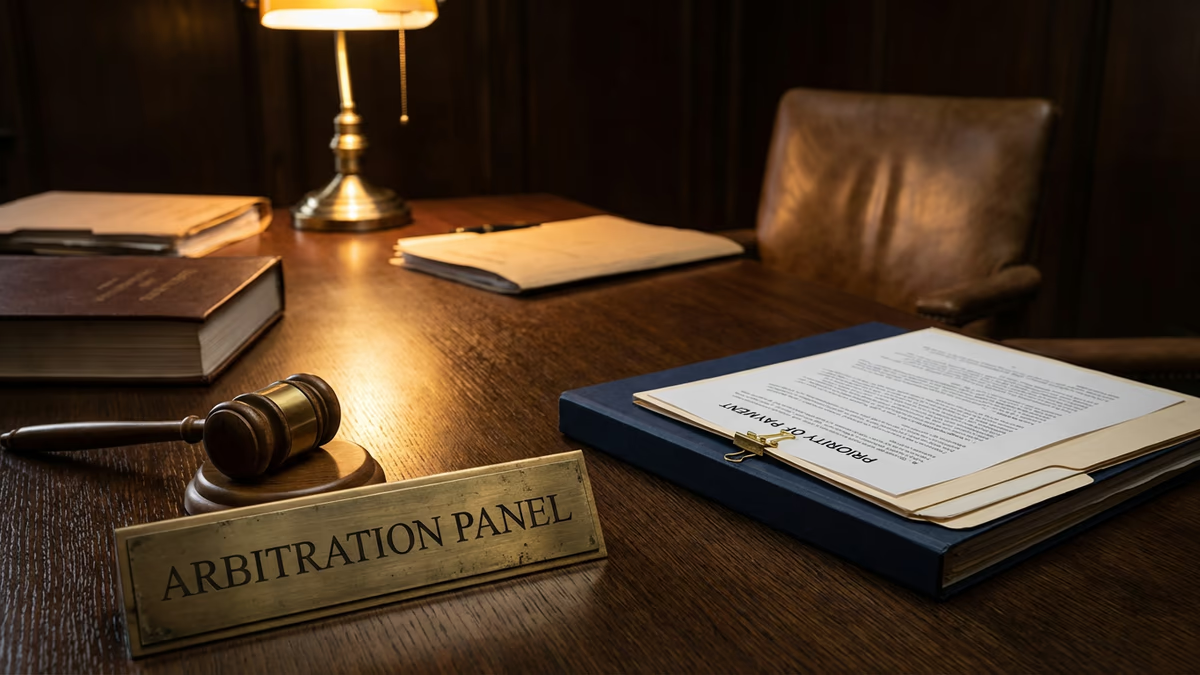
Why Trust This Analysis
This article is part of our ongoing no-fault coverage, with 271 published articles analyzing no-fault issues across New York State. Attorney Jason Tenenbaum brings 24+ years of hands-on experience to this analysis, drawing from his work on more than 1,000 appeals, over 100,000 no-fault cases, and recovery of over $100 million for clients throughout Nassau County, Suffolk County, Queens, Brooklyn, Manhattan, and the Bronx. For personalized legal advice about how these principles apply to your specific situation, contact our Long Island office at (516) 750-0595 for a free consultation.
Key Takeaways
- The Court of Appeals denied leave to appeal in Matter of Allstate Prop. & Cas. Ins. Co. v New Way Massage Therapy P.C., ending the carrier’s Article 75 campaign on the Mallela limitation question.
- The Mallela doctrine lets carriers withhold no-fault reimbursement from professional corporations that are fraudulently incorporated or fail to meet licensing requirements.
- Test-case selection matters: a weak factual vehicle can entrench unfavorable precedent for an entire industry.
- With leave denied, the Appellate Division’s ruling stands — and the strategic lesson belongs to every carrier contemplating an Article 75 petition.
The Mallela limitation doctrine represents a significant development in New York no-fault insurance law, establishing important boundaries for when insurance companies can seek declaratory judgments against healthcare providers. When insurance carriers file Article 75 petitions seeking court declarations about coverage limitations, the choice of test case can make or break the legal precedent.
This particular case demonstrates how poor case selection can lead to unfavorable outcomes that may have lasting implications for New York no-fault insurance law. The procedural journey from trial court through the Appellate Division to a denied leave application at the Court of Appeals illustrates the importance of strategic litigation decisions in the no-fault insurance context.
Understanding these limitation cases is crucial for healthcare providers who regularly treat accident victims and must address the complex web of no-fault insurance requirements and potential coverage disputes.
Free Consultation · No Fee Unless We Win
Does this apply to your situation?
Every case is different. Get a free, confidential case review from an experienced attorney who can tell you exactly where you stand.
The Leave Denial
Jason Tenenbaum’s Analysis:
Matter of Allstate Prop. & Cas. Ins. Co. v New Way Massage Therapy P.C., as Assignee of Nancy Febus, 2016 NY Slip Op 94294 (2016)
This was not a wise case on which to file an Article 75 , a more perverse case to take to the Appellate Division and, in a fitting farewell, leave has been denied. My thoughts about this case were noted when the Appellate Division order was published. I am just shocked the Petitioner was not Ameriprise.
The Mallela Doctrine in Brief
The shorthand comes from State Farm Mut. Auto. Ins. Co. v Mallela, 4 NY3d 313 (2005), where the Court of Appeals answered a certified question from the Second Circuit: a no-fault carrier may withhold reimbursement from a medical professional corporation that is fraudulently incorporated — for example, a PC nominally owned by a licensed professional but actually controlled by unlicensed laypersons.
The regulatory anchor is 11 NYCRR 65-3.16(a)(12), which provides that a provider of health services is not eligible for no-fault reimbursement if it “fails to meet any applicable New York State or local licensing requirement.” Mallela converted that eligibility language into a potent coverage defense, and a body of case law has grown up around its edges: which licensing defects count, what proof a carrier needs, and whether the defense is precluded by an untimely denial.
The “Mallela limitation” cases sit at those edges. Not every corporate or licensing blemish renders a provider ineligible, and carriers have repeatedly litigated — in plenary actions, declaratory judgment suits, and arbitration-related proceedings — over how far the doctrine stretches. The line of cases on fraudulent procurement and preclusion shows the same tension from a different angle: eligibility-type defenses are powerful precisely because courts must decide whether they survive the no-fault preclusion rules.
Article 75 and the Test-Case Problem
CPLR Article 75 is the vehicle for judicial involvement in arbitration: petitions to stay or compel arbitration and to confirm, vacate, or modify awards. Because Insurance Law § 5106(b) gives no-fault claimants the option to arbitrate, carriers regularly end up in Article 75 proceedings when they want a court to undo or cabin an arbitration result.
Judicial review of no-fault master arbitration awards is narrow. A carrier that brings an Article 75 petition hoping to establish a favorable rule of law is therefore making a leveraged bet: the standard of review is deferential, the record is whatever the arbitration produced, and a loss gets published. Take a bad vehicle up on appeal and you do not just lose the case — you mint adverse precedent that every claimant’s attorney will cite back at the industry.
That is the story here. As noted when the Appellate Division order came down, this was a poor case for an Article 75 petition, a worse one to appeal, and the leave denial sealed the result.
Why This Matters for Carriers and Providers
For carriers, the lesson is discipline in test-case selection. Eligibility defenses under Mallela are fact-intensive; the difference between a clean record of layperson control and a marginal corporate-formality dispute is the difference between extending the doctrine and shrinking it. Once the Court of Appeals denies leave, the Appellate Division’s word is final for the Second Department’s enormous no-fault docket.
For medical providers, the denial of leave is a reminder that Mallela challenges have limits. Carriers cannot convert every corporate irregularity into a wholesale eligibility defense, and appellate courts have shown a willingness to police overreach. Providers facing Mallela-style discovery or declaratory actions should scrutinize whether the carrier’s theory actually fits within 65-3.16(a)(12) or is a generalized fraud theory dressed in licensing clothes.
For both sides, the procedural posture matters as much as the substance. Whether a Mallela issue arrives by plenary action, declaratory judgment, or Article 75 petition changes the record, the standard of review, and the preclusive effect of the outcome.
Related Resources
- Understanding procedural strategies in CPLR 3212(g) cases
- Strategic timing considerations for summary judgment motions under CPLR 3212(a)
- Compliance requirements and verification standards in no-fault claims
- Regulatory changes affecting no-fault insurance practices
- New York No-Fault Insurance Law
- Fraudulent procurement defense precluded
- The firm’s Legal Encyclopedia
- No-Fault Defense practice
Legal Context
Why This Matters for Your Case
New York's no-fault insurance system, established under Insurance Law Article 51, is one of the most complex insurance frameworks in the country. Every motorist must carry Personal Injury Protection coverage that pays medical expenses and lost wages regardless of fault, up to $50,000 per person.
But insurers routinely deny valid claims using peer reviews, EUO scheduling tactics, fee schedule reductions, and coverage defenses. The Law Office of Jason Tenenbaum has handled over 100,000 no-fault cases since 2002 — from initial claim submissions through arbitration before the American Arbitration Association, trials in Civil Court and Supreme Court, and appeals to the Appellate Term and Appellate Division. Jason Tenenbaum is one of the few attorneys in the state who both writes his own appellate briefs and tries his own cases.
His 2,600+ published legal articles on no-fault practice are cited by attorneys throughout New York. Whether you are dealing with a medical necessity denial, an EUO no-show defense, a fee schedule dispute, or a coverage question, this article provides the kind of detailed case-law analysis that helps practitioners and claimants understand exactly where the law stands.
About This Topic
New York No-Fault Insurance Law
New York's no-fault insurance system requires every driver to carry Personal Injury Protection (PIP) coverage that pays medical expenses and lost wages regardless of who caused the accident. But insurers routinely deny, delay, and underpay valid claims — using peer reviews, IME no-shows, and fee schedule defenses to avoid paying providers and injured claimants. Attorney Jason Tenenbaum has litigated thousands of no-fault arbitrations and court cases since 2002.
271 published articles in No-Fault
Keep Reading
More No-Fault Analysis

Car Accident Recorded Statement in New York: Should You Give One?
The at-fault driver's adjuster wants a recorded statement within days of a New York car accident — and that call is designed to weaken your case.
Apr 5, 2026
Who Pays Car Accident Medical Bills in New York? A Step-by-Step Guide
New York no-fault PIP, primary health insurance, Medicaid/Medicare, and litigation liens — the full payment ladder for car-accident medical bills.
Apr 5, 2026
Happy Mother’s Day
Comprehensive guide to legal rights for mothers in NY. No-fault insurance, personal injury claims, family protections. Call 516-750-0595 for help.
May 12, 2019
Form and procedure – not part of a prima facie case in a cancellation case
New York appellate court clarifies burden of proof in no-fault insurance cancellation disputes, shifting responsibility to claimants to prove procedural defects.
Jun 18, 2012
NY No-Fault: The Verification Paradigm
Learn about NY no-fault insurance: claim filing steps, verification process, and recent case law affecting insurance carriers' verification rights.
Apr 29, 2024
Proving an IME No-Show: Personal Knowledge vs. Business Records in New York No-Fault Cases
How New York courts evaluate proof that a no-fault claimant failed to appear for an IME — personal knowledge testimony versus business record foundations.
Nov 22, 2021Frequently Asked Questions
Common Questions About This Topic
3 answers from the firm's New York personal-injury and employment-law practice. Click any question to expand.
What is the Mallela doctrine in New York no-fault law?
It is the rule, from *State Farm v Mallela*, 4 NY3d 313 (2005), that a no-fault insurer may withhold reimbursement from a medical professional corporation that is fraudulently incorporated or fails to meet New York licensing requirements, based on 11 NYCRR 65-3.16(a)(12).
What does it mean when the Court of Appeals denies leave to appeal?
New York's highest court hears most civil appeals only by permission. A denial of leave means the Court declined to take the case — the Appellate Division's order stands as the final word, though the denial itself is not a ruling on the merits.
What is a CPLR Article 75 proceeding?
Article 75 is the CPLR article governing arbitration-related court proceedings, including petitions to compel or stay arbitration and to confirm or vacate awards. In no-fault practice, carriers and providers use it to challenge or enforce arbitration outcomes, subject to a narrow standard of review.
Was this article helpful?
Disclaimer: This article is published by the Law Office of Jason Tenenbaum, P.C. for informational and educational purposes only. It does not constitute legal advice, and no attorney-client relationship is formed by reading this content. The legal principles discussed may not apply to your specific situation, and the law may have changed since this article was last updated.
New York law varies by jurisdiction — court decisions in one Appellate Division department may not be followed in another, and local court rules in Nassau County Supreme Court differ from those in Suffolk County Supreme Court, Kings County Civil Court, or Queens County Supreme Court. The Appellate Division, Second Department (which covers Long Island, Brooklyn, Queens, and Staten Island) and the Appellate Term (which hears appeals from lower courts) each have distinct procedural requirements and precedents that affect litigation strategy.
If you need legal help with a no-fault matter, contact our office at (516) 750-0595 for a free consultation. We serve clients throughout Long Island (Huntington, Babylon, Islip, Brookhaven, Smithtown, Riverhead, Southampton, East Hampton), Nassau County (Hempstead, Garden City, Mineola, Great Neck, Manhasset, Freeport, Long Beach, Rockville Centre, Valley Stream, Westbury, Hicksville, Massapequa), Suffolk County (Hauppauge, Deer Park, Bay Shore, Central Islip, Patchogue, Brentwood), Queens, Brooklyn, Manhattan, the Bronx, Staten Island, and Westchester County. Prior results do not guarantee a similar outcome.