Why Trust This Analysis
This article is part of our ongoing personal injury coverage, with 180 published articles analyzing personal injury issues across New York State. Attorney Jason Tenenbaum brings 24+ years of hands-on experience to this analysis, drawing from his work on more than 1,000 appeals, over 100,000 no-fault cases, and recovery of over $100 million for clients throughout Nassau County, Suffolk County, Queens, Brooklyn, Manhattan, and the Bronx. For personalized legal advice about how these principles apply to your specific situation, contact our Long Island office at (516) 750-0595 for a free consultation.
Last reviewed: June 2026
Key Takeaways — June 2026 Status
- Vetoed four times. The latest version, S4423/A6063, passed the Senate 51-10 on May 28, 2025, passed the Assembly on June 9, 2025, was delivered to Governor Hochul on December 1, 2025, and was vetoed on December 5, 2025 (veto memo 87).
- No fifth version has reached the Governor. The 2026 session ends mid-June. Whatever Albany does, the law on the books today governs your case today.
- Today’s law is the 1847 pecuniary-loss rule. EPTL §5-4.3 pays for economic loss only: lost earnings, lost services, funeral and medical expenses. Grief and loss of companionship are not compensable, no matter how devastating the loss.
- You have two years from the death, not three. That is EPTL §5-4.1, not the GFA’s proposed three years. Waiting for Albany is how families lose claims permanently.
- The 2026 auto tort-reform package did NOT change wrongful-death damages. The May 26, 2026 enactment (S9008-C, Part EE) rewrote motor-vehicle threshold and fault rules. It did not touch EPTL §5-4.1 or §5-4.3, and its new $100,000 bad-actor cap expressly excludes death cases.
- The politics cut both ways. A governor who just signed insurer-friendly auto reform could balance the ledger by signing the GFA, or could decide that her affordability message forecloses it. Nobody outside the second floor knows which.
- If you lost a family member, call (516) 750-0595 now. The two-year clock, and in municipal cases the 90-day notice-of-claim clock, run regardless of what Albany does.
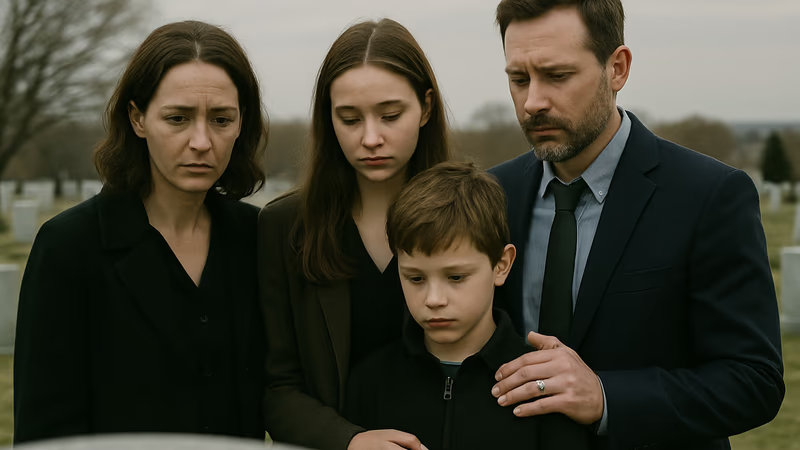
New York’s wrongful-death statute predates the light bulb. Enacted in 1847, when New York became the first American state to allow wrongful-death recovery at all, it has carried the same core limitation ever since: a family may recover only its pecuniary loss, the dollars-and-cents value of the decedent’s earnings and services. Nothing for grief. Nothing for the empty chair.
The Grieving Families Act was supposed to change that. Four times the Legislature has passed it. Four times Governor Hochul has vetoed it, most recently on December 5, 2025, four days after the bill reached her desk. Now the 2026 session is closing in mid-June, advocates are pressing a fifth attempt, and Albany has just finished a bruising fight over auto tort reform that moved the politics of civil-justice legislation in ways nobody fully understands yet.
Free Consultation · No Fee Unless We Win
Does this apply to your situation?
Every case is different. Get a free, confidential case review from an experienced attorney who can tell you exactly where you stand.
I have watched all four vetoes from the same seat: explaining to Long Island families, year after year, that New York still measures their loss by the decedent’s pay stubs. So this is the practitioner’s status read, not the press-release version. What the law is today, what the GFA would change, why it keeps dying on the second floor of the Capitol, how it interacts with the 2026 auto reforms, and what families with pending or potential claims should do now. The deadlines in force today do not pause for legislation that might pass tomorrow.
Quick Reference — Grieving Families Act, June 2026
What Happened
S4423/A6063 passed both chambers in 2025, was delivered to Governor Hochul December 1, 2025, and was vetoed December 5, 2025 — the fourth veto since January 2023.
Where It Stands
No fifth version has been delivered to the Governor as of this writing. The 2026 session ends mid-June. Current law — the 1847 pecuniary-loss rule — remains fully in force.
Who Is Affected
Every New York family with a pending or potential wrongful-death claim. The EPTL §5-4.1 deadline is two years from death today — not the GFA's three.
The 1847 Rule: Why New York Pays Nothing for Grief
Start with what the Grieving Families Act is trying to fix, because the current rule genuinely surprises people, including lawyers from other states.
Under EPTL §5-4.1, a wrongful-death action belongs to the decedent’s personal representative, must generally be commenced within two years of the death, and is brought for the benefit of the decedent’s distributees. Under EPTL §5-4.3, the recoverable damages are limited to “fair and just compensation for the pecuniary injuries” suffered by those distributees: lost financial support, lost household services, lost parental nurture and guidance for minor children, funeral expenses, and medical expenses tied to the fatal injury.
What is missing from that list is everything most people assume a wrongful-death case is about. New York’s Court of Appeals confirmed decades ago — most prominently in Liff v. Schildkrout (1980) — that grief, mental anguish, and loss of companionship are not recoverable by the surviving family in a wrongful-death action. The decedent’s own conscious pain and suffering before death is a separate survival claim, but the family’s loss is measured in dollars the decedent would have generated, full stop.
The practical consequences are brutal and well known to anyone who litigates these cases:
- The death of a child often produces a startlingly small wrongful-death recovery, because a child has no earnings history and the law offsets the projected cost of raising them.
- The death of a retiree is valued at little beyond funeral expenses and lost household services, because there are no future earnings to project.
- The death of a stay-at-home parent is valued through replacement-services testimony — what it costs to hire out childcare and household labor — rather than the actual loss the family suffered.
I have had to walk parents through that arithmetic. It is the worst conversation in this practice, and the statute requires it.
Advocates’ core argument, repeated in every legislative memo since the bill’s earliest iterations, is that the pecuniary rule systematically undervalues the deaths of children, seniors, women, and lower-income New Yorkers. Nearly every other state allows some form of non-economic recovery in wrongful death. New York’s refusal is a function of a statute written when Zachary Taylor was running for president. Our Wrongful Death Modernization Act cornerstone page tracks the framework and the reform effort in depth.
1847
Year New York's wrongful-death statute was enacted
First in the nation — and still limited to pecuniary loss more than 175 years later.
4
Vetoes by Governor Hochul
January 2023, December 2023, December 2024, and December 5, 2025.
51–10
Senate vote on S4423 (May 28, 2025)
Both chambers' reported margins exceeded the two-thirds override threshold. No override was attempted.
2 yrs
Wrongful-death statute of limitations — today
EPTL §5-4.1. The GFA's three-year period is not law. Do not calendar to a bill.
What the Grieving Families Act Would Actually Change
The vetoed 2025 version — S4423, sponsored by Senator Brad Hoylman-Sigal, with A6063 carried by Assemblymember Jen Lunsford — is the best guide to what a fifth attempt would look like, because each iteration has been a modest refinement of the last. Defense-side commentators at Hurwitz Fine memorably described the 2025 bill as “meet the new bill — same as the old bill.”
Here is the old rule against the GFA, provision by provision:
| Issue | Current Law (EPTL §§5-4.1, 5-4.3) | Grieving Families Act (as vetoed, S4423) |
|---|---|---|
| Emotional damages | Not recoverable Pecuniary loss only. No recovery for grief, anguish, or loss of companionship (Liff v. Schildkrout, 1980). |
Recoverable Adds grief or anguish caused by the death, plus loss of love, nurture, guidance, counsel, and companionship. |
| Who benefits | Distributees only Intestate heirs under EPTL Article 4. A devoted stepparent or functionally-parental grandparent may recover nothing. |
Expanded class Spouse or domestic partner, distributees, and persons in an in-loco-parentis relationship with the decedent — fact-finder allocates by closeness of relationship. |
| Statute of limitations | 2 years From the date of death, with limited tolling. Shorter still against municipalities. |
3 years EPTL §5-4.1 amended from two years to three years after death. |
| Retroactivity | N/A Current rule applies to all pending claims. |
Retroactive As passed, S4423 applied to causes of action accruing on or after January 1, 2022 — a provision that would have drawn immediate constitutional challenge. |
Sources: S4423 bill text and history, nysenate.gov · Segal McCambridge legislative update. Vetoed December 5, 2025 — none of the right-hand column is law.
Two practice notes on that table. First, the damages expansion is the headline, but the beneficiary expansion is what would most change case architecture: under current law I have seen step-children raised from infancy recover nothing while an estranged biological relative qualified as a distributee. Second, the retroactivity clause, reaching back to January 1, 2022, is why defense groups treated every GFA cycle as a live emergency for open claims, and why families with deaths after that date had a genuine stake in each veto.
Four Vetoes in Four Years: The Timeline
The GFA’s history is a loop: lopsided bipartisan passage in June, delivery in late fall, veto before New Year’s. The repetition is itself the story, and the reason nobody should bet a filing deadline on attempt number five.
Grieving Families Act — Timeline of an Impasse
Sources: nysenate.gov S4423 action history · Hurwitz Fine (fourth veto) · Spectrum News (third veto) · Condon & Forsyth (second veto).
The override question hangs over the whole timeline. The reported 2025 margins — 51–10 in the Senate, and an Assembly margin commentators put well above the two-thirds line — would, on paper, have supported an override. The Legislature has never attempted one, on this or virtually any other Hochul veto. Whatever the internal politics, the practical takeaway for families is that passage margins do not equal enactment, and the Legislature’s leadership has so far been unwilling to force the issue.
The Politics Now: Does Post-Tort-Reform Albany Help or Hurt the GFA?
The 2026 session was dominated by something else entirely: the auto-insurance tort-reform package Governor Hochul signed on May 26, 2026. Elimination of the 90/180 serious-injury category, fault-first trial sequencing, a mostly-at-fault recovery bar for Article 51 motor-vehicle cases, and a narrow $100,000 bad-actor cap. That package was sold, top to bottom, as affordability legislation: lower premiums for working New Yorkers.
How does that change the GFA’s odds? Honest answer: it supports two opposite readings, and anyone who tells you they know which one is operative is guessing.
The reading that helps the GFA. Hochul has now delivered the largest insurer-side civil-justice win in a generation. The trial bar, organized labor, and victims’ families absorbed real losses in the auto package. Signing a Grieving Families Act — perhaps a narrowed one, with prospective-only application and a phased effective date — would let the Governor balance the ledger: tort restraint where costs were demonstrably driving premiums, tort modernization where New York is a national outlier. Her veto memos have consistently claimed openness to compromise; post-reform, she has more political room to define one and sign it.
The reading that hurts the GFA. Every one of the four veto memos rests on the same foundation as the auto package: cost. A governor whose 2026 signature accomplishment is lowering insurance costs would be undercutting her own narrative by signing a bill that her own memos say raises liability-insurance costs for hospitals, municipalities, and small businesses. The auto package shows where Albany’s center of gravity sits right now, and it is cost containment, not damages expansion. The GFA’s strongest opponents (hospital associations, municipal insurers, the medical society) are the constituencies the Governor just spent a session courting.
Both readings are hedged for a reason. The Legislature’s behavior in the next days — whether a fifth version passes before adjournment, and in what form — will tell us more than any tea-leaf reading. We saw the same dynamic in the Child Victims Act litigation wave and the Archdiocese of New York’s $800 million settlement: legislative change to liability rules reshapes case values overnight, and the institutional stakeholders know it. That is precisely why the GFA fight is this entrenched.
The 2026 Auto Tort Reform Did NOT Change Wrongful-Death Damages
This deserves its own section because it is the single most common misunderstanding I am hearing from clients and referring attorneys this month.
The enacted auto package (S9008-C/A10008-C, Part EE) amended Insurance Law §5102(d), §5104, and added CPLR §1411(b). It did not amend EPTL §5-4.1 or §5-4.3. Concretely, for death cases:
- Wrongful-death damages are unchanged. The pecuniary-loss rule, the two-year limitations period, and the distributee-only beneficiary class all remain exactly as they were. The auto reform neither enacted nor displaced anything in the GFA.
- Death remains a “serious injury.” The 90/180 category was deleted from Insurance Law §5102(d), but death has always been — and remains — an enumerated threshold category. Threshold is not a defense in a motor-vehicle death case.
- The new $100,000 bad-actor cap expressly excludes death cases. Insurance Law §5104(d) caps non-economic damages for certain convicted impaired, uninsured, or fleeing drivers — “other than death cases.” Even setting that aside, current wrongful-death law awards no non-economic damages to cap.
- Fault allocation now matters more in motor-vehicle death cases. The new CPLR §1411(b) mostly-at-fault bar applies to personal-injury actions subject to Insurance Law Article 51, and fault-first sequencing restructures motor-vehicle trials. How these provisions apply in wrongful-death actions arising from crashes will be litigated. The prudent assumption for any family is that evidence of the decedent’s comparative fault is now even more consequential, and early accident reconstruction is money well spent.
- The joint-and-several change did not pass. CPLR §1602(6) remains in force; deep-pocket recovery rules in death cases are unchanged. Reports to the contrary are wrong.
If your family’s case involves a fatal crash, the interaction of the new motor-vehicle rules with unchanged wrongful-death law is exactly the kind of question to put to counsel early. Our analysis of wrongful-death car accident settlements in New York walks through the valuation framework in detail, and our settlement calculator reflects the post-reform rules.
What Families Should Do Now — Do Not Wait for Albany
Here is the part that matters more than any of the politics. Four veto cycles have taught a hard lesson: families who waited for the GFA lost rights they could have preserved. A family whose loved one died in early 2023, who held off filing in the hope that the 2023 or 2024 bill would add grief damages and a third year, watched the two-year deadline pass and the bill die. Twice. The claim is gone. No fifth attempt revives it.
Six Steps for Families With a Potential Wrongful-Death Claim
1
Calendar two years — period
EPTL §5-4.1 gives most families two years from the date of death. That is the law today. Calendar to the statute, never to a pending bill.
2
Check for shorter municipal clocks
If a city, county, school district, or public authority may be liable, GML §50-e generally requires a notice of claim within 90 days, and suit deadlines are far shorter than two years. These trap families constantly.
3
Get the personal representative appointed
Only the estate's personal representative can sue. Surrogate's Court appointment takes time — start it now, not at month 22.
4
Build the pecuniary record
Under current law, value lives in proof: earnings history, benefits, household services, and — for children of the decedent — nurture and guidance evidence. Preserve it while it is fresh.
5
Plead the survival claim
The decedent's conscious pain and suffering before death is a separate claim with its own value — often the largest non-economic component available under current law.
6
File to preserve GFA upside
Every GFA version has included retroactivity (most recently to January 1, 2022 accruals). A timely-filed case could benefit if a future version passes. A time-barred claim benefits from nothing.
Point six is the strategic one and worth restating plainly: filing now costs you nothing if the GFA never passes, and preserves everything if it does. Retroactivity provisions reach back to accrued causes of action; they do not resurrect claims already extinguished by the statute of limitations. If the GFA (in any future form) becomes law with a retroactive reach, the families positioned to benefit will be the ones with live, pending cases. For a deeper treatment of the deadlines, see our guide to the New York wrongful death statute of limitations, and note the special rules for medical-malpractice deaths and claims against estates. Every case needs its own deadline audit.
How We Handle These Cases
Wrongful-death litigation under the pecuniary rule is a proof discipline. The difference between an undervalued case and a fully valued one is almost always the economic workup: vocational and economic experts on earnings trajectory, household-services economists, and, where the decedent left minor children, a properly developed nurture-and-guidance presentation, which New York juries can and do value substantially even within the pecuniary framework. Our Long Island wrongful death attorney practice page covers the full framework, and our overview of what wrongful-death families on Long Island should expect addresses the Surrogate’s Court side, including compromise orders and distribution.
If your family lost someone and you are weighing what to do while Albany deliberates, call (516) 750-0595 for a free consultation. We will audit every applicable deadline — EPTL, municipal, malpractice, estate — and give you a straight answer on what current law allows and what filing now preserves. Every case differs, and nothing in this article is a prediction of value in any specific matter.
For attorneys: we regularly serve as trial, appellate, and per-diem counsel on wrongful-death and serious-injury matters for other firms, including post-reform threshold and fault-sequencing questions in fatal crash cases, and Surrogate’s Court compromise proceedings. Co-counsel and referral arrangements honored. Attorney inquiries answered same day at (516) 750-0595.
Wrongful Death & 2026 Reform Cluster — Keep Reading
Status Tracker
Wrongful Death Modernization Act — Live Tracker
Our cornerstone EPTL §5-4.3 reform page: current-law vs GFA damages comparison, multi-state context, and bill status.
2026 Tort Reform
What the Auto Package Did — and Didn't Do
90/180 eliminated, fault-first sequencing, the Article 51 mostly-at-fault bar — and why wrongful-death damages were untouched.
Practice Area
Long Island Wrongful Death Attorney
How we build, value, and try wrongful-death cases for Nassau and Suffolk families under current New York law.
Legal Context
Why This Matters for Your Case
Personal injury law in New York is governed by a complex web of statutes, case law, and procedural rules that differ from most other states. The statute of limitations for most personal injury claims is three years under CPLR 214(5), but claims against municipalities require a Notice of Claim within 90 days. Motor vehicle accident victims must meet the serious injury threshold under Insurance Law §5102(d) before they can recover pain and suffering damages.
The Law Office of Jason Tenenbaum has recovered over $100 million for injured clients across Long Island, Nassau County, Suffolk County, Queens, Brooklyn, Manhattan, and the Bronx. With 24+ years of trial and appellate experience, more than 1,000 appeals written, and 2,600+ published legal articles, Jason Tenenbaum provides the authoritative legal analysis that practitioners and injury victims need to understand their rights.
This article reflects real courtroom experience and a deep understanding of how New York courts actually evaluate personal injury claims — from the initial filing through discovery, summary judgment, trial, and appeal.
About This Topic
New York Personal Injury Law
When negligence causes serious injury, New York law entitles victims to compensation for medical bills, lost income, pain and suffering, and more. From car accidents and slip-and-falls to construction injuries and medical malpractice, the Law Office of Jason Tenenbaum has recovered over $100 million for injured Long Islanders and New Yorkers since 2002.
180 published articles in Personal Injury
Keep Reading
More Personal Injury Analysis

Nassau Police Ordered to Pay $34,690.50 in FOIL Fees: What Meyer Means After a Crash
The Second Department raised a FOIL fee award against the Nassau County Police Department from $12,000 to $34,690.50. The statute, the math, and the FOIL clock.
Oct 8, 2026
Long Island Pedestrian Crashes After Dark: State Data Before the Clocks Change
From November through January, 485 of 520 evening pedestrian crashes in Nassau and Suffolk happened in the dark. State and federal data, with the CSV files.
Oct 8, 2026
Bicycle Accident Settlement Amounts in New York (2024–2026)
How much is a bicycle accident settlement worth in New York?
Apr 4, 2026
Partially at Fault in a New York Car Accident?
Learn how New York's comparative negligence laws allow you to recover compensation even when partially at fault in a car accident.
Jun 16, 2025
Lawyer Analysis: Amazon Accidents
Expert Amazon accident lawyer legal strategies for victims of van crashes, securing compensation and holding corporations accountable.
Feb 10, 2025
Patterson v. Meta: Is a Social Media App a Product?
Court of Appeals, September 15: is a social media platform a product, and does Section 230 end the case? What Patterson v. Meta means for New York families.
Sep 11, 2026Frequently Asked Questions
Common Questions About This Topic
6 answers from the firm's New York personal-injury and employment-law practice. Click any question to expand.
Did the Grieving Families Act pass in 2026?
No. The most recent version (S4423/A6063) passed both chambers in 2025 but was vetoed by Governor Hochul on December 5, 2025, the fourth veto since January 2023. As of mid-June 2026, with the legislative session ending, no fifth version has been delivered to the Governor. New York's wrongful-death law today remains the pecuniary-loss rule with a two-year statute of limitations.
How long do I have to file a wrongful death lawsuit in New York?
Generally two years from the date of death under EPTL §5-4.1, not the three years the Grieving Families Act proposed. Shorter deadlines can apply: claims against municipalities and public authorities typically require a notice of claim within 90 days under GML §50-e, and medical-malpractice deaths involve their own limitations rules. Have an attorney audit every deadline in your case promptly; the GFA's three-year period is not law.
What damages can a family recover in a New York wrongful death case right now?
Under EPTL §5-4.3, recoverable wrongful-death damages are limited to pecuniary (economic) injuries: lost financial support and inheritance, lost household services, lost parental nurture and guidance for the decedent's children, and funeral and medical expenses. Grief, anguish, and loss of companionship are not compensable. A separate survival claim can recover the decedent's own conscious pain and suffering before death.
Did the 2026 New York tort reform change wrongful death damages?
No. The auto package signed May 26, 2026 (S9008-C, Part EE) amended Insurance Law §§5102(d) and 5104 and added CPLR §1411(b): motor-vehicle threshold and fault rules. It did not amend EPTL §5-4.1 or §5-4.3, death remains an enumerated serious-injury category, and the new $100,000 bad-actor cap expressly excludes death cases. Wrongful-death damages law is exactly where the fourth GFA veto left it.
Will the Grieving Families Act be retroactive if it eventually becomes law?
Every recent version has included retroactivity; the vetoed 2025 bill applied to causes of action accruing on or after January 1, 2022. But retroactivity provisions reach pending and accrued claims. They do not revive claims already barred by the statute of limitations, and any retroactive application would likely face constitutional challenge. The practical move is to file timely under current law so your case is positioned to benefit if a future version passes.
Why does Governor Hochul keep vetoing the Grieving Families Act?
Her veto memos — including the December 5, 2025 memo on S4423 — consistently cite projected costs, economic uncertainty, and unintended consequences for healthcare consumers, with particular concern for liability-insurance premiums paid by hospitals, municipalities, and small businesses. She has repeatedly stated openness to a narrower compromise; the Legislature has repeatedly passed versions she says lack the changes she requested. Whether the post-tort-reform politics of 2026 break that stalemate is the open question. --- *This article reflects the law and legislative status as of June 12, 2026, and will be updated if the Grieving Families Act sees further action. It is attorney advertising and general information, not legal advice. Every case differs. For advice on a specific matter, call the Law Office of Jason Tenenbaum, P.C. at (516) 750-0595.*
Was this article helpful?
Disclaimer: This article is published by the Law Office of Jason Tenenbaum, P.C. for informational and educational purposes only. It does not constitute legal advice, and no attorney-client relationship is formed by reading this content. The legal principles discussed may not apply to your specific situation, and the law may have changed since this article was last updated.
New York law varies by jurisdiction — court decisions in one Appellate Division department may not be followed in another, and local court rules in Nassau County Supreme Court differ from those in Suffolk County Supreme Court, Kings County Civil Court, or Queens County Supreme Court. The Appellate Division, Second Department (which covers Long Island, Brooklyn, Queens, and Staten Island) and the Appellate Term (which hears appeals from lower courts) each have distinct procedural requirements and precedents that affect litigation strategy.
If you need legal help with a personal injury matter, contact our office at (516) 750-0595 for a free consultation. We serve clients throughout Long Island (Huntington, Babylon, Islip, Brookhaven, Smithtown, Riverhead, Southampton, East Hampton), Nassau County (Hempstead, Garden City, Mineola, Great Neck, Manhasset, Freeport, Long Beach, Rockville Centre, Valley Stream, Westbury, Hicksville, Massapequa), Suffolk County (Hauppauge, Deer Park, Bay Shore, Central Islip, Patchogue, Brentwood), Queens, Brooklyn, Manhattan, the Bronx, Staten Island, and Westchester County. Prior results do not guarantee a similar outcome.