Key Takeaway
A practical guide for New York parents: when social media harm to a child is actionable, what evidence to save now, deadlines for minors, and how to start.
This article is part of our ongoing personal injury coverage, with 179 published articles analyzing personal injury issues across New York State. Attorney Jason Tenenbaum brings 24+ years of hands-on experience to this analysis, drawing from his work on more than 1,000 appeals, over 100,000 no-fault cases, and recovery of over $100 million for clients throughout Nassau County, Suffolk County, Queens, Brooklyn, Manhattan, and the Bronx. For personalized legal advice about how these principles apply to your specific situation, contact our Long Island office at (516) 750-0595 for a free consultation.
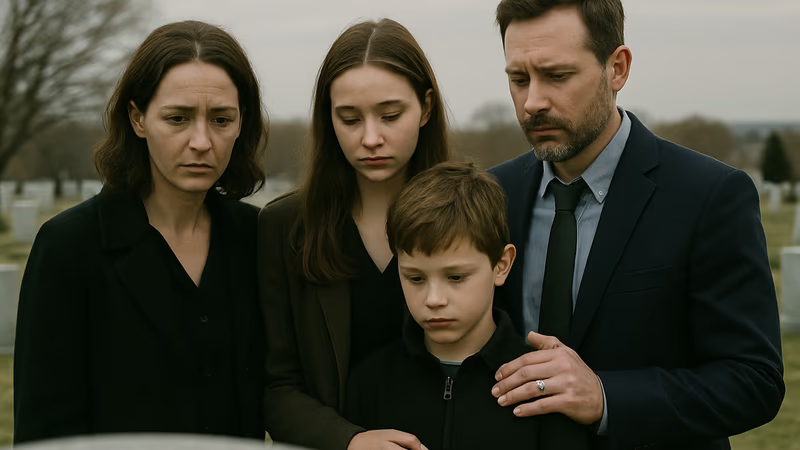
Most parents who call me about this are not curious about mass torts. Something already happened. A daughter hospitalized for an eating disorder that started with appearance filters and “thinspo” content the algorithm kept serving. A son who stopped sleeping because the notifications never did. A suicide attempt nobody saw coming until the phone was unlocked afterward.
If that is where your family is, two things before anything else. First: if your child is in crisis right now, call or text 988, the Suicide & Crisis Lifeline, before you think about lawyers. Second: you are not overreacting by asking the legal question. Nearly 2,900 families and school districts have asked it formally, in one federal courtroom.
This guide is the practical version for New York parents: how to tell whether your child’s situation is actionable, what to save this week, how a family here actually joins the litigation, and what the deadlines look like for minors. If you want the full litigation landscape instead, the courtroom history, the legal theories, the defendants, we covered that in our guide to social media addiction lawsuits and MDL 3047. This article assumes you care less about the docket and more about your kid.
Free, Confidential Consultation for Parents
Not Sure Whether Your Child's Situation Is a Case? Ask.
You do not need to have it figured out before you call. Tell us what happened, what treatment your child has received, and which apps were involved. We will tell you honestly whether it is worth pursuing, and what to preserve either way. No fee unless there is a recovery.
Does your child’s situation actually add up to a case?
Here is the screening conversation I have with parents, compressed. Lawyers evaluating these cases are looking for three things together.
Free Consultation · No Fee Unless We Win
Does this apply to your situation?
Every case is different. Get a free, confidential case review from an experienced attorney who can tell you exactly where you stand.
Documented mental-health harm. Not “my kid is on the phone too much,” which describes most American households. A diagnosis or a treatment record: depression, an anxiety disorder, an eating disorder, self-harm, a suicide attempt, an inpatient stay. The paper matters. A pediatrician’s referral note, a therapist’s intake, an ER record. If your child struggled but never saw anyone, the case is much harder, though getting your child evaluated now serves both their health and, secondarily, the record.
Heavy use of the defendant platforms as a minor. Instagram, TikTok, Snapchat, YouTube. The claims target design features: algorithmic feeds tuned for engagement, endless scroll, appearance filters, streaks, notifications engineered to pull a developing brain back in. Use that started before 18 and ran hours a day is the core fact pattern.
A timeline that connects them. The harm followed the use, and tracks it. Grades dropped after the account went active. Sleep collapsed during the period the screen-time data shows 1 a.m. sessions. The eating disorder emerged while the “For You” feed filled with diet content. Nobody has to prove the platform was the only cause. New York law does not require that. It has to be a substantial factor, and that connection is ultimately built by medical experts, but it starts with your family’s timeline.
One distinction saves parents a lot of confusion. These cases are about design, not posts. If your complaint is that a specific user posted something horrible about your child, Section 230 of the Communications Decency Act still largely shields platforms from liability for other people’s content. What Judge Yvonne Gonzalez Rogers held in the federal MDL, back in November 2023, is that Section 230 does not shield the platforms’ own product design choices: defective parental controls, ineffective age verification, features built to addict. Massachusetts’ highest court reached a similar conclusion in April 2026 in the state’s own case against Meta. So when a lawyer keeps asking about features and hours instead of specific posts, that is why.
Worth a Phone Call If...
Your child was diagnosed with or treated for depression, anxiety, an eating disorder, or self-harm while a heavy user of Instagram, TikTok, Snapchat, or YouTube
There was a suicide attempt or hospitalization, and the phone or accounts show intense platform use in the period before it
Use started young, under 13 especially, since the platforms' own age rules say those accounts should not exist
Treatment providers have connected the platform use to the condition, even informally in session notes
None of these guarantee a case. All of them justify a free consultation before evidence disappears.
What to preserve this week, before you do anything else
I put this section ahead of the litigation explanation on purpose. Deadlines for minors are generous in New York, but evidence is not patient. Platforms purge data. Phones get replaced. Kids delete accounts in a healthy impulse to move on, and take the proof with them.
Do not delete or deactivate the accounts. This is the big one. The account history, watch time, follower activity, and message logs are the backbone of proving heavy use. If your child needs distance from the apps for their recovery, log out, remove the app from the phone, change the password and hold it yourself. Delete nothing.
Export screen-time data. iPhones: Settings, Screen Time, where weekly reports show per-app hours; screenshot everything going back as far as the device shows. Android: Digital Wellbeing. If you have Family Sharing or parental-control apps (Bark, Qustodio), export those reports too. This data rolls off. Capture it now.
Request the account data from each platform. Every major platform has a self-service export: Instagram’s “Download Your Information,” TikTok’s “Download Your Data,” Google Takeout for YouTube, Snapchat’s “My Data.” These exports include signup dates, activity logs, and sometimes ad-targeting categories the platform assigned to your child. Request them for each account, save the files in two places.
Gather the medical record trail. Pediatrician visits, therapy and psychiatry records, ER and inpatient records, prescriptions. You do not need to assemble a perfect file; your lawyer will subpoena the full records. What helps is a simple list of every provider, with rough dates.
School records and your own timeline. Report cards before and after. Attendance. Emails with teachers or counselors who flagged changes. Then sit down for an hour and write the timeline as you remember it: when the accounts started, when you noticed changes, what you tried, when treatment began. Parents’ contemporaneous memories fade faster than they expect, and that document becomes the spine of the case.
One caution while you are gathering: be careful what you and your child post publicly about the situation. It is discoverable. We have written about how social media activity gets used against injury plaintiffs in an entirely different context, and the lesson transfers.
How a New York family actually joins this litigation
There is no special New York enrollment window, no class action to sign up for, and, as of this writing, no separate New York state coordinated proceeding for family claims. The center of gravity is federal: In re Social Media Adolescent Addiction/Personal Injury Products Liability Litigation, MDL 3047, before Judge Yvonne Gonzalez Rogers in the Northern District of California, with nearly 2,900 cases pending as of July 2026.
Mechanically, it works like this. Your family retains a lawyer on contingency. The lawyer investigates: platform data, medical records, the timeline you built. If the case is filed, it is filed as your child’s individual lawsuit, then transferred into the MDL, where discovery and pretrial rulings are coordinated across all the cases. You do not travel to California. Your work is local and mostly paperwork: a plaintiff fact sheet, authorizations for records, and staying in treatment, which matters for your child first and the case second.
An MDL is not a class action. Your child’s case remains individual, valued on its own facts, and you can accept or reject any settlement offered. What consolidation buys is leverage: internal documents pried loose once, rulings that apply across thousands of cases, and bellwether trials that test what juries think these cases are worth. For where the bellwethers stand, see our June coverage of the eve-of-trial settlement and the $6 million K.G.M. verdict.
A minority of cases stay in state court instead, and there are strategic reasons a lawyer might choose that. That is a case-by-case call, not something to decide from a blog post.
Deadlines for Minors in New York
New York's personal injury statute of limitations is 3 years (CPLR 214), but CPLR 208 pauses that clock while your child is under 18. In most cases a child injured by these platforms has until age 21 to file. Two big exceptions: if your child is already 18 or older, the 3-year clock is running now. And if a family has lost a child, wrongful death deadlines are shorter and work differently. When in doubt, ask; the consultation costs nothing.
The deadline math, and why waiting is still a mistake
Under CPLR 208, the limitations period for a minor’s claim is tolled until the 18th birthday. For a three-year personal injury claim, that means suit can generally be filed until the child turns 21. If your child is 14 today, the law gives you years.
The evidence does not. Platform retention policies, device turnover, and ordinary life will thin your proof long before the legal deadline arrives. I have seen strong cases weakened because the family waited two years and the old phone with the screen-time history had been traded in. The toll protects your right to sue. It does nothing to protect the material you will need to win.
The other reason not to wait: the litigation is moving. Global settlement frameworks, when they come in mass torts, tend to treat filed, documented cases differently from late arrivals. Nobody can promise a settlement here, but positioning costs you nothing on contingency.
What realistic expectations look like
I will not dress this up.
Timeline. Years, not months. The MDL was created in late 2022 and the first federal bellwether reached the eve of trial in mid-2026. Individual family cases will resolve in waves as the litigation matures. Anyone promising you a quick payout is selling something.
Value. There is no settlement grid yet. The data points are partial: a Los Angeles jury awarded $6 million against Meta and YouTube in the K.G.M. state-court trial in March 2026, the first federal bellwether, a Kentucky school district’s case, settled for a reported $27 million shortly before its June trial date, and Snap and TikTok have settled individual cases confidentially. Those numbers show the claims are being taken seriously, not what your child’s case is worth. That turns on severity of harm, treatment records, and causation proof.
Court protection for your child. In New York, any settlement of a minor’s claim requires a judge’s approval, through what is called an infant compromise proceeding. The court reviews the amount, the attorney’s fee, and how the funds are held for the child. Families dealing with child injury claims in other contexts, like the school bus accident settlements we have written about, go through the same process. It exists so nobody, including the lawyers, shortchanges a child.
No guarantees. These are contested cases against the best-funded defendants on earth. The Section 230 rulings have gone plaintiffs’ way on design claims, but causation fights child by child will be hard. A lawyer who screens your case carefully before filing is doing you a favor.
Where the school districts fit, briefly
You may have seen that school districts are suing too. More than a thousand districts are in the MDL, and this month Boston sued Meta, TikTok, Snap, and Google on behalf of Boston Public Schools, citing a student mental-health crisis its schools are paying to manage. New York City’s claims on behalf of its schools are part of the federal litigation, and Long Island districts have been watching the Breathitt County settlement closely.
For parents, the practical point is narrow: the district cases seek money for the schools’ costs, not compensation for your child. If your district recovers, your family’s individual claim is unaffected, and vice versa. They matter to you mainly as pressure on the defendants.
New York’s SAFE for Kids Act, and what it means for your case
New York has also moved legislatively. The SAFE for Kids Act, signed in 2024, will prohibit platforms from serving addictive algorithmic feeds and overnight notifications to minors without parental consent. It is not yet in force: the Attorney General proposed implementing rules in September 2025, public comment closed December 1, 2025, and the law takes effect 180 days after the rules are finalized, which puts enforcement in late 2026 at the earliest.
The Act is enforced by the Attorney General, not through private lawsuits, so it is not a vehicle for your family’s claim. Its significance is different: New York’s legislature has now said, in a statute, that algorithmic feeds aimed at minors are harmful enough to prohibit. That legislative judgment is part of the atmosphere these cases are tried in, and it undercuts the industry position that the feeds are harmless entertainment.
Talk to someone who will give you a straight answer
If your child was seriously harmed and the platforms’ design played a role, your family has options, real ones, with real deadlines and real evidence problems that get worse with time. And if the honest answer is that your situation is not a case, you deserve to hear that in one phone call instead of wondering for a year.
Our personal injury practice handles catastrophic injury claims for families across Long Island, Nassau and Suffolk Counties, and New York City, on contingency, with free consultations. Start with the timeline and the accounts. We will take it from there.
Law Office of Jason Tenenbaum, P.C.
Your Child's Story Deserves a Careful Listener
Bring what you have: the diagnosis, the apps, the timeline as you remember it. We will tell you whether there is a case, what to preserve, and what the road looks like. Free, confidential, no obligation, and no fee unless your family recovers.
Related reading
- Social Media Addiction Lawsuits in New York: MDL 3047 and the Litigation Landscape
- The First Federal Social Media Bellwether Settled on the Eve of Trial: What It Means
- School Bus Accident Settlements in New York: What Your Child’s Claim Is Worth
- Personal Injury Practice Overview
Resources for parents
- 988 Suicide & Crisis Lifeline — call or text 988, 24/7
- NY Attorney General — Protecting Children Online — SAFE for Kids Act status and parent resources
- MDL 3047 docket, N.D. Cal. (Judge Yvonne Gonzalez Rogers) — official court page
This article describes New York law and the status of the social media litigation as of July 2026. It is general information, not legal advice and not medical advice; every case turns on its own facts. The Law Office of Jason Tenenbaum, P.C. is licensed in New York State.
Last reviewed: 2026-07-13.
Legal Context
Why This Matters for Your Case
Personal injury law in New York is governed by a complex web of statutes, case law, and procedural rules that differ from most other states. The statute of limitations for most personal injury claims is three years under CPLR 214(5), but claims against municipalities require a Notice of Claim within 90 days. Motor vehicle accident victims must meet the serious injury threshold under Insurance Law §5102(d) before they can recover pain and suffering damages.
The Law Office of Jason Tenenbaum has recovered over $100 million for injured clients across Long Island, Nassau County, Suffolk County, Queens, Brooklyn, Manhattan, and the Bronx. With 24+ years of trial and appellate experience, more than 1,000 appeals written, and 2,600+ published legal articles, Jason Tenenbaum provides the authoritative legal analysis that practitioners and injury victims need to understand their rights.
This article reflects real courtroom experience and a deep understanding of how New York courts actually evaluate personal injury claims — from the initial filing through discovery, summary judgment, trial, and appeal.
About This Topic
New York Personal Injury Law
When negligence causes serious injury, New York law entitles victims to compensation for medical bills, lost income, pain and suffering, and more. From car accidents and slip-and-falls to construction injuries and medical malpractice, the Law Office of Jason Tenenbaum has recovered over $100 million for injured Long Islanders and New Yorkers since 2002.
179 published articles in Personal Injury
Keep Reading
More Personal Injury Analysis

Long Island Pedestrian Crashes After Dark: State Data Before the Clocks Change
From November through January, 485 of 520 evening pedestrian crashes in Nassau and Suffolk happened in the dark. State and federal data, with the CSV files.
Oct 8, 2026
Can New York Be Liable for a Parkway Crash Where There Was No Median Barrier?
A Patchogue family says a Bethpage Parkway crossover crash was preventable. What a claim against the State needs: notice, design immunity, and the 90-day clock.
Oct 2, 2026
Car Accident Recorded Statement in New York: Should You Give One?
The at-fault driver's adjuster wants a recorded statement within days of a New York car accident — and that call is designed to weaken your case.
Apr 5, 2026
Bar Brawl Aftermath: Can Victims Claim Compensation?
Injured in a bar brawl? Understand your compensation rights in NY premises liability cases. Get expert legal help to fight for justice. Call 516-750-0595.
Sep 19, 2025
How Long Does a Personal Injury Lawsuit Take?
How long does a personal injury lawsuit take? Expert injury attorneys at The Law Office of Jason Tenenbaum explain.
Mar 18, 2025
Road Worker Hit by a Driver in New York: Workers' Comp and the Third-Party Claim
A driver enters a Long Island work zone and hits the crew. Workers' comp pays first, but the negligence claim against the driver is where full damages live.
Sep 28, 2026Frequently Asked Questions
Common Questions About This Topic
6 answers from the firm's New York personal-injury and employment-law practice. Click any question to expand.
My child is 19 now. Is it too late to sue a social media company in New York?
Probably not. New York's CPLR 208 pauses the statute of limitations during childhood, so for most personal injury claims the three-year clock starts at the 18th birthday, giving your child until 21 to file. But once your child is an adult, the clock is running, and platform data gets harder to recover every year. Talk to a lawyer now rather than at 20 and a half.
Do we have to go to California to join the social media MDL?
No. Your family's case is filed individually and transferred to MDL 3047 in the Northern District of California for coordinated pretrial proceedings. The work on your end happens locally: a plaintiff fact sheet, records authorizations, and preserving your child's account data. If your case were ever set for its own trial, venue would be addressed then, but the vast majority of MDL cases resolve without that.
What does it cost to bring a social media harm case for my child?
Nothing up front at most firms handling these cases, including ours. They are contingency cases: the attorney is paid a percentage of any recovery and nothing if there is none. In New York, a court must also approve any settlement made on behalf of a minor, including the fee, which is an added layer of protection for your child.
Will my child have to testify or be examined?
At the current stage, most families complete a detailed fact sheet and provide medical and platform records rather than sitting for testimony. If an individual case advances toward trial, depositions and defense mental-health examinations become possible. A good lawyer prepares your family for that well in advance and pushes back on anything abusive.
Can we sue over cyberbullying by another student instead of the platform's design?
It is a different case with different defendants. Claims aimed at what another user posted run into Section 230, which still largely protects platforms from liability for third-party content. But bullying cases sometimes support claims against a school district that ignored reports under New York's Dignity for All Students Act framework, and severe cases can involve claims against the bully's family. Bring the whole picture to a consultation and let the lawyer sort the theories.
Should my child stop using the apps before we file?
That is a treatment decision for your child's clinician, not a legal tactic. What I ask parents not to do is delete the accounts. Deactivating or deleting can destroy the usage history that proves the case. Preserve first, then make health decisions with your child's providers.
Was this article helpful?
Disclaimer: This article is published by the Law Office of Jason Tenenbaum, P.C. for informational and educational purposes only. It does not constitute legal advice, and no attorney-client relationship is formed by reading this content. The legal principles discussed may not apply to your specific situation, and the law may have changed since this article was last updated.
New York law varies by jurisdiction — court decisions in one Appellate Division department may not be followed in another, and local court rules in Nassau County Supreme Court differ from those in Suffolk County Supreme Court, Kings County Civil Court, or Queens County Supreme Court. The Appellate Division, Second Department (which covers Long Island, Brooklyn, Queens, and Staten Island) and the Appellate Term (which hears appeals from lower courts) each have distinct procedural requirements and precedents that affect litigation strategy.
If you need legal help with a personal injury matter, contact our office at (516) 750-0595 for a free consultation. We serve clients throughout Long Island (Huntington, Babylon, Islip, Brookhaven, Smithtown, Riverhead, Southampton, East Hampton), Nassau County (Hempstead, Garden City, Mineola, Great Neck, Manhasset, Freeport, Long Beach, Rockville Centre, Valley Stream, Westbury, Hicksville, Massapequa), Suffolk County (Hauppauge, Deer Park, Bay Shore, Central Islip, Patchogue, Brentwood), Queens, Brooklyn, Manhattan, the Bronx, Staten Island, and Westchester County. Prior results do not guarantee a similar outcome.