Why Trust This Analysis
This article is part of our ongoing employment law coverage, with 81 published articles analyzing employment law issues across New York State. Attorney Jason Tenenbaum brings 24+ years of hands-on experience to this analysis, drawing from his work on more than 1,000 appeals, over 100,000 no-fault cases, and recovery of over $100 million for clients throughout Nassau County, Suffolk County, Queens, Brooklyn, Manhattan, and the Bronx. For personalized legal advice about how these principles apply to your specific situation, contact our Long Island office at (516) 750-0595 for a free consultation.
Last reviewed: June 2026
Key Takeaways
- On January 22, 2026, the EEOC voted 2–1 to rescind its April 29, 2024 Enforcement Guidance on Harassment in the Workplace, the agency’s first comprehensive harassment guidance update in roughly 25 years. Chair Andrea Lucas and Commissioner Brittany Panuccio voted to rescind; Commissioner Kalpana Kotagal dissented.
- The guidance was rescinded in its entirety, not just the gender-identity portions targeted by Executive Order 14168. But a guidance rescission does not change Title VII: workplace harassment based on race, sex, religion, national origin, age, disability, and other protected traits remains illegal under federal law.
- New York’s protections never depended on EEOC guidance. The NYSHRL’s 2019 amendments eliminated the federal “severe or pervasive” requirement: harassment is unlawful in New York when it subjects you to inferior terms, conditions or privileges of employment, unless the conduct amounts to nothing more than petty slights or trivial inconveniences.
- New York covers more people than federal law. The NYSHRL applies to all employers regardless of size (Title VII requires 15+ employees) and protects independent contractors, gig workers, and domestic workers — categories federal harassment law largely misses.
- Your deadlines are longer in New York. An EEOC charge must be filed within 300 days; a NYSHRL claim can be filed with the Division of Human Rights within 3 years (for conduct on or after February 15, 2024) or taken directly to court within 3 years — no agency charge required.
- Employer obligations in New York are unchanged. The state’s mandatory sexual harassment prevention policy and annual training requirements under Labor Law §201-g are state statutes. The EEOC cannot rescind them.
- NYC Human Rights Law is broader still. Harassment is actionable when you are “treated less well” because of a protected characteristic, and gender-based harassment claims reach employers of any size.
The EEOC took 25 years to update its harassment guidance and less than two years to throw the update out. On January 22, 2026, the Commission voted 2–1 to rescind its Enforcement Guidance on Harassment in the Workplace, the comprehensive guidance it had approved on April 29, 2024 after considering more than 37,000 public comments. The headlines were dramatic. The legal reality, for anyone working on Long Island, is much narrower.
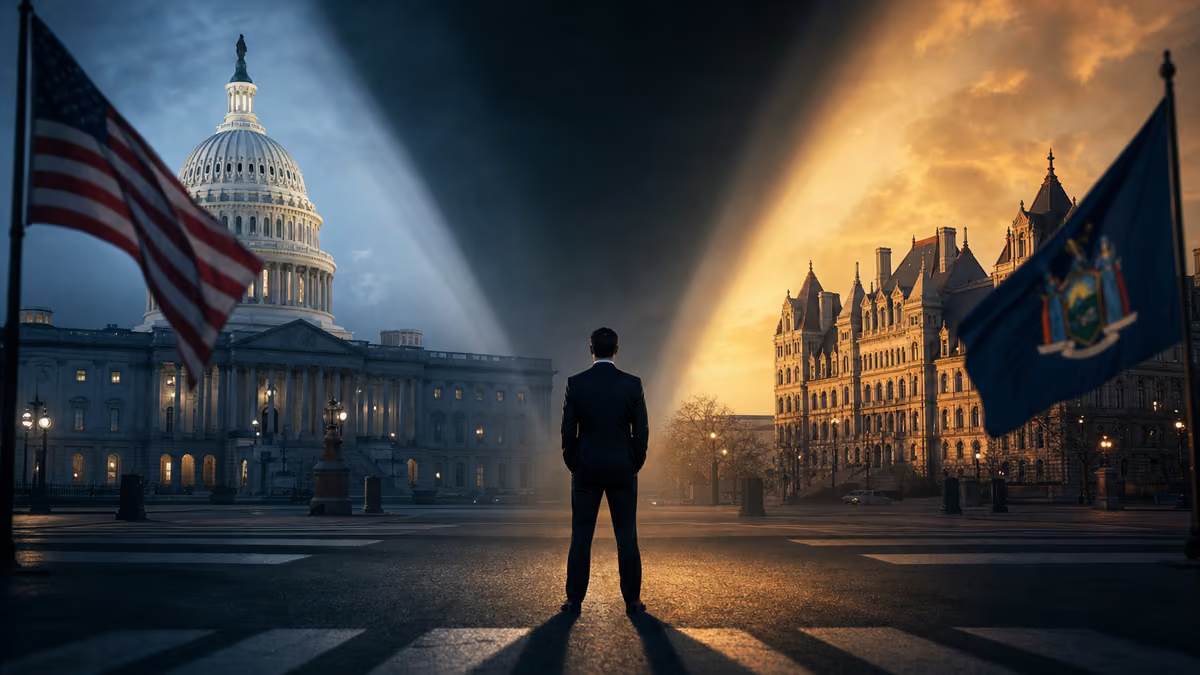
Here is the sentence that matters for our clients: federal guidance shrank; New York’s protections didn’t. The New York State Human Rights Law was deliberately rewritten in 2019 to be more protective than federal law, to cover more workers, and to run on its own track no matter what the EEOC says or unsays. If you are experiencing harassment at a job in Nassau or Suffolk County right now, the January rescission took almost nothing off your table.
Free Consultation · No Fee Unless We Win
Does this apply to your situation?
Every case is different. Get a free, confidential case review from an experienced attorney who can tell you exactly where you stand.
The week after the vote, I took calls from clients convinced their cases had just died. They had not. But I understand why they thought so, and the confusion cuts in both directions: workers giving up claims they still hold, employers trimming compliance programs they are still required to run. This article covers what the EEOC actually rescinded, what a guidance rescission can and cannot legally do, where the federal-state gap now sits, and what workers and employers in New York should do about it. I litigate employment matters on both sides of the table, so it is written from both angles.
Quick Reference — EEOC Harassment Guidance Rescission
What Happened
EEOC voted 2–1 to rescind its April 29, 2024 Enforcement Guidance on Harassment in the Workplace — in its entirety, not just the gender-identity sections.
When
January 22, 2026. Chair Andrea Lucas and Commissioner Brittany Panuccio voted yes; Commissioner Kalpana Kotagal dissented.
Who Is Affected
Federal charge handling and EEOC litigation positions. Title VII itself is unchanged. NYSHRL and NYC Human Rights Law are untouched.
What the EEOC Actually Rescinded on January 22, 2026
The document at issue was the EEOC’s Enforcement Guidance on Harassment in the Workplace, approved April 29, 2024 by a 3–2 Commission vote. It was the agency’s first comprehensive consolidation of its harassment positions since 1999: a single reference that pulled together decades of case law on hostile work environments, employer liability for supervisors versus co-workers, systemic harassment, and online and remote-work harassment, illustrated with dozens of concrete examples. According to Jackson Lewis’s analysis of the rescission, the 2024 guidance had incorporated more than 37,000 public comments.
On January 22, 2026, a two-member Republican majority — Chair Andrea Lucas and Commissioner Brittany Panuccio — voted to rescind it. Commissioner Kalpana Kotagal, the lone Democratic commissioner, voted no. The majority gave three rationales, summarized across firm alerts from Littler, Troutman Pepper Locke, and Holland & Knight:
- Claimed overreach. The majority’s position that portions of the guidance exceeded the Commission’s authority under Title VII and amounted to rulemaking the agency was never authorized to do.
- The gender-identity provisions. Particularly the 2024 guidance’s treatment of misgendering and bathroom access as potential harassment, which the majority viewed as extending Bostock v. Clayton County beyond its holding.
- Executive Order 14168. President Trump’s January 2025 order, “Defending Women from Gender Ideology Extremism”, directed agencies to rescind guidance inconsistent with its two-sex policy.
Notably, the Commission did not do a surgical edit. As NPR reported, the agency rescinded the guidance covering everyone: the race, religion, national origin, age, disability, and sex-harassment material went out the door along with the gender-identity sections. At the same time, all three commissioners emphasized that combating unlawful harassment remains an enforcement priority, and the EEOC stated that the rescission changes no underlying law.
2–1
Rescission Vote
Lucas and Panuccio for; Kotagal dissenting. January 22, 2026.
37,000+
Public Comments
Considered before the 2024 guidance was approved on April 29, 2024 — the first comprehensive update since 1999.
0
Words of NYSHRL Changed
The EEOC has no power over New York's Human Rights Law. State and NYC protections are untouched.
3 yrs
NYSHRL Deadline
To sue in court — or file with the NYS Division of Human Rights — versus only 300 days for an EEOC charge.
What a Guidance Rescission Actually Does — and What It Does NOT Do
This is the part most coverage gets wrong, in both directions. EEOC enforcement guidance is a sub-regulatory document: it tells the public, employers, and the agency’s own investigators how the EEOC interprets the statutes it enforces. It is not a statute. It is not a regulation. Courts were never required to follow it, and they are not required to follow its absence either.
What the Rescission DOES
- →Removes the EEOC's consolidated playbook for how its investigators evaluate harassment charges — expect less predictable federal charge handling.
- →Signals the Commission majority will not litigate gender-identity harassment theories (misgendering, bathroom access) beyond what it reads Bostock to require.
- →Withdraws the examples and employer-liability framework that HR departments and smaller employers relied on for training and policy design.
- →Deprives courts of a persuasive (never binding) reference some judges cited when analyzing hostile-work-environment claims.
What the Rescission Does NOT Do
- ✓Title VII is unchanged. Harassment based on race, color, religion, sex, and national origin remains illegal under federal statute. Only Congress can amend Title VII.
- ✓Bostock v. Clayton County still stands. The Supreme Court's 2020 holding that Title VII's sex discrimination ban covers sexual orientation and gender identity is binding precedent no agency can rescind.
- ✓Decades of federal case law remain good law — Meritor, Harris, Faragher, Ellerth were court decisions, not EEOC documents.
- ✓State and city law are completely untouched. The NYSHRL and NYC Human Rights Law do not derive from, defer to, or depend on EEOC guidance in any way.
Think of it this way: the EEOC threw away its own instruction manual. The machine — the statutes and the court decisions interpreting them — keeps running. And in New York, there is a second, more powerful machine that the EEOC never had a key to in the first place.
The Federal-State Gap: Title VII vs. NYSHRL vs. NYC Human Rights Law
New York rebuilt its harassment law in 2019 precisely so that it would not rise or fall with federal interpretation. The 2019 NYSHRL amendments (S.6577/A.8421), signed August 12, 2019, eliminated the federal “severe or pervasive” requirement for claims filed on or after October 11, 2019. Under Executive Law §296, harassment is now unlawful in New York when it subjects a person to inferior terms, conditions or privileges of employment because of a protected characteristic, regardless of whether the conduct would be “severe or pervasive” under federal precedent. The employer’s escape hatch is narrow: an affirmative defense that the conduct amounts to nothing more than petty slights or trivial inconveniences as judged by a reasonable victim with the same protected characteristic.
The same amendments directed courts to construe the NYSHRL liberally, independently of how federal courts construe federal civil rights laws. That is a statutory firewall, built in 2019, against exactly the kind of federal retrenchment we saw in January.
Here is how the three regimes now compare:
| Issue | Title VII (Federal) | NYSHRL (NY State) | NYC Human Rights Law |
|---|---|---|---|
| Harassment standard | Hardest "Severe or pervasive" hostile work environment. |
Lower "Inferior terms, conditions or privileges" — more than "petty slights or trivial inconveniences." No severe-or-pervasive requirement since Oct. 11, 2019. |
Broadest "Treated less well" because of a protected characteristic (Williams v. NYCHA); liberal construction mandated. |
| Employer size | 15+ employees only. | All employers, regardless of size (since Feb. 8, 2020). | 4+ employees; any size for gender-based harassment. |
| Independent contractors & gig workers | Generally not covered | Covered Contractors, subcontractors, vendors, consultants (Exec. Law §296-d); domestic workers protected (§296-b). | Covered Independent contractors and freelancers protected. |
| Filing deadline | 300 days to file an EEOC charge (NY is a deferral state); then 90 days to sue after a right-to-sue letter. | 3 years to sue in court (CPLR §214) — or 3 years to file with the Division of Human Rights for conduct on or after Feb. 15, 2024. | 3 years to sue in court; NYC Commission filing window is shorter (generally 1 year; 3 for gender-based harassment). |
| Agency charge required before suing? | Yes Must exhaust at the EEOC first. | No Direct to court — no EEOC, no DHR charge needed. | No Direct to court. |
| Punitive damages | Capped ($50k–$300k combined compensatory/punitive, by employer size). | Uncapped Available against private employers since 2019, plus attorney's fees. | Uncapped Punitive damages and attorney's fees available. |
| Affected by the Jan. 22, 2026 rescission? | Guidance only The statute and court precedent are unchanged. | No | No |
Sources: 2019 NYSHRL amendments (S.6577/A.8421) · NYS Division of Human Rights, 3-year statute of limitations (eff. Feb. 15, 2024) · Littler ASAP on the Jan. 22, 2026 rescission. Every case differs; deadlines depend on when the conduct occurred.
A practical note on the standards row, because precision matters here. New York did not abolish the requirement that harassment be objectively meaningful — the statute still screens out conduct that a reasonable person with the same protected characteristic would consider mere “petty slights or trivial inconveniences.” What New York abolished is the federal requirement that you endure conduct severe or pervasive enough to transform your entire working environment before the law notices. Under the NYSHRL, conduct that treats you worse because of who you are — short of trivial — is actionable. That is a genuinely different, and genuinely lower, bar.
What This Means for Long Island Workers Experiencing Harassment Right Now
If you are dealing with harassment at work in Nassau County, Suffolk County, or anywhere in New York, here is the operational takeaway: you do not need the EEOC to have a case. You never did, and after January 22 that is more true than ever.
-
You can go straight to court under the NYSHRL. Unlike Title VII, the state Human Rights Law has no administrative-exhaustion requirement. You do not need an EEOC charge, a right-to-sue letter, or a Division of Human Rights complaint before filing a lawsuit in state (or federal) court on a NYSHRL claim. Our Long Island employment discrimination practice handles these cases under state law as a matter of course.
-
The state standard is the one your case will likely be measured by. When we plead harassment claims for New York workers, the NYSHRL and (where applicable) NYC Human Rights Law claims are typically the strongest counts precisely because the “inferior terms, conditions or privileges” standard reaches conduct federal law tolerates. A pattern of demeaning comments, exclusion from meetings, or worse assignments tied to your race, sex, age, disability, religion, or other protected trait can be actionable in New York even where a federal court would shrug.
-
Small-employer and contractor cases are state cases by definition. If your employer has fewer than 15 employees — a huge share of Long Island businesses — Title VII never applied to begin with. Same if you are an independent contractor, freelancer, gig worker, or domestic worker. Those cases live under the NYSHRL, and nothing the EEOC did in January touches them. See our pages on hostile work environment claims and sexual harassment claims for how these cases are built.
-
Still consider a protective EEOC charge in dual-track cases. For employees of 15+ employee companies, we often file an EEOC charge anyway to preserve the federal claim (and the possibility of federal-court remedies) while the state claims do the heavy lifting. The agency’s intake obligations did not disappear with the guidance, but with the EEOC’s posture shifting, treat the 300-day federal window as a use-it-or-lose-it insurance policy, not as your main protection. Our Long Island EEOC lawyer page walks through the charge process.
-
Document now, complain in writing, and watch for retaliation. The 2019 amendments also eliminated the rule that failing to use an employer’s internal complaint procedure dooms your claim. Even so, a contemporaneous written record remains the single most valuable thing a harassment plaintiff can create. And if your hours, assignments, or employment status change after you complain, that is a separate retaliation claim under both federal and state law. We cover that in depth on our employer retaliation page. Para los trabajadores hispanohablantes de Long Island, nuestra guía en español sobre represalias laborales en Nueva York explica los mismos derechos.
-
If you were fired after complaining, the clock matters most. Termination cases blend harassment, retaliation, and wrongful-discharge theories; the Long Island wrongful termination attorney page explains how New York treats them. Three years feels long. It is not. Evidence goes stale and witnesses scatter long before the statute runs.
Free Consultation · Long Island
Harassment at Work? Federal Guidance Did Not Take Your Case With It.
The NYSHRL gives New York workers a lower harassment standard, coverage at employers of every size, and a 3-year window to sue — with no EEOC charge required. If something at work feels wrong, get it evaluated before evidence disappears. The Law Office of Jason Tenenbaum reviews harassment, discrimination, and retaliation matters for Nassau and Suffolk workers at no charge.
Call (516) 750-0595 for a free, confidential consultation.
The Employer Side: New York’s Compliance Obligations Did Not Move an Inch
I also counsel and defend employers, so let me be equally blunt in the other direction: if you run a New York business, the January rescission gave you nothing to deregulate.
Employer Sidebar — These NY Obligations Are State Law and Unchanged
- Written sexual harassment prevention policy — every New York employer, regardless of size, must adopt one meeting or exceeding the state model (Labor Law §201-g).
- Annual interactive sexual harassment training — for all employees, every year. NYC layers its own training requirements on employers with 15+ employees.
- NYSHRL liability standards — the "inferior terms, conditions or privileges" standard, contractor coverage, and uncapped punitive damages all remain in force against your business.
- 3-year exposure window — the Division of Human Rights accepts complaints for three years (conduct on or after Feb. 15, 2024), and court actions carry a 3-year statute of limitations.
An employer that trims its harassment policy or training to the new federal floor is building a compliance program for the wrong sovereign. Your regulator is Albany — and for NYC operations, also the NYC Commission on Human Rights.
There is one genuinely tricky compliance wrinkle the rescission sharpens. The current EEOC has signaled — in this rescission and in its DEI enforcement campaign — that it views some diversity-flavored training content as potential reverse-discrimination exposure, while New York simultaneously mandates harassment training under Labor Law §201-g. Employers should keep the two separable: satisfy the state training mandate rigorously, and audit any bundled DEI content separately. We analyzed that whipsaw at length in our Two-Front War cornerstone.
Attorney inquiries answered same day. The firm regularly takes per-diem assignments, appellate briefing, and co-counsel arrangements in employment matters for other practitioners — including NYSHRL claims being evaluated for state-versus-federal forum strategy after the EEOC’s shift.
Deadlines: The Clocks Are Different, and the Federal One Is Short
Harassment Claim Deadlines for New York Workers — 2026
Day 1 — The harassment occurs (or the last act in a pattern)
Every clock below starts from the unlawful conduct — generally the most recent incident in a continuing pattern. Document everything immediately.
300 days — EEOC charge deadline (federal claims)
Title VII, ADEA, and ADA claims die if no charge is filed within 300 days (New York's deferral-state window). Roughly 10 months — the shortest clock on this timeline.
~1 year+ — 90 days after any EEOC right-to-sue letter
If you filed a federal charge and receive a right-to-sue letter, the federal lawsuit must be filed within 90 days of receipt — a trap that catches unrepresented workers every year.
3 years — NYS Division of Human Rights complaint
For conduct on or after February 15, 2024, the DHR filing window is three years (it was one year before). Free to file, no lawyer required — but an election-of-remedies decision with real strategic consequences.
3 years — NYSHRL / NYCHRL lawsuit in court
The state-law court action — no agency charge required, lower liability standard, uncapped punitive damages and attorney's fees. For most New York harassment victims, this is the main event.
General time limits; specific facts (continuing violations, tolling, public employers, notice-of-claim rules for government defendants) can shorten or extend these. Get specific advice early.
One strategic point we make in every intake: filing with the Division of Human Rights and filing in court are alternatives, not a sequence. New York’s election-of-remedies doctrine generally bars a court action on the same claim once a DHR complaint is decided on the merits. Which path maximizes your recovery depends on the evidence, the employer, and the damages — which is exactly the conversation to have with counsel before filing anything.
How This Fits the Broader Federal-State Collision
The January 22 rescission is not an isolated event. It is one move in a two-year-long divergence between Washington and Albany that we mapped in The Two-Front War: How New York Employers Got Caught Between Trump’s EEOC and Albany’s Pro-Worker Backlash: the federal government narrowing its civil-rights enforcement posture — rescinding guidance, redefining priorities, and targeting DEI programs as reverse discrimination — while New York codifies broader liability, longer deadlines, and bigger damages on the state side. Albany’s push to ban most noncompete agreements, which cleared the Senate again on June 3, is part of the same arc. For background on how the year’s other federal developments land in New York, see our 2026 New York employment law changes tracker.
For workers, the divergence means forum choice is now the most consequential early decision in a harassment case. For employers, it means the compliance floor and the enforcement risk are increasingly set in Albany and lower Manhattan, not Washington. Either way, the answer to “did the law just change for me?” in New York is almost always: the federal posture changed; your rights and obligations under state law did not.
Related Reading — Federal-State Employment Law Cluster
Cornerstone
The Two-Front War
How New York employers got caught between Trump's EEOC and Albany's pro-worker backlash — the full federal-state collision map.
Timeline
The EEOC's War on DEI
A complete timeline of reverse-discrimination enforcement, 2024–2026 — the campaign this rescission belongs to.
En Español
Represalias Laborales en Nueva York
Cómo defenderse de las represalias en el trabajo — sus derechos bajo la ley de Nueva York, explicados en español.
Legal Context
Why This Matters for Your Case
Employment law in New York provides some of the strongest worker protections in the nation. The New York State Human Rights Law (Executive Law §296) prohibits discrimination based on race, sex, age, disability, sexual orientation, gender identity, and other protected characteristics. The New York City Human Rights Law goes even further, applying a broader standard and covering more employers.
Federal protections under Title VII, the ADA, the ADEA, and the FLSA provide additional layers of protection. The Law Office of Jason Tenenbaum represents employees facing workplace discrimination, wrongful termination, wage theft, hostile work environments, and employer retaliation throughout Long Island, Nassau County, Suffolk County, and the five boroughs of New York City.
Whether your case involves EEOC filings, NYS Division of Human Rights complaints, or direct court action under CPLR Article 78, this article provides the expert legal analysis that workers and practitioners need to understand their rights and develop effective litigation strategies under current New York employment law.
About This Topic
New York Employment Law
New York has some of the strongest worker protections in the nation — from the NYC Human Rights Law to state-level whistleblower statutes. Whether you're dealing with discrimination, wage theft, wrongful termination, or hostile work environments, understanding your rights is the first step. Attorney Jason Tenenbaum represents employees across Long Island and NYC in federal and state employment claims.
81 published articles in Employment Law
Keep Reading
More Employment Law Analysis
Religious Accommodation at Work After Bergin: The "Motivating Factor" Test in New York
The Second Circuit replaced its old religious-accommodation test with Abercrombie's motivating-factor test. What changed, what New York law adds, what to keep.
Oct 14, 2026
Does a New York Employer Have to Keep a Personnel File? What the Law Requires
No New York law says "keep a personnel file," but wage, I-9 and payroll rules already require one. What § 210-b adds on November 8, 2026.
Oct 13, 2026
DEI as a False Claims Act Trap: IBM's $17M Settlement and What It Means for New York Federal Contractors
DOJ's Civil Rights Fraud Initiative (May 2025) and the April 10, 2026 IBM False Claims Act settlement: what NY federal contractors and whistleblowers face.
May 12, 2026
Hidden Cameras at Northwell: Justice or Betrayal?
Northwell Health faces class action lawsuit over illegal bathroom filming at Manhasset facility. Over 250 victims seek compensation for privacy violations.
Aug 4, 2025
Hoffman vs. Dallas Hot Wieners: A Wage and Workplace Rights Battle
Legal case: Rose Hoffman v. Dallas Hot Wieners details workplace harassment, wage violations & court rulings in NY Supreme Court case.
Dec 20, 2024
New York Ghost Jobs Bill: Can Employers Post Jobs They Do Not Intend to Fill?
New York's ghost jobs bill would require large employers and job platforms to disclose whether a posting is current, delayed, or only collecting resumes.
Aug 19, 2026Frequently Asked Questions
Common Questions About This Topic
6 answers from the firm's New York personal-injury and employment-law practice. Click any question to expand.
Did the EEOC make workplace harassment legal?
No. The EEOC rescinded a guidance document — its own interpretive manual — on January 22, 2026. Title VII of the Civil Rights Act still prohibits harassment based on race, color, religion, sex, and national origin; the ADEA and ADA still prohibit age and disability harassment. Only Congress can change those statutes, and decades of Supreme Court precedent interpreting them remain binding. In New York, the State Human Rights Law and NYC Human Rights Law independently prohibit workplace harassment under standards that are *more* protective than federal law.
Can I still sue for workplace harassment in New York after the EEOC rescinded its guidance?
Yes, and your strongest claims were probably state claims all along. The NYSHRL lets you sue directly in court, without any EEOC charge, within three years. The standard is lower than federal law (harassment subjecting you to "inferior terms, conditions or privileges of employment" rather than "severe or pervasive" conduct), it covers employers of every size, and uncapped punitive damages plus attorney's fees are available. Nothing about the January 2026 rescission affects any of that.
Do I still need to file with the EEOC within 300 days?
Only if you want to preserve *federal* claims under Title VII, the ADEA, or the ADA: those statutes require an EEOC charge within 300 days in New York before you can sue federally. Your NYSHRL claims need no charge at all. In many cases we file a protective EEOC charge to keep the federal option alive while building the state-law case, but missing the 300-day window does not kill a New York harassment case. Talk to a lawyer before deciding which clocks matter for your facts.
What is the harassment standard under New York law in 2026?
Since October 11, 2019, the NYSHRL makes harassment unlawful when it subjects a person to inferior terms, conditions, or privileges of employment because of a protected characteristic, regardless of whether the conduct is "severe or pervasive" under federal precedent. The employer's affirmative defense is limited to showing the conduct was nothing more than "petty slights or trivial inconveniences" to a reasonable person with the same protected characteristic. New York City's Human Rights Law goes further still: harassment is actionable when you are "treated less well" because of a protected trait.
Does my small Long Island employer have to follow harassment laws if it has fewer than 15 employees?
Yes. Title VII's 15-employee threshold never applied to New York state law. Since February 8, 2020, the NYSHRL covers every New York employer regardless of size, and every New York employer — even one with a single employee — must maintain a sexual harassment prevention policy and provide annual interactive training under Labor Law §201-g. Independent contractors, gig workers, and domestic workers are protected too.
Are New York employers still required to provide sexual harassment training after the EEOC rescission?
Yes. New York's mandatory written policy and annual interactive sexual harassment training requirements come from state statute (Labor Law §201-g), not from EEOC guidance, and they are completely unaffected by the January 22, 2026 rescission. NYC adds its own training requirements for employers with 15 or more employees. An employer that drops its training program because "the federal guidance went away" is exposing itself to liability under the laws that actually govern it. --- If you are experiencing harassment at work on Long Island — or you were fired after reporting it — the federal news cycle has not weakened your case. The Law Office of Jason Tenenbaum, P.C. handles harassment, discrimination, retaliation, and wrongful termination claims under the NYSHRL, NYCHRL, and federal law for workers throughout Nassau and Suffolk Counties. Call (516) 750-0595 for a free, confidential consultation, or start with our employment discrimination practice overview. *This article is attorney advertising and general information, not legal advice. Deadlines and outcomes depend on specific facts; every case differs.*
Was this article helpful?
Disclaimer: This article is published by the Law Office of Jason Tenenbaum, P.C. for informational and educational purposes only. It does not constitute legal advice, and no attorney-client relationship is formed by reading this content. The legal principles discussed may not apply to your specific situation, and the law may have changed since this article was last updated.
New York law varies by jurisdiction — court decisions in one Appellate Division department may not be followed in another, and local court rules in Nassau County Supreme Court differ from those in Suffolk County Supreme Court, Kings County Civil Court, or Queens County Supreme Court. The Appellate Division, Second Department (which covers Long Island, Brooklyn, Queens, and Staten Island) and the Appellate Term (which hears appeals from lower courts) each have distinct procedural requirements and precedents that affect litigation strategy.
If you need legal help with a employment law matter, contact our office at (516) 750-0595 for a free consultation. We serve clients throughout Long Island (Huntington, Babylon, Islip, Brookhaven, Smithtown, Riverhead, Southampton, East Hampton), Nassau County (Hempstead, Garden City, Mineola, Great Neck, Manhasset, Freeport, Long Beach, Rockville Centre, Valley Stream, Westbury, Hicksville, Massapequa), Suffolk County (Hauppauge, Deer Park, Bay Shore, Central Islip, Patchogue, Brentwood), Queens, Brooklyn, Manhattan, the Bronx, Staten Island, and Westchester County. Prior results do not guarantee a similar outcome.