Key Takeaway
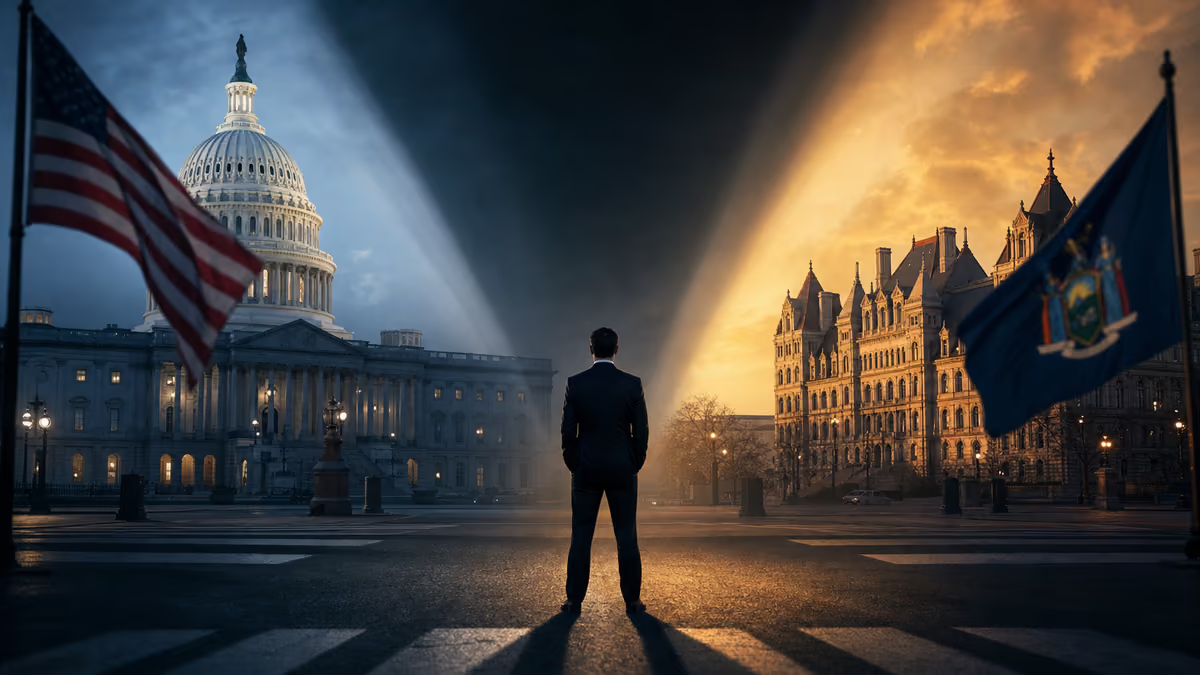
Trump's EEOC and New York's NYSHRL now demand opposite things from the same employer.
This article is part of our ongoing employment law coverage, with 82 published articles analyzing employment law issues across New York State. Attorney Jason Tenenbaum brings 24+ years of hands-on experience to this analysis, drawing from his work on more than 1,000 appeals, over 100,000 no-fault cases, and recovery of over $100 million for clients throughout Nassau County, Suffolk County, Queens, Brooklyn, Manhattan, and the Bronx. For personalized legal advice about how these principles apply to your specific situation, contact our Long Island office at (516) 750-0595 for a free consultation.
Last reviewed: May 15, 2026 — Federal and state enforcement landscapes are both moving quickly. We will update this analysis as the EEOC, DOJ, and NYS Division of Human Rights publish new guidance.
May 2026 NY Employment Law Cluster
Practice Hub
Long Island Employment Discrimination
NYSHRL, Title VII, retaliation, wage-and-hour — the full firm practice.
Wage & Hour
The Tip Credit Trap
Long Island restaurants are one audit away from a six-figure NYLL Article 19 wage bill.
Classification
Independent Contractor 2026
Why the Trump-II DOL rule won't save you from NY's four parallel misclassification tests.
Federal Contracts
DEI as a False Claims Act Trap
IBM's $17M settlement and the Civil Rights Fraud Initiative — what NY federal contractors must do now.
If you run a business in New York with more than fifteen employees, you are now legally exposed in two opposite directions at once. The federal Equal Employment Opportunity Commission, under Chair Andrea Lucas, has spent the last sixteen months treating a wide range of diversity, equity, and inclusion programs as unlawful workplace discrimination — and the Department of Justice has joined the project with False Claims Act suits and a Civil Rights Fraud Initiative aimed at federal contractors. Meanwhile, Albany has moved in precisely the opposite direction, codifying disparate-impact liability into the New York State Human Rights Law (Senate Bill S8338, signed December 19, 2025), banning credit-history inquiries in hiring, expanding retaliation protections, and pushing minimum-wage and pay-transparency frameworks that look nothing like the federal regime.
I represent both sides of the employment fight — plaintiffs in discrimination, wage-and-hour, and retaliation cases and management defendants when employers come to me before or during a dispute. I see this clash from both seats. This article is the practitioner-level read I give clients who walk in with the same question: which government do I have to comply with first, and what happens when I can’t comply with both?
“You got fucked by the state, you got fucked by the federal government, and the city kind of cut you a little bit of a break — until they didn’t. It’s hard enough to run a business in New York. Now you’re staring down the barrel of yet another gun because you have to conform with federal employment law that’s completely 180 degrees diametrically opposed to state law. How do you navigate that?”
— Jason Tenenbaum, on the operating reality for Long Island employers in 2026
Free Consultation · No Fee Unless We Win
Does this apply to your situation?
Every case is different. Get a free, confidential case review from an experienced attorney who can tell you exactly where you stand.
The structural conflict I’m describing is not theoretical. It is already producing federal court filings on one side and NYS Division of Human Rights complaints on the other — frequently against the same employer for the same conduct. Below is a clean map of the two regimes, where they collide, and what to actually do about it.
The Federal Pivot: What Chair Lucas’s EEOC Now Treats as Discrimination
The current EEOC is not the agency employers have spent thirty years learning to navigate. Glenn Spencer, Senior Vice President of the Employment Policy Division at the U.S. Chamber of Commerce, frames the change in a way that captured a lot of management attention earlier this year:
“From one administration to the next you typically see some changes in labor policy — NLRB, Department of Labor, EEOC. They tended to move within the 40-yard lines. Maybe within the 30-yard lines now as things have changed. The EEOC is a pretty dramatic shift in the way people have become used to viewing that agency.”
— Glenn Spencer, SVP, Employment Policy Division, U.S. Chamber of Commerce, on the Greenberg Traurig “Big Law Redefined” podcast, May 2026
Chair Lucas published the EEOC’s 2027 enforcement priorities at the start of the year and has been consistent and public about every one. The four priorities are: rooting out unlawful race and sex discrimination arising from or related to DEI programs; protecting American workers from unlawful national-origin discrimination involving preferences for foreign workers; defending sex-based rights at work; and protecting workers from religious bias and harassment. Read together they amount to a single thesis — the statute says “do not discriminate,” and the commission intends to read that literally and prosecute it that way.
The clearest illustration of how the EEOC is now thinking, again from Spencer:
“If you were doing a women-in-business two-day retreat and you were not also willing to do a men-in-business two-day retreat, you probably shouldn’t do the first one. That literally is where they’re thinking. Those types of programs are going to become unlawful, and from the chair’s perspective it’s just a reading of the statute. The statute doesn’t say anything about specific ethnic groups. It says you shouldn’t discriminate. So that’s their view: discrimination means discrimination, period.”
— Glenn Spencer, on the EEOC’s read of Title VII
This is a profound change in operating posture. Many of the practices that made up corporate DEI for the last decade — diverse-slate interview requirements, affinity groups closed to majority employees, bonus modifiers tied to demographic outcomes, mentorship or fellowship programs restricted by protected class, internal hiring goals expressed in racial or gender terms — sit squarely in the crosshairs of the new EEOC. Our deeper analysis of how this turn started and where it has gone is in our EEOC reverse-discrimination timeline and the foundational Trump EEOC executive orders piece.
The IBM settlement made this concrete. On April 10, 2026, IBM paid $17.077 million to resolve the first publicly reported DEI-related False Claims Act case under the Justice Department’s Civil Rights Fraud Initiative, addressing allegations that the company tied bonuses to demographic targets, required diverse interview slates, and restricted mentoring access by protected class. That’s not an EEOC charge that takes years to develop. That’s a treble-damages federal recovery, debarment-eligible, with a qui tam relator’s share that incentivizes former employees to come forward. It is, as Spencer put it, “a totally different way of thinking about how this agency is going to be enforced.” Federal contractors and Medicare-billing healthcare systems are not insulated. We unpack the FCA angle in detail in our companion piece on DEI as a False Claims Act trap.
The State Counter-Offensive: What Albany Did While Washington Pivoted
While the federal regime was reorienting against the employment frameworks Albany spent a decade encouraging, the New York Legislature was busy strengthening every protection the federal government was walking back. The result is a state employment-law floor that is now meaningfully higher than the federal ceiling in many areas — and, more importantly, points in a different direction.
December 19, 2025
S8338 — Disparate-Impact Codification
Codified disparate-impact liability into the NYSHRL. A facially neutral practice that produces a statistically adverse outcome by protected class is now actionable in New York even when the federal EEOC is signaling it will not pursue disparate-impact theories.
Operative date: immediate
April 18, 2026
Employment Credit-Check Ban
Most employers are now prohibited from using consumer credit reports in hiring, promotion, transfer, or discipline decisions. The narrow statutory exemptions do not save a generic background-check vendor that pulls a credit file on every applicant.
In effect: now
2026 session
Expanded NYSHRL Retaliation
The retaliation provisions of Executive Law §296 have been broadened to reach a wider range of adverse actions and to lengthen the limitations window. The state has been clear it expects retaliation cases to do more work as discrimination cases get pushed harder.
Plaintiff leverage: rising
Pending
Trapped at Work Act + $30 Wage
Pending statewide proposals to ban captive-audience meetings on political and religious topics and to step the New York City minimum wage to $30 over a phased schedule. Even before passage, the political direction is unmistakable.
Trend signal: pro-worker
Each of those moves is, in its own right, a sensible reaction to a particular labor-market problem. Read together with the EEOC’s pivot, they create the structural collision this article is about. New York is widening the universe of statistically-actionable employment practices precisely as the federal government is narrowing it. We covered the credit-check piece separately in our analysis of the New York credit-check employment ban, and the broader wage-and-hour exposure framework in our New York wage and hour laws guide.
The Structural Conflict: Where Federal-Compliant ≠ State-Compliant
The center of the problem is that several common workplace practices now expose a New York employer to liability from one side or the other depending on which direction the practice points. There is no neutral position. Here are the live fault lines I see crossing my desk most often.
Collision Point 1
Hiring slates
Diverse-slate requirements are presumptively unlawful under the EEOC's Title VII read. Dropping them can produce statistically adverse hiring patterns actionable under S8338's disparate-impact framework.
Federal exposure: high · State exposure: high
Collision Point 2
Affinity groups + ERGs
Closed-membership ERGs support reverse-discrimination claims federally. Opening membership has to be implemented without retaliating against current participants who, in New York, keep robust NYSHRL claims.
Federal exposure: rising · State exposure: elimination-driven
Collision Point 3
Mandatory training
State-mandated sexual-harassment training under Labor Law §201-g must satisfy state requirements without bundling implicit-bias or attribution content the EEOC has flagged as actionable.
Solution: federally-safe content, state-compliant cadence
Collision Point 4
Bonus modifiers + scorecards
Demographic-target bonus modifiers are now direct evidence of intentional discrimination federally. Removal must be paired with neutral business-necessity documentation to avoid state retaliation exposure.
Federal exposure: the IBM template · FCA risk: material
Collision Point 5
AI hiring + screening
EEOC flags biased screening as Title VII exposure. NYC Local Law 144 and state analogs require bias audits. Maryland banned AI interviewing outright. The compliance floor is rising on both axes.
Action: documented bias audit + neutral validation
The Through-Line
No neutral position
Every collision point shares a structure: the same compliance lever moves the employer toward, then away from, liability depending on which sovereign is looking. The defense is documentation, not avoidance.
Posture: documented middle path
Hiring slates and pipeline programs
Many large employers — particularly federal contractors, banks, and healthcare systems — adopted “Rooney Rule” style diverse-slate requirements during the last decade. The EEOC is now signaling these are presumptively unlawful disparate-treatment programs because they restrict the candidate pool by protected class. Drop the diverse-slate program, however, and your statewide hiring numbers may begin to show statistically adverse patterns by race or sex — and S8338 has now made that the basis of a disparate-impact claim under the NYSHRL. The same compliance lever moves the employer toward, then away from, liability depending on which sovereign is doing the looking.
Affinity groups and employee resource groups
The EEOC’s current public position is that affinity groups closed to majority employees can support a Title VII claim by an excluded white or male employee. The state-law side is more permissive about voluntary protected-class affinity programming so long as participation is open and benefits are equally available. The fix that protects the federal exposure (opening the group to all employees) is often the right move, but it has to be done in a way that doesn’t read as retaliatory or pretextual to the affinity group members themselves — who, in New York, retain robust NYSHRL claims if the change is implemented in a way that targets them.
Mandatory training and “DEI training”
Glenn Spencer’s guidance to the Chamber’s member companies on this point is one of the most useful pieces of management-side advice I have heard publicly this year:
“You’ve got states like Illinois that mandate a certain number of those trainings every year. It’s a challenge for employers to navigate. The place to start is to go back and look at the executive order from Trump 1 that addressed how government contractors should conduct these trainings. It said there are certain things you can talk about and certain things, if you veer into them, would be problematic. Use that as your baseline for state-mandated training. Talk about anti-discrimination. Don’t talk about the things that the EO flagged as problematic. That’s a defensible posture.”
— Glenn Spencer, on threading state-mandated training through federal exposure
For New York specifically, that means satisfying the state’s sexual-harassment training mandate under Labor Law §201-g without folding in implicit-bias modules, race-based attribution frameworks, or “privilege” curricula that the EEOC has telegraphed it views as potentially actionable. Many off-the-shelf training products bundle the two. That bundling is now an employer-liability question.
Bonus modifiers, scorecards, and demographic targets
The IBM settlement gave the DOJ and the EEOC their template here. A bonus modifier explicitly tied to demographic outcomes is now treated as direct evidence of intentional discrimination under federal law. The same modifier removed under federal pressure can, depending on how it gets removed, evidence intent to retaliate under New York law if the removal is paired with an adverse action against the employees who designed or championed the program. The careful path is to scrub the modifier and document a neutral, business-necessity rationale, neither apologizing for the program nor punishing its participants.
AI in hiring and screening
This is the fastest-moving fault line. The EEOC has flagged biased AI screening as a Title VII exposure and continues to invite charges. New York City’s automated employment decision tool law (Local Law 144), and the analog state-level rules that are spreading, require bias audits, candidate notice, and ongoing reporting. Maryland has banned the use of AI in interviews outright. The employer who buys the most popular HR-tech screening product is currently buying both compliance and litigation risk in the same purchase order. The path forward for New York employers is documented bias audits plus a neutral, validated screening rationale capable of surviving disparate-impact scrutiny under S8338.
“Look at this congruence — or where there is no congruence. The federal side says, what are you going to do for women you’ve got to do for men. The state will not give you a similar right. So Dr. Cheese says you need to look at where there’s parity and where there’s disparity. Looking at the disparity is what I’m thinking. That’s where the trap is.”
— Jason Tenenbaum, on the practical framework for spotting the federal-state collision points
Jason’s “Disparity Table” Framework
For employers trying to build a defensible posture, the cleanest exercise I run with management clients is a side-by-side classification table. The point is not legal advice — it is to spot, on a single page, where federal and state law are pointing in different directions for the same protected class. The picture for 2026 is roughly:
Race / Ethnicity
Federal posture
Aggressive prosecution of programs favoring any group. Disparate impact deprioritized.
New York posture
Disparate impact codified under NYSHRL. Statistical outcomes are actionable independent of intent.
Sex / Gender
Federal posture
Chair Lucas reading Bostock strictly to facts. "Women's spaces" framework. Withdrawn harassment guidance.
New York posture
Sexual-orientation and gender-identity protections fully intact under Executive Law §296. Expanded retaliation reach.
National Origin / Citizenship
Federal posture
EEOC, DOL, and DOJ jointly targeting H-1B preferences and "substitution" patterns. Citizenship-status protection for American workers.
New York posture
Robust national-origin and immigration-status protections under NYSHRL. Inquiry into status sharply limited.
Age / Disability / Pregnancy
Federal posture
ADEA, ADA, PWFA still actively enforced. Roughly parallel to state, with narrower coverage thresholds.
New York posture
NYSHRL applies to employers of 4+, lower bar on accommodations, longer limitations window. State remains the stronger plaintiff lens.
“Take that classification table. White males, women, minorities, international visitors, pregnant women. Run down the list. Tell me which side wins on which law. That’s where the trap is, and that’s the framework. Now, the other thing — the definition of independent contractor on this administration’s reading is way more robust than under Biden. For our Uber clients that militates away from liability under federal law. But under New York state law? Different test, different result. Your federal compliance helps you on one defense and hurts you on the next.”
— Jason Tenenbaum
For a deeper read on that final point — independent-contractor classification across the two regimes — see our updated independent contractor 2026 analysis.
The JP Morgan / Goldman Suit and What It Tells New York Employers
In late April 2026 the Justice Department joined a private suit on behalf of a senior white-male banker alleging he had been passed over for promotion three times in favor of less-qualified candidates whose selection, the suit alleges, was driven by an internal demographic-balance program. That filing is not, by itself, a sea change. It is a signal that the federal government will lend its enforcement weight to majority-group plaintiffs whose claims would, three years ago, have been close to non-starters at the EEOC. Several practitioners I respect have argued the JP Morgan / Goldman pattern will replicate across financial services, big law, and large healthcare systems through 2026 and into 2027.
The hard question for the New York employer is what to do now, before the same banker walks into the same conference room with their counsel and says “I see the announcement said you promoted three diverse candidates this year.” Spencer’s framing on the EEOC’s likely posture is the right place to start:
“It’s fine to know what your demographic numbers look like. What’s not OK is to say, well, we’re short on this demographic, so that’s all we’re going to hire for now. The airline example — ‘we’re going to hire 10,000 African-American pilots’ — that kind of numerical goal is a big red flag for this EEOC.”
— Glenn Spencer, on the line between awareness and intentional substitution
In other words: tracking is fine, targets are dangerous, and any statement of a target — public or internal — now has Title VII implications it did not have under prior administrations. Most New York employers in the regulated sectors (finance, defense, healthcare, federal contracting) have already begun a documentation overhaul along these lines. For mid-market Long Island businesses that did not have to deal with this depth of compliance before, the lift is significant and the timeline is shorter than most operating officers expect.
Eight Practical Moves for Long Island Employers This Quarter
This is the action list I work through with management clients in 2026. None of it is a substitute for engaged employment counsel walking through your own facts. All of it is the kind of thing that does not get done unless someone on the operations side is told it has to get done.
Inventory every DEI program by exposure type
Hiring slates, affinity groups, training modules, bonus modifiers, mentoring programs, recruiting pipelines. Tag each by federal disparate-treatment exposure and state disparate-impact exposure.
Retitle and reframe, do not just rename
A renamed program with the same eligibility criteria is the same program. Reframe each remaining program around neutral, business-necessity criteria and document the rationale contemporaneously.
Audit AI screening tools
Get the vendor's most recent bias-audit report. If they cannot produce one, you have a problem. Maryland has banned AI interviewing outright; assume the regulatory floor is rising.
Pull credit-history out of every background-check workflow
The 2026 New York ban does not have a quiet phase-in. Most background-check vendors still default to bundled credit reports. Document the change in writing with the vendor.
Separate FCA exposure from EEOC exposure
Federal contractors and Medicare-billing healthcare systems face the qui tam vector that no other employer faces. Map every certification you sign that references civil-rights compliance, then close the gap to actual practice.
Refresh sexual-harassment training to a federal-safe template
Satisfy Labor Law §201-g. Strip out modules the EEOC has flagged as problematic. Keep the training, keep the documentation of completion. The cleanest posture is a New York-compliant program that would survive a Trump-EO audit.
Refresh handbooks and retaliation policies
The NYSHRL retaliation expansion is a tax on every employer that does not have a current, lawyer-reviewed retaliation policy. Update the handbook, retrain managers, and document the rollout.
Document business necessity for every retained practice
Under S8338's codified disparate-impact framework, business necessity is the affirmative defense. It has to be in writing, contemporaneous, and tied to legitimate operational rationale. Lawyering it after the complaint comes in is much harder.
For the firm’s broader management-defense and counseling work, our Long Island employment discrimination practice page and our wage-and-hour practice page lay out the depth of representation we provide on the employer side.
What Employees Should Know — Both Sides Now Have a Lane
The flip side of the same dichotomy is that, in 2026, both majority-group and protected-class workers have viable lanes for an employment claim in New York that did not exist three years ago.
If you are a protected-class worker
Your state law remedies have, if anything, strengthened. S8338 makes disparate-impact statistically-proven claims actionable under the NYSHRL. The retaliation expansion lengthens your runway and broadens the kinds of conduct that qualify. The NYSHRL applies to employers with as few as four employees — far below the federal fifteen-employee Title VII threshold — and gives you a longer limitations window. If you have been pushed out of a role, denied a promotion, or watched a workplace practice produce statistically adverse results for your protected class, you have a stronger state lane than at any time in the last decade. Our wrongful termination guide and workplace discrimination overview walk through the threshold elements.
If you are a majority-group worker
The change is more dramatic on your side because the federal posture has flipped. Reverse-discrimination cases that would have been close to unworkable under the prior EEOC are now actively encouraged at the federal level. The IBM precedent, the DOJ-supported JP Morgan / Goldman complaint, and Chair Lucas’s open invitation for majority-group complainants are the structural pieces. Practically: if you were passed over for a promotion or compensation decision after a colleague was selected pursuant to a stated demographic target, you have meaningful federal exposure to develop and a federal commission that wants to hear about it. The reverse-discrimination timeline is the cleanest practitioner read on what the EEOC has actually done.
Both lanes get retaliation protection
This is the under-discussed piece. Both federal Title VII anti-retaliation provisions and the expanded NYSHRL retaliation framework protect the protected activity itself — including the act of opposing an unlawful practice, filing a charge, or providing testimony. A majority-group complainant in 2026 has the same anti-retaliation protections as the protected-class complainant always had. Our whistleblower and retaliation overview, our covert harassment piece, and our legal approach to workplace culture and discrimination — bystander intervention framework cover what evidence to preserve and how to document the protected activity at the front end.
The Bottom Line for Long Island
The Trump EEOC and Albany are not converging. The federal government’s read of Title VII is moving toward a strict neutrality that treats DEI programs as actionable discrimination. New York’s read of the NYSHRL is moving toward a disparate-impact framework that treats neutral practices producing adverse outcomes as actionable discrimination. The same employer can be sued under one for the conduct that the other now requires.
For employers, the right posture is not to pick a side. It is to do the inventory work, scrub the most exposed programs, document business necessity for everything retained, and stop assuming that whatever the federal regulator says will preempt state law. It will not — federal employment law generally sets a floor that state law can build above, and New York has built well above the federal floor in nearly every protected-class category. For employees, both lanes are wider than they were a year ago, and the right move is to talk to counsel about which lane fits the facts before you make any of the disclosure or filing decisions that lock you in.
For a confidential consultation about a New York employment matter — discrimination, retaliation, harassment, wage-and-hour, or management-side counseling — call (516) 750-0595 or contact the firm. Our Long Island employment discrimination practice and wage-and-hour practice cover the full spectrum across Nassau County, Suffolk County, and the five boroughs.
Related Reading
- The EEOC Rescinded Its Harassment Guidance — New York’s Protections Didn’t Move
- New York’s Noncompete Ban Bill: S9759 Passes the Senate
- The EEOC’s War on DEI — Complete Timeline 2024-2026
- Trump EEOC Executive Orders and Employment Law — foundational read
- DEI as a False Claims Act Trap: IBM’s $17M Settlement and New York Federal-Contractor Risk
- The Tip Credit Trap: Why Long Island Restaurants Are One Audit Away from a Six-Figure Wage Bill
- Independent Contractor 2026: Why the Trump-II DOL Rule Won’t Save You in New York
- New York Employment Credit Check Ban — what workers need to know
- New York Wage and Hour Laws — comprehensive guide
- New York Wage Law 2026: Is Your Overtime Pay at Risk?
- Wrongful Termination — Know Your Rights
- Recognizing Covert Harassment at Work
- Long Island Employment Discrimination Practice
- Long Island Wage and Hour Attorney
- What to wear to court — the complete national guide (testifying employees, depositions, EEOC hearings, and trial appearances all reward business-formal attire)
Editor’s note (May 12, 2026): This article summarizes federal and New York state employment-law developments through May 12, 2026. The federal-state collision points described above are evolving on multiple fronts simultaneously. Specific litigation outcomes, EEOC guidance, and NYS Division of Human Rights enforcement priorities can move quickly. Nothing in this article is legal advice. For analysis of how the framework applies to your specific business or employment situation, contact the Law Office of Jason Tenenbaum directly. The Greenberg Traurig “Big Law Redefined” podcast featuring Glenn Spencer (cited throughout) is available at gtlaw.com.
Legal Context
Why This Matters for Your Case
Employment law in New York provides some of the strongest worker protections in the nation. The New York State Human Rights Law (Executive Law §296) prohibits discrimination based on race, sex, age, disability, sexual orientation, gender identity, and other protected characteristics. The New York City Human Rights Law goes even further, applying a broader standard and covering more employers.
Federal protections under Title VII, the ADA, the ADEA, and the FLSA provide additional layers of protection. The Law Office of Jason Tenenbaum represents employees facing workplace discrimination, wrongful termination, wage theft, hostile work environments, and employer retaliation throughout Long Island, Nassau County, Suffolk County, and the five boroughs of New York City.
Whether your case involves EEOC filings, NYS Division of Human Rights complaints, or direct court action under CPLR Article 78, this article provides the expert legal analysis that workers and practitioners need to understand their rights and develop effective litigation strategies under current New York employment law.
About This Topic
New York Employment Law
New York has some of the strongest worker protections in the nation — from the NYC Human Rights Law to state-level whistleblower statutes. Whether you're dealing with discrimination, wage theft, wrongful termination, or hostile work environments, understanding your rights is the first step. Attorney Jason Tenenbaum represents employees across Long Island and NYC in federal and state employment claims.
82 published articles in Employment Law
Keep Reading
More Employment Law Analysis

New York's Scaffold Law in the 2027 Budget: What Happens If Labor Law 240 Changes, and What Happens If It Doesn't
Labor Law 240 and the 2027 New York budget: what each side argues, the bills on file, and what each possible outcome would change.
Oct 19, 2026
No Small-Business Exemption: Which New York Employment Laws Cover a One-Employee Business
Title VII starts at 15 employees. New York's Human Rights Law starts at one. Which state laws reach the smallest employers, and where size still counts.
Oct 15, 2026
Retaliation in New York After 2019: "Reasonably Likely to Deter" and "Motivated in Part"
Title VII needs but-for causation and a materially adverse act. New York's Human Rights Law asks less. Three tests, the employer's paper problem, what to save.
Oct 7, 2026
Fired for Complaining About Unpaid Wages? That's Illegal
New York workers who report wage theft or file wage claims are protected from retaliation by federal and state law. Learn your rights and how to fight back.
Jul 7, 2026
NY Archdiocese $800 Million Settlement: A Clergy Abuse Lawyer's Guide for Survivors
The proposed $800 million New York Archdiocese settlement, announced May 1, 2026, covers about 1,300 Child Victims Act claimants and is not final.
May 3, 2026
How Long Does an Employment Lawsuit Take?
How long does an employment lawsuit take in New York? Get a realistic timeline from filing through trial — plus what affects speed.
Mar 18, 2025Frequently Asked Questions
Common Questions About This Topic
10 answers from the firm's New York personal-injury and employment-law practice. Click any question to expand.
What is the practical conflict between Trump's EEOC and New York employment law in 2026?*
The conflict is between what the EEOC treats as intentional discrimination and what New York treats as actionable effect. The EEOC's published position, as read on September 21, 2026, is that Title VII protects all workers equally, that no diversity interest justifies a race- or sex-motivated action, and that limiting programs to certain protected classes can be unlawful. New York went the other way on neutral practices: Executive Law § 296(5-b) makes a practice with a discriminatory effect unlawful without intent unless the employer proves business necessity. Law changed December 19, 2025: Executive Law § 296(5-b) added that disparate-impact standard; it applies to conduct on or after that date.
What did the IBM settlement on April 10, 2026 actually do?
On April 10, 2026, the Department of Justice announced that IBM agreed to pay the United States $17,077,043 to resolve allegations that it violated the False Claims Act by failing to comply with anti-discrimination requirements in its federal contracts. The government alleged a diversity modifier that tied bonus compensation to demographic targets, diverse interview slates, demographic goals for business units, and training, mentoring and leadership programs open only to certain employees by race or sex. It was the first resolution under the Civil Rights Fraud Initiative launched in May 2025. The claims are allegations only, there was no determination of liability, and IBM received credit for cooperation and remedial steps.
Does federal employment law preempt the New York State Human Rights Law?
No. Title VII, 42 U.S.C. § 2000e-7, states that nothing in it exempts any person from liability under any present or future state or local law, other than a law that would require or permit an unlawful employment practice under Title VII. New York law is broader in coverage and time: Executive Law § 292(5) covers all employers while 42 U.S.C. § 2000e(b) reaches employers of fifteen or more; a Division of Human Rights complaint may be filed within three years under Executive Law § 297(5) while an EEOC charge is due within 300 days under 42 U.S.C. § 2000e-5(e)(1). Compliance with one does not settle the other.
What is S8338 and why does it matter?*
S8338 is the bill, signed December 19, 2025 as Chapter 706, that added the employment disparate-impact subdivision now numbered Executive Law § 296(5-b). Under it, an unlawful discriminatory practice may be established by a practice's discriminatory effect, even if the practice was not motivated by discriminatory intent. The complainant must prove the practice caused or predictably will cause a disparate impact on a protected class; the employer must then prove the practice is job related and consistent with business necessity; the complainant may still prevail by proving a less discriminatory alternative. Law changed December 19, 2025: the standard applies to employment discrimination occurring on or after that date.
What is the EEOC's current posture on DEI training programs?
The EEOC's page on DEI-related discrimination, as read on September 21, 2026, says DEI training may give rise to a hostile-work-environment claim depending on the facts, and that separating workers by race or sex when administering trainings can be unlawful segregation. Nothing there excuses New York's requirement: Labor Law § 201-g requires every employer to adopt a sexual harassment prevention policy and provide annual interactive training that meets the state model's minimum standards. Both can be met by keeping the mandated content and avoiding content that singles out a protected class. Agency positions change with administrations; check the EEOC page date before relying on it.
Can a majority-group worker actually bring an employment-discrimination claim in 2026?
Yes. Title VII, 42 U.S.C. § 2000e-2(a), makes it unlawful to discriminate against any individual because of race, color, religion, sex or national origin, without limiting the protection to particular groups. The EEOC's published position, as read on September 21, 2026, is that Title VII's protections apply equally to all workers, that it applies the same standard of proof regardless of the victim's race, and that there is no separate category of reverse discrimination. Executive Law § 296(1)(a) likewise protects any individual. A worker passed over because a role was reserved for another race or sex should preserve the policy or announcement and file with the EEOC within 300 days.
What should a Long Island employer do this quarter to manage the federal-state collision?*
Start with the items that have statutory dates. Consumer credit history may no longer be requested or used for employment purposes under General Business Law § 380-b(d) unless a listed exemption applies. Sexual harassment prevention policy and annual training remain required under Labor Law § 201-g. Under Executive Law § 296(5-b), a neutral practice with a discriminatory effect is defensible only if the employer proves it is job related and consistent with business necessity, so the reasons for each retained practice should be written down now. Law changed April 18, 2026: General Business Law § 380-b(d) bars employment use of consumer credit history; earlier requests are governed by prior law.
Does the EEOC's current enforcement posture affect protected-class workers' remedies?*
Federal remedies still exist; the EEOC changed what it prioritizes, not what Title VII says. New York's remedies stand on their own: Executive Law § 292(5) covers every employer; a Division of Human Rights complaint may be filed within three years under Executive Law § 297(5); a court action under Executive Law § 297(9) allows compensatory and, against private employers, punitive damages; and Executive Law § 296(5-b) reaches discriminatory effect without proof of intent. Title VII damages are capped at $50,000 to $300,000 by employer size under 42 U.S.C. § 1981a(b)(3). Law changed December 19, 2025: Executive Law § 296(5-b) added disparate-impact liability for conduct on or after that date.
How does the federal-state dichotomy interact with retaliation claims?
Retaliation protection runs to the protected activity, whoever engages in it. Title VII, 42 U.S.C. § 2000e-3(a), forbids discrimination against an individual who opposed an unlawful practice or made a charge, testified or participated in a proceeding. Executive Law § 296(7) forbids retaliation for opposing forbidden practices, filing a complaint, testifying or requesting a reasonable accommodation. Pay and workplace complaints are covered separately: Labor Law § 215 allows reinstatement, lost compensation, liquidated damages up to $20,000 and attorney's fees; Labor Law § 740 allows a jury trial under § 740(4)(b) and § 740(5) relief including reinstatement, lost wages and punitive damages. Public employees look to Civil Service Law § 75-b.
Who can I talk to about a New York employment dispute right now?
Call the Law Office of Jason Tenenbaum at (516) 750-0595 or use the firm's contact page to arrange a confidential consultation. Bring the documents that matter: the offer letter or handbook, the policy or announcement you believe was discriminatory, any written complaint you made and the employer's response, and pay records if wages are at issue. Deadlines run from the adverse action, and the shortest is the 300-day EEOC charge period under 42 U.S.C. § 2000e-5(e)(1), so the first task in any consultation is to fix the dates.
* The law on this point has changed. The answer states the change, its effective date, and which claims the earlier rule still governs. Answers reviewed against the statutes and decisions in force as of September 2026.
Was this article helpful?
Disclaimer: This article is published by the Law Office of Jason Tenenbaum, P.C. for informational and educational purposes only. It does not constitute legal advice, and no attorney-client relationship is formed by reading this content. The legal principles discussed may not apply to your specific situation, and the law may have changed since this article was last updated.
New York law varies by jurisdiction — court decisions in one Appellate Division department may not be followed in another, and local court rules in Nassau County Supreme Court differ from those in Suffolk County Supreme Court, Kings County Civil Court, or Queens County Supreme Court. The Appellate Division, Second Department (which covers Long Island, Brooklyn, Queens, and Staten Island) and the Appellate Term (which hears appeals from lower courts) each have distinct procedural requirements and precedents that affect litigation strategy.
If you need legal help with a employment law matter, contact our office at (516) 750-0595 for a free consultation. We serve clients throughout Long Island (Huntington, Babylon, Islip, Brookhaven, Smithtown, Riverhead, Southampton, East Hampton), Nassau County (Hempstead, Garden City, Mineola, Great Neck, Manhasset, Freeport, Long Beach, Rockville Centre, Valley Stream, Westbury, Hicksville, Massapequa), Suffolk County (Hauppauge, Deer Park, Bay Shore, Central Islip, Patchogue, Brentwood), Queens, Brooklyn, Manhattan, the Bronx, Staten Island, and Westchester County. Prior results do not guarantee a similar outcome.