Why Trust This Analysis
This article is part of our ongoing no-fault coverage, with 271 published articles analyzing no-fault issues across New York State. Attorney Jason Tenenbaum brings 24+ years of hands-on experience to this analysis, drawing from his work on more than 1,000 appeals, over 100,000 no-fault cases, and recovery of over $100 million for clients throughout Nassau County, Suffolk County, Queens, Brooklyn, Manhattan, and the Bronx. For personalized legal advice about how these principles apply to your specific situation, contact our Long Island office at (516) 750-0595 for a free consultation.
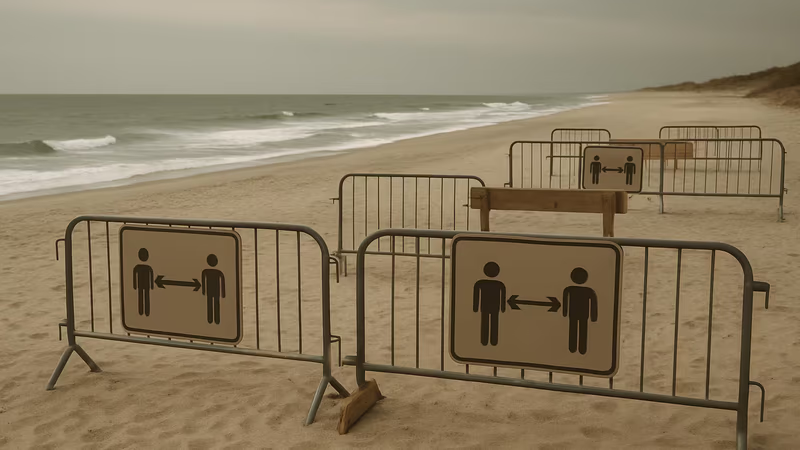
The early days of the COVID-19 pandemic presented unprecedented challenges for policymakers across the United States. As health officials scrambled to implement containment measures, inconsistencies in public health responses became glaringly apparent. While some states imposed strict lockdown orders, others maintained a more relaxed approach, leaving beaches and other public spaces open despite mounting evidence of community transmission.
This patchwork of regulations raised fundamental questions about the effectiveness of a state-by-state response to a national health emergency. The disconnect between expert medical advice calling for social distancing and the reality of crowded beaches highlighted the complex intersection of public health policy, individual behavior, and governmental authority during times of crisis.
Jason Tenenbaum’s Analysis:
The epidemiologists are telling us to socially distance. For the introverts among the readers, that is perhaps too easy. For others, it is clearly a challenge. At this moment, the statistics say “34,407” total cases. They also say “414” deaths. That skews at 1.5%. The experts tell us that 20-30 percent of survivors will suffer significant permanent lung damage.
Common notion is that this disease spreads easier than the common flu and the standard cold. This asks the next question – why would people, otherwise presumed sane and competent, expose themselves to such grave harm?
Free Consultation · No Fee Unless We Win
Does this apply to your situation?
Every case is different. Get a free, confidential case review from an experienced attorney who can tell you exactly where you stand.
It also calls into question why an epidemic is being treated on a state level. When was the last war that was left to the individual sates to fight? That was the Civil War. It did not go too well.
How do we only have regional lock downs? How is that medically necessary? Without a collective game plan, we cannot move forward.
Legal and Policy Implications
The fragmented response to COVID-19 exposed significant gaps in our public health infrastructure and emergency response protocols. Just as the legal system requires consistent application of laws and regulations to function effectively, public health emergencies demand coordinated responses that transcend jurisdictional boundaries.
This situation parallels challenges we see in other areas of law where coordination between different levels of government is crucial. For instance, in New York No-Fault Insurance Law, we see how state-specific regulations must work within broader federal frameworks to provide comprehensive protection for injured parties.
Key Takeaway
The early COVID-19 response highlighted the dangers of treating national emergencies as state-level issues. Without unified federal coordination, inconsistent policies like keeping beaches open while implementing partial lockdowns undermined public health efforts and created confusion about appropriate safety measures during a critical period of the pandemic.
Related Articles
Legal Context
Why This Matters for Your Case
New York's no-fault insurance system, established under Insurance Law Article 51, is one of the most complex insurance frameworks in the country. Every motorist must carry Personal Injury Protection coverage that pays medical expenses and lost wages regardless of fault, up to $50,000 per person.
But insurers routinely deny valid claims using peer reviews, EUO scheduling tactics, fee schedule reductions, and coverage defenses. The Law Office of Jason Tenenbaum has handled over 100,000 no-fault cases since 2002 — from initial claim submissions through arbitration before the American Arbitration Association, trials in Civil Court and Supreme Court, and appeals to the Appellate Term and Appellate Division. Jason Tenenbaum is one of the few attorneys in the state who both writes his own appellate briefs and tries his own cases.
His 2,600+ published legal articles on no-fault practice are cited by attorneys throughout New York. Whether you are dealing with a medical necessity denial, an EUO no-show defense, a fee schedule dispute, or a coverage question, this article provides the kind of detailed case-law analysis that helps practitioners and claimants understand exactly where the law stands.
About This Topic
New York No-Fault Insurance Law
New York's no-fault insurance system requires every driver to carry Personal Injury Protection (PIP) coverage that pays medical expenses and lost wages regardless of who caused the accident. But insurers routinely deny, delay, and underpay valid claims — using peer reviews, IME no-shows, and fee schedule defenses to avoid paying providers and injured claimants. Attorney Jason Tenenbaum has litigated thousands of no-fault arbitrations and court cases since 2002.
271 published articles in No-Fault
Keep Reading
More No-Fault Analysis

Car Accident Recorded Statement in New York: Should You Give One?
The at-fault driver's adjuster wants a recorded statement within days of a New York car accident — and that call is designed to weaken your case.
Apr 5, 2026
Who Pays Car Accident Medical Bills in New York? A Step-by-Step Guide
New York no-fault PIP, primary health insurance, Medicaid/Medicare, and litigation liens — the full payment ladder for car-accident medical bills.
Apr 5, 2026
Is Your NY Insurer Acting in Bad Faith?
Learn how insurers commit bad faith under NY's No-Fault Law and how to fight denied claims with legal strategies.
Feb 25, 2025
Unitrin and Lincoln General again
Island Life Chiropractic v 21st Century case review: EUO failure, 30-day denial deadlines, and Unitrin defense preclusion in New York no-fault insurance claims.
Dec 18, 2021
Jurisdiction defenses need to specific
New York court ruling on jurisdiction defenses in no-fault insurance cases - waiver of personal jurisdiction objections under CPLR 3211(e) requirements.
Jul 24, 2019
The teeth were taken out of CPLR 3408
Wells Fargo v Meyers ruling weakens CPLR 3408 mortgage foreclosure protections, allowing banks to negotiate in bad faith without meaningful consequences.
May 4, 2013Was this article helpful?
Disclaimer: This article is published by the Law Office of Jason Tenenbaum, P.C. for informational and educational purposes only. It does not constitute legal advice, and no attorney-client relationship is formed by reading this content. The legal principles discussed may not apply to your specific situation, and the law may have changed since this article was last updated.
New York law varies by jurisdiction — court decisions in one Appellate Division department may not be followed in another, and local court rules in Nassau County Supreme Court differ from those in Suffolk County Supreme Court, Kings County Civil Court, or Queens County Supreme Court. The Appellate Division, Second Department (which covers Long Island, Brooklyn, Queens, and Staten Island) and the Appellate Term (which hears appeals from lower courts) each have distinct procedural requirements and precedents that affect litigation strategy.
If you need legal help with a no-fault matter, contact our office at (516) 750-0595 for a free consultation. We serve clients throughout Long Island (Huntington, Babylon, Islip, Brookhaven, Smithtown, Riverhead, Southampton, East Hampton), Nassau County (Hempstead, Garden City, Mineola, Great Neck, Manhasset, Freeport, Long Beach, Rockville Centre, Valley Stream, Westbury, Hicksville, Massapequa), Suffolk County (Hauppauge, Deer Park, Bay Shore, Central Islip, Patchogue, Brentwood), Queens, Brooklyn, Manhattan, the Bronx, Staten Island, and Westchester County. Prior results do not guarantee a similar outcome.