Key Takeaway
Postmates couriers ruled employees, not independent contractors in watershed NY Court of Appeals decision.
This article is part of our ongoing independent contractor coverage, with 6 published articles analyzing independent contractor issues across New York State. Attorney Jason Tenenbaum brings 24+ years of hands-on experience to this analysis, drawing from his work on more than 1,000 appeals, over 100,000 no-fault cases, and recovery of over $100 million for clients throughout Nassau County, Suffolk County, Queens, Brooklyn, Manhattan, and the Bronx. For personalized legal advice about how these principles apply to your specific situation, contact our Long Island office at (516) 750-0595 for a free consultation.
Matter of Vega (Postmates Inc.–Commissioner of Labor), 2020 NY Slip Op 02094 (2020)
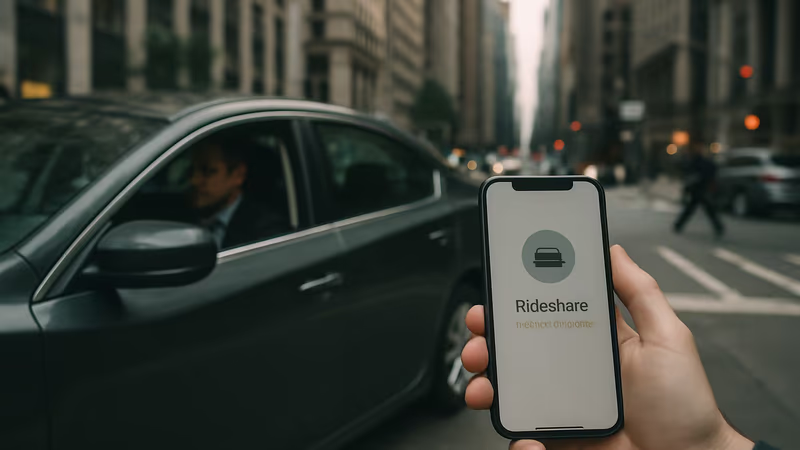
Your Uber driver is an employee. Watershed moment I think.
Evidence of Postmates’ control over its couriers
“Here, there is substantial evidence in the record to support the Board’s determination that Postmates exercised control over its couriers sufficient to render them employees rather than independent contractors operating their own businesses. The company is operated through Postmates’ digital platform, accessed via smartphone app, which connects customers to Postmates couriers, without whom the company could not operate. While couriers decide when to log into the Postmates’ app and accept delivery jobs, the company controls the assignment of deliveries by determining which couriers have access to possible delivery jobs. Postmates informs couriers where requested goods are to be delivered only after a courier has accepted the assignment. Customers cannot request that the job be performed by a particular worker. In the event a courier becomes unavailable after accepting a job, Postmates—not the courier—finds a replacement.
Although Postmates does not dictate the exact routes couriers must take between the pick-up and delivery locations, the company tracks courier location during deliveries in real time on the omnipresent app, providing customers an estimated time of arrival for their deliveries. The couriers’ compensation, which the company unilaterally fixes and the couriers have no ability to negotiate, are paid to the couriers by Postmates. Postmates, not its couriers, bears the loss when customers do not pay. Because the total fee charged by Postmates is based solely on the distance of the delivery and couriers are not given that information in advance, they are unable to determine their share until after accepting a job.
Free Consultation · No Fee Unless We Win
Does this apply to your situation?
Every case is different. Get a free, confidential case review from an experienced attorney who can tell you exactly where you stand.
Further, Postmates unilaterally sets the delivery fees, for which it bills the customers directly through the app. Couriers receive a company sponsored “PEX” card which they may use to purchase the customers’ requested items, when necessary. Postmates handles all customer complaints and, in some circumstances, retains liability to the customer for incorrect or damaged deliveries.
Incidental control or domination of the couriers’ work
Postmates exercises more than “incidental control” over its couriers—low-paid workers performing unskilled labor who possess limited discretion over how to do their jobs. That the couriers retain some independence to choose their work schedule and delivery route does not mean that they have actual control over their work or the service Postmates provides its customers; indeed, there is substantial evidence for the Board’s conclusion that Postmates dominates the significant aspects of its couriers’ work by dictating to which customers they can deliver, where to deliver the requested items, effectively limiting the time frame for delivery and controlling all aspects of pricing and payment.
Although the operative technology has changed in the interim decades, this case is indistinguishable from Matter of Rivera, where we held that substantial evidence supported the Board’s conclusion that a similar delivery person was an employee of the delivery company—even though he set his own delivery routes and did not have a set work schedule but called the company’s dispatcher whenever he wished to engage in work, accepting only the jobs he desired (see Matter of Rivera , 69 NY2d 679 , cert denied 481 US 1049 ; see also Matter of Di Martino , 59 NY2d 638 ).”
What the decision means for app-based driver cases
So remember this. All of your ATIC non yellow taxi cases? Sue the “base”. At the least app cases are toast. When they say the policy is $100,000, smile and say, my client had a scope and we are in the Bronx – no deal.
Related Articles
Legal Context
Why This Matters for Your Case
New York law is among the most complex and nuanced in the country, with distinct procedural rules, substantive doctrines, and court systems that differ significantly from other jurisdictions. The Civil Practice Law and Rules (CPLR) governs every stage of civil litigation, from service of process through trial and appeal. The Appellate Division, Appellate Term, and Court of Appeals create a rich and ever-evolving body of case law that practitioners must follow.
Attorney Jason Tenenbaum has practiced across these areas for over 24 years, writing more than 1,000 appellate briefs and publishing over 2,600 legal articles that attorneys and clients rely on for guidance. The analysis in this article reflects real courtroom experience — from motion practice in Civil Court and Supreme Court to oral arguments before the Appellate Division — and a deep understanding of how New York courts actually apply the law in practice.
Keep Reading
More Independent contractor Analysis

How Courts Apply the Independent Contractor Defense in NY No-Fault Insurance Cases
First Department upholds independent contractor defense in no-fault case, analyzing control factors and employment criteria.
Mar 22, 2021
Ubder D-Duber fail
NY court ruling shows Uber failed to prove driver was independent contractor, expanding rideshare company liability beyond app usage in personal injury cases.
Sep 25, 2020
The first application of the new precludable independent contractor rule
New precedent protects NYC & Long Island medical providers from post-payment independent contractor challenges in no-fault insurance cases. Call 516-750-0595.
Jan 10, 2013
The Independent Contractor Defense and CPLR 3211(a)(7) Dismissal in New York No-Fault Cases
Why a statement on a no-fault claim form that services were rendered by an independent contractor supports dismissal under CPLR 3211(a)(7) in New York.
Jun 25, 2011
Are all of the cards stacked in Allstate’s favor?
Understanding Allstate insurance claim denials and Box #16 independent contractor issues in NY. Expert legal guidance for Long Island practitioners.
Jan 25, 2009Was this article helpful?
Disclaimer: This article is published by the Law Office of Jason Tenenbaum, P.C. for informational and educational purposes only. It does not constitute legal advice, and no attorney-client relationship is formed by reading this content. The legal principles discussed may not apply to your specific situation, and the law may have changed since this article was last updated.
New York law varies by jurisdiction — court decisions in one Appellate Division department may not be followed in another, and local court rules in Nassau County Supreme Court differ from those in Suffolk County Supreme Court, Kings County Civil Court, or Queens County Supreme Court. The Appellate Division, Second Department (which covers Long Island, Brooklyn, Queens, and Staten Island) and the Appellate Term (which hears appeals from lower courts) each have distinct procedural requirements and precedents that affect litigation strategy.
If you need legal help with a independent contractor matter, contact our office at (516) 750-0595 for a free consultation. We serve clients throughout Long Island (Huntington, Babylon, Islip, Brookhaven, Smithtown, Riverhead, Southampton, East Hampton), Nassau County (Hempstead, Garden City, Mineola, Great Neck, Manhasset, Freeport, Long Beach, Rockville Centre, Valley Stream, Westbury, Hicksville, Massapequa), Suffolk County (Hauppauge, Deer Park, Bay Shore, Central Islip, Patchogue, Brentwood), Queens, Brooklyn, Manhattan, the Bronx, Staten Island, and Westchester County. Prior results do not guarantee a similar outcome.