Key Takeaway
Learn about trial bifurcation strategies in New York personal injury litigation. Expert legal guidance. Call 516-750-0595.
This article is part of our ongoing no-fault coverage, with 271 published articles analyzing no-fault issues across New York State. Attorney Jason Tenenbaum brings 24+ years of hands-on experience to this analysis, drawing from his work on more than 1,000 appeals, over 100,000 no-fault cases, and recovery of over $100 million for clients throughout Nassau County, Suffolk County, Queens, Brooklyn, Manhattan, and the Bronx. For personalized legal advice about how these principles apply to your specific situation, contact our Long Island office at (516) 750-0595 for a free consultation.
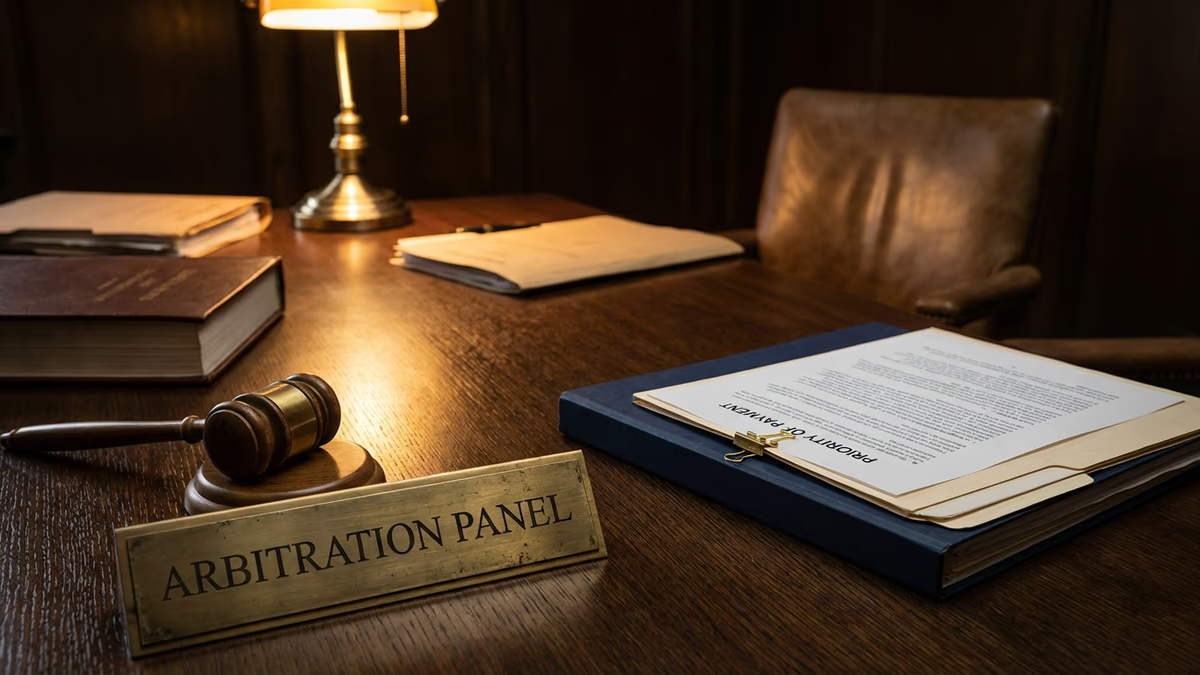
Trial bifurcation represents a critical strategic decision in New York personal injury litigation that can significantly impact case outcomes, jury psychology, and litigation costs. The recent case of Castro v Malia Realty, LLC clarifies the Second Department’s approach to bifurcation and provides important guidance for practitioners navigating this complex procedural decision.
What is Trial Bifurcation?
Trial bifurcation involves separating a personal injury trial into distinct phases: first determining liability (fault), and then, if liability is established, proceeding to a separate trial on damages (compensation). This procedural approach contrasts with unified trials where both liability and damages are presented to the same jury simultaneously.
The Castro v Malia Decision
The Castro v Malia Realty, LLC decision addresses decades of confusion regarding the Second Department’s approach to bifurcation. The court clarified that trial judges have discretion to determine whether personal injury trials should be unified or bifurcated, contrary to the perception that the Second Department inflexibly favored bifurcation.
Key Holdings
- Judicial Discretion: Trial courts have discretion in determining whether to bifurcate personal injury trials
- Standard Analysis: Courts should apply the statewide rule favoring bifurcation when it assists in clarification and fair resolution
- Exception Recognition: Unified trials are appropriate when the nature of injuries has important bearing on liability issues
Free Consultation · No Fee Unless We Win
Does this apply to your situation?
Every case is different. Get a free, confidential case review from an experienced attorney who can tell you exactly where you stand.
Strategic Considerations for Bifurcation
The decision to seek bifurcation requires careful analysis of case-specific factors:
When to Seek Bifurcation
- Clear liability with complex damages calculations
- Cases with significant prejudicial impact from severe injuries
- Multiple defendant scenarios where liability apportionment is complex
- Cost-effective resolution when liability is disputed
When to Oppose Bifurcation
- Cases where injury severity impacts liability determination
- Situations where unified presentation creates stronger narrative
- When bifurcation may cause jury confusion or inconsistency
Practical Implications
The Castro decision provides greater flexibility for Second Department practitioners, allowing for more nuanced arguments regarding unified versus bifurcated trials based on specific case circumstances.
If you’re facing complex decisions about trial strategy in your personal injury case, experienced legal guidance is essential. Understanding procedural options like bifurcation can significantly impact your case outcome. Call 516-750-0595 for a free consultation with our experienced personal injury team.
This article is for educational purposes only and does not constitute legal advice. Consult with a qualified personal injury attorney for advice regarding your specific situation.
Related Articles
- Understanding CPLR 3212(a): Critical Timing Rules for Summary Judgment Motions in New York
- The CPLR 3212(g) paradigm
- Understanding IME No-Shows in New York No-Fault Insurance: Rights, Consequences, and Strategic Considerations
- No-Fault Verification Requirements: When Partial Compliance Isn’t Enough
- New York No-Fault Insurance Law
Legal Context
Why This Matters for Your Case
New York's no-fault insurance system, established under Insurance Law Article 51, is one of the most complex insurance frameworks in the country. Every motorist must carry Personal Injury Protection coverage that pays medical expenses and lost wages regardless of fault, up to $50,000 per person.
But insurers routinely deny valid claims using peer reviews, EUO scheduling tactics, fee schedule reductions, and coverage defenses. The Law Office of Jason Tenenbaum has handled over 100,000 no-fault cases since 2002 — from initial claim submissions through arbitration before the American Arbitration Association, trials in Civil Court and Supreme Court, and appeals to the Appellate Term and Appellate Division. Jason Tenenbaum is one of the few attorneys in the state who both writes his own appellate briefs and tries his own cases.
His 2,600+ published legal articles on no-fault practice are cited by attorneys throughout New York. Whether you are dealing with a medical necessity denial, an EUO no-show defense, a fee schedule dispute, or a coverage question, this article provides the kind of detailed case-law analysis that helps practitioners and claimants understand exactly where the law stands.
About This Topic
New York No-Fault Insurance Law
New York's no-fault insurance system requires every driver to carry Personal Injury Protection (PIP) coverage that pays medical expenses and lost wages regardless of who caused the accident. But insurers routinely deny, delay, and underpay valid claims — using peer reviews, IME no-shows, and fee schedule defenses to avoid paying providers and injured claimants. Attorney Jason Tenenbaum has litigated thousands of no-fault arbitrations and court cases since 2002.
271 published articles in No-Fault
Keep Reading
More No-Fault Analysis

Car Accident Recorded Statement in New York: Should You Give One?
The at-fault driver's adjuster wants a recorded statement within days of a New York car accident — and that call is designed to weaken your case.
Apr 5, 2026
Who Pays Car Accident Medical Bills in New York? A Step-by-Step Guide
New York no-fault PIP, primary health insurance, Medicaid/Medicare, and litigation liens — the full payment ladder for car-accident medical bills.
Apr 5, 2026
The amendments to the regulations and what they mean to you.
The 2013 Regulation 68-C amendment, its effective-date limits, verification and denial provisions, and what Chapa clarified about the 120-day rule in 2026.
Feb 14, 2013
Collateral Estoppel In New York No-Fault Cases
Discover how collateral estoppel affects NY no-fault claims and how new legal reforms protect your rights after a car accident.
Feb 14, 2025
The New York experience at the Appellate Courts from a PIP perspective: My end of year observations.
New York appellate court observations from a PIP attorney's perspective on rising appeal costs, electronic filing needs, and procedural challenges in 2021.
Dec 18, 2021
Another hiccup to the briefing schedule rule
Learn about court briefing schedule rules and judicial discretion in New York no-fault insurance cases. Expert legal analysis of Golden Star decision.
Jun 21, 2019Frequently Asked Questions
Common Questions About This Topic
3 answers from the firm's New York personal-injury and employment-law practice. Click any question to expand.
How does bifurcation affect settlement negotiations?
Bifurcation can encourage earlier settlement discussions by clarifying liability issues first, potentially avoiding costly damages trials if liability is established.
What happens if liability is found in a bifurcated trial?
If the jury finds liability in the first phase, the same jury typically hears evidence on damages in a separate trial phase, though scheduling and practical considerations may require empaneling a new jury.
Can the bifurcation decision be appealed?
Bifurcation decisions are generally reviewable only for abuse of discretion, making successful appeals challenging unless the trial court’s decision was clearly improper.
Was this article helpful?
Disclaimer: This article is published by the Law Office of Jason Tenenbaum, P.C. for informational and educational purposes only. It does not constitute legal advice, and no attorney-client relationship is formed by reading this content. The legal principles discussed may not apply to your specific situation, and the law may have changed since this article was last updated.
New York law varies by jurisdiction — court decisions in one Appellate Division department may not be followed in another, and local court rules in Nassau County Supreme Court differ from those in Suffolk County Supreme Court, Kings County Civil Court, or Queens County Supreme Court. The Appellate Division, Second Department (which covers Long Island, Brooklyn, Queens, and Staten Island) and the Appellate Term (which hears appeals from lower courts) each have distinct procedural requirements and precedents that affect litigation strategy.
If you need legal help with a no-fault matter, contact our office at (516) 750-0595 for a free consultation. We serve clients throughout Long Island (Huntington, Babylon, Islip, Brookhaven, Smithtown, Riverhead, Southampton, East Hampton), Nassau County (Hempstead, Garden City, Mineola, Great Neck, Manhasset, Freeport, Long Beach, Rockville Centre, Valley Stream, Westbury, Hicksville, Massapequa), Suffolk County (Hauppauge, Deer Park, Bay Shore, Central Islip, Patchogue, Brentwood), Queens, Brooklyn, Manhattan, the Bronx, Staten Island, and Westchester County. Prior results do not guarantee a similar outcome.