Key Takeaway
Appeals court procedure when a trial court declines to sign a proposed order to show cause, including when leave to appeal is required versus direct appellate review.
This article is part of our ongoing procedural issues coverage, with 187 published articles analyzing procedural issues issues across New York State. Attorney Jason Tenenbaum brings 24+ years of hands-on experience to this analysis, drawing from his work on more than 1,000 appeals, over 100,000 no-fault cases, and recovery of over $100 million for clients throughout Nassau County, Suffolk County, Queens, Brooklyn, Manhattan, and the Bronx. For personalized legal advice about how these principles apply to your specific situation, contact our Long Island office at (516) 750-0595 for a free consultation.
This case is one every litigator in New York should understand, because it exposes a procedural trap that can cost your client an appeal if you don’t recognize what the trial court actually did.
The Case: Gluck v Hirsch
Gluck v Hirsch, 2018 NY Slip Op 05828 (2d Dept. 2018)
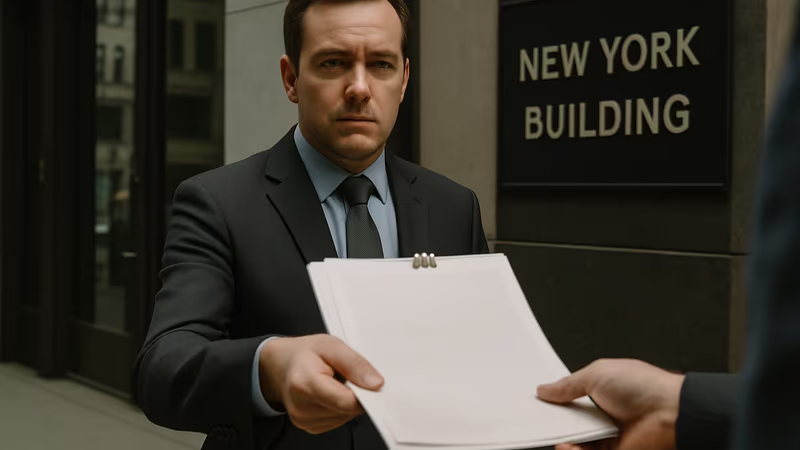
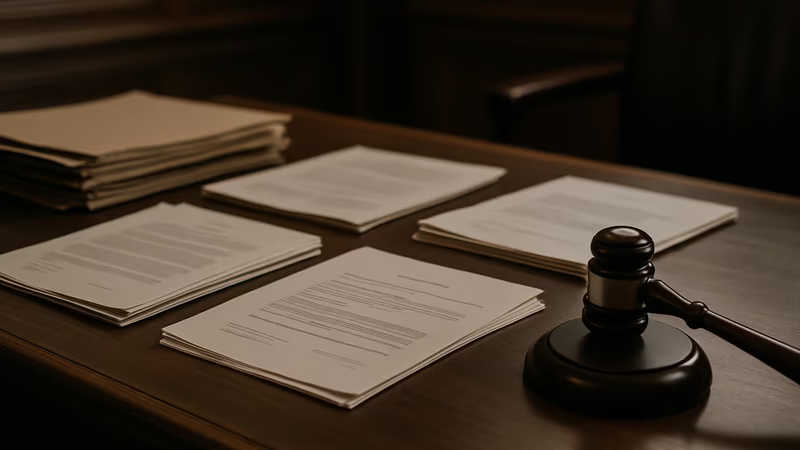
The Hirsches were facing foreclosure and submitted a proposed order to show cause seeking to vacate a judgment of foreclosure and sale. After oral argument, the Supreme Court declined to sign it — but it didn’t just write “declined to sign” and hand it back. The court made a handwritten notation that the Hirsches “failed to demonstrate a meritorious defense to the action” and “failed to submit proof of misconduct by the plaintiff’s attorney.”
That notation is what changes everything.
Free Consultation · No Fee Unless We Win
Does this apply to your situation?
Every case is different. Get a free, confidential case review from an experienced attorney who can tell you exactly where you stand.
Background: How Orders to Show Cause Normally Work
For practitioners who don’t deal with this every day, here’s the setup. Under CPLR 2214, a party can ask the court to sign an order to show cause (“OSC”) in lieu of a notice of motion. The OSC is procedurally useful because the court sets the return date and can include a temporary restraining order or stay — something you can’t get with a regular notice of motion. In foreclosure defense, OSCs are used constantly because you often need to stop a sale while the motion is pending.
The catch: signing the OSC is entirely discretionary. As Siegel puts it in NY Practice § 248, whether the circumstances constitute a “proper case” for an OSC is up to the judge who receives it. A court can simply decline to sign, and there’s nothing inherently wrong with that.
The Normal Remedy: CPLR 5704
When a trial court refuses to sign an OSC, the standard remedy is straightforward. Under CPLR 5704, you walk the application over to the Appellate Division (or Appellate Term, depending on the court below). You present the papers, explain why the lower court should have signed the OSC, and the appellate court can sign it themselves. No leave to appeal is needed. No motion practice. You just go.
This is a well-understood procedure. Most practitioners who have dealt with an unsigned OSC know the 5704 route.
The Court’s Language from Gluck
From the Second Department’s decision:
“The court in a proper case may grant an order to show cause, to be served in lieu of a notice of motion, at a time and in a manner specified therein” (CPLR 2214). Whether the circumstances constitute a “proper case” for the use of an order to show cause instead of a notice of motion is a matter within the discretion of the court to which the proposed order is presented (see Siegel, NY Prac § 248). Here, under the particular circumstances of this case, this was a proper case for the use of an order to show cause, and the Supreme Court improvidently exercised its discretion in declining to sign the proposed order to show cause (see Matter of Georghakis v Matarazzo, 123 AD3d 711, 711).
The Appellate Division granted leave, stayed the foreclosure sale pending the appeal, and ultimately reversed.
What Happened Here — and Why It Matters
Here’s where Gluck v Hirsch gets interesting. The Supreme Court didn’t merely decline to sign the OSC. By writing a substantive notation explaining why it was declining — evaluating the merits of the proposed motion, finding no meritorious defense, and finding no proof of attorney misconduct — the court effectively decided the motion on its merits. It did so without any responsive papers from the opposing side and without full briefing.
That changes the procedural posture entirely. A bare refusal to sign an OSC is not an “order” in the appellate sense — it’s a ministerial act, and CPLR 5704 is your remedy. But when the court goes further and rules on the substance of the application, the refusal to sign transforms into what amounts to an order on a motion decided without notice to all parties. And an order requires leave to appeal under the standard appellate rules.
The Second Department recognized exactly this. It granted the Hirsches leave to appeal and stayed the foreclosure sale pending resolution. On the merits, the court found that the Supreme Court “improvidently exercised its discretion” — this was a proper case for an OSC, and the lower court should have signed it.
My Take
I flagged this case because the procedural distinction it draws is one that can trip up even experienced attorneys.
Most lawyers know that when a judge won’t sign your OSC, you take it to the Appellate Division under CPLR 5704. What they don’t always recognize is the moment when the court’s refusal crosses the line from a ministerial act into a substantive ruling. Once the judge writes down reasons — particularly reasons that go to the merits of the underlying motion — you’re no longer dealing with a simple unsigned OSC. You’re dealing with an order, and you need to treat it like one.
If you take the CPLR 5704 route when the court has actually issued a substantive ruling, you may be using the wrong vehicle entirely. And if you file for leave to appeal when the court only declined to sign without comment, you’ve wasted time and money on unnecessary motion practice.
The practical lesson: read the notation carefully.
- If the judge just wrote “declined to sign” or simply handed back the papers → use CPLR 5704. Walk it up to the Appellate Division or Appellate Term. No leave needed.
- If the judge wrote anything that evaluates the substance of your application — the strength of your defenses, the sufficiency of your evidence, the merits of your claim — you likely have an order on your hands. You need leave to appeal, and the timeline and procedural requirements are different.
Getting this wrong in either direction has real consequences. In a foreclosure case like Gluck, the difference could be whether you stop the sale in time or whether your client loses their home while you’re pursuing the wrong appellate remedy.
Gluck v Hirsch is a clean illustration of this distinction, and the Second Department got it right on both the procedural and substantive points.
Key Statutes
- CPLR 2214 — Governs motions and orders to show cause; court discretion to sign an OSC “in a proper case”
- CPLR 5704 — Permits a party to seek appellate relief when a lower court refuses to grant an order “authorized by law”
This appellate-procedure issue surfaces in every kind of New York civil litigation — including the personal injury and no-fault matters our firm handles every week. Reading a court’s notation correctly can be the difference between a timely appeal and a missed deadline.
Related Articles
- Combating Litigation Delay Tactics in New York No-Fault Insurance Cases
- Single Motion Rule and Statute of Limitations: Long Island & NYC Legal Guide
- How to Talk to a Judge in New York: What to Say, What to Avoid, and How to Present Yourself
- A party that really blew it gets not only a second but a third chance to correct his mistake
- New York No-Fault Insurance Law
Related: CPLR 2214 motion papers and notice — the practitioner’s guide.
Legal Context
Why This Matters for Your Case
New York law is among the most complex and nuanced in the country, with distinct procedural rules, substantive doctrines, and court systems that differ significantly from other jurisdictions. The Civil Practice Law and Rules (CPLR) governs every stage of civil litigation, from service of process through trial and appeal. The Appellate Division, Appellate Term, and Court of Appeals create a rich and ever-evolving body of case law that practitioners must follow.
Attorney Jason Tenenbaum has practiced across these areas for over 24 years, writing more than 1,000 appellate briefs and publishing over 2,600 legal articles that attorneys and clients rely on for guidance. The analysis in this article reflects real courtroom experience — from motion practice in Civil Court and Supreme Court to oral arguments before the Appellate Division — and a deep understanding of how New York courts actually apply the law in practice.
About This Topic
Procedural Issues in New York Litigation
New York civil procedure governs every stage of litigation — from pleading requirements and service of process to motion practice, discovery deadlines, and trial procedures. The CPLR creates strict procedural rules that can make or break a case regardless of the underlying merits. These articles examine the procedural pitfalls, timing requirements, and strategic considerations that practitioners face in New York state courts, with a particular focus on no-fault insurance and personal injury practice.
187 published articles in Procedural Issues
Keep Reading
More Procedural Issues Analysis
How to Talk to a Judge in New York: What to Say, What to Avoid, and How to Present Yourself
Address the judge as 'Your Honor,' stand when you speak, wait to be recognized, and keep answers short and honest. A Long Island trial lawyer explains.
Feb 24, 2026
CPLR § 2106 Amendment Eliminates Affidavit Notarization Requirement: What This Means for New York Litigation
New York's CPLR 2106 permits affirmations in place of many sworn documents. See the 2024 and 2025 changes, exceptions, and historical case notes.
Feb 18, 2026
CPLR 3212(a) not applicable in the lower courts? Not again.
Compare Custis with Lance, Khokhlova, Coello and Metro. Lower-court motion timing depends on the applicable filing, orders and good-cause showing.
Apr 11, 2010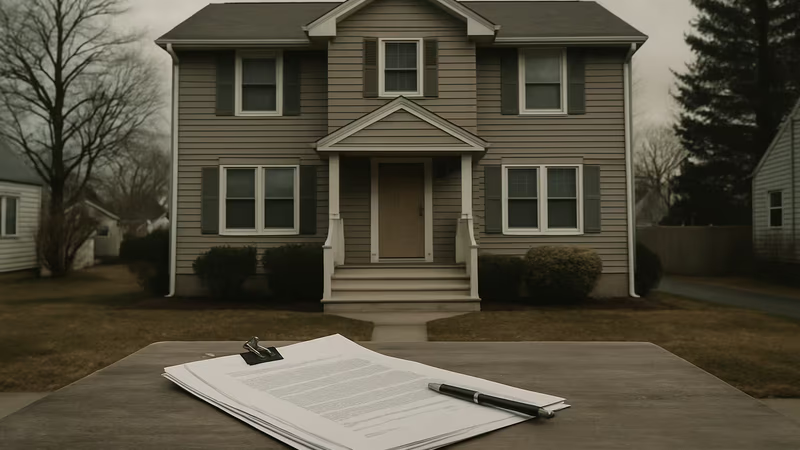
New York Foreclosure Defense: Challenging RPAPL 1304 Notice Violations
NY foreclosure defense case shows defendants can challenge RPAPL 1304 notice violations even after summary judgment is granted, emphasizing strict compliance requirements.
Jun 11, 2019
How Huntington/Travelers can play out
Legal strategies for defending multiple no-fault insurance cases from the same assignor after Huntington v.
Apr 19, 2014
So the newest 2309(c) case now holds that this statute is irrelevent
Second Department rules that CPLR 2309(c) notarization defects are not fatal when corrective certification can be provided nunc pro tunc under CPLR 2001.
Apr 8, 2012Was this article helpful?
Disclaimer: This article is published by the Law Office of Jason Tenenbaum, P.C. for informational and educational purposes only. It does not constitute legal advice, and no attorney-client relationship is formed by reading this content. The legal principles discussed may not apply to your specific situation, and the law may have changed since this article was last updated.
New York law varies by jurisdiction — court decisions in one Appellate Division department may not be followed in another, and local court rules in Nassau County Supreme Court differ from those in Suffolk County Supreme Court, Kings County Civil Court, or Queens County Supreme Court. The Appellate Division, Second Department (which covers Long Island, Brooklyn, Queens, and Staten Island) and the Appellate Term (which hears appeals from lower courts) each have distinct procedural requirements and precedents that affect litigation strategy.
If you need legal help with a procedural issues matter, contact our office at (516) 750-0595 for a free consultation. We serve clients throughout Long Island (Huntington, Babylon, Islip, Brookhaven, Smithtown, Riverhead, Southampton, East Hampton), Nassau County (Hempstead, Garden City, Mineola, Great Neck, Manhasset, Freeport, Long Beach, Rockville Centre, Valley Stream, Westbury, Hicksville, Massapequa), Suffolk County (Hauppauge, Deer Park, Bay Shore, Central Islip, Patchogue, Brentwood), Queens, Brooklyn, Manhattan, the Bronx, Staten Island, and Westchester County. Prior results do not guarantee a similar outcome.