Why Trust This Analysis
This article is part of our ongoing procedural issues coverage, with 187 published articles analyzing procedural issues issues across New York State. Attorney Jason Tenenbaum brings 24+ years of hands-on experience to this analysis, drawing from his work on more than 1,000 appeals, over 100,000 no-fault cases, and recovery of over $100 million for clients throughout Nassau County, Suffolk County, Queens, Brooklyn, Manhattan, and the Bronx. For personalized legal advice about how these principles apply to your specific situation, contact our Long Island office at (516) 750-0595 for a free consultation.
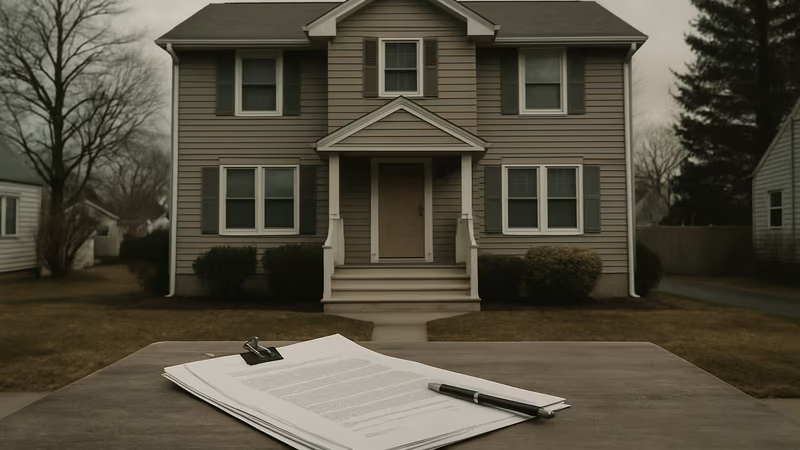
Foreclosure proceedings in New York involve strict procedural requirements, and one of the most critical is compliance with RPAPL 1304, which mandates specific pre-foreclosure notices to borrowers. The Wells Fargo v. Merino case demonstrates an important principle: even when a lender obtains summary judgment, defendants may still challenge inadequate pre-foreclosure notices before final judgment is entered.
This case highlights the distinction between different phases of litigation. While summary judgment motions focus on the merits of claims, RPAPL 1304 compliance is a jurisdictional prerequisite that can be raised at various stages. The timing of procedural challenges in foreclosure cases can be complex, and defendants should understand their rights to contest procedural defects even after adverse rulings.
RPAPL 1304 serves as a consumer protection measure, requiring mortgage lenders to provide borrowers with 90-day pre-foreclosure notices before commencing legal action. This notice must contain specific information about the default, the borrower’s right to cure, and available foreclosure prevention resources. The statute’s requirements are not mere technicalities—courts have consistently held that strict compliance is a condition precedent to maintaining a foreclosure action. This means that even a technically valid claim on the merits can be dismissed if the procedural prerequisites were not satisfied.
The significance of RPAPL 1304 extends beyond simple notice requirements. The statute reflects legislative intent to provide homeowners with meaningful opportunities to avoid foreclosure through loan modification, repayment plans, or other alternatives. By requiring lenders to wait 90 days and provide detailed information about rights and resources, the law creates a mandatory pre-litigation period designed to facilitate resolution without court involvement. When lenders fail to comply with these requirements, they undermine the statute’s protective purposes.
Free Consultation · No Fee Unless We Win
Does this apply to your situation?
Every case is different. Get a free, confidential case review from an experienced attorney who can tell you exactly where you stand.
Courts have developed a robust body of case law interpreting what constitutes sufficient proof of RPAPL 1304 compliance. Lenders must not only demonstrate that the required notice was sent, but also establish that it was properly addressed and mailed according to standard business procedures. Generic affidavits lacking specific knowledge of mailing practices routinely fail to meet this standard, as the Merino case illustrates.
Jason Tenenbaum’s Analysis:
Wells Fargo Bank, N.A. v Merino, 2019 NY Slip Op 04655 (1st Dept. 2019)
“While defendant, who was initially pro se, raised the defense of plaintiff’s noncompliance with the strict requirements of RPAPL 1304 90-day pre-foreclosure notices in her answer, she did not raise it in her opposition to plaintiff’s motion for summary judgment, which was subsequently granted. This does not preclude her, however, from raising plaintiff’s noncompliance prior to entry of judgment of foreclosure and sale (Emigrant, 142 AD3d at 755-756).
Plaintiff failed to establish strict compliance with RPAPL 1304, a condition precedent to the commencement of a foreclosure action (see HSBC Bank USA v Rice, 155 AD3d 443 ). The affidavits submitted by plaintiff failed to demonstrate a familiarity with plaintiff’s mailing practices and procedures (HSBC Bank, 155 AD3d at 444), and they did not suffice as affidavits of service.”
This one is interesting. In one instance, Plaintiff received summary judgment. And after obtaining summary judgment, the defendant move to dismiss based upon violation of RPAPL 1304. Head scratching
Legal Significance
The First Department’s decision in Wells Fargo Bank, N.A. v Merino addresses a critical procedural question: can defendants raise RPAPL 1304 defenses after summary judgment has been granted but before final judgment is entered? The court’s affirmative answer has significant implications for foreclosure defense strategy and the timeline for raising procedural challenges.
The court relied on Emigrant Mortgage Co., Inc. v Corcione, 142 AD3d 755, which established that RPAPL 1304 compliance can be challenged at various stages of litigation, including after summary judgment. This holding reflects the fundamental principle that condition precedent defenses go to the court’s subject matter jurisdiction—they cannot be waived by procedural default or failure to raise them at the earliest opportunity. Even when a defendant initially appears pro se and fails to raise the defense in opposition to summary judgment, the right to challenge RPAPL 1304 compliance persists until final judgment is entered.
The court’s substantive analysis of the plaintiff’s proof is equally instructive. Wells Fargo submitted affidavits purporting to establish compliance with RPAPL 1304’s notice requirements, but the First Department found these submissions deficient. Citing HSBC Bank USA v Rice, 155 AD3d 443, the court held that the affidavits failed to demonstrate familiarity with Wells Fargo’s actual mailing practices and procedures. This requirement means that affiants must have personal knowledge of how the specific institution handles pre-foreclosure mailings—they cannot simply recite generic procedures or rely on assumptions about standard practices.
Moreover, the court found that the submitted affidavits did not suffice as proper affidavits of service. This distinction is important: proving that a notice was generated or prepared is not the same as proving it was properly mailed. Lenders must establish both creation and delivery of the required notice, typically through testimony from individuals with direct knowledge of the mailing process or detailed business records showing standardized mailing procedures were followed.
Practical Implications
For foreclosure defendants, this decision provides important strategic guidance. First, RPAPL 1304 defenses remain viable even after adverse summary judgment rulings. Defendants who initially appeared pro se or failed to raise these defenses earlier should not assume the issue is waived—they can bring motions to dismiss based on notice violations before final judgment is entered.
Second, defendants should carefully scrutinize the lender’s proof of RPAPL 1304 compliance. Key questions include: Does the affiant have personal knowledge of the lender’s specific mailing procedures? Does the affidavit describe actual practices rather than generic statements? Is there documentary evidence supporting the mailing, such as certified mail receipts or detailed business records? Generic, boilerplate affidavits lacking these elements may be insufficient even if the lender obtained summary judgment.
For foreclosure plaintiffs, this case underscores the importance of establishing robust proof of RPAPL 1304 compliance from the outset. Lenders should ensure that affidavits addressing pre-foreclosure notice are prepared by individuals with genuine familiarity with their mailing procedures and contain sufficient detail to satisfy judicial scrutiny. Relying on conclusory statements or template affidavits risks reversal even after successful summary judgment motions.
The decision also highlights the distinction between merits-based summary judgment and compliance with condition precedent requirements. Lenders may have valid claims for defaulted mortgage payments while simultaneously failing to satisfy procedural prerequisites. Foreclosure counsel must address both substantive and procedural elements to achieve final judgment.
Key Takeaway
The Merino decision reinforces that RPAPL 1304 compliance is a condition precedent to foreclosure actions that can be challenged even after summary judgment is granted. Lenders must provide proper affidavits demonstrating familiarity with their mailing procedures, and defendants retain the right to contest notice deficiencies before final judgment.
Related Articles
Legal Context
Why This Matters for Your Case
New York law is among the most complex and nuanced in the country, with distinct procedural rules, substantive doctrines, and court systems that differ significantly from other jurisdictions. The Civil Practice Law and Rules (CPLR) governs every stage of civil litigation, from service of process through trial and appeal. The Appellate Division, Appellate Term, and Court of Appeals create a rich and ever-evolving body of case law that practitioners must follow.
Attorney Jason Tenenbaum has practiced across these areas for over 24 years, writing more than 1,000 appellate briefs and publishing over 2,600 legal articles that attorneys and clients rely on for guidance. The analysis in this article reflects real courtroom experience — from motion practice in Civil Court and Supreme Court to oral arguments before the Appellate Division — and a deep understanding of how New York courts actually apply the law in practice.
About This Topic
Procedural Issues in New York Litigation
New York civil procedure governs every stage of litigation — from pleading requirements and service of process to motion practice, discovery deadlines, and trial procedures. The CPLR creates strict procedural rules that can make or break a case regardless of the underlying merits. These articles examine the procedural pitfalls, timing requirements, and strategic considerations that practitioners face in New York state courts, with a particular focus on no-fault insurance and personal injury practice.
187 published articles in Procedural Issues
Keep Reading
More Procedural Issues Analysis

How to Talk to a Judge in New York: What to Say, What to Avoid, and How to Present Yourself
Address the judge as 'Your Honor,' stand when you speak, wait to be recognized, and keep answers short and honest. A Long Island trial lawyer explains.
Feb 24, 2026
CPLR § 2106 Amendment Eliminates Affidavit Notarization Requirement: What This Means for New York Litigation
New York's CPLR 2106 permits affirmations in place of many sworn documents. See the 2024 and 2025 changes, exceptions, and historical case notes.
Feb 18, 2026
202.48 – settle an order
Court rules on discretionary application of 60-day settlement order deadline, prioritizing judicial efficiency over strict procedural compliance in liability cases.
Nov 7, 2018
Marked-Off Cases in New York Civil Court: Why CPLR 3404 Dismissal Does Not Apply
New York Civil Court cases marked off the calendar cannot be dismissed under CPLR 3404, but may remain dormant indefinitely without revival options.
Mar 18, 2014
A signature placed at the direction of the signor
Court ruling clarifies that electronic signatures placed at the direction of the signor are legally valid, even when appearing as facsimile stamps on peer review reports.
Mar 12, 2012
Those promised framed issue hearings on "stamped signature" cases were quite short lived
Amercure's opinion was withdrawn from publication, not proven vacated. Read Jason's dated reaction with the later Park Slope signature-hearing decision.
Mar 26, 2010Was this article helpful?
Disclaimer: This article is published by the Law Office of Jason Tenenbaum, P.C. for informational and educational purposes only. It does not constitute legal advice, and no attorney-client relationship is formed by reading this content. The legal principles discussed may not apply to your specific situation, and the law may have changed since this article was last updated.
New York law varies by jurisdiction — court decisions in one Appellate Division department may not be followed in another, and local court rules in Nassau County Supreme Court differ from those in Suffolk County Supreme Court, Kings County Civil Court, or Queens County Supreme Court. The Appellate Division, Second Department (which covers Long Island, Brooklyn, Queens, and Staten Island) and the Appellate Term (which hears appeals from lower courts) each have distinct procedural requirements and precedents that affect litigation strategy.
If you need legal help with a procedural issues matter, contact our office at (516) 750-0595 for a free consultation. We serve clients throughout Long Island (Huntington, Babylon, Islip, Brookhaven, Smithtown, Riverhead, Southampton, East Hampton), Nassau County (Hempstead, Garden City, Mineola, Great Neck, Manhasset, Freeport, Long Beach, Rockville Centre, Valley Stream, Westbury, Hicksville, Massapequa), Suffolk County (Hauppauge, Deer Park, Bay Shore, Central Islip, Patchogue, Brentwood), Queens, Brooklyn, Manhattan, the Bronx, Staten Island, and Westchester County. Prior results do not guarantee a similar outcome.