Key Takeaway
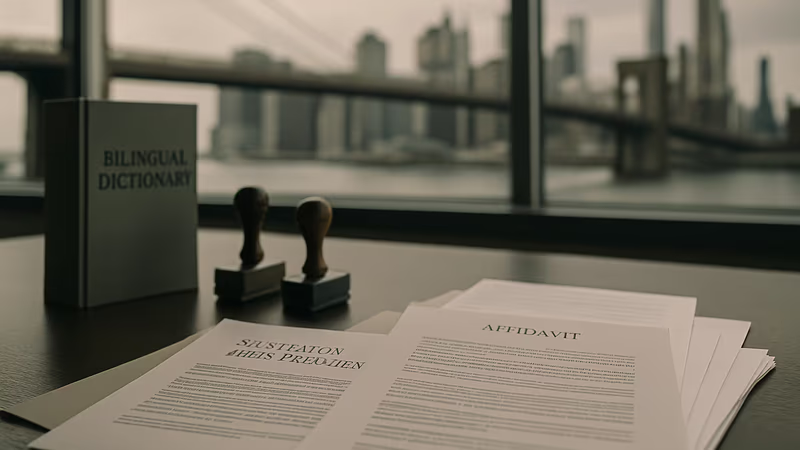
NY appellate court rules certificate of acknowledgment defects in prenuptial agreements may be cured nunc pro tunc with proper evidence of contemporaneous execution.
This article is part of our ongoing 2106 and 2309 coverage, with 31 published articles analyzing 2106 and 2309 issues across New York State. Attorney Jason Tenenbaum brings 24+ years of hands-on experience to this analysis, drawing from his work on more than 1,000 appeals, over 100,000 no-fault cases, and recovery of over $100 million for clients throughout Nassau County, Suffolk County, Queens, Brooklyn, Manhattan, and the Bronx. For personalized legal advice about how these principles apply to your specific situation, contact our Long Island office at (516) 750-0595 for a free consultation.
Galetta v Galetta, 2012 NY Slip Op 04865 (4th Dept. 2012)
We here about the now dead(?) certificate of conformity. How about the certificate of acknowledgment that must be annexed to a prenuptual agreement? In a procedurally interesting 3-2 decision, the Fourth Department says “maybe”.
Factually, Plaintiff moved for summary judgment in a matrimonial action seeking to declare that the prenuptual agreement was invalid. The motion was based upon the failure of the acknowledgment stating that the deponent: “knows or has satisfactory evidence, that the person making it is the person described in and who executed such instrument.”
The Court held that this could be cured based upon the facts in the record. According to the Court,”Here, defendant is not attempting to cure the complete absence of a contemporaneous acknowledgment. Rather, he is attempting to submit evidence that there was, in fact, a proper and contemporaneous acknowledgment at the time the prenuptial agreement was executed. In our view, the affidavit from the notary who took defendant’s acknowledgment is sufficient to raise a triable issue of fact whether “the parties … contemporaneously demonstrated the deliberate nature of their agreement” (Schoeman, Marsh & Updike v Dobi, 264 AD2d 572, 573, lv dismissed 94 NY2d 944, 97 NY2d 721, lv denied 100 NY2d 508; cf. Leighton v Leighton, 46 AD3d 264, 265, appeal dismissed 10 NY3d 739). The statements of the notary, i.e., that it was his usual and customary practice to ask and confirm that the person signing the document was the same person named in the document and that he or she was signing said document, “constitute competent and admissible evidence concerning routine professional practice sufficient to raise a triable issue of fact” (Gier v CGF Health Sys., 307 AD2d 729, 730; see generally Halloran v Virginia Chems., 41 NY2d 386, 389). We thus conclude that the court properly denied that part of plaintiff’s motion for summary judgment seeking a determination as a matter of law that the parties’ prenuptial agreement is invalid.”
Free Consultation · No Fee Unless We Win
Does this apply to your situation?
Every case is different. Get a free, confidential case review from an experienced attorney who can tell you exactly where you stand.
I mention this because what do the rules of curing deficiencies in this type of certificate and the infamous certificate of conformity have in common?
Well, not a whole heck of a lot.
Related Articles
- CPLR 2309 Compliance: Navigating Notarization Requirements in New York Litigation
- CPLR 2309 Requirements: Understanding Affidavit Attestation Rules from the Appellate Division, Second Department
- Renewal Under Certain Circumstances May Be Granted to Correct an Improper Affirmation: A Comprehensive Guide to CPLR 2106 Requirements
- The Failure to Place Evidence in Proper Form Cannot Be Cured in a Supplemental Opposition
- New York No-Fault Insurance Law
Legal Context
Why This Matters for Your Case
New York law is among the most complex and nuanced in the country, with distinct procedural rules, substantive doctrines, and court systems that differ significantly from other jurisdictions. The Civil Practice Law and Rules (CPLR) governs every stage of civil litigation, from service of process through trial and appeal. The Appellate Division, Appellate Term, and Court of Appeals create a rich and ever-evolving body of case law that practitioners must follow.
Attorney Jason Tenenbaum has practiced across these areas for over 24 years, writing more than 1,000 appellate briefs and publishing over 2,600 legal articles that attorneys and clients rely on for guidance. The analysis in this article reflects real courtroom experience — from motion practice in Civil Court and Supreme Court to oral arguments before the Appellate Division — and a deep understanding of how New York courts actually apply the law in practice.
About This Topic
CPLR 2106 and 2309: Affirmation & Oath Requirements
CPLR 2106 governs who may submit an affirmation in lieu of an affidavit in New York courts, while CPLR 2309 addresses the requirements for oaths, affidavits, and the certification of out-of-state documents. These seemingly technical provisions have significant practical impact — an improperly executed affirmation or affidavit can render an entire summary judgment motion defective. These articles analyze the formal requirements, common defects, and court decisions that practitioners must navigate when preparing sworn statements.
31 published articles in 2106 and 2309
Keep Reading
More 2106 and 2309 Analysis
How to Talk to a Judge in New York: What to Say, What to Avoid, and How to Present Yourself
Address the judge as 'Your Honor,' stand when you speak, wait to be recognized, and keep answers short and honest. A Long Island trial lawyer explains.
Feb 24, 2026
CPLR § 2106 Amendment Eliminates Affidavit Notarization Requirement: What This Means for New York Litigation
New York's CPLR 2106 permits affirmations in place of many sworn documents. See the 2024 and 2025 changes, exceptions, and historical case notes.
Feb 18, 2026
When Insurance Defense Goes Wrong: Progressive’s Procedural Failures in Peer Review
Eagle Surgical: defective chiropractor peer reviews, timely mailing proof, and why denial of the insurer's motion did not establish a payment award.
Feb 3, 2012
It takes more than a mere allegation that a signature is not holographic in order to invoke the "stamped signature" rule. Also, a form defect can be fixed in reply.
Analysis of signature authenticity requirements and reply procedures in NY insurance litigation.
Feb 26, 2010
E-filing and its perils
New York court ruling on e-filing deadlines and venue change motions.
Apr 1, 2017
Stay not granted in declaratory judgment action
Court denies stay in declaratory judgment action due to insufficient overlap between parties in separate proceedings under CPLR 2201.
Feb 26, 2014Was this article helpful?
Disclaimer: This article is published by the Law Office of Jason Tenenbaum, P.C. for informational and educational purposes only. It does not constitute legal advice, and no attorney-client relationship is formed by reading this content. The legal principles discussed may not apply to your specific situation, and the law may have changed since this article was last updated.
New York law varies by jurisdiction — court decisions in one Appellate Division department may not be followed in another, and local court rules in Nassau County Supreme Court differ from those in Suffolk County Supreme Court, Kings County Civil Court, or Queens County Supreme Court. The Appellate Division, Second Department (which covers Long Island, Brooklyn, Queens, and Staten Island) and the Appellate Term (which hears appeals from lower courts) each have distinct procedural requirements and precedents that affect litigation strategy.
If you need legal help with a 2106 and 2309 matter, contact our office at (516) 750-0595 for a free consultation. We serve clients throughout Long Island (Huntington, Babylon, Islip, Brookhaven, Smithtown, Riverhead, Southampton, East Hampton), Nassau County (Hempstead, Garden City, Mineola, Great Neck, Manhasset, Freeport, Long Beach, Rockville Centre, Valley Stream, Westbury, Hicksville, Massapequa), Suffolk County (Hauppauge, Deer Park, Bay Shore, Central Islip, Patchogue, Brentwood), Queens, Brooklyn, Manhattan, the Bronx, Staten Island, and Westchester County. Prior results do not guarantee a similar outcome.