
Key Takeaway
Enko explains an unrebutted medical-supplies denial. Compare the actual proof, existing treatment and provider response without inventing a cost test.
This article is part of our ongoing medical necessity coverage, with 170 published articles analyzing medical necessity issues across New York State. Attorney Jason Tenenbaum brings 24+ years of hands-on experience to this analysis, drawing from his work on more than 1,000 appeals, over 100,000 no-fault cases, and recovery of over $100 million for clients throughout Nassau County, Suffolk County, Queens, Brooklyn, Manhattan, and the Bronx. For personalized legal advice about how these principles apply to your specific situation, contact our Long Island office at (516) 750-0595 for a free consultation.
Last reviewed: September 2026.
Medical Necessity in No-Fault Insurance: Understanding the First Department’s Victory for Insurance Carriers
In the evolving landscape of New York no-fault insurance law, medical necessity determinations have become increasingly critical for both healthcare providers and insurance carriers. The December 30, 2010 decision in Enko Enterprises International, Inc. v Clarendon National Insurance Co. represents a significant victory for insurance carriers, providing clear guidance on how medical necessity challenges can successfully defeat claims for medical supplies and equipment.
For healthcare providers throughout Long Island, Queens, Brooklyn, Manhattan, and the Bronx who supply medical equipment and supplies under no-fault insurance coverage, understanding how courts evaluate medical necessity is essential to avoiding costly claim denials. At the Law Office of Jason Tenenbaum, we’ve been closely monitoring these developments and helping healthcare providers address the complex requirements for proving medical necessity in no-fault cases.
The Enko Decision: A Medical Necessity Victory for Carriers
Enko Enters. Intl., Inc. v Clarendon Natl. Ins. Co., 2010 NY Slip Op 52267(U) (App. Term 1st Dept. 2010)
Free Consultation · No Fee Unless We Win
Does this apply to your situation?
Every case is different. Get a free, confidential case review from an experienced attorney who can tell you exactly where you stand.
Defendant demonstrated, through the affirmed peer review report of a physician, that the medical supplies plaintiff-provider afforded to its assignor were not medically necessary (see generally CPT Medical Services, P.C. v New York Cent. Mut. Fire Ins. Co., 18 Misc 3d 87 ). In this connection, we note that the physician opined that the medical supplies were not medically necessary because the assignor was already receiving both physical and chiropractic therapy for his injuries, treatment that the physician concluded was sufficient under the circumstances. In opposition, plaintiff, which did not submit any evidence regarding the medical necessity of the supplies, failed to raise a triable issue.”
Not only do we have a victory from the carrier on a medical necessity summary judgment case since CPT -but we have a medical rationale that has prima facie proven the supplies to lack medical utility. Not bad.
Understanding Medical Necessity in New York No-Fault Law
The Enko decision applied the summary-judgment standard to a particular medical-supplies claim. For medical equipment suppliers, durable medical equipment (DME) providers, and other healthcare practitioners serving patients throughout Nassau County, Suffolk County, and the five boroughs of New York City, this ruling has important implications for how they document and justify the medical supplies they provide.
The Legal Standard for Medical Necessity
For a practical medical review, consider the following questions. They are not a statutory test announced in Enko:
- Appropriate: The service must be suitable for the patient’s condition and diagnosis
- Necessary: The service must be required for the patient’s medical condition
- Reasonable: The service must be consistent with generally accepted medical standards
- Relationship to existing care: Explain the disputed supply’s purpose when other treatment is already being provided
The Enko Analysis: Duplication and Sufficiency
The Enko decision is particularly significant because it establishes that medical supplies can be deemed unnecessary when the patient is already receiving adequate treatment through other modalities. The court’s analysis focused on the concept of treatment sufficiency rather than absolute contraindication.
The key finding in Enko was that the physician reviewers concluded the assignor was “already receiving both physical and chiropractic therapy for his injuries, treatment that the physician concluded was sufficient under the circumstances.” This reasoning suggests that courts will look at the totality of care being provided rather than evaluating each service in isolation.
Strategic Implications for Healthcare Providers
For healthcare providers throughout the New York metropolitan area, the Enko decision creates new challenges in establishing medical necessity for supplies and equipment, particularly when patients are receiving multiple forms of treatment.
Documentation Requirements
Following the Enko decision, healthcare providers should enhance their documentation practices to include:
Comprehensive Medical Justification: Detailed explanations of why specific supplies or equipment are necessary despite other ongoing treatments.
Treatment Coordination: Clear documentation showing how supplied equipment complements rather than duplicates other therapies.
Clinical Rationale: Specific medical reasons why existing treatment is insufficient without the additional supplies.
Objective Measurements: Quantifiable data showing the need for additional interventions beyond current therapy.
The Burden of Proof Evolution
In Enko, the insurer’s physician supplied the medical reasoning for the motion. The provider then had to raise a triable issue; merely pointing to an outstanding bill did not answer that opinion.
This shift has several implications for providers throughout Long Island, Queens, Brooklyn, Manhattan, the Bronx, and Westchester County:
Proactive Evidence Gathering: Providers must anticipate challenges and gather supporting evidence before claims are denied.
Expert Medical Support: Having qualified medical professionals who can testify to necessity becomes more critical.
Comprehensive Treatment Planning: Providers must demonstrate how their services fit into the overall treatment plan.
The Peer Review Process and Medical Necessity
The Enko decision highlights the critical role of peer review in medical necessity determinations. The insurance carrier successfully used an “affirmed peer review report of a physician” to establish that the medical supplies lacked necessity.
Understanding Peer Review Standards
Peer reviews in no-fault cases typically involve qualified physicians reviewing treatment records and making determinations about medical necessity. The Enko case demonstrates that these reviews can be successful when they provide specific medical reasoning for their conclusions.
Key elements of effective peer reviews include:
- Review by appropriately qualified medical professionals
- Consideration of all relevant medical records and treatment history
- Specific analysis of why proposed treatment is unnecessary
- Reference to accepted medical standards and guidelines
- Clear explanation of the medical reasoning behind the determination
Challenging Peer Review Determinations
For healthcare providers facing peer review determinations, the Enko case underscores the importance of mounting effective challenges. Providers should consider:
Expert Rebuttal: Obtaining contradictory opinions from equally qualified medical professionals who can explain why the supplies are medically necessary.
Clinical Evidence: Presenting objective evidence showing the inadequacy of existing treatment modalities.
Treatment Outcomes: Demonstrating improved patient outcomes when the disputed supplies are provided.
Standard of Care: Showing that providing the supplies is consistent with accepted medical practice in the relevant specialty.
Medical Supplies vs. Treatment Services
The Enko decision specifically addressed medical supplies rather than active treatment services, which creates important distinctions for providers to understand.
Supplies and Equipment Considerations
Medical supplies and durable medical equipment face unique challenges in establishing necessity:
Passive vs. Active Treatment: Supplies often provide passive support while therapies provide active intervention, making it easier to argue duplication.
Medical comparison: Address the reviewer’s stated reason for finding the existing therapy sufficient in the particular case.
Usage Documentation: Providers must document actual usage and benefit from supplied equipment.
Alternatives: If a reviewer identifies another treatment, respond to the medical basis for that comparison. Enko does not impose a cheapest-option requirement.
Integration with Active Treatment
The Enko reasoning suggests that medical supplies are most vulnerable when they appear to duplicate the benefits of active treatment. Providers should focus on demonstrating how supplies enhance or enable other treatments rather than merely supplement them.
Impact on Different Provider Categories
The Enko decision affects different types of healthcare providers in various ways:
Durable Medical Equipment (DME) Suppliers
DME providers throughout Nassau County, Suffolk County, and New York City must now:
- Document how equipment addresses specific functional limitations not resolved by therapy
- Show how equipment enables or enhances the effectiveness of other treatments
- Provide objective measures of patient need that therapy alone cannot address
- Demonstrate compliance monitoring and outcome tracking
Medical Supply Companies
Companies providing medical supplies must enhance their documentation to show:
- Specific medical conditions requiring the supplies
- How supplies address needs not met by active treatment
- Clinical evidence supporting the necessity of specific supplies
- Coordination with treating physicians to establish medical necessity
Litigation Strategy After Enko
Enko illustrates a supplies claim resolved on an unrebutted medical opinion.
For Healthcare Providers
Providers facing medical necessity challenges should:
Develop Comprehensive Records: Create detailed documentation showing the specific medical need for supplies beyond existing treatment.
Coordinate Care Documentation: Ensure treating physicians document the necessity for additional supplies in their treatment notes.
Gather Expert Support: Identify medical experts who can explain why supplies are necessary despite other ongoing treatments.
Document Outcomes: Track and document improved patient outcomes when disputed supplies are provided.
For Insurance Companies
The Enko decision provides insurance carriers with a roadmap for successful medical necessity challenges:
Comprehensive Peer Review: Ensure peer reviewers consider all aspects of the patient’s treatment plan.
Specific Medical Reasoning: Require peer reviewers to provide detailed medical justification for their determinations.
Treatment Duplication Analysis: Focus on whether existing treatment already addresses the medical needs targeted by disputed supplies.
Scope of the opinion: Limit the review to reasons supported by the record; the published decision does not announce a general cost-effectiveness defense.
The Broader Context: First Department Trends
Use this decision for its stated evidentiary reasoning. The following considerations are practical review questions, not findings about a broader judicial trend.
Increased Scrutiny of Supply Claims
Enko concerned supplies prescribed while physical and chiropractic treatment was underway. That factual overlap made the purpose of the supplies material to the motion; one decision does not establish a trend across all supply claims.
Focus on Treatment Integration
The Enko reasoning emphasizes the importance of viewing treatment as an integrated whole rather than separate components. Providers must demonstrate how their services fit into comprehensive treatment plans.
Economic Considerations
The opinion does not state an economic-policy rationale. Its explanation is the physician’s assessment of the treatment already provided and the absence of rebuttal evidence.
Protecting Your Practice in Medical Necessity Disputes
Whether you’re a DME supplier dealing with equipment denials or a medical provider whose necessity determinations are being challenged, understanding the evolving standards established by decisions like Enko is essential to protecting your practice and ensuring appropriate patient care.
The Enko decision represents just one component of an increasingly complex framework of no-fault insurance law in New York. For healthcare providers serving patients throughout Long Island, Queens, Brooklyn, Manhattan, the Bronx, and surrounding areas, staying informed about these legal developments can mean the difference between successful claim recovery and financial losses.
Expert Legal Representation for Medical Necessity Disputes
Navigating medical necessity challenges in New York’s no-fault insurance system requires experienced legal counsel who understands both the medical and legal aspects of these complex cases. The Law Office of Jason Tenenbaum has extensive experience representing healthcare providers in medical necessity disputes throughout Long Island and the greater New York City area.
Our comprehensive understanding of decisions like Enko and their implications for different types of healthcare providers allows us to develop effective strategies for both establishing medical necessity and defending against improper denials. We understand how to present compelling medical evidence, challenge inadequate peer reviews, and advocate for appropriate patient care within the no-fault system.
From our offices serving Nassau County, Suffolk County, Queens, Brooklyn, Manhattan, the Bronx, and Westchester County, we provide experienced representation for:
- Durable medical equipment suppliers facing necessity challenges
- Medical supply companies dealing with systematic claim denials
- Healthcare providers whose treatment decisions are being questioned
- Medical practices navigating complex no-fault insurance requirements
- Patients whose medically necessary supplies have been inappropriately denied
Don’t Let Medical Necessity Challenges Undermine Patient Care
The victory for insurance carriers in the Enko case serves as a reminder that New York’s no-fault insurance laws continue to evolve in ways that can significantly impact healthcare providers and patient access to necessary medical supplies. Whether you’re facing a specific medical necessity challenge or need to strengthen your documentation practices to prevent future denials, having experienced legal counsel can make the critical difference.
Understanding the nuances of medical necessity determinations, peer review challenges, and the integration of treatment modalities requires both medical knowledge and legal expertise. Don’t allow inadequate legal representation to compromise your practice or your patients’ access to medically necessary supplies and equipment.
Contact the Law Office of Jason Tenenbaum today at 516-750-0595 for experienced representation in your medical necessity dispute. Protect your practice and ensure your patients receive the medical supplies they need.
Call 516-750-0595 now to schedule a consultation and learn how we can help you navigate New York’s complex medical necessity requirements and defend against inappropriate insurance carrier challenges.
Read Enko as a decision about this evidentiary record
Enko was decided on December 30, 2010. The January 2011 date belongs to this blog note. The appeal came from the Bronx Civil Court and was decided by the Appellate Term, First Department. Keep that court designation when describing its precedential weight; this was not an Appellate Division ruling announcing a statewide equipment ban.
The published opinion is short. It reports a physician’s conclusion that the physical and chiropractic treatment already being provided was sufficient under the circumstances. The provider submitted no evidence addressing the medical necessity of the supplies. That combination explains the result. The opinion does not publish a cost comparison, prescribe a mandatory outcomes study, or identify a cheaper substitute that every supplier must use.
Preparing a response to a duplication argument
A useful response starts with the particular need the disputed supply was intended to address. If a reviewer says existing treatment already meets that need, the responding clinician should explain any difference using the patient’s actual record. Counsel should not supply a medical explanation the clinician has never made.
A practical review can ask whether or not the report considered your prescription as well as the relevant treatment notes that were presented to them. And if their answer relies upon some limitation that is not present in those records given to the reviewer, find out what record supports that and make sure you understand why it’s significant. But if there is no supporting evidence, signing a letter that is conclusory will not make it so.
This is an evidence-development approach, not a holding that Enko requires four mandatory categories of documents. The distinction matters because the existing treatment may be sufficient in one patient’s circumstances and insufficient in another’s. The published decision does not decide the second patient’s claim.
Connect the successful motion to the failed motions
The contrast with Amherst Medical Supply is useful: the insurer there offered an inadequately explained opinion, while the provider described the conditions and intended benefits of the prescribed goods. Park Slope v GEICO reached another result because competing medical evidence created a trial issue. These cases let a reader compare actual reasons for success and failure rather than assume a trend favors one side.
Historical note: Enko applied summary judgment to an unrebutted medical showing in a specific supplies claim; it did not enact a new cost-effectiveness test. The current procedural framework is CPLR 3212(b).
Connect to the Encyclopedia
Start with the medical-necessity and peer-review hub. Use these related notes to compare the initial showing, the response and the result:
- High Quality: an inadequate rebuttal
- Two medical-necessity reversals and trial-limiting findings
- GZ Medical: medical opposition and missing discovery
- Exclusive: the successful motion and its limits
For help assessing a pending claim or motion, contact the firm with the denial, medical reports, motion papers and any court order. This historical discussion is general information, not advice on a particular file.
Legal Context
Why This Matters for Your Case
New York law is among the most complex and nuanced in the country, with distinct procedural rules, substantive doctrines, and court systems that differ significantly from other jurisdictions. The Civil Practice Law and Rules (CPLR) governs every stage of civil litigation, from service of process through trial and appeal. The Appellate Division, Appellate Term, and Court of Appeals create a rich and ever-evolving body of case law that practitioners must follow.
Attorney Jason Tenenbaum has practiced across these areas for over 24 years, writing more than 1,000 appellate briefs and publishing over 2,600 legal articles that attorneys and clients rely on for guidance. The analysis in this article reflects real courtroom experience — from motion practice in Civil Court and Supreme Court to oral arguments before the Appellate Division — and a deep understanding of how New York courts actually apply the law in practice.
About This Topic
Medical Necessity Disputes in No-Fault Insurance
Medical necessity is the most common basis for no-fault claim denials in New York. Insurers hire peer reviewers to opine that treatment was not medically necessary, shifting the burden to providers and claimants to demonstrate otherwise. The legal standards for establishing and rebutting medical necessity — including the sufficiency of peer review reports, the qualifications of reviewing physicians, and the evidentiary burdens at arbitration and trial — are the subject of extensive case law. These articles provide detailed analysis of medical necessity litigation strategies and court decisions.
170 published articles in Medical Necessity
Keep Reading
More Medical Necessity Analysis
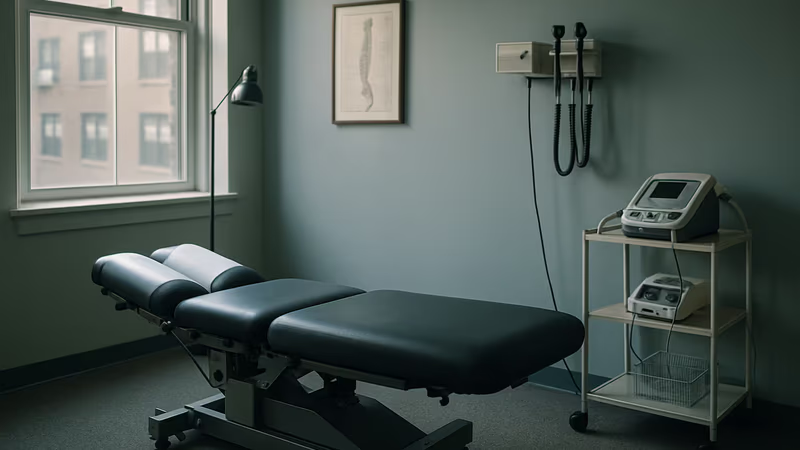
MUA is dangerous
Mollo's 2020 MUA ruling turned on competing expert testimony. Read the actual trial result without treating an expert's safety concerns as a universal rule.
Mar 17, 2021
Another Medical Necessity?
DRD Medical defeated the insurer's motion in 2020. Compare the court's finding of a factual dispute with Jason's original criticism of the affidavit.
Apr 27, 2020
A potent dissent
A dissenting judge criticizes vague peer review reports in no-fault insurance cases, highlighting the importance of detailed medical necessity determinations.
Aug 25, 2011
Proof That Physician Was Internist Sufficient for Expert Medical Testimony in NY Personal Injury Cases
Learn how internist qualifications meet NY expert witness standards for personal injury cases. Nassau & Suffolk County medical malpractice lawyer insights.
Jan 7, 2010
Triable issue of fact as to medical necessity
Five Boro involved both an incomplete peer review and a supported review met by opposing evidence. The insurer's motion failed for different reasons.
Mar 30, 2016
A motion for summary judgment is denied pending disclosure
New York court denies summary judgment in no-fault case where plaintiff timely requested but didn't receive peer review reports and medical documentation from defendant insurer.
Jan 6, 2014Frequently Asked Questions
Common Questions About This Topic
5 answers from the firm's New York personal-injury and employment-law practice. Click any question to expand.
Q: Can medical supplies be deemed unnecessary if a patient is receiving other treatment?
A: Yes, according to the _Enko_ decision, medical supplies can be found unnecessary if a physician determines that existing treatment (such as physical and chiropractic therapy) is sufficient to address the patient’s medical needs.
Q: What type of evidence is most effective in challenging a medical necessity determination?
A: The most effective evidence includes expert medical opinions explaining why the disputed supplies are necessary despite other treatments, objective clinical data showing ongoing need, and documentation of improved outcomes when supplies are provided.
Q: How should healthcare providers document medical necessity for supplies?
A: Providers should create comprehensive documentation showing: (1) specific medical conditions requiring the supplies, (2) how supplies address needs not met by existing treatment, (3) clinical evidence supporting necessity, and (4) coordination with treating physicians.
Q: Can peer review determinations be successfully challenged?
A: Yes, peer review determinations can be challenged with contradictory expert opinions, clinical evidence of medical necessity, documentation of treatment outcomes, and evidence that providing the supplies is consistent with accepted medical practice.
Q: What should providers do if their medical necessity is questioned?
A: Providers should immediately gather supporting documentation, consult with treating physicians, consider obtaining expert medical opinions, and work with experienced legal counsel who understands no-fault insurance medical necessity requirements.
Was this article helpful?
Disclaimer: This article is published by the Law Office of Jason Tenenbaum, P.C. for informational and educational purposes only. It does not constitute legal advice, and no attorney-client relationship is formed by reading this content. The legal principles discussed may not apply to your specific situation, and the law may have changed since this article was last updated.
New York law varies by jurisdiction — court decisions in one Appellate Division department may not be followed in another, and local court rules in Nassau County Supreme Court differ from those in Suffolk County Supreme Court, Kings County Civil Court, or Queens County Supreme Court. The Appellate Division, Second Department (which covers Long Island, Brooklyn, Queens, and Staten Island) and the Appellate Term (which hears appeals from lower courts) each have distinct procedural requirements and precedents that affect litigation strategy.
If you need legal help with a medical necessity matter, contact our office at (516) 750-0595 for a free consultation. We serve clients throughout Long Island (Huntington, Babylon, Islip, Brookhaven, Smithtown, Riverhead, Southampton, East Hampton), Nassau County (Hempstead, Garden City, Mineola, Great Neck, Manhasset, Freeport, Long Beach, Rockville Centre, Valley Stream, Westbury, Hicksville, Massapequa), Suffolk County (Hauppauge, Deer Park, Bay Shore, Central Islip, Patchogue, Brentwood), Queens, Brooklyn, Manhattan, the Bronx, Staten Island, and Westchester County. Prior results do not guarantee a similar outcome.