

Retroactive rescission
A Florida choice of law analysis leads to successful retroactive rescission, highlighting the importance of understanding different state laws in no-fault insurance cases.
Retroactive rescission — Read Article →In-depth legal analysis from Attorney Jason Tenenbaum — covering court rulings, legal standards, and practical guidance on choice of law under New York law.
Expert Analysis
When an accident or insurance dispute involves multiple states, New York courts must determine which state's law governs the claim. Choice-of-law analysis in New York uses an interest analysis approach for tort claims and a grouping-of-contacts test for contract-based insurance disputes. The choice between New York and another state's law can dramatically affect the outcome — particularly regarding no-fault thresholds, damage caps, and procedural requirements. These articles examine the analytical framework New York courts apply to resolve choice-of-law disputes.
Read Our Choice of law Articles
Frequently Asked Questions
New York follows an 'interest analysis' approach to choice-of-law questions, examining which jurisdiction has the greatest interest in having its law applied. In insurance and personal injury cases, relevant factors include where the accident occurred, where the policy was issued, where the insured resides, and where the insurer is domiciled. Choice-of-law issues frequently arise in cross-border accidents and when out-of-state insurance policies cover New York accidents.
A Florida choice of law analysis leads to successful retroactive rescission, highlighting the importance of understanding different state laws in no-fault insurance cases.
Retroactive rescission — Read Article →
Analysis of Pennsylvania retroactive rescission law in NY courts, including Monroe v Omni and burden of proof requirements for insurers seeking policy rescission.
Pa retroactive rescission — Read Article →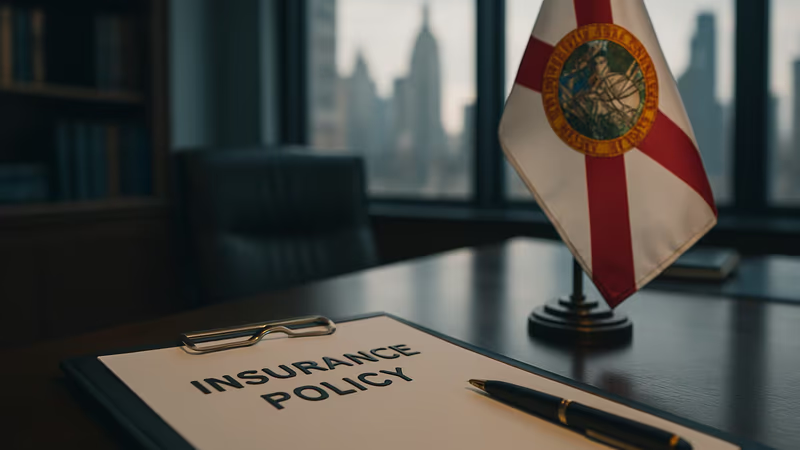
Florida insurance policy rescission requirements under state law - notice to insured and premium return mandates for valid ab initio rescission in New York courts.
Rescinding a policy in accordance with Florida law — Read Article →
Expert guidance on multi-state personal injury cases and choice of law issues. Experienced NY attorneys. Call 516-750-0595 for free consultation.
Understanding Choice of Law in Multi-State Personal Injury Cases — Read Article →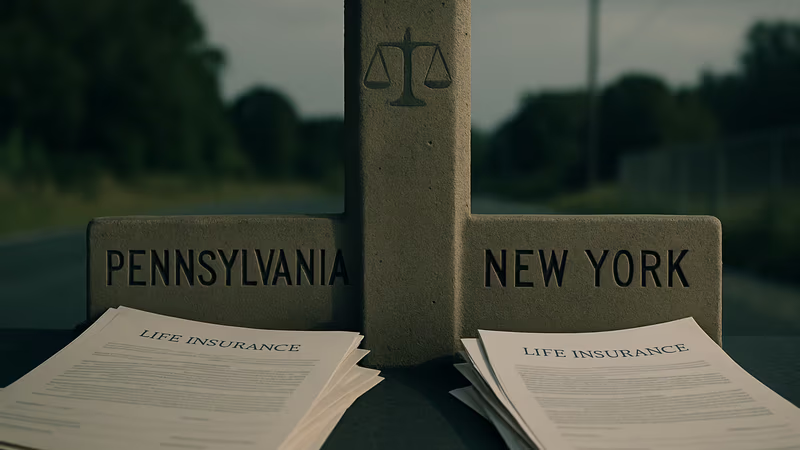
Navigate complex choice of law issues when Pennsylvania insurance policies meet New York litigation. Learn the innocent third party doctrine. Call 516-750-0595.
Pennsylvania Insurance Law in New York Courts: Navigating Choice of Law and the Innocent Third Party Doctrine — Read Article →Need Legal Guidance?
Get a Free Case Evaluation
No fees unless we win. Available 24/7.

Learn how interstate insurance laws affect NY personal injury cases. Expert analysis of multi-state complications. Call 516-750-0595.
Interstate Insurance Law Complications in New York Personal Injury Cases — Read Article →
Insurance companies try technical defenses to deny NY no-fault benefits. Learn how business records rule & choice of law protects your claim. Call 516-750-0595
Understanding New York No-Fault Insurance Claims and the Business Records Rule — Read Article →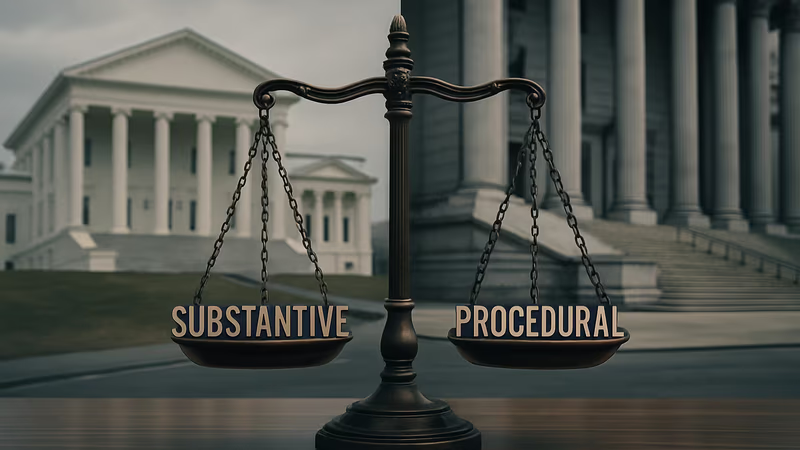
New York courts apply substantive law from other states but use NY procedural law, as shown in this GEICO case involving Virginia insurance law and mailing requirements.
VA substantive law; NY Procedural law — Read Article →
New York court upholds insurance company's retroactive policy rescission under Florida law, demonstrating how choice of law principles apply in multi-state insurance disputes.
Policy voided — Read Article →
NY court applies PA law protecting innocent third parties from insurance policy rescission in Island Life Chiropractic v Infinity Group case analysis.
Innocent third-party under PA law — Read Article →
New York court rejects insurance rescission under Florida law when insurer failed to provide proper notice and return premiums within reasonable time after discovering fraud.
Rescission not upheld — Read Article →
Georgia and New York laws both prohibit retroactive rescission of auto insurance policies despite material misrepresentations in procurement applications.
Georgia Law and New York law on material misrepresentations — Read Article →
Pennsylvania insurance law case shows that policy rescission may not affect innocent third parties, highlighting complex choice of law issues in no-fault insurance disputes.
Innocent third-party plays out under Pennsylvania law analysis — Read Article →
New Jersey arbitration statute requires application for Article 75 relief to compel arbitration in no-fault insurance disputes, as New York procedural law controls over substantive...
New Jersey arbitration statute requires an application for Article 75 relief — Read Article →
Massachusetts law governs no-fault insurance claims with lower PIP limits and health insurance offset provisions, creating expedient claim resolution strategies.
Massachusetts law applies — Read Article →
NY court rules AAA Michigan must follow NY law despite out-of-state status, blocking policy rescission to protect innocent third parties in no-fault claims.
AAA is licensed to transact business in NY – and recission not allowed — Read Article →
New York appellate court reverses summary judgment in no-fault insurance case due to missing affidavit, raising questions about the necessity of the appeal.
An appeal for the sake of an appeal? — Read Article →
Florida law prevails in New York court allowing retroactive policy rescission for material misrepresentation in insurance application under Florida Statutes § 627.409.
Choice of law – Florida prevails allowing retroactive recission — Read Article →
New York court applies Pennsylvania insurance law requiring strict compliance with cancellation notice requirements, including proof of proper mailing address.
Failure to comply with PA law — Read Article →
Court ruling clarifies that arbitration options don't justify dismissal; proper procedure requires CPLR 7503 motion to compel arbitration instead of summary judgment dismissal.
Dismissal on arbitration grounds should be made through CPLR 7503 — Read Article →
Delta Diagnostic v Infinity Group case shows NY court vacating consent order due to changed Pennsylvania insurance law interpretation affecting retroactive policy rescission burden...
Pennsylvania law — Read Article →
Attorney Jason Tenenbaum critiques a case where counsel failed to research applicable Rhode Island law before proceeding to trial, highlighting the importance of thorough legal...
Embarrassment or hubrus? — Read Article →
Pennsylvania law allows insurers to rescind policies for misrepresentation, but innocent third parties retain protection rights despite the rescission.
Proofs insufficient under PA law — Read Article →
Pennsylvania insurance policy rescission defense fails against innocent third parties in NY courts. Choice of law typically favors vehicle registration state in cross-border...
Fraudulent prcourement defnese — Read Article →
New York court applies Pennsylvania insurance law to dismiss no-fault benefits claim where injured party was complicit in insurance fraud scheme.
Reargument granted and complaint dismissed under PA law — Read Article →
PA law policy rescission case - insufficient proof against assignor in NY no-fault insurance fraud claim. Delta Diagnostic v Infinity Group 2014 decision analysis.
Policy can be rescined under PA law; proof insufficient as to particular Assignor — Read Article →
New York court applies Pennsylvania law to auto insurance dispute, finding PA's protection for innocent third parties prevents policy rescission against assignor.
A choice of law analysis – PA law controls — Read Article →
Delaware insurance law applied to NY court case involving out-of-state policy, accident location, and $15K coverage limits in no-fault claim dispute.
Delaware law applies — Read Article →
New York court applies New Jersey insurance law in medical provider dispute, highlighting conflicts between state no-fault laws and mandatory dispute resolution requirements.
New Jersey Law – but see where it all went wrong — Read Article →
Understanding how Florida law applies to New York no-fault insurance disputes. Expert legal analysis from Long Island insurance attorneys. Call (516) 750-0595.
Understanding Florida Choice of Law in New York No-Fault Insurance Cases: Long Island Legal Analysis — Read Article →
Analysis of Florida vs New York no-fault insurance laws, focusing on retroactive policy rescission differences and choice of law implications in cross-state accident cases.
A primer on Florida Law — Read Article →
New Jersey law significantly limited subrogation recovery in this PIP case involving cross-border accident, workers' compensation, and no-fault benefits under choice of law...
New Jersey law bars most of Plaintiff's recovery in this PIP subrogation action — Read Article →
NY Court of Appeals applies Massachusetts law to SUM claim despite NY policy and NY victim, prioritizing accident location over policy terms in complex choice of law analysis.
Choice of law in SUM context – interesting — Read Article →
Expert legal guidance on NY-NJ cross-state insurance claims. Long Island attorney explains choice of law implications. Call 516-750-0595.
When NY and NJ Insurance Laws Collide: Understanding Cross-State Claims — Read Article →The Law Office of Jason Tenenbaum publishes detailed legal analysis on choice of law and related topics as part of an ongoing commitment to legal education and transparency. Since 2008, Attorney Tenenbaum has written over 2,353 articles examining how New York courts decide cases involving personal injury, no-fault insurance, employment discrimination, and complex litigation matters. Each article is based on an actual court decision and provides the kind of substantive analysis that practitioners and clients need to understand the current state of the law.
Attorney Tenenbaum brings over 24 years of New York litigation experience to every article. His practice spans Nassau County, Suffolk County, Queens, Brooklyn, Manhattan, the Bronx, and Staten Island. He has handled thousands of cases involving insurance disputes, personal injury claims, and employment law matters, giving him a practical perspective that academic commentators often lack. The articles in this collection reflect that experience, offering readers insight into how judges actually apply legal standards in contested cases.
If you are dealing with a legal issue related to choice of law or any topic covered on this blog, the firm offers free initial consultations by phone or in person. Call (516) 750-0595 to speak with an attorney, or visit the contact page to submit a case review request online. No fee is charged unless the firm recovers compensation on your behalf. The firm's six attorneys bring over 112 combined years of legal experience and speak English, Spanish, Italian, Japanese, and Russian, ensuring clients can communicate in the language they are most comfortable with. Attorney Tenenbaum is admitted to practice in New York, New Jersey, Florida, Texas, Georgia, and Michigan state courts, as well as multiple federal courts, and he has authored more than 2,353 published legal articles that attorneys, judges, and insurance professionals across the state rely on for guidance.
New York's legal framework for choice of law matters involves an intricate web of statutes, regulations, and case law that has developed over decades. The state's court system — including the Civil Court, District Courts, Supreme Court, Appellate Term, Appellate Division, and Court of Appeals — each plays a distinct role in shaping how choice of law cases are litigated and decided. Trial-level decisions in Nassau County Supreme Court, Suffolk County Supreme Court, and the New York City Civil Courts establish important factual precedents, while appellate rulings create binding legal standards that all lower courts must follow.
The Civil Practice Law and Rules (CPLR) governs procedure in New York civil litigation and contains provisions that directly impact choice of law cases. CPLR Article 31 establishes the scope and methods of disclosure, including depositions under CPLR 3107, interrogatories under CPLR 3130, and document demands under CPLR 3120. CPLR 3212 provides the standard for summary judgment, requiring the movant to establish a prima facie case through admissible evidence and shifting the burden to the opponent to raise a triable issue of fact. CPLR 3215 governs default judgments, which require proof of service, proof of the facts constituting the claim, and proof of the amount due. Understanding these procedural tools is essential for anyone involved in choice of law litigation in New York.
Statutes of limitations vary significantly depending on the type of claim. General negligence and personal injury claims carry a three-year deadline under CPLR 214(5). Medical malpractice claims have a shortened two-and-a-half-year deadline under CPLR 214-a. Claims against municipalities require a Notice of Claim within 90 days under General Municipal Law Section 50-e. No-fault insurance claims have their own regulatory deadlines, including the 30-day filing window for applications and the 45-day submission period for provider claims. Employment discrimination claims under the New York State Human Rights Law generally have a three-year statute of limitations, while federal Title VII claims require EEOC filing within 300 days.
The Appellate Term and Appellate Division regularly issue decisions that clarify and refine the legal standards applicable to choice of law cases. The Second Department, which covers Long Island and parts of New York City, is particularly active in this area. Its decisions on evidentiary standards, burden-shifting frameworks, and procedural requirements directly affect how trial courts evaluate motions and how attorneys prepare their cases. Attorney Tenenbaum monitors these decisions and analyzes them in the articles on this page, providing practitioners with the timely legal commentary they need to stay current.
The Law Office of Jason Tenenbaum, P.C. is located at 326 Walt Whitman Road, Suite C, Huntington Station, New York 11746, centrally situated on Long Island to serve clients throughout Nassau County, Suffolk County, and the five boroughs of New York City. With over 24 years of experience and more than 1,000 appeals written, Attorney Tenenbaum combines deep legal knowledge with practical courtroom experience. If you need help with a choice of law matter, call (516) 750-0595 for a free consultation.
Successful outcomes in choice of law cases often depend on procedural compliance as much as substantive merit. In no-fault insurance litigation, the prima facie case standard requires the plaintiff to submit admissible evidence establishing the claim was properly submitted, overdue, and unpaid. If the defendant raises a defense — such as an IME no-show, EUO non-appearance, lack of medical necessity, or fee schedule dispute — the burden shifts to the plaintiff to present evidence creating a triable issue of fact. Summary judgment motions under CPLR 3212 require the movant to make a prima facie showing through affidavits, deposition testimony, or documentary evidence, and the opposition must raise a genuine factual dispute to avoid dismissal.
In personal injury cases, the discovery process is governed by CPLR Article 31 and involves depositions of parties and witnesses, exchange of medical records under CPLR 3121 authorizations, physical and mental examinations, and expert disclosure. Once discovery is complete, either party may file a note of issue certifying readiness for trial, after which a 120-day deadline applies for filing summary judgment motions under CPLR 3212(a). Motion practice often determines the outcome of cases before trial, and understanding the specific evidentiary standards applied by courts in your jurisdiction is essential. The articles on this page analyze these standards in detail, drawing on real cases litigated by Attorney Tenenbaum and decisions from courts across the state.
The firm serves clients throughout Long Island, including the towns and villages of Huntington, Babylon, Islip, Brookhaven, Smithtown, Hempstead, Garden City, Mineola, Great Neck, Freeport, Long Beach, Rockville Centre, Valley Stream, Westbury, Hicksville, and Massapequa, as well as all five boroughs of New York City. Attorney Tenenbaum regularly appears in Nassau County Supreme Court, Suffolk County Supreme Court, the New York City Civil Court, the American Arbitration Association, the Workers' Compensation Board, and the Appellate Term and Appellate Division of the Second Department. If you need legal assistance with a choice of law matter or any topic discussed in these articles, call (516) 750-0595 for a free, confidential case evaluation.
The Law Office of Jason Tenenbaum, P.C. was founded in 2002 and has grown into one of Long Island's most respected personal injury, employment law, and insurance litigation firms. The firm's six attorneys — led by founding partner Jason Tenenbaum — bring over 112 combined years of legal experience to every case. The team speaks English, Spanish, Italian, Japanese, and Russian, ensuring that clients from diverse backgrounds can communicate in the language they are most comfortable with during what is often one of the most stressful periods of their lives.
Attorney Tenenbaum earned his Juris Doctor from Syracuse University College of Law and is admitted to practice in New York, New Jersey, Florida, Texas, Georgia, and Michigan state courts, as well as the United States District Courts for the Eastern and Southern Districts of New York. He has written more than 1,000 appellate briefs, handled over 100,000 no-fault insurance cases, and recovered over $100 million in verdicts and settlements for injured individuals and workers throughout Long Island and New York City. His 2,353+ published legal articles on New York case law make him one of the most prolific legal commentators in the state, and his analysis is relied upon by attorneys, judges, and insurance professionals across all four Appellate Division departments.
The firm operates on a contingency fee basis for personal injury and employment discrimination cases, which means clients pay no attorney fees unless the firm recovers compensation on their behalf. Every consultation is free, confidential, and without obligation. The firm's centrally located Huntington Station office provides convenient access to Nassau County Supreme Court in Mineola, Suffolk County Supreme Court in Riverhead, the Nassau County District Court, Suffolk County courts in Central Islip, and the New York City Civil Court. Whether you need help with a car accident claim, a workplace discrimination complaint, a no-fault insurance denial, a workers' compensation dispute, or any other legal matter, the Law Office of Jason Tenenbaum, P.C. is ready to fight for your rights.
Questions About Choice of law?
Attorney Jason Tenenbaum has been writing about choice of law since 2008, drawing on 24+ years of practice. Get a free, confidential case evaluation.
No fees unless we win · Available 24/7 · Hablamos Español
Injured? Don't Wait.
Get Your Free Case Evaluation Today
No fees unless we win — available 24/7 for emergencies.