
Why Trust This Analysis
This article is part of our ongoing choice of law coverage, with 35 published articles analyzing choice of law issues across New York State. Attorney Jason Tenenbaum brings 24+ years of hands-on experience to this analysis, drawing from his work on more than 1,000 appeals, over 100,000 no-fault cases, and recovery of over $100 million for clients throughout Nassau County, Suffolk County, Queens, Brooklyn, Manhattan, and the Bronx. For personalized legal advice about how these principles apply to your specific situation, contact our Long Island office at (516) 750-0595 for a free consultation.
Choice of law issues in insurance cases often involve complex multi-jurisdictional scenarios where courts must determine which state’s laws should govern a claim. This becomes particularly intricate in Supplementary Uninsured/Underinsured Motorist (SUM) coverage cases, where the insurance policy, accident location, parties involved, and applicable damages may all be governed by different states’ laws.
Erie Insurance Co. v Boss in the Fourth Department
The Fourth Department’s decision in Erie Insurance Co. v Boss presents a fascinating example of how New York courts approach these jurisdictional puzzles. When faced with competing interests between the state that issued the policy and the state where the accident occurred, courts must balance various policy considerations and legal principles to reach a fair outcome.
This case also highlights the ongoing evolution of choice of law doctrine in insurance contexts, which has seen significant development in recent years, particularly in no-fault insurance cases and complex multi-state scenarios.
Jason Tenenbaum’s Analysis:
Free Consultation · No Fee Unless We Win
Does this apply to your situation?
Every case is different. Get a free, confidential case review from an experienced attorney who can tell you exactly where you stand.
New York policy, Massachusetts accident, Massachusetts tortfeasor
Matter of Erie Ins. Co. v Boss, 2011 NY Slip Op 03758 (4th Dept. 2011)
(1) New York policy, (2) Massachusetts accident, (3) Massachusetts tort-feasor, and (4) New York victim.
What is the result? Massachusetts law.
The purpose of SUM coverage and the measure of damages
“We thus conclude that an individual insured under a New York automobile policy who is injured in an accident in another jurisdiction should not be placed in either a better or worse position when filing a SUM benefits claim than he or she would have been if the tortfeasor had been fully insured. To apply New York law to the measure of damages in this case would not be consistent with the purpose served by SUM coverage, which is to take the place of a tortfeasor’s insufficient insurance coverage.”
Compare with recent New York no-fault choice of law cases.
Key Takeaway
The Fourth Department’s ruling demonstrates that in SUM coverage cases, courts prioritize the fundamental purpose of uninsured motorist coverage over the technical details of policy origin. By applying Massachusetts law despite the New York policy and New York victim, the court ensured the injured party received the same protection they would have had if the tortfeasor carried adequate insurance, maintaining the essential function of SUM coverage as a substitute for insufficient third-party insurance.
Related Articles
Legal Context
Why This Matters for Your Case
New York law is among the most complex and nuanced in the country, with distinct procedural rules, substantive doctrines, and court systems that differ significantly from other jurisdictions. The Civil Practice Law and Rules (CPLR) governs every stage of civil litigation, from service of process through trial and appeal. The Appellate Division, Appellate Term, and Court of Appeals create a rich and ever-evolving body of case law that practitioners must follow.
Attorney Jason Tenenbaum has practiced across these areas for over 24 years, writing more than 1,000 appellate briefs and publishing over 2,600 legal articles that attorneys and clients rely on for guidance. The analysis in this article reflects real courtroom experience — from motion practice in Civil Court and Supreme Court to oral arguments before the Appellate Division — and a deep understanding of how New York courts actually apply the law in practice.
About This Topic
Choice of Law in New York Insurance & Injury Cases
When an accident or insurance dispute involves multiple states, New York courts must determine which state's law governs the claim. Choice-of-law analysis in New York uses an interest analysis approach for tort claims and a grouping-of-contacts test for contract-based insurance disputes. The choice between New York and another state's law can dramatically affect the outcome — particularly regarding no-fault thresholds, damage caps, and procedural requirements. These articles examine the analytical framework New York courts apply to resolve choice-of-law disputes.
35 published articles in Choice of law
Keep Reading
More Choice of law Analysis

Choice of law?
Court applies New York no-fault law over New Jersey law based on most significant relationship test, despite accident occurring in New Jersey.
Mar 17, 2021
Retroactive rescission
A Florida choice of law analysis leads to successful retroactive rescission, highlighting the importance of understanding different state laws in no-fault insurance cases.
Sep 25, 2020
New Jersey law bars most of Plaintiff's recovery in this PIP subrogation action
New Jersey law significantly limited subrogation recovery in this PIP case involving cross-border accident, workers' compensation, and no-fault benefits under choice of law...
Jun 17, 2011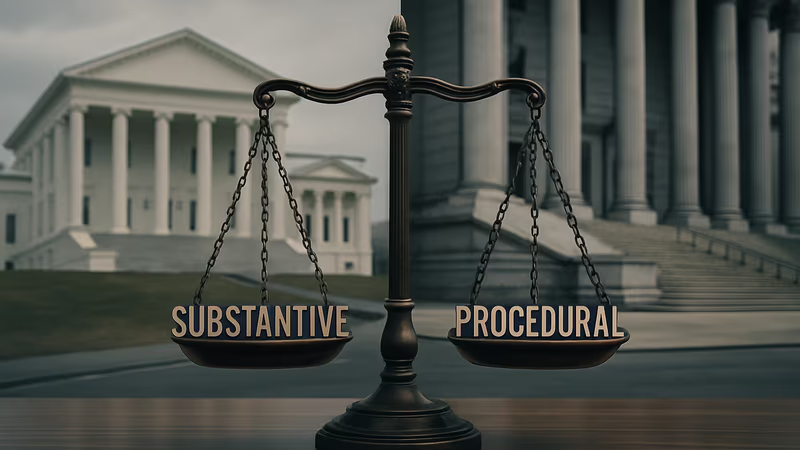
VA substantive law; NY Procedural law
New York courts apply substantive law from other states but use NY procedural law, as shown in this GEICO case involving Virginia insurance law and mailing requirements.
Jul 21, 2018
AAA is licensed to transact business in NY – and recission not allowed
NY court rules AAA Michigan must follow NY law despite out-of-state status, blocking policy rescission to protect innocent third parties in no-fault claims.
May 3, 2016
Fraudulent prcourement defnese
Pennsylvania insurance policy rescission defense fails against innocent third parties in NY courts.
Mar 19, 2015Was this article helpful?
Disclaimer: This article is published by the Law Office of Jason Tenenbaum, P.C. for informational and educational purposes only. It does not constitute legal advice, and no attorney-client relationship is formed by reading this content. The legal principles discussed may not apply to your specific situation, and the law may have changed since this article was last updated.
New York law varies by jurisdiction — court decisions in one Appellate Division department may not be followed in another, and local court rules in Nassau County Supreme Court differ from those in Suffolk County Supreme Court, Kings County Civil Court, or Queens County Supreme Court. The Appellate Division, Second Department (which covers Long Island, Brooklyn, Queens, and Staten Island) and the Appellate Term (which hears appeals from lower courts) each have distinct procedural requirements and precedents that affect litigation strategy.
If you need legal help with a choice of law matter, contact our office at (516) 750-0595 for a free consultation. We serve clients throughout Long Island (Huntington, Babylon, Islip, Brookhaven, Smithtown, Riverhead, Southampton, East Hampton), Nassau County (Hempstead, Garden City, Mineola, Great Neck, Manhasset, Freeport, Long Beach, Rockville Centre, Valley Stream, Westbury, Hicksville, Massapequa), Suffolk County (Hauppauge, Deer Park, Bay Shore, Central Islip, Patchogue, Brentwood), Queens, Brooklyn, Manhattan, the Bronx, Staten Island, and Westchester County. Prior results do not guarantee a similar outcome.