Key Takeaway
Court of Appeals argument September 16: must a bar submit its own evidence to beat a Dram Shop claim, or can it just point to gaps? What victims should know.
This article is part of our ongoing personal injury coverage, with 183 published articles analyzing personal injury issues across New York State. Attorney Jason Tenenbaum brings 24+ years of hands-on experience to this analysis, drawing from his work on more than 1,000 appeals, over 100,000 no-fault cases, and recovery of over $100 million for clients throughout Nassau County, Suffolk County, Queens, Brooklyn, Manhattan, and the Bronx. For personalized legal advice about how these principles apply to your specific situation, contact our Long Island office at (516) 750-0595 for a free consultation.
On Wednesday, September 16, 2026, the New York Court of Appeals heard Brown v Z-Live Inc. (No. 75, APL 2025-138). It is a Dram Shop case, but the real question is who has to prove what when a bar moves to throw a case out.
I handle Dram Shop claims on Long Island: people hit by drunk drivers, and people beaten up by a patron who should have been cut off. Every one of those cases turns on evidence the bar controls.
The short version
A bar moving for summary judgment is supposed to prove, with its own evidence, that it made no unlawful sale or that the sale had nothing to do with the injury. Pointing at holes in the plaintiff's proof is not supposed to be enough.
In Brown, the First Department dismissed a Dram Shop claim on a manager's testimony about training and an after-the-fact review. Two justices called that gap-pointing. The Court of Appeals decides who was right.
Update: what happened at argument (September 16, 2026)
The Court heard Brown v Z-Live first on Wednesday afternoon and kept both lawyers up for more than half an hour on a twenty-minute allotment. Nobody said how they would vote. But the questions from the bench went almost entirely to one issue: what a bar has to put in the record to win summary judgment on a Dram Shop claim.
Z-Live’s case rested on one witness, the general manager, who oversees the whole operation and was on the premises that night. He testified that “no such incident happened,” that there was no incident report, and he described the security protocols: roaming guards, patrons turned away or thrown out if they looked intoxicated, a report filed whenever that happens. Its lawyer argued that this negated the element of a sale to a visibly intoxicated person, that the smell of alcohol is not visible intoxication, and that Brown had three chances to put a fact in the record and took none of them.
Free Consultation · No Fee Unless We Win
Does this apply to your situation?
Every case is different. Get a free, confidential case review from an experienced attorney who can tell you exactly where you stand.
The judges kept returning to what that witness did not say. He did not say he saw the three men inside. He did not say anyone else did. He did not say who was tending bar. When Z-Live’s lawyer explained that none of the bartenders were still employed by the time of discovery, one judge asked why personal knowledge was not required; another asked why Z-Live never deposed one of the two assailants, who had defaulted in the civil case but were prosecuted criminally: “If they defaulted, that doesn’t mean you can’t find them.” Judge Rivera asked whether any bartender had testified about whom they served that night, and a colleague repeated the question. The answer was no.
Brown’s lawyer got pressed too. Judge Garcia put a hypothetical: one bar on the block, a drunk man on the street, and nothing in the record placing him inside. Does that go to a jury? She said yes, then conceded that case “would be the tougher case.” Asked for an Appellate Division decision finding a Dram Shop violation with no witness who saw the person served, she could not name one. Her better ground was this record. Brown testified that the three came out of the club’s front door around 3:30 a.m., that at least one reeked of alcohol, and that they climbed onto a posted construction site and hugged a stranger before the assault. The Chief Judge asked whether sober adults do that. And the club’s own security came out to the street to break up the fight, yet no incident report was written, which says something about how much weight the absence of a report can carry.
When Judge Troutman asked whether the point was that Z-Live never offered anyone with personal knowledge of what happened that evening, Brown’s lawyer answered, “Yes, absolutely.” She closed by reading Judge Smith’s concurrence in Yun Tung Chow, which urged movants to remember that New York puts the burden on the moving party: someone with actual knowledge of who was and was not served should say so, by affidavit or deposition.
What I took from it. New York’s summary judgment rule has not changed. The moving defendant has to disprove an element with evidence, not point at the plaintiff’s gaps. A bar that wants to win a Dram Shop motion needs the bartender who poured, the doorman who watched the line, or the camera. “The bartender doesn’t work here anymore” is not a reason. It is a subpoena. As Brown’s lawyer put it on rebuttal, the manager “didn’t say the bartender was dead,” and there were two of them. If a witness has left the state, the Uniform Interstate Depositions and Discovery Act gets you a sister-state subpoena. That is work, and it is the work the rule demands.
The contrast is the federal standard. Under Celotex Corp. v. Catrett, 477 U.S. 317 (1986), a federal movant can win by showing the plaintiff cannot prove an element; the burden shifts on far less. New York has always required more, and Florida, which used to, adopted the federal standard in 2021. It is one reason plaintiffs’ lawyers here fight to keep cases in state court.
My read of the bench is that a majority was not satisfied with a manager’s account of policies and an empty file. The Court could still go narrow, as I wrote before argument, and decide the case on whether Brown ever placed the men inside. A decision usually follows within a few months. I will update this post when it comes down.
Quotations are from the Court’s webcast of the September 16, 2026 argument; the official transcript will be posted on the Court of Appeals website.
What the Dram Shop Act is
New York’s Dram Shop Act is General Obligations Law § 11-101. Anyone injured by an intoxicated person, or by reason of that intoxication, has a claim against whoever unlawfully sold that person alcohol and contributed to it.
Unlawfully is the operative word. Alcoholic Beverage Control Law § 65 forbids a licensee from serving a visibly intoxicated person, anyone under 21, or a known habitual drunkard. The statute allows actual and exemplary damages.
GOL § 11-100 is the companion for minors. It reaches anyone, not only a licensed bar, who unlawfully furnishes alcohol to someone under 21 knowing or having reason to believe their age. For adults there is no social-host liability.
What a plaintiff has to prove
Two things: an unlawful sale, meaning the bar served the person while visibly intoxicated or under 21, and a reasonable or practical connection between that sale and your injury. That is looser than ordinary proximate cause.
Visibly intoxicated means what a bartender could see: slurred speech, stumbling, glassy eyes. A later blood alcohol reading is not proof by itself, but with a toxicologist’s extrapolation it is strong circumstantial evidence.
The Court of Appeals confirmed that in Adamy v Ziriakus, 92 NY2d 396 (1998). Our dram shop settlement guide covers how those elements get proven.
What happened in Brown v Z-Live
Darrick Brown was assaulted by two men while working at a Verizon construction site about 100 feet from Stage 48, Level 3 and Cantina Rooftop, all run by Z-Live Inc. He sued the men and Z-Live.
His only link between the assailants and the venues was his own testimony: he saw them come out through doors that led to Z-Live’s establishments.
Z-Live moved for summary judgment on a manager’s deposition about employee training and his review after the suit: security tape, incident reports for the night, and a doorman who recalled no incident.
Supreme Court, Bronx County (Kim Adair Wilson, J.) denied the motion. In May 2025 the First Department reversed and dismissed the case against Z-Live, 3 to 2 on the Dram Shop claim.
The majority held the manager’s testimony made a prima facie case, and that there was no evidence, circumstantial or otherwise, that the assailants were ever inside a Z-Live establishment, let alone served alcohol there.
Justices Kapnick and Rodriguez read the same record differently: the manager testified he performed no investigation after notice of the suit, and nothing else in Z-Live’s papers negated an element of the claim.
Their conclusion: Z-Live “merely pointed to gaps in plaintiff’s proof,” so the burden never shifted. Two dissents on a question of law in a final order got Brown to the Court of Appeals as of right under CPLR 5601(a).
The negligence claims are gone. The whole panel agreed those were abandoned when Brown did not oppose their dismissal, and that a venue is not liable for an assault 100 feet away.
The rule actually at stake
On summary judgment the moving party has to make a prima facie showing of entitlement to judgment as a matter of law with admissible evidence. If it does not, the motion is denied no matter how weak the opposition.
That has been the rule since Winegrad v New York Univ. Med. Ctr., 64 NY2d 851 (1985), and Alvarez v Prospect Hosp., 68 NY2d 320 (1986). The First Department’s corollary: pointing to gaps in the plaintiff’s proof is not a showing.
The dissent cites Martin v City of New York, 191 AD3d 152 (1st Dept 2020), Kolakowski v 10839 Assoc., 185 AD3d 427 (1st Dept 2020), and Vazquez v Jerome Gas Corp., 173 AD3d 526 (1st Dept 2019).
The distinction is not academic. “You cannot prove we served him” is a gap. “Here are our receipts, our tape and our staff, and none of it shows him” is evidence. The first leaves the burden on the bar; the second shifts it.
The Court’s issue statement asks exactly that: whether defendants merely pointed to gaps in plaintiff’s proof rather than submitting evidence negating an element of the claim. Brown’s facts are the vehicle.
Who has to show what on a Dram Shop motion
| Element | Plaintiff at trial | Bar moving for summary judgment |
|---|---|---|
| Service | The bar sold or gave alcohol to the person who hurt you | Evidence he was never served: receipts, point-of-sale data, staff who can say so |
| Visible intoxication | He showed signs a server could see when served | Evidence of his condition at the time of service, not a training policy |
| Connection to the injury | A reasonable or practical link between the sale and the harm | Evidence breaking the link, such as proof he left sober hours earlier |
| Gaps in the plaintiff's file | Not the plaintiff's problem until the bar carries its burden | Not enough on its own, per the Brown dissent. This is what the Court decides. |
Why this matters for crash and assault victims
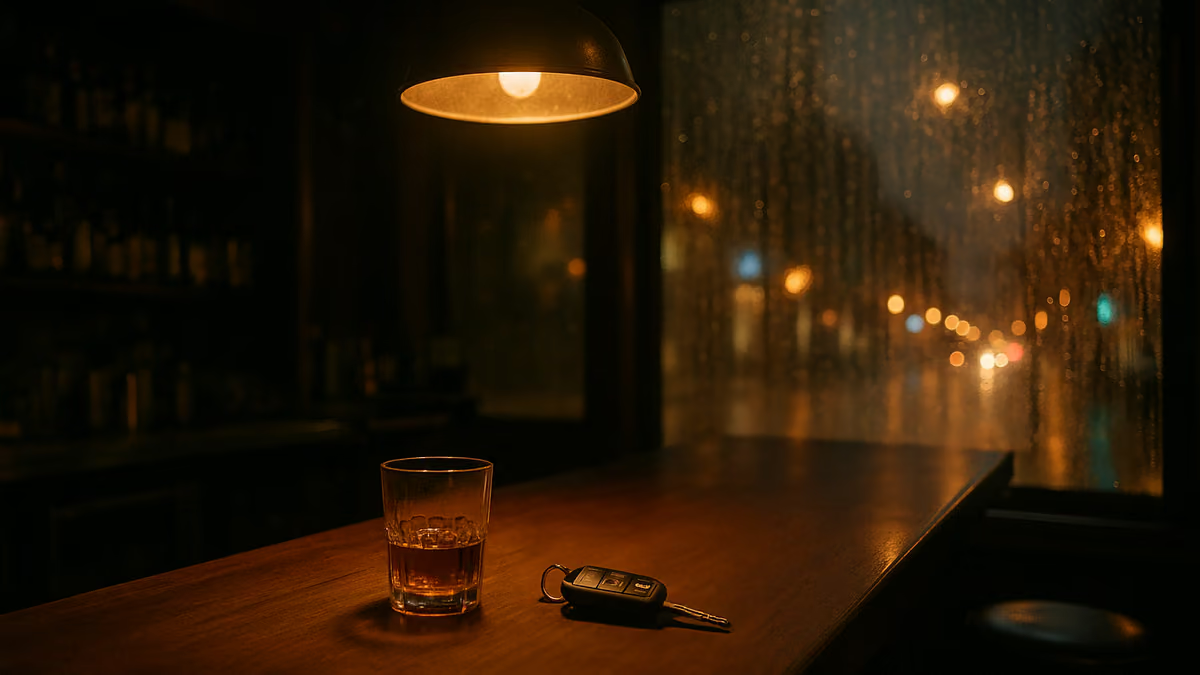
Nobody hands a Dram Shop plaintiff a confession. The proof is circumstantial: a bar tab with eleven drinks on it, a bartender’s memory, door surveillance, a blood alcohol reading extrapolated back to last call.
Almost all of it sits in the bar’s hands, and the plaintiff was somewhere else, usually in an ambulance. If “I checked, nothing happened” wins the motion, the incentive is to keep the records thin and move early.
If the Court holds the bar to its own evidence, the bar produces what it has and a jury decides. That is the rule I want, but it is not a free pass: once the burden shifts, you still need admissible proof of your own.
For drivers, one more reason to move fast. Since May 26, 2026, New York bars a car-accident plaintiff found more at fault than the defendant from recovering (CPLR 1411(b)). Give no insurer a recorded statement before you have counsel.
What each side had to win on September 16
Brown has to convince the Court that the gap-pointing rule applies to what Z-Live submitted. His best fact is the dissent’s reading of the manager: no investigation, and no further affidavits from either side in the record.
His problem is the hole in his own case. He never saw the men inside; he saw them come out of doors. If a defendant may rely on a total absence of proof of service, the burden question may not save him.
Z-Live has to convince the Court that trained staff, a review that turned up nothing and a doorman who recalled no incident were affirmative evidence, so the burden shifted and Brown had nothing to answer with.
The Court could also go narrow: affirm on Brown’s inability to place the men inside and leave the rule alone. I would not bet either way.
What to preserve after a drunk-driving crash or a bar assault
Whatever the Court does, the cases I win are the ones where the evidence was locked down in the first two weeks.
Surveillance. Bars overwrite footage on a rolling basis, often within weeks. A written preservation demand to the bar and its insurer, sent the first week, is the only reliable way to keep it.
Receipts and tabs. Credit-card and point-of-sale records show what was poured, to whom and when, and identify the server.
The police file. In a crash, the driver’s breath or blood test and the officer’s observations anchor the BAC extrapolation. In an assault, the complaint report and any arrest identify the attacker.
Witnesses. Other patrons, the bouncer, the bartender, the rideshare driver. Names the same night beat a subpoena a year later.
The bar’s file and license history. Incident reports, the doorman’s log, the staff schedule, and the State Liquor Authority’s disciplinary record for the license. Prior charges for serving an intoxicated person change the case.
- Get treated and keep the ER record; it also fixes the time.
- Get the police report or complaint number and the driver's or attacker's name.
- Write down where the person had been drinking, who told you, and who else was there.
- Photograph the bar, its doors and cameras, and any receipt you have.
- Get preservation letters to the bar, its insurer and the driver's insurer within days.
- Do not give a recorded statement to any insurer before you have counsel.
Our Long Island dram shop page and drunk driving accident page go deeper on both claims.
Deadlines
A Dram Shop claim carries a three-year statute of limitations; wrongful death is two years from the date of death. If the seller was a county or town operation, a notice of claim is due within 90 days under General Municipal Law § 50-e.
No-fault runs on its own clock: the application to your own carrier is due within 30 days regardless of who was drunk. Our car accident page covers it.
What to watch
Argued September 16, 2026; the update above covers the argument. The Court posts the recording and transcript on its Oral Argument Archive, and a decision usually follows within a few months. I will update this post when it comes down.
Sources
- Brown v Z-Live Inc., 2025 NY Slip Op 03242, 238 AD3d 658 (1st Dept May 29, 2025), majority and dissent in part
- Court of Appeals, Case Issue Statements, September 2026 (Brown v Z-Live Inc., No. 75)
- Court of Appeals, webcast of the September 16, 2026 argument (No. 75, first case on the afternoon calendar); transcript to follow on the Oral Argument Archive
- General Obligations Law § 11-101 (Dram Shop Act)
- General Obligations Law § 11-100 (unlawful furnishing to persons under 21)
A bar that serves someone who then hurts a stranger has always been answerable in New York. The question argued on September 16 was whether it has to open its own records to stay in the case, or can win by pointing at what the victim never had.
Call 516-750-0595 or request a free case review if you were hurt by a drunk driver or assaulted by an intoxicated bar patron on Long Island.
Legal Context
Why This Matters for Your Case
Personal injury law in New York is governed by a complex web of statutes, case law, and procedural rules that differ from most other states. The statute of limitations for most personal injury claims is three years under CPLR 214(5), but claims against municipalities require a Notice of Claim within 90 days. Motor vehicle accident victims must meet the serious injury threshold under Insurance Law §5102(d) before they can recover pain and suffering damages.
The Law Office of Jason Tenenbaum has recovered over $100 million for injured clients across Long Island, Nassau County, Suffolk County, Queens, Brooklyn, Manhattan, and the Bronx. With 24+ years of trial and appellate experience, more than 1,000 appeals written, and 2,600+ published legal articles, Jason Tenenbaum provides the authoritative legal analysis that practitioners and injury victims need to understand their rights.
This article reflects real courtroom experience and a deep understanding of how New York courts actually evaluate personal injury claims — from the initial filing through discovery, summary judgment, trial, and appeal.
About This Topic
New York Personal Injury Law
When negligence causes serious injury, New York law entitles victims to compensation for medical bills, lost income, pain and suffering, and more. From car accidents and slip-and-falls to construction injuries and medical malpractice, the Law Office of Jason Tenenbaum has recovered over $100 million for injured Long Islanders and New Yorkers since 2002.
183 published articles in Personal Injury
Keep Reading
More Personal Injury Analysis
Hit by an Illegal E-Moto in New York? Who Pays When It Was Sold as an E-Bike
A device sold as an e-bike that exceeds New York's limits is a motor vehicle. Who pays the person it hits, what the seller faces, and what the owner risks.
Oct 25, 2026NYC's Pending E-Bike Bills: What They Would Change for People Hurt in a Crash
NYC heard 23 e-bike and delivery bills on September 30, 2026. What each text would change for hurt pedestrians and riders, and the law that applies today.
Oct 21, 2026
Don’t Sign the Check! – Insurance Settlements Considerations
Learn why quick insurance settlements can risk your financial future and how to protect your rights after an accident.
Jan 27, 2025
What to Do If Your Car Accident Claim Is Denied in New York
A denied car accident claim isn't the end. Learn why insurers deny claims, your rights under New York Insurance Law, and the steps to appeal and recover the compensation you...
Apr 5, 2026
What Happens When No-Fault Insurance Runs Out After a Car Accident in New York
What to check when New York no-fault benefits run out: the payment ledger, additional PIP, health coverage, unpaid bills and a separate injury claim.
Apr 4, 2026
Truck Accident Settlements in New York (2026 Guide)
New York truck accident settlements — FMCSR violations, ELD evidence, and multi-defendant recovery from $200K to $20M+. Call (516) 750-0595.
Apr 4, 2026Frequently Asked Questions
Common Questions About This Topic
7 answers from the firm's New York personal-injury and employment-law practice. Click any question to expand.
What is the Dram Shop Act in New York?
General Obligations Law § 11-101. A person injured by an intoxicated person, or by reason of that intoxication, can sue whoever unlawfully sold the alcohol and contributed to the intoxication, for actual and exemplary damages.
Who can be sued under the Dram Shop Act?
The bar, restaurant, club or store that made an unlawful sale under Alcoholic Beverage Control Law § 65. Private hosts serving adults are not covered; GOL § 11-100 reaches anyone who unlawfully furnishes alcohol to a minor.
Can I sue a bar if I was assaulted, not hit by a car?
Yes. The statute covers injury by any intoxicated person, and *Brown* is an assault case. You still need an unlawful sale to the attacker and a reasonable or practical connection to the assault.
What does "visibly intoxicated" mean?
Signs a server could observe when serving: slurred speech, unsteadiness, glassy eyes, aggression. It can be proven circumstantially, including through a later BAC and expert extrapolation, under *Adamy v Ziriakus*.
Can the drunk driver sue the bar that served him?
No. The Dram Shop Act protects third parties. The intoxicated person cannot recover from the bar for his own injuries.
Why does the summary-judgment burden matter so much?
Because the bar holds the evidence. If it can win by pointing to gaps in the plaintiff's proof, it never has to produce its receipts, tape or staff. If it must negate an element with its own evidence, those records come out.
How long do I have to bring a Dram Shop claim in New York?
Three years from the injury; two years from death for wrongful death; a 90-day notice of claim if the seller is a county or town entity.
Was this article helpful?
Disclaimer: This article is published by the Law Office of Jason Tenenbaum, P.C. for informational and educational purposes only. It does not constitute legal advice, and no attorney-client relationship is formed by reading this content. The legal principles discussed may not apply to your specific situation, and the law may have changed since this article was last updated.
New York law varies by jurisdiction — court decisions in one Appellate Division department may not be followed in another, and local court rules in Nassau County Supreme Court differ from those in Suffolk County Supreme Court, Kings County Civil Court, or Queens County Supreme Court. The Appellate Division, Second Department (which covers Long Island, Brooklyn, Queens, and Staten Island) and the Appellate Term (which hears appeals from lower courts) each have distinct procedural requirements and precedents that affect litigation strategy.
If you need legal help with a personal injury matter, contact our office at (516) 750-0595 for a free consultation. We serve clients throughout Long Island (Huntington, Babylon, Islip, Brookhaven, Smithtown, Riverhead, Southampton, East Hampton), Nassau County (Hempstead, Garden City, Mineola, Great Neck, Manhasset, Freeport, Long Beach, Rockville Centre, Valley Stream, Westbury, Hicksville, Massapequa), Suffolk County (Hauppauge, Deer Park, Bay Shore, Central Islip, Patchogue, Brentwood), Queens, Brooklyn, Manhattan, the Bronx, Staten Island, and Westchester County. Prior results do not guarantee a similar outcome.