Key Takeaway
Sue a building for Legionnaires' disease in New York: how cooling-tower outbreaks are traced to owners, who is liable, what you prove, and deadlines.
This article is part of our ongoing premises liability coverage, with 13 published articles analyzing premises liability issues across New York State. Attorney Jason Tenenbaum brings 24+ years of hands-on experience to this analysis, drawing from his work on more than 1,000 appeals, over 100,000 no-fault cases, and recovery of over $100 million for clients throughout Nassau County, Suffolk County, Queens, Brooklyn, Manhattan, and the Bronx. For personalized legal advice about how these principles apply to your specific situation, contact our Long Island office at (516) 750-0595 for a free consultation.
Last reviewed: July 2026
As I write this, the New York City Health Department is running one of the largest Legionnaires’ investigations the city has seen in years. It started with two cases in early July on the Upper East Side. By mid-month the count had climbed past fifty confirmed infections, with more than a dozen people still hospitalized, and the Department had sampled well over a hundred and eighty cooling towers across Carnegie Hill and Yorkville. Thirty-one buildings, the Guggenheim Museum among them, were ordered to clean and disinfect their towers after testing positive for the strain of Legionella that causes the disease.
If you or a family member got sick during an outbreak like that, the question comes fast: can you sue the building? The short answer is yes, often. Legionnaires’ disease is not a random act of nature. It grows in water systems that were supposed to be maintained, and when they are not, the owner or operator who let the bacteria bloom can be held to account under New York premises law. But these cases live or die on proof of the source, and that proof has a short shelf life.
I handle injury litigation in New York courts, and I write this the way I would walk a family through it: concretely, and without overselling. Legionnaires’ cases are provable, but they are technical, and the clock is already running.
Free Consultation · No Fee Unless We Win
Does this apply to your situation?
Every case is different. Get a free, confidential case review from an experienced attorney who can tell you exactly where you stand.
Quick Reference — NY Legionnaires' Building Claims
Governing Law
NY premises liability (reasonable care under the circumstances, Basso v. Miller); NYC Admin. Code §17-194.1 and Health Code Chapter 8 cooling-tower rules; ASHRAE Standard 188 as the maintenance benchmark.
Critical Deadlines
Generally 3 years to sue a private owner for personal injury (CPLR §214); 2 years for wrongful death. If a public building is involved, a 90-day notice of claim (GML §50-e) comes first.
Who May Be Liable
Building owner, landlord, property manager, hotel operator, water-treatment or HVAC contractor, and in some cases the public entity that ran the system.
How a Legionnaires’ Outbreak Gets Traced Back to a Building
Legionnaires’ disease is a severe pneumonia caused by Legionella pneumophila, a bacterium that thrives in warm, stagnant, poorly treated water. You do not catch it from another person. You catch it by breathing in contaminated water droplets, an aerosol fine enough to reach deep into the lungs. That is why the machinery that turns water into mist is the usual culprit.
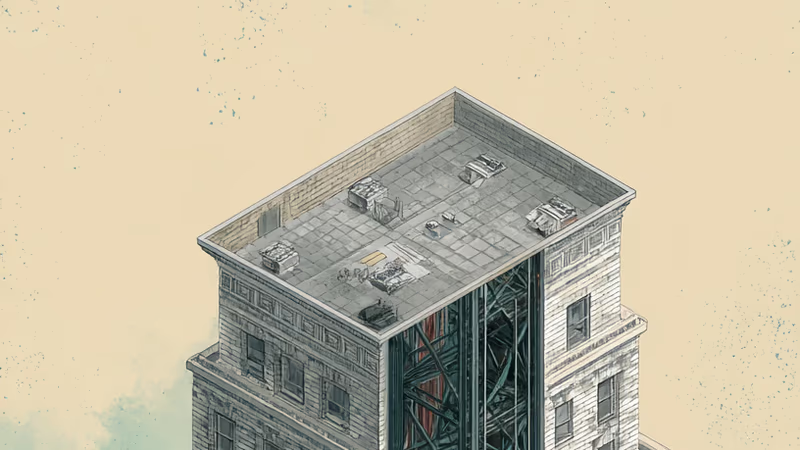
The classic source in a dense city is a rooftop cooling tower: part of a large building’s air-conditioning system, essentially a giant evaporative radiator that throws a plume of warm water vapor into the air. When the water inside is not treated and cleaned on schedule, Legionella colonizes it, and the tower quietly seeds the surrounding blocks. That is why a single neglected building can sicken dozens of people who never set foot inside it. Other sources sit closer to the tenant: hot-water tanks run too cool, decorative fountains, plumbing with dead legs where water stagnates, hot tubs, and misting devices.
Here is the part plaintiffs need to understand. You almost never prove the source yourself; the public-health investigation does. When cases cluster, the health department maps them geographically, pulls water samples from every cooling tower and suspect system in the zone, and runs them for Legionella. The decisive evidence is genetic: laboratories compare the DNA fingerprint of the bacteria in a patient’s lungs against the bacteria pulled from a specific tower. When those match, you have source attribution that a jury can understand and a defendant cannot easily explain away. That matching is the spine of the case.
What a Legionnaires' Plaintiff Has to Prove
Duty. The defendant owned, controlled, or maintained the water system that produced the aerosol.
Breach. They failed to maintain, test, disinfect, or register it as the code and accepted standards required.
Source causation. The bacteria that made you sick came from that system — usually shown by the health department's genetic match and exposure geography.
Damages. Hospitalization, lasting lung or cognitive injury, lost income, and in the worst cases a wrongful-death claim.
Who Can Be Liable
New York abandoned the old common-law categories of invitee, licensee, and trespasser in Basso v. Miller, 40 N.Y.2d 233 (1976). Since then every property owner owes one duty: reasonable care under the circumstances. In a Legionnaires’ case the “circumstances” include a well-known, well-documented, and entirely preventable bacterial risk that the law has regulated in New York City for a decade. That framing matters, because it widens the list of who can end up in the caption.
| Potential Defendant | Typical Theory | What the Case Usually Turns On |
|---|---|---|
| Building owner | Premises liability; failure to maintain and register the cooling tower or water system | Registration status, inspection and testing logs, whether disinfection actually happened after a positive result. |
| Landlord / property manager | Control over the water system; failure to enforce the maintenance program and plan | Who had contractual control and the practical ability to fix it; management-agreement discovery. |
| Hotel / office / gym operator | Negligent operation of hot-water systems, spas, fountains, or misters used by guests and members | Water-temperature records, spa and fountain maintenance, whether the operator knew of prior positives. |
| Water-treatment / HVAC contractor | Negligent servicing; a defective or misapplied treatment program | Service contract scope, chemical-dosing records, and whether the vendor followed ASHRAE 188. |
| Public entity (city, NYCHA, hospital, school) | Negligent operation of a publicly owned water system | The 90-day notice of claim under GML §50-e, plus governmental-immunity defenses. |
Deadlines below apply differently to public and private defendants. Identify the owner early — in a shared or managed building it is rarely obvious.
Two practitioner notes. First, control beats title. The name on the deed is not always the right defendant. In a managed high-rise the party that had the contract, the budget, and the practical ability to service the tower may be a management company or a water-treatment vendor, and discovery into those agreements is not optional. Second, more than one defendant is common: a neglected tower usually reflects failures at several links in the chain, and New York’s joint-and-several rules let you pursue each of them.
One more thing, briefly, because people ask. If you were sickened at your own workplace, you may also have a separate workers’ compensation path. That is its own analysis with its own rules and not the subject of this article; if it applies to you, raise it with a lawyer directly.
The Code Is Your Negligence Case: Local Law 77 and ASHRAE 188
This is where New York City plaintiffs have an advantage that plaintiffs in most of the country do not. After a deadly 2015 outbreak in the South Bronx, the City enacted Local Law 77 of 2015 and built a real regulatory regime around cooling towers. Owners must register each tower with the Department of Buildings, adopt a written maintenance program and plan, and inspect, clean, disinfect, and test the water on a fixed schedule, with records kept for at least three years. The requirements are codified at NYC Administrative Code §17-194.1 and in the Health Department’s rules at Chapter 8 of Title 24 of the Rules of the City of New York. The rules have only tightened since; recent amendments moved routine Legionella sampling to a monthly cadence.
Underneath the local law sits the technical standard the industry uses to run these systems: ANSI/ASHRAE Standard 188, “Legionellosis: Risk Management for Building Water Systems.” ASHRAE 188 is a voluntary consensus standard, but New York’s cooling-tower rules incorporate its core elements, and in litigation it functions as the accepted standard of care. When a defendant’s own water-management vendor ignored the practices ASHRAE 188 spells out, an expert can say so plainly.
Why does an injury lawyer care this much about a building code? Because in New York, a violation of a statute or regulation is generally admissible as some evidence of negligence. Put a registration lapse, a skipped test, or a positive result that was never disinfected next to a hospitalized plaintiff, and the case reframes itself. The documentary trail the code requires becomes the plaintiff’s best evidence. The first things I subpoena are the DOB registration record, the maintenance program and plan, and every inspection and lab result the owner was supposed to keep for three years. What is missing from that file is often as damning as what is in it.
Damages: Why These Are Serious Cases
Legionnaires’ disease is not a bad cold. It is a pneumonia that puts a large share of the people who get it in the hospital, frequently in intensive care, and it kills roughly one in ten diagnosed patients. Survivors can carry lasting lung damage, fatigue, and neurological or cognitive effects for months or years. Older adults, smokers, and people with weakened immune systems fare worst, which is exactly why an outbreak that sweeps through an apartment building or a nursing facility is so dangerous.
In litigation terms, the recoverable damages track that severity:
- Medical expenses, past and future — ICU stays, ventilator care, rehabilitation, and long-term pulmonary follow-up.
- Lost income and lost earning capacity, which can be substantial when recovery takes months.
- Pain, suffering, and loss of enjoyment of life, including the lasting deficits many survivors describe.
- Wrongful death and pecuniary loss where a family member does not survive, brought through the estate under New York’s wrongful-death statute.
The catastrophic cases here resemble the catastrophic injury work we do elsewhere in the practice: they need life-care planning, pulmonary and infectious-disease experts, and an economist. A grandparent who dies after an outbreak and a marathon runner left with permanent lung scarring are worlds apart on damages, and any lawyer who quotes you a number before reading the medical record is guessing.
The Deadlines That End Cases Before They Start
The Two Clocks in a Legionnaires' Case
Private building — generally 3 years
Personal-injury suits against a private owner, landlord, or contractor are generally governed by the three-year statute of limitations in CPLR §214. A wrongful-death claim carries its own two-year clock from the date of death.
Public building — 90 days first
If the source is a city-owned building, a public hospital, NYCHA, or a school, General Municipal Law §50-e requires a sworn notice of claim within 90 days of the injury, long before any lawsuit. Miss it and you are asking a judge for discretionary permission that is never guaranteed.
The discovery-rule wrinkle
Because Legionnaires' is a toxic exposure, CPLR §214-c can matter where the injury or its cause was not immediately apparent, measuring the three years from discovery. Its application is fact-specific — do not rely on it as a safety net.
The illness has a lag built in. Legionella incubates for roughly two to ten days, so people diagnosed in an outbreak were exposed a week or two earlier, and the diagnosis can be missed at first because it looks like ordinary pneumonia. That lag is why source evidence disappears while patients are still hospitalized. By the time a family is well enough to think about a lawyer, the implicated tower has often already been drained, chlorinated, and scrubbed under a health-department order. That remediation is good public health and terrible for proof, which is the central tension in these cases.
What to Do, and What to Preserve, Right Now
1
Get the diagnosis documented
Ask that testing confirm Legionella specifically — a urinary antigen test and, ideally, a respiratory culture. The culture is what later lets a lab compare your strain to a building's.
2
Write down where you were
In the two weeks before you got sick: home, work, gym, hotel, hospital visits, buildings you passed regularly. Exposure geography is how investigators tie you to a source.
3
Report to the health department
Cooperating with the DOH investigation is not just civic duty — it builds the genetic-match record that anchors your claim. Keep your case reference.
4
Don't give recorded statements
A building's insurer may call sounding sympathetic. Decline recorded statements and quick releases until you have counsel.
5
Send preservation letters fast
Maintenance logs, water samples, and lab results can be lost during remediation. A lawyer can demand the building and the health department preserve them before they vanish.
6
Flag any public building
If the likely source is a city, NYCHA, hospital, or school building, the 90-day notice-of-claim clock is already running. Call now: (516) 750-0595.
The preservation piece is the one families never handle on their own, and it is the one that matters most. The moment a tower tests positive, the owner cleans it, which is exactly what public health demands and exactly what destroys the physical evidence. A prompt preservation demand to the owner, the vendor, and where appropriate the health department locks down the sample data, the lab reports, and the maintenance file before they are “lost.” I have seen strong cases weakened because that letter went out three weeks too late.
Free consultation
Diagnosed with Legionnaires' after an outbreak?
The evidence that ties your illness to a specific building disappears when the tower is cleaned. If you or a family member was hospitalized, speak with a lawyer before the maintenance records and water samples are gone.
The Law Office of Jason Tenenbaum, P.C. · Serving Nassau County, Suffolk County, and New York City.
Long Island and NYC: Where These Cases Come From
Cooling towers get the headlines because that is where the big urban outbreaks originate, and the current Upper East Side cluster fits the pattern. But the risk is not only a Manhattan high-rise problem. On Long Island the same bacteria turn up in hotels, hospitals and nursing homes, gyms, apartment complexes, and large office buildings with central water systems. Nassau and Suffolk sit outside the city’s cooling-tower registration regime, but the underlying duty of reasonable care is identical, and state sanitary-code and general negligence principles still govern.
Health-facility cases deserve special mention. When Legionella colonizes a hospital or nursing-home water system, the victims are, by definition, the people least able to survive it, and those cases can overlap with facility-neglect claims; our Long Island nursing home abuse practice handles that intersection. Where the real cause is a defective water-treatment product or a mis-engineered system rather than simple neglect, a product liability theory can run alongside the premises claim.
At bottom, a Legionnaires’ case is a premises case, and the same backbone applies: notice, control, and the failure to fix a known hazard. For the fuller version of how those elements get proven, our guides on proving a New York premises liability case and on avoiding the common premises-liability traps walk through them, and our personal injury practice page explains how we take these cases on.
The same notice-and-control framework governs every premises case, from a contaminated cooling tower to a wet lobby floor; our Long Island slip and fall attorney page shows how it plays out in the most common one.
Sickened by a building's water system? Let's review it.
We investigate the source, send the preservation demands, and identify every liable party and insurance layer. No fee unless we recover for you.
The Law Office of Jason Tenenbaum, P.C. · Serving Nassau County, Suffolk County, and New York City. Licensed in New York State only. This article is informational and not legal advice.
Legal Context
Why This Matters for Your Case
Personal injury law in New York is governed by a complex web of statutes, case law, and procedural rules that differ from most other states. The statute of limitations for most personal injury claims is three years under CPLR 214(5), but claims against municipalities require a Notice of Claim within 90 days. Motor vehicle accident victims must meet the serious injury threshold under Insurance Law §5102(d) before they can recover pain and suffering damages.
The Law Office of Jason Tenenbaum has recovered over $100 million for injured clients across Long Island, Nassau County, Suffolk County, Queens, Brooklyn, Manhattan, and the Bronx. With 24+ years of trial and appellate experience, more than 1,000 appeals written, and 2,600+ published legal articles, Jason Tenenbaum provides the authoritative legal analysis that practitioners and injury victims need to understand their rights.
This article reflects real courtroom experience and a deep understanding of how New York courts actually evaluate personal injury claims — from the initial filing through discovery, summary judgment, trial, and appeal.
Keep Reading
More Premises Liability Analysis
NYC's Pending E-Bike Bills: What They Would Change for People Hurt in a Crash
NYC heard 23 e-bike and delivery bills on September 30, 2026. What each text would change for hurt pedestrians and riders, and the law that applies today.
Oct 21, 2026
New York's Scaffold Law in the 2027 Budget: What Happens If Labor Law 240 Changes, and What Happens If It Doesn't
Labor Law 240 and the 2027 New York budget: what each side argues, the bills on file, and what each possible outcome would change.
Oct 19, 2026
Understanding Uninsured Motorist for Motorcycle Accidents
Learn how uninsured motorist coverage protects NYC motorcyclists when at-fault drivers lack insurance.
Jun 13, 2025
Premises Liability: Property Owners’ Hidden Responsibilities
Premises liability laws establish property owners' responsibility to maintain safe conditions or warn of hazards.
Feb 3, 2025
New York Slip-and-Fall Claims: When Is a Hazard "Open and Obvious"?
"I saw it before I fell" does not automatically end a New York slip-and-fall case — but a new Second Department decision shows exactly.
Sep 3, 2026
Drowsy Driving Accident Settlement Amounts in New York (2024–2026)
How much is a drowsy driving accident settlement worth in New York?
Apr 4, 2026Frequently Asked Questions
Common Questions About This Topic
6 answers from the firm's New York personal-injury and employment-law practice. Click any question to expand.
Can I sue my apartment building for Legionnaires' disease in New York?
Often, yes. If the building's cooling tower, hot-water system, or another water source was the origin of your infection and the owner failed to maintain, test, or disinfect it as the law required, you can bring a premises-liability claim. The strongest cases are the ones where the health department's genetic testing matches the bacteria that made you sick to a specific system and the owner's own records show a maintenance or registration failure. Talk to a lawyer early, because that evidence is time-sensitive.
How do you prove the building made me sick?
Mainly through the public-health investigation. When cases cluster, the health department maps them, samples the cooling towers and water systems in the area, and compares the genetic fingerprint of the *Legionella* in patients against the bacteria found in each system. A DNA match, combined with proof that you were in the exposure zone during the incubation window, is powerful causation evidence. Your medical records confirming a *Legionella* diagnosis, ideally a respiratory culture and not just a urinary antigen test, make that comparison possible.
What is the deadline to sue for Legionnaires' disease in New York?
For a private building owner or contractor, the general personal-injury deadline is three years under CPLR §214, and a wrongful-death claim carries a two-year clock from the date of death. If the source is a public building (a city agency, NYCHA, a public hospital, or a school), you must serve a notice of claim within 90 days under General Municipal Law §50-e, well before any lawsuit. Because a toxic-exposure discovery rule (CPLR §214-c) can also come into play, and the rules differ by defendant, confirm your specific deadline with a lawyer rather than assuming.
What if the building already cleaned the cooling tower?
That is common, and it is not the end of your case, but it makes speed critical. Once a tower tests positive, the owner is ordered to disinfect it, which removes the physical bacteria. What survives is the record: the lab results, the maintenance and inspection logs, the health department's genetic-match data, and your own medical results. A prompt preservation demand keeps those from being discarded, which is why calling a lawyer while you are still recovering matters.
Who is responsible — the owner, the manager, or the maintenance company?
Potentially all of them. New York's reasonable-care standard reaches whoever owned or controlled the water system and whoever was contractually responsible for maintaining it. In a large managed building that can mean the owner, a property-management company, and an outside water-treatment or HVAC vendor at the same time. Sorting out who had control and who dropped the ball is what discovery is for, and New York law lets you pursue more than one defendant.
How much is a Legionnaires' disease lawsuit worth?
There is no honest universal figure. Value depends on how sick you got, whether there is permanent lung or cognitive damage, your age and lost income, and, above all, the strength of the source evidence and the insurance available. A hospitalization that fully resolves and a fatal outbreak in a nursing home occupy completely different ranges. Any responsible answer comes only after reviewing the medical records and the investigation file. A free consultation at (516) 750-0595 will get you a fact-specific read. --- New York Premises Liability — Keep Reading Proof Proving a Premises Liability Case Notice, control, and constructive knowledge — the evidentiary backbone every premises case shares, outbreaks included. Pitfalls Premises Liability Traps to Avoid The mistakes that quietly sink otherwise-winnable New York premises cases. Practice Page Long Island Premises Liability How we investigate and litigate injury claims against property owners across Nassau and Suffolk. A Legionnaires' diagnosis starts two clocks at once: the medical one and the evidentiary one. The Law Office of Jason Tenenbaum, P.C. handles personal injury and premises claims throughout Nassau County, Suffolk County, and the five boroughs. Consultations are free, and there is no fee unless we recover. If you or someone in your family was hospitalized after an outbreak, call before the building's records are gone. Talk to a New York injury attorney Sickened by a building's water system? Let's review it. We investigate the source, send the preservation demands, and identify every liable party and insurance layer. No fee unless we recover for you. Start your free case review → Call (516) 750-0595 The Law Office of Jason Tenenbaum, P.C. · Serving Nassau County, Suffolk County, and New York City. Licensed in New York State only. This article is informational and not legal advice.
Was this article helpful?
Disclaimer: This article is published by the Law Office of Jason Tenenbaum, P.C. for informational and educational purposes only. It does not constitute legal advice, and no attorney-client relationship is formed by reading this content. The legal principles discussed may not apply to your specific situation, and the law may have changed since this article was last updated.
New York law varies by jurisdiction — court decisions in one Appellate Division department may not be followed in another, and local court rules in Nassau County Supreme Court differ from those in Suffolk County Supreme Court, Kings County Civil Court, or Queens County Supreme Court. The Appellate Division, Second Department (which covers Long Island, Brooklyn, Queens, and Staten Island) and the Appellate Term (which hears appeals from lower courts) each have distinct procedural requirements and precedents that affect litigation strategy.
If you need legal help with a premises liability matter, contact our office at (516) 750-0595 for a free consultation. We serve clients throughout Long Island (Huntington, Babylon, Islip, Brookhaven, Smithtown, Riverhead, Southampton, East Hampton), Nassau County (Hempstead, Garden City, Mineola, Great Neck, Manhasset, Freeport, Long Beach, Rockville Centre, Valley Stream, Westbury, Hicksville, Massapequa), Suffolk County (Hauppauge, Deer Park, Bay Shore, Central Islip, Patchogue, Brentwood), Queens, Brooklyn, Manhattan, the Bronx, Staten Island, and Westchester County. Prior results do not guarantee a similar outcome.