
Key Takeaway
When the other driver disputes fault in a New York car accident, the case is built on evidence — cameras, reconstruction, witnesses.
This article is part of our ongoing personal injury coverage, with 183 published articles analyzing personal injury issues across New York State. Attorney Jason Tenenbaum brings 24+ years of hands-on experience to this analysis, drawing from his work on more than 1,000 appeals, over 100,000 no-fault cases, and recovery of over $100 million for clients throughout Nassau County, Suffolk County, Queens, Brooklyn, Manhattan, and the Bronx. For personalized legal advice about how these principles apply to your specific situation, contact our Long Island office at (516) 750-0595 for a free consultation.
After a car accident on Long Island or anywhere in New York, the other driver may tell a very different story about what happened. Their insurer may call you and suggest you were at fault — or partially at fault. This situation is more common than most people realize, and it does not automatically mean your claim is worthless.
Understanding how fault is determined, what New York’s comparative negligence rules mean for your recovery, and what steps you can take to protect your claim is critical in the days and weeks after any disputed crash.
How Fault Is Determined in a New York Car Accident
Fault in a car accident comes down to negligence — who failed to exercise reasonable care while operating their vehicle. New York law imposes a duty on every driver to operate their vehicle safely and to follow the rules of the road. When a driver breaches that duty and causes a collision, they are liable for the resulting injuries and damages.
Fault is established through evidence. The most important sources of evidence in disputed-fault cases include:
Free Consultation · No Fee Unless We Win
Does this apply to your situation?
Every case is different. Get a free, confidential case review from an experienced attorney who can tell you exactly where you stand.
Police reports. When officers respond to the scene, they gather statements from all involved drivers and any witnesses, note physical evidence (skid marks, final rest positions of vehicles, debris), and issue violations if warranted. The report includes a diagram and often a “contributing factor” notation. While police reports are valuable, they are not the final word on fault (more on this below).
Witness statements. Independent witnesses — pedestrians, bystanders, passengers in other vehicles — carry significant weight because they have no financial stake in the outcome. Getting witness contact information at the scene is one of the most important things you can do.
Photographs. Photos of vehicle damage, the collision location, skid marks, traffic signals, road conditions, and your injuries tell a factual story that is difficult to dispute. Time-stamped photos taken immediately after a crash preserve evidence that may be gone within hours.
Traffic camera footage. Many intersections in Nassau and Suffolk County are monitored by municipal traffic cameras. Convenience stores, banks, and businesses near the crash site may also have exterior security cameras. This footage may capture the accident itself and is often overwritten within 30 to 60 days. Your attorney must act quickly to send a preservation letter before it is gone.
Dashcam video. Dashcam footage from your vehicle or from another car nearby can resolve disputed-fault cases in minutes. If you have a dashcam, preserve the footage immediately. Do not record over it.
Accident reconstruction. In serious cases involving significant injuries, an accident reconstructionist can analyze the physical evidence — crush damage patterns, point of impact, vehicle trajectories, airbag control module (black box) data — to determine how the crash occurred and which driver was responsible. This type of expert testimony can be powerful at trial.
New York’s Pure Comparative Negligence Rule
New York follows a rule called pure comparative negligence, codified in CPLR Article 14-A. Under this rule, your ability to recover compensation is not eliminated simply because you bear some share of fault for the accident.
Here is what pure comparative negligence means in practice: your total recovery is reduced by your percentage of fault. If you were 20% at fault and the other driver was 80% at fault, you can recover 80% of your proven damages. If you were 50% at fault, you can recover 50%.
New York’s rule is called “pure” because it applies no matter how high your percentage of fault is. Even if you are found 99% responsible for a crash, you can still recover 1% of your damages from the other party. Many states cut off recovery entirely once the plaintiff’s fault exceeds 50% or 51%. New York does not.
Active legislative update (April 2026): Governor Hochul is pushing to amend CPLR §1411 in the 2026-2027 budget to add a 50% bar — moving New York into the same camp as roughly 35 modified-comparative-negligence states. A separate proposal would limit joint-and-several liability for deep-pocket defendants who are less than 50% at fault. Both reforms would apply prospectively to accidents occurring after the effective date. For full analysis of what the proposed reforms would change for marginal-fault, innocent-passenger, and rideshare scenarios, see our breakdown of Hochul’s 2026 tort reform package.
This means that if another driver contributed to your accident at all — even in a minor way — you may have a viable claim. Do not assume a partial-fault situation means no compensation.
At trial, the jury receives a special verdict form that asks them to apportion fault among all parties. The court then applies the percentages to the damages award. Comparative fault can also be allocated among multiple defendants — for example, a negligent driver and a municipality responsible for a defective traffic signal.
Common Disputed Fault Scenarios
Red light vs. green light disputes. Both drivers claim they had the green. Without a witness or camera footage, this becomes a credibility contest. Physical evidence (vehicle damage patterns, entry speeds, skid marks) and witness testimony become critical.
Left turn vs. speeding disputes. A driver making a left turn was hit by an oncoming vehicle. The left-turner says they had a clear gap; the oncoming driver says they had the right of way. The oncoming driver may allege that the left-turner cut them off; the left-turner may argue the other driver was speeding. Speed can be reconstructed through physical evidence and black-box data.
Merging lane disputes. A driver merging from an on-ramp or changing lanes strikes another vehicle. Each driver claims the other was in their lane or failed to yield. Dashcam footage from either vehicle or nearby traffic cameras is often dispositive.
Rear-end with sudden stop. Rear-end collisions are presumptively the fault of the following driver in New York under the “rear-end doctrine,” but this presumption can be rebutted if the lead driver stopped suddenly without justification. The following driver may claim a sudden, inexplicable stop; the lead driver denies it. Witness statements and dashcam footage often resolve these cases.
Why Police Reports Are Not Determinative
Many accident victims assume the police report settles the question of fault. It does not.
Police officers responding to a crash rarely witness the accident itself. They arrive after the fact and gather information from parties who each have a reason to tell the story favorably. The officer’s notations about “contributing factors” or their decision to issue a violation are opinions based on available information at that moment — they are not binding legal findings.
Courts treat police reports as admissible evidence, but they are not conclusive. The fault conclusion in a police report can be challenged with independent evidence, witness testimony, and expert analysis. An accident reconstructionist’s analysis of the physical evidence may directly contradict what the responding officer wrote. Juries are instructed to weigh all evidence and are not required to defer to the officer’s opinion.
If you believe a police report incorrectly describes what happened, contact a car accident attorney immediately. An attorney can investigate, gather evidence, and challenge the report’s conclusions through the litigation process.
What to Do When the Other Driver Disputes Fault
The steps you take in the hours and days after a disputed crash significantly affect your ability to recover.
Get all witness contact information at the scene. Do not leave until you have the name and phone number of every witness who stopped. Independent witness testimony is among the most valuable evidence in disputed-liability cases.
Photograph everything. Document all vehicle damage from multiple angles, the final positions of both vehicles, skid marks, road conditions, traffic control devices, and any visible injuries. Photograph the other driver’s license plate and insurance card.
Preserve dashcam footage. If your vehicle is equipped with a dashcam, remove the memory card and store it safely as soon as possible. Do not drive the car with the dashcam recording over existing footage.
Order the police report and review it carefully. You can obtain the accident report from the responding police department. Read it thoroughly. Note whether any facts are incorrect, whether witnesses were identified, and what contributing factors were recorded. Share any errors with your attorney.
Do not give a recorded statement to the other driver’s insurer. This is critical. The other driver’s insurance company is not on your side. Their adjuster will contact you quickly, often within 24 hours, and may seem friendly and reasonable. They may tell you the recorded statement is routine. It is not. Anything you say can and will be used to minimize or deny your claim. You have no legal obligation to give a recorded statement to the adverse insurer. Politely decline and direct them to your attorney.
No-Fault Benefits Are Paid Regardless of Fault
New York’s no-fault insurance system, established under Insurance Law Article 51, covers your medical bills and lost wages regardless of who caused the accident. Your own insurance company pays Personal Injury Protection (PIP) benefits — up to $50,000 in medical expenses and 80% of lost wages (capped at $2,000 per month) — without any finding of fault.
This means that even if the other driver disputes fault and the liability question is unresolved, you can and should apply for no-fault benefits immediately. Your insurer cannot deny your no-fault application simply because fault is in dispute. The no-fault system exists precisely to ensure that injured accident victims receive prompt medical treatment and wage replacement while the fault question is sorted out through the liability process.
The distinction matters: no-fault covers economic losses (bills and wages). Recovering for pain and suffering, permanent injury, or losses exceeding the no-fault caps requires proving the other driver’s fault through a third-party liability claim or lawsuit. But do not delay your medical treatment or your no-fault application while waiting for the fault question to resolve.
How Disputed-Fault Cases Are Investigated
When liability is in dispute, a thorough investigation becomes essential.
Your insurance company will conduct its own liability investigation. But your attorney can conduct an independent investigation that may be far more comprehensive. This includes:
Hiring a private investigator to interview witnesses, canvass the area for surveillance cameras, and preserve evidence.
Retaining an accident reconstructionist to analyze vehicle damage, point of impact, vehicle trajectories, and any available electronic data from the vehicles’ event data recorders (black boxes). Modern vehicles store pre-crash speed, braking input, steering input, and seatbelt status data in their EDR systems. This data can be extracted and used to reconstruct the sequence of events.
Obtaining traffic camera and security camera footage through preservation letters sent immediately after the accident. Footage is often overwritten quickly, so this step cannot wait.
Subpoenaing cell phone records in cases where distracted driving is suspected. Cell carrier records can confirm whether the other driver was on the phone or texting at the time of the crash.
Reviewing social media for statements or admissions by the other driver about the accident or their driving behavior.
What Happens If the Insurer Denies Liability
If the other driver’s insurer investigates and concludes their insured was not at fault, they will deny your claim. At that point, you have two main options: file suit or pursue uninsured/underinsured motorist coverage if available.
When you file suit, the question of fault goes to a jury. Under New York’s pure comparative negligence system, the jury allocates fault percentages among all parties. Your attorney presents your evidence; the defendant presents theirs. The jury decides. If the jury finds the defendant was even partially responsible, you recover that percentage of your proven damages.
Juries in Nassau and Suffolk County see disputed-liability car accident cases regularly. An experienced attorney who knows these courtrooms, the common defense tactics used by insurance carriers, and the range of settlements and verdicts in the local market is invaluable in these situations.
Protecting Your Claim From the Start
Disputed fault does not mean no recovery. New York’s pure comparative negligence rule ensures that even partial fault on another driver’s part — even if you bear significant fault yourself — translates into a proportionate recovery.
The keys are evidence preservation and prompt legal representation. Evidence disappears quickly after a crash. Traffic camera footage gets overwritten. Witnesses move on and forget details. Physical evidence at the scene is altered by weather, road crews, and other traffic. The sooner you engage an attorney, the sooner that evidence can be secured.
If the other driver is disputing fault after your Long Island car accident, contact our office to discuss what evidence exists, what your claim may be worth, and how to proceed. We handle disputed-liability cases across Nassau and Suffolk County courts and work on a contingency basis — you pay nothing unless we recover for you.
For a full overview of the car accident claim process in New York, visit our Long Island car accident lawyer page.
May 2026 Practitioner Update — The Evidence Playbook Has Gotten Better, Not Worse
Disputed-liability cases are the case category where the 2024-2026 explosion of consumer-grade and vehicle-grade camera coverage has changed practitioner economics the most. Five years ago a disputed-fault sideswipe was a coin-flip case at best. In 2026 the same case usually has at least one camera angle — Tesla 8-camera coverage on one or both vehicles, a $40 dashcam in a passing car, a Ring camera on a nearby residence, a gas-station security feed, or Nassau or Suffolk DOT traffic cameras. The case-building exercise increasingly turns on which footage actually exists and how fast preservation letters go out.
First 24 hours
In-vehicle camera coverage
Tesla vehicles record continuously to onboard storage. Modern dashcams overwrite in 24-72 hours. Pull every USB stick or SD card before the loop overwrites the relevant footage.
First 48-72 hours
Commercial camera footage
Gas stations, banks, fast-food drive-throughs, parking lots — typical retention is 24-72 hours, occasionally up to 30 days. A preservation letter from counsel must go out promptly.
First 30-60 days
Municipal traffic cameras
Nassau and Suffolk DOT, NYC DOT, NYSP — varied retention windows, typically 30-60 days. FOIL request or subpoena required; lead time can be 2-3 weeks.
Anytime
Telematics + ECM data
Modern vehicles store crash-mode telemetry (speed, brake application, steering input, airbag deployment timing) in the event-data recorder. Preserve through CDR imaging before vehicles go to salvage.
Editor’s note (May 13, 2026): Disputed-liability case strategy in New York continues to evolve as vehicle and consumer camera coverage expands. The pending Hochul-era comparative-negligence reform covered in our tort-reform analysis would make the camera evidence more decisive — pushing more cases to clean-fault verdicts and fewer to the 50-50 settlement zone. Nothing in this article is legal advice. For your specific case, call (516) 750-0595.
Related Reading
- Hochul’s 2026 Tort Reform Push — 50% Bar + Joint-and-Several Liability Changes
- Comparative fault in New York car accident cases
- What to do in the first 24 hours after a car accident on Long Island
- Long Island car accident lawyer — practice page
- Negligent entrustment accident settlements in New York
- Car accident recorded statement in New York — should you give one?
- What to wear to court — the complete guide for testifying litigants (witness credibility on disputed-fault cases turns substantially on courtroom presentation)
Legal Context
Why This Matters for Your Case
Personal injury law in New York is governed by a complex web of statutes, case law, and procedural rules that differ from most other states. The statute of limitations for most personal injury claims is three years under CPLR 214(5), but claims against municipalities require a Notice of Claim within 90 days. Motor vehicle accident victims must meet the serious injury threshold under Insurance Law §5102(d) before they can recover pain and suffering damages.
The Law Office of Jason Tenenbaum has recovered over $100 million for injured clients across Long Island, Nassau County, Suffolk County, Queens, Brooklyn, Manhattan, and the Bronx. With 24+ years of trial and appellate experience, more than 1,000 appeals written, and 2,600+ published legal articles, Jason Tenenbaum provides the authoritative legal analysis that practitioners and injury victims need to understand their rights.
This article reflects real courtroom experience and a deep understanding of how New York courts actually evaluate personal injury claims — from the initial filing through discovery, summary judgment, trial, and appeal.
About This Topic
New York Personal Injury Law
When negligence causes serious injury, New York law entitles victims to compensation for medical bills, lost income, pain and suffering, and more. From car accidents and slip-and-falls to construction injuries and medical malpractice, the Law Office of Jason Tenenbaum has recovered over $100 million for injured Long Islanders and New Yorkers since 2002.
183 published articles in Personal Injury
Keep Reading
More Personal Injury Analysis
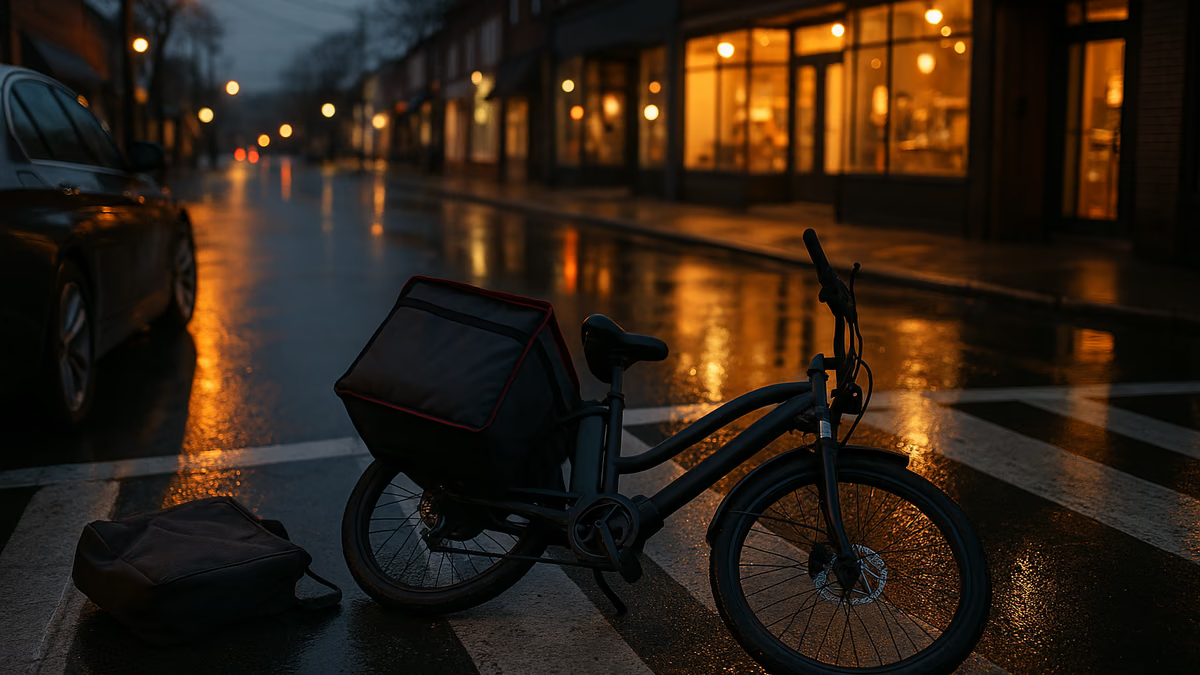
Hit by an Illegal E-Moto in New York? Who Pays When It Was Sold as an E-Bike
A device sold as an e-bike that exceeds New York's limits is a motor vehicle. Who pays the person it hits, what the seller faces, and what the owner risks.
Oct 25, 2026NYC's Pending E-Bike Bills: What They Would Change for People Hurt in a Crash
NYC heard 23 e-bike and delivery bills on September 30, 2026. What each text would change for hurt pedestrians and riders, and the law that applies today.
Oct 21, 2026
Speeding Accident Settlement in New York: What Your Case Is Worth
If you were injured by a speeding driver in New York, your case may be worth more than you think.
Apr 4, 2026
Ozempic Lawsuits
Learn about Ozempic lawsuit claims, side effects, and legal options. Get help with your Ozempic injury case from experienced attorneys.
Mar 3, 2025
NY Archdiocese $800 Million Settlement: A Clergy Abuse Lawyer's Guide for Survivors
The proposed $800 million New York Archdiocese settlement, announced May 1, 2026, covers about 1,300 Child Victims Act claimants and is not final.
May 3, 2026
Health Insurance Liens on New York Car Accident Settlements: ERISA, Commercial Plans, and Medicare
When health insurance pays for your car accident treatment in New York, the insurer may have a lien on your settlement.
Apr 4, 2026Was this article helpful?
Disclaimer: This article is published by the Law Office of Jason Tenenbaum, P.C. for informational and educational purposes only. It does not constitute legal advice, and no attorney-client relationship is formed by reading this content. The legal principles discussed may not apply to your specific situation, and the law may have changed since this article was last updated.
New York law varies by jurisdiction — court decisions in one Appellate Division department may not be followed in another, and local court rules in Nassau County Supreme Court differ from those in Suffolk County Supreme Court, Kings County Civil Court, or Queens County Supreme Court. The Appellate Division, Second Department (which covers Long Island, Brooklyn, Queens, and Staten Island) and the Appellate Term (which hears appeals from lower courts) each have distinct procedural requirements and precedents that affect litigation strategy.
If you need legal help with a personal injury matter, contact our office at (516) 750-0595 for a free consultation. We serve clients throughout Long Island (Huntington, Babylon, Islip, Brookhaven, Smithtown, Riverhead, Southampton, East Hampton), Nassau County (Hempstead, Garden City, Mineola, Great Neck, Manhasset, Freeport, Long Beach, Rockville Centre, Valley Stream, Westbury, Hicksville, Massapequa), Suffolk County (Hauppauge, Deer Park, Bay Shore, Central Islip, Patchogue, Brentwood), Queens, Brooklyn, Manhattan, the Bronx, Staten Island, and Westchester County. Prior results do not guarantee a similar outcome.