Why Trust This Analysis
This article is part of our ongoing legal news coverage, with 22 published articles analyzing legal news issues across New York State. Attorney Jason Tenenbaum brings 24+ years of hands-on experience to this analysis, drawing from his work on more than 1,000 appeals, over 100,000 no-fault cases, and recovery of over $100 million for clients throughout Nassau County, Suffolk County, Queens, Brooklyn, Manhattan, and the Bronx. For personalized legal advice about how these principles apply to your specific situation, contact our Long Island office at (516) 750-0595 for a free consultation.
This article was published July 30, 2025. Corrected October 14, 2026: earlier versions dated the F.E. Warren Air Force Base airman's death to July 2024 and said the Air Force inspected 113,479 M18 pistols. The airman died on July 20, 2025; Air Force Global Strike Command inspected its 7,970 M18s, and the 113,479 figure is the Department of War's inspection count as Sig Sauer reports it. The text below states the facts as verified.
Last reviewed: October 2026.
Key Takeaways (updated October 14, 2026)
- The Sig Sauer P320 is the pistol at the center of the uncommanded-discharge litigation: 150+ alleged unintentional discharges and, by plaintiffs’ counsel’s count, 125+ claimants from 45 states.
- The verdict record is now split. Plaintiffs won in Georgia ($2.35M, Lang, 2024; Sig Sauer’s appeal is still pending in the Eleventh Circuit) and Philadelphia (Abrahams, November 2024, but the $10M punitive award was vacated in June 2025, leaving $1M). Sig Sauer won a defense verdict in Maine on August 7, 2026 (Cole), the first jury rejection of the holstered-discharge theory; the Coles moved for a new trial on September 8, 2026.
- A Massachusetts jury found the P320 defectively designed in July 2025 (Desrosiers) but awarded $0 because the officer kept carrying it knowing of the defect.
- The Missouri consumer class action was thrown out on July 16, 2026: the Eighth Circuit held a buyer whose pistol never misfired has no standing (Glasscock).
- New York matters most for our readers: on May 28, 2026 the Second Circuit revived Colwell v. Sig Sauer, a Troy police sergeant’s holster-discharge case, holding a New York jury may find a design defect without expert causation testimony. Trial is set for November 16, 2026 in Albany.
- The P365 now has its own cases. In Harvard v. Sig Sauer (N.D. Ga.) a federal judge refused on August 7, 2026 to dismiss a P365X design-defect claim on Second Amendment grounds, at the pleading stage. A holstered-P365 suit was filed in Orlando federal court in July 2026.
- No recall, no MDL. The Judicial Panel on Multidistrict Litigation’s October 1, 2026 list of pending MDLs includes no P320 or P365 docket. New Hampshire (Sig Sauer’s home state) passed a 2025 law barring defect claims based on the absence of an external safety; New York has no such law.
- These cases are won or lost on the pistol itself. Courts have thrown out P320 claims where the plaintiff’s experts did not test the actual pistol or could not say what touched the trigger. If yours fired on its own, preserve the evidence before anything else.
- New York statute of limitations: 3 years from injury under CPLR §214; 2 years for wrongful death under EPTL §5-4.1.
- If you were injured by a P320 that fired without a trigger pull, you may qualify for a product liability claim. Free consultation: (516) 750-0595.
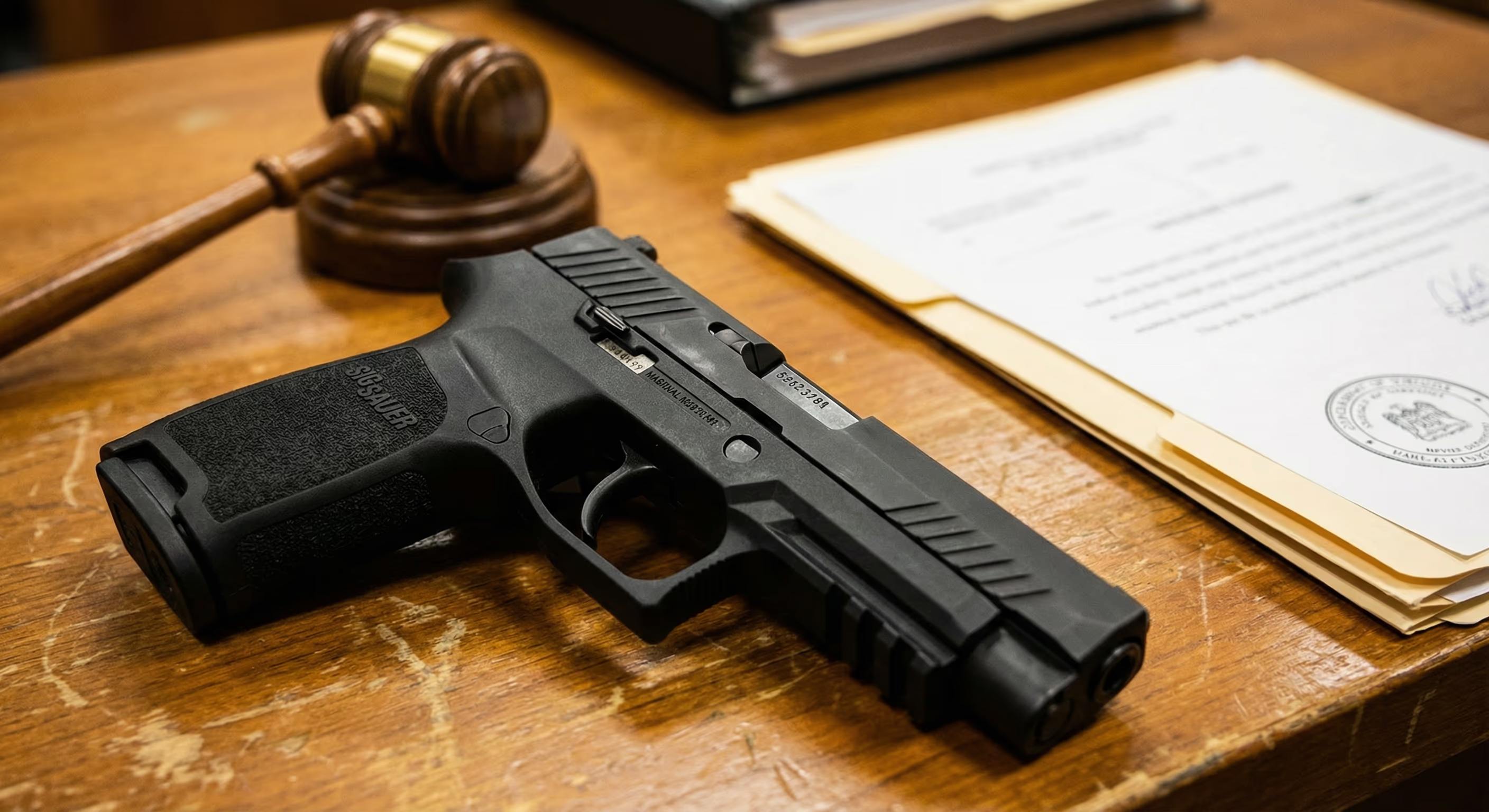
If you own a Sig Sauer P320 and it fired without a trigger pull, you may be entitled to compensation. A Philadelphia jury awarded $11 million to a U.S. Army veteran whose holstered P320 discharged, an award the trial court later cut to $1 million by vacating the punitive damages, and more than 125 people have since brought similar claims. Juries have now gone both ways: Georgia, Philadelphia and a Massachusetts jury found the design defective; New Hampshire (2022) and Maine (August 2026) juries sided with Sig Sauer. Here is what a New York owner needs to know.
Which Sig Sauer misfires? The P320
The Sig Sauer P320 is the model at the center of the uncommanded-discharge lawsuits: the striker-fired pistol (and its X-Series variants) that owners say has fired while holstered, when dropped, or when bumped, with no finger on the trigger. That is what “misfire without a trigger pull” means in these cases: not a dud round or a jam, but a live discharge with the trigger untouched. A Philadelphia jury awarded $11 million on exactly that theory in Abrahams v. Sig Sauer (November 2024), and more than 120 similar federal suits are pending.
Free Consultation · No Fee Unless We Win
Does this apply to your situation?
Every case is different. Get a free, confidential case review from an experienced attorney who can tell you exactly where you stand.
As of September 2026, more than 150 people have alleged the P320 fired without a trigger pull, and plaintiffs’ counsel count 125+ claimants across 45 states. The verdict record is split: plaintiffs’ verdicts in Georgia ($2.35M, 2024, on appeal) and Philadelphia (2024, reduced from $11M to $1M in June 2025), a Massachusetts defect finding with no damages (July 2025), and defense verdicts in New Hampshire (2022) and Maine (August 7, 2026). The Missouri consumer class certified in 2025 was vacated on appeal in July 2026. The civilian P320 lacks the external thumb safety found on the military M17/M18 (the design choice at the heart of every one of these cases), and for New York owners the case to watch is Colwell v. Sig Sauer, revived by the Second Circuit in May 2026 and set for trial in Albany on November 16, 2026.
P320 Misfire Defect: When Safety Mechanisms Fail
Firearms should protect and empower people who use them. But sometimes a trusted gun like the Sig Sauer P320 fires without warning. That happened to U.S. Army veteran George Abrahams. A jury in Philadelphia just handed him $11 million after his holstered pistol shot through his thigh, leaving permanent damage. It’s a harsh lesson in how small manufacturing slips can wreck lives. According to an AP report, the suit alleged the gun fired without the trigger being pulled.
This verdict follows a $2.35 million award in Georgia earlier this year, a verdict the trial judge upheld in February 2025 by denying Sig Sauer’s request for a new trial; Sig Sauer’s appeal to the Eleventh Circuit is still pending. Both cases spotlight problems with Sig Sauer’s popular handgun. Plaintiffs say it discharges accidentally, even though the company insists on tough safety tests. And these aren’t isolated events; they highlight key ideas in product liability. Defects or weak safeguards put users at risk. People often need sharp lawyers to fight back and win justice.
The Law Office of Jason Tenenbaum, P.C. handles tough personal injury and product liability cases like these. The firm holds manufacturers responsible. Call (516) 750-0595 to talk about what happened to you.
What makes a case like this so compelling? It shows how everyday items can turn deadly. Abrahams thought his gun was safe. Then it wasn’t.
P320 Fires Without Trigger: What Really Happened
Picture this: George Abrahams heads down some stairs. His Sig Sauer P320 sits holstered in his athletic pants pocket. Suddenly, the gun fires on its own. The bullet rips through his right thigh and comes out above the knee.
Court records paint a grim picture. This random shot caused lasting harm. A simple walk turned into a nightmare, exposing what critics call design flaws in the pistol.
Misfires aren’t like other gun problems: no jams or stuck casings here. This means the gun goes off without anyone pulling the trigger on purpose. Movement or pressure might set it off. That’s different from mistakes users make. The issue of potential accidental discharge has been a point of contention for the Sig Sauer P320.
Sig Sauer fights back hard. Company reps call the P320 one of the most dependable handguns out there. They pointed fingers at Abrahams’ handling. But the jury didn’t buy it. They ruled Sig Sauer sold a faulty product and holster, plain and simple.
Details on any settlement beyond the verdict? Scarce so far. Yet this case echoes more than 120 similar complaints across the country. People demand recalls and fixes. Sig Sauer plans to appeal, of course.
It’s frustrating, isn’t it? A company stands by its product, but juries keep siding with victims. Makes you wonder about trust in big manufacturers.
One short note: These incidents often start small. A bump, a twist, and boom. Life changes forever.
Injured by a firearm that discharged without a trigger pull? You may have a defective product claim. The Law Office of Jason Tenenbaum, P.C. fights for victims of dangerous firearms and other defective products. Call (516) 750-0595 for a free consultation.
Can You Sue Sig Sauer? Product Liability Basics
Product liability laws protect consumers. They make manufacturers pay when defective goods hurt people. In many places, strict liability applies. That means victims just prove the product was dangerously flawed and caused the injury. No need to dig into the company’s mistakes or intentions.
Three main ways to claim liability stand out. First, manufacturing defects. That’s when a product comes off the line wrong, not matching the plans. Second, design defects. Here, the blueprint itself has problems, making the item unsafe no matter how well it’s built.
Third? Failure to warn. Companies skip proper labels or instructions about risks they know about.
Firearms get tricky. Courts see them as inherently risky; you can’t make a gun completely safe. Still, laws apply. Judges look closely at safety features. Take the P320: Military versions have external safeties. Civilian ones don’t. That gap raises questions about preventing accidents.
Plaintiffs carry the proof load. They show the defect was there from the factory and directly led to the harm. With guns, defendants might argue users knew the risks. Assumption of risk comes up a lot.
But here’s a twist: even with that defense, strong evidence wins out. Experts help a ton. They dissect designs, test failures, and explain to juries why something went wrong.
Think about it: Why do some guns have more safeties than others? Cost-cutting? Oversight? Cases like Abrahams’ force answers.
Expanding on this, let’s consider how these laws play out in real life. Say someone buys a car with bad brakes. The maker knew but didn’t fix it. Liability kicks in. Same with guns. If a design invites accidents, courts step up.
And product recalls? They happen when patterns emerge. The Sig Sauer issues have sparked talks of one. But companies drag their feet. Victims push through lawsuits to force change.
A quick aside (because it’s worth noting): Not every defect is obvious. Some hide in plain sight, like a trigger too sensitive to jostling.
Sig Sauer Settlement Amounts and Compensation
Shifting gears a bit, what about compensation? Verdicts like $11 million cover medical bills, lost wages, pain. But they also send messages. Manufacturers notice big payouts. They rethink designs.
Of course, not all cases win. Juries weigh evidence carefully. Plaintiffs need solid stories, backed by facts. Weak links break chains.
Still, progress happens. Laws evolve with technology. New gun designs incorporate better tech, such as biometric locks or smarter triggers. But until then, incidents like this remind everyone to stay vigilant.
One more thing: States differ on these laws. Some lean strict, others require more proof of negligence. Know your local rules. It matters.
Wrapping back to Abrahams: his win builds on others. It pressures Sig Sauer. More suits could follow, each chipping away at denials.
Deeper Dive into Firearm Liability
Firearms aren’t just any product. Their dangers demand extra care from makers. Yet slip-ups occur. The P320 saga illustrates that.
Critics point to the lack of a manual safety in civilian models. Soldiers get one; why not everyone? Sig Sauer says the gun’s internal mechanisms suffice. Juries disagree.
Expert witnesses play key roles. They test guns, recreate scenarios. In Abrahams’ trial, they likely showed how a holstered pistol could fire from impact or movement.
And the holster? Sig Sauer sold it too. If it didn’t secure the gun properly, that’s another defect layer.
Broader picture: Over 120 lawsuits allege similar misfires. Some settled quietly. Others head to court. Patterns like this often lead to class actions or mass torts.
What drives these claims? Partly, the P320’s popularity. Law enforcement uses it widely. When issues hit pros, civilians take note.
Sig Sauer upgraded the design in 2017, adding a trigger pull upgrade program. Voluntary, though. Not everyone participated. Questions linger: Was it enough?
A mild contradiction here: the company touts safety, yet pays out millions. Actions speak louder.
For gun owners, this raises practical tips. Inspect gear regularly. Choose holsters that fit snugly. Train properly. But even then, defects lurk.
Legal side: File claims quickly. Statutes of limitations apply. Evidence fades.
The Law Office of Jason Tenenbaum, P.C. guides clients through this maze. The firm gathers experts, builds cases, fights for fair outcomes. Reach out at (516) 750-0595.
Timeline: The Sig Sauer P320 Crisis
The P320’s problems didn’t start overnight. Here is a timeline of incidents, lawsuits, and responses stretching back nearly a decade.
January 2014
P320 Enters the Market
Sig Sauer launches the P320, a modular striker-fired pistol with no external manual safety. It is marketed to civilians, law enforcement, and military worldwide.
January 2017
U.S. Army Awards $580M MHS Contract
The U.S. Army selects the P320-based M17/M18 as its Modular Handgun System, replacing the Beretta M9. The military version includes an external thumb safety not found on civilian models.
August 2017
Drop-Test Failures Go Viral
Independent testers post video of a brand-new P320 discharging twice in three drops when landed on its beavertail at a 30-degree angle. Sig Sauer's own internal testing of 11 models confirms the weakness. Dallas Police suspends P320 duty carry. Sig announces a "Voluntary Upgrade Program" adding six new trigger group components from the M17 design.
2018
First Class-Action Lawsuit Filed
David Hartley files a class-action suit in Missouri alleging the P320 can fire when the slide and barrel are misaligned. The case settles by 2020 with no admission of fault.
2019
Virginia Deputy Sues for $10 Million
Deputy Marcie Vadnais sues Sig Sauer after her holstered P320 allegedly fires into her leg without a trigger pull. The case settles for an undisclosed amount.
January - July 2020
Milwaukee PD: 8 Discharges in 7 Months
Milwaukee Police Department documents eight P320 accidental discharges among officers. In July, an officer's holstered P320 fires and strikes his partner in the knee.
June 2020
George Abrahams Injured in Philadelphia
U.S. Army veteran George Abrahams is walking down stairs when his holstered P320, sitting in his pants pocket, fires. The bullet rips through his right thigh and exits above his knee, causing permanent damage.
November 2020
Canadian Special Forces Soldier Wounded
A Joint Task Force 2 operator in Canada is wounded during range training when a P320 (designated C22) fires unexpectedly. An investigation concludes it was an "unpredictable accident."
2023
100+ Lawsuits Filed Nationwide
More than 100 civilians and law enforcement officers have sued Sig Sauer. At least 80 people wounded between 2016 and 2023. The Philadelphia firm Saltz Mongeluzzi & Bendesky alone represents approximately 100 plaintiffs.
June 2024
Georgia Jury Awards $2.35 Million
Robert Bryan Lang wins a $2.35 million verdict after his holstered P320 fires into his body. First significant jury verdict against Sig Sauer in a P320 case.
November 2024
$11 Million Verdict: Abrahams v. Sig Sauer
A Philadelphia jury awards $11 million ($10M punitive, $1M compensatory), finding Sig Sauer negligent and reckless. Evidence reveals Sig abandoned a safer trigger mechanism and ignored its own safety policy requiring external safeties on pre-cocked pistols.
February 2025
Georgia $2.35M Verdict Upheld on Appeal
A federal judge denies Sig Sauer's motion for a new trial, upholding the $2.35 million verdict in the Robert Bryan Lang case. The court rejects arguments to exclude gunsmith testimony, reinforcing the strength of design-defect claims against the P320.
June 2025
New Hampshire Keeps Multi-Plaintiff Cases Together
On June 17, 2025 (Currington) and again on July 29, 2025 (Anderson, 22 owners or users from 16 states), the New Hampshire federal court denies Sig Sauer's motions to sever multi-plaintiff P320 cases and transfer them to each plaintiff's home district, as it had in Armendariz in 2023.
July 2025
Missouri Class Action Certified, a Landmark
In Glasscock v. Sig Sauer, Inc. (Case 6:22-cv-03095-MDH), U.S. District Judge Douglas Harpool certifies the first statewide consumer class action against Sig Sauer. The class covers all Missouri purchasers of P320s without external thumb safety from September 2017 to present.
July 20, 2025
Airman Killed at F.E. Warren AFB
Airman Brayden Lovan is fatally shot with an M18 at F.E. Warren Air Force Base in Wyoming. Air Force Global Strike Command pauses M18 use.
August 2025
Air Force Reinstates M18 After Inspection
Air Force Global Strike Command resumes M18 use on August 25, 2025 after inspecting its entire inventory of 7,970 M18s. The command found 191 pistols with discrepancies such as component wear, often on safety levers, striker assemblies or sears, and added new inspection rules.
September 2025
Canadian Police Offer Gun Swaps
After a Charlottetown police officer's holstered P320 discharges near a detention centre, the department offers all 72 officers the option to swap back to Beretta Storm sidearms.
November 2025
Washington State Class Action Filed
Schreiber v. Sig Sauer Inc. is filed on November 17, 2025 in federal court in Seattle (W.D. Wash.), a proposed class action under the Washington Consumer Protection Act on behalf of Washington P320 buyers.
November 2025
U.S. Army Approves M17/M18 Modular Accessories
The U.S. Army approves a general forces configuration with modular accessories for M17/M18. The military continues investing in the P320 platform despite mounting civilian lawsuits.
2025
22+ New Federal Lawsuits Across 16 States
Twenty-two additional victims file new federal court lawsuits alleging the P320 is dangerously defective. 18 new injuries reported in 2025 alone, including 3 ICE agents wounded by their duty P320s. Police departments continue to restrict P320 use. Sig Sauer appeals the Abrahams verdict and maintains the pistol is safe.
February 2026
The Trace / Bloomberg Investigation Reveals Insider Allegations
A joint investigation by The Trace and Bloomberg Businessweek reveals insider allegations that production pressure led to shoddy manufacturing practices at Sig Sauer dating to at least 2010. Quality control failures were documented even on the P226 DAK during internal testing. Updated count: 150+ people have now alleged unintentional P320 discharge. A Pennsylvania father was killed by an alleged unintentional P320 discharge.
May 2026
Second Circuit Revives New York Case
In Colwell v. Sig Sauer, the Second Circuit reverses summary judgment for a Troy, NY police sergeant whose holstered P320 fired during training. New York juries may find a design defect without expert causation testimony. Trial set for November 16, 2026 in Albany. A day earlier, on May 27, Judge James L. Robart denies Sig Sauer's motion to dismiss the Washington consumer class action (Schreiber).
July 2026
Eighth Circuit Throws Out the Missouri Class
The Glasscock consumer class certified in 2025 is vacated: a buyer whose pistol never misfired has no Article III standing. Sig Sauer counts roughly 20 dismissals to date.
August 7, 2026
Maine Jury Sides With Sig Sauer
After a nine-day trial in Bangor, a federal jury rejects Somerset County detective David Cole's strict-liability and negligence claims over a holstered P320 that fired into his leg, the first defense verdict on the holster-discharge theory. The court had excluded evidence of the 2017 Voluntary Upgrade Program and of agency bans.
August 7, 2026
A P365X Case Survives in Atlanta
The same day as the Maine verdict, Judge Thomas W. Thrash, Jr. denies Sig Sauer's partial motion to dismiss in Harvard v. Sig Sauer (N.D. Ga.), holding at the pleading stage that a design-defect claim over a holstered P365X does not invoke the Second Amendment.
August 2026
Pentagon Affirms the M17/M18
After the Air Force inspection and the Department of War's review, the military calls the M17/M18 "safe and reliable" and says every alleged incident traced back to a trigger pull. The military pistols carry the external safety the civilian P320 lacks.
September 8, 2026
Coles Move for a New Trial
Plaintiffs file a motion for a new trial in Maine; responses are due September 29. No notice of appeal yet.
By The Numbers
120+
Lawsuits Filed
150+
Alleged Unintentional Discharges
3-2
Jury findings of defect vs. defense verdicts (2022 to 2026)
Were you or a loved one injured by a Sig Sauer P320 or any firearm that discharged without a trigger pull? The clock is ticking. The Law Office of Jason Tenenbaum, P.C. handles product liability and defective firearm claims across Long Island and New York. Call (516) 750-0595 for a free case review.
2025 to 2026: a split record and a New York trial date
The P320 litigation shifted in 2025 and 2026, and not in one direction. What started as individual injury claims has evolved into a multi-front legal assault, with class actions, consolidated proceedings, and investigative bombshells piling pressure on Sig Sauer.
October 2026 Status Tracker
The fastest way to read the P320 docket as of this update: a split jury record, no federal MDL, the Missouri class gone, and, for New York owners, a Second Circuit decision that puts a holster-discharge case in front of an Albany jury in November.
Front 1: Maine
Cole v. Sig Sauer
Status: Defense verdict August 7, 2026 (D. Me., 1:23-cv-00327) after a nine-day trial; judgment entered August 10. Plaintiffs' motion for a new trial filed September 8, 2026; no ruling on it appears on the public docket as of October 14, 2026.
What to watch: The new-trial ruling. Plaintiffs argue the jury never heard about the 2017 upgrade program or agency bans, both excluded before trial, and whether an appeal to the First Circuit follows.
Front 2: New York
Colwell v. Sig Sauer
Status: Second Circuit reversed summary judgment May 28, 2026 (Nos. 24-2724 / 24-3047). Remanded to the Northern District of New York; trial set for November 16, 2026 in Albany.
What to watch: The first New York jury to weigh the P320 design under the Voss risk-utility test, without expert causation testimony, which the Second Circuit held New York law does not always require.
Front 3: Missouri / Washington
Glasscock & Schreiber
Status: The Missouri class certified July 28, 2025 was vacated by the Eighth Circuit on July 16, 2026 for lack of standing: the named plaintiff's pistol never misfired. Schreiber (W.D. Wash.), a Washington Consumer Protection Act class, survived a motion to dismiss on May 27, 2026 and is pending.
What to watch: Whether any no-injury consumer class can survive the standing ruling. Injury cases are unaffected by it.
Front 4: New Hampshire / Pennsylvania
Immunity Law + Refilings
Status: New Hampshire's HB 551 (signed May 23, 2025) bars defect claims based on the lack of an external safety, prospectively. Plaintiffs' counsel refiled 34 claimants from 23 states in Pennsylvania in November 2025. No P320 or P365 docket is on the JPML pending-MDL list of October 1, 2026.
What to watch: Slatowski (E.D. Pa.), revived by the Third Circuit in August 2025, is in the March 2027 trial pool. Florida and Georgia copycat immunity bills died in 2026.
Status as of October 14, 2026. Federal dockets move quickly; we update this analysis as rulings post.
September 2026: Sig Sauer wins in Maine, and what it does and doesn’t mean
On August 7, 2026, a nine-person federal jury in Bangor, Maine returned a verdict for Sig Sauer in Cole v. Sig Sauer, Inc. (D. Me., No. 1:23-cv-00327). Somerset County Sheriff’s detective David Cole alleged that on May 4, 2022 his holstered duty P320 fired while he was executing a search warrant, sending a round through his right thigh and calf into his ankle. After nine trial days, the jury answered “no” to both strict liability (design defect or inadequate warning) and negligence; the damages and punitive questions were never reached. Judgment was entered August 10. Sig Sauer’s counsel called the verdict a validation of “the engineering and design of the P320 and the extensive independent testing behind it.”
Three things a New York owner should take from it:
- It is one jury, on one record. Before trial the court excluded evidence of the 2017 Voluntary Upgrade Program and, in general, evidence that police agencies have banned the pistol. Juries in Georgia, Philadelphia and Massachusetts, who heard broader records, found the design defective. Jury verdicts do not make law; they decide a case.
- It is not final. The Coles filed a motion for a new trial on September 8, 2026, and no ruling on it appears on the public docket as of October 14, 2026. An appeal to the First Circuit remains available.
- It changes nothing about New York law. The Second Circuit’s May 2026 decision in Colwell, discussed below, is the ruling that governs how a P320 case is tried here, and it went the other way.
The honest scoreboard after Maine: two plaintiffs’ verdicts (Georgia and Philadelphia), one defect finding with no damages (Massachusetts), two defense verdicts (New Hampshire in 2022 and Maine in 2026), and roughly twenty cases Sig Sauer has had dismissed, including several where the officer ultimately conceded the trigger was pulled. Sig Sauer’s position has not moved: “The P320 cannot, under any circumstances, discharge without a trigger pull.” The plaintiffs’ bar has not moved either: more than 125 claimants are on file.
The Philadelphia Verdict Today: $1 Million, Not $11 Million
This article’s headline dates from the November 2024 Abrahams verdict: $1 million in compensatory damages plus $10 million in punitive damages against Sig Sauer for a holstered P320 that fired into a veteran’s leg. On June 17, 2025, the trial judge vacated the $10 million punitive award, leaving the $1 million compensatory verdict standing. Sig Sauer has said it will seek dismissal of the remainder. The Georgia verdict (Lang, $2.35 million, upheld against a new-trial motion in February 2025) is on appeal to the Eleventh Circuit, with no decision as of this update. We have corrected every figure in this article accordingly.
Desrosiers: A Defect Finding Worth $0
On July 30, 2025, a federal jury in Boston found the P320 defectively designed and that the defect caused Cambridge police officer Timothy Desrosiers’ injury, then awarded nothing, finding he “voluntarily and unreasonably” kept using the pistol knowing of the defect. Final judgment for Sig Sauer, including on the consumer-protection claim, entered September 9, 2026. The lesson for owners is blunt: once you know of the problem, keep carrying the pistol at your own legal risk. Assumption of the risk is a live defense, and it can zero out a winning liability case.
New York: the Second Circuit revives Colwell, trial November 16, 2026
The most important development for our readers is a New York case. Troy Police Sergeant Michael Colwell’s department-issued P320 fired in its holster during a June 2021 training exercise, striking his right leg. The Northern District of New York excluded his experts’ causation opinions and granted Sig Sauer summary judgment. On May 28, 2026, the Second Circuit reversed (Judge Lynch, joined by Judge Leval; Judge Sullivan dissenting). The court held that under Voss v. Black & Decker New York does not always require expert causation testimony in a design-defect case: a jury may combine the unchallenged design-defect opinions with its own examination of the P320 and the holster. The court also refused to let Sig Sauer win on the Scarangella optional-equipment doctrine, because Sig Sauer identified no normal use of the P320 that avoids the alleged defect. On remand, the case is set for a firm trial date of November 16, 2026 in Albany.
Two other New York dockets are worth knowing: Jinn v. Sig Sauer (S.D.N.Y.), a federal agent’s Bronx range injury, ended in summary judgment for Sig Sauer in 2023; and Farrell v. Sig Sauer (E.D.N.Y., filed October 2025) is pending in Brooklyn.
The New Hampshire immunity law and why it doesn’t reach New York
Sig Sauer is headquartered in New Hampshire, and on May 23, 2025 Governor Ayotte signed HB 551, which bars any product-liability claim (design defect, failure to warn, negligence or strict liability) premised on a firearm’s lack of a magazine disconnect, loaded-chamber indicator, authorized-user technology, or external mechanical safety, including a tabbed trigger. Manufacturing-defect and express-warranty claims survive, and the law is prospective only. Plaintiffs’ counsel responded by refiling 34 claimants from 23 states in Pennsylvania in November 2025. Copycat bills in Florida and Georgia died in 2026. New York has no such statute. P320 cases here proceed under the Protection of Lawful Commerce in Arms Act’s product-defect exception (15 U.S.C. §7903(5)(A)(v)) and New York’s Voss risk-utility test.
Agencies and the military, 2025 to 2026
ICE barred the P320 for its officers in July 2025; Houston Police pulled it for roughly 1,200 officers in August 2025; Chicago, Denver, Milwaukee, Dallas, SEPTA and San Francisco had restricted or phased it out earlier. Washington State’s police academy banned it permanently in February 2025, and Sig Sauer sued the academy in July 2025. New Jersey’s Attorney General sued Sig Sauer in October 2025 seeking a recall, citing a police lieutenant’s 2023 death. On the other side of the ledger, after the July 2025 death of an airman at F.E. Warren Air Force Base (which courts-martial later attributed to another airman pointing the pistol and pulling the trigger), Air Force Global Strike Command inspected its 7,970 M18s, found 191 with discrepancies such as component wear (often on safety levers, striker assemblies or sears), and resumed use on August 25, 2025 under new inspection rules. In August 2026 the Department of War declared the M17/M18 “safe and reliable”; Sig Sauer says that review covered 113,479 pistols. The distinction the article has always drawn holds: the military pistols carry an external thumb safety; the standard civilian P320 does not.
Missouri’s Class Action: Certified in 2025, Thrown Out in 2026
On July 28, 2025, U.S. District Judge Douglas Harpool certified the first statewide consumer class action against Sig Sauer in Glasscock v. Sig Sauer, Inc. (Case 6:22-cv-03095-MDH). The certified class includes all Missouri purchasers of P320 pistols without an external thumb safety from September 2017 to the present.
It did not last. On July 16, 2026 the Eighth Circuit vacated the certification and ordered the case dismissed: the named plaintiff’s pistol had never misfired, so he had suffered no injury and had no Article III standing. The ruling is a real setback for consumer class actions by uninjured owners; it does not touch injury cases, which have always been fought one by one. Whether the Washington class action (Schreiber) survives the same standing analysis is the open question. Sig Sauer’s counsel said the ruling “adds to our approximately 20 case dismissals.” It had been a landmark: class certification meant Sig Sauer faced a single proceeding representing potentially thousands of Missouri gun owners, and the ruling could have served as a blueprint for class actions in other states.
Schreiber: the Washington class action survives dismissal
Schreiber v. Sig Sauer, Inc. (W.D. Wash., No. 2:25-cv-02303-JLR) was filed on November 17, 2025 by a Washington man who bought a P320 in November 2021 and says he read Sig Sauer’s website safety claims first. It is a proposed class action under the Washington Consumer Protection Act, and its theory is an omission: the website never disclosed that the pistol has no way to de-energize the striker with a round chambered and no external safety to stop the trigger from moving. On May 27, 2026, Judge James L. Robart denied Sig Sauer’s motion to dismiss. The court held that the complaint pleads an omission-based claim with the required particularity, that paying more for a pistol than it was worth is a cognizable economic injury under the Washington statute, and that the plaintiff may seek an injunction. That ruling came seven weeks before the Eighth Circuit’s Glasscock decision, so it does not answer whether a Washington buyer whose pistol never fired can clear the federal standing bar the Eighth Circuit applied. The case is a consumer case about what a buyer paid, not an injury case.
New Hampshire: injured plaintiffs from many states, tried in one court
Sig Sauer is headquartered in Newington, New Hampshire, and that is where several groups of injured owners have sued together. In Armendariz v. Sig Sauer (D.N.H., No. 1:22-cv-00536-JL), a consolidated case with more than 20 plaintiffs, the court denied Sig Sauer’s motion to sever the claims and transfer each one to the plaintiff’s home district on June 27, 2023 (2023 WL 4204666). The court reached the same result on June 17, 2025 in Currington v. Sig Sauer, a three-plaintiff case (2025 WL 1695427), and again on July 29, 2025 in Anderson v. Sig Sauer (No. 1:25-cv-00113-JL, 2025 DNH 084), where 22 P320 owners or users from 16 states and 17 spouses sued together. The court found that joinder would promote judicial efficiency by resolving related issues in a single lawsuit, and left the structure of any trial for later. The denials were without prejudice, so Sig Sauer may raise the issue again. New Hampshire’s 2025 immunity statute, discussed above, applies prospectively; plaintiffs’ counsel filed later claims in Pennsylvania after it passed.
What This Means for P320 Owners
If your P320 has injured you or a family member, nothing in the 2026 rulings changes your right to bring an individual claim. The Maine verdict decided one case, and the Eighth Circuit’s standing ruling concerns uninjured buyers. If you own a P320 that has not misfired, the Missouri decision means a federal consumer class claim for the pistol’s diminished value now faces a standing problem in the Eighth Circuit. Washington’s Schreiber case, which survived a motion to dismiss in May 2026, is the one consumer class still pending.
If you’re a P320 owner who has experienced an unintentional discharge or are concerned about your rights, consult with a personal injury attorney who handles product liability claims. The Law Office of Jason Tenenbaum, P.C. can help you understand your options: contact us or call (516) 750-0595.
The Georgia Verdict Survives Appeal
In February 2025, a federal judge upheld the $2.35 million verdict in the Robert Bryan Lang case, denying Sig Sauer’s request for a new trial. Sig Sauer had argued that gunsmith testimony should have been excluded. The court disagreed. Sig Sauer’s appeal to the Eleventh Circuit (Nos. 25-10810 and 25-10812) was fully briefed in early 2026 and remains undecided as of September 2026.
This matters because it signals that P320 design-defect claims can survive not just trial but post-trial challenges. For plaintiffs in pending cases, it reinforces that juries’ findings against Sig Sauer will hold up under appellate scrutiny.
The Trace Investigation: What Insiders Say About Sig Sauer
A February 2026 joint investigation by The Trace and Bloomberg Businessweek pulled back the curtain on Sig Sauer’s manufacturing culture. Insiders alleged that pressure to increase production led to shoddy manufacturing practices dating back to at least 2010, years before the P320 even launched.
The investigation documented quality control failures even on the P226 DAK during internal testing. The reporting painted a picture of a company where speed and volume were prioritized over precision.
The numbers continue to climb. As of the investigation’s publication, over 150 people have alleged unintentional P320 discharge, up significantly from previously reported figures. In 2025 alone, 18 additional injuries were reported, including three ICE agents wounded by their duty-issued P320s. A Pennsylvania father was killed by an alleged unintentional P320 discharge.
These insider revelations could prove devastating in ongoing litigation. Evidence that a manufacturer knew about systemic quality problems across multiple product lines, and continued pushing production is exactly the kind of evidence that supports punitive damages.
Military Developments: The M17/M18 Paradox
The military’s relationship with the P320 platform remains complicated. After Airman Brayden Lovan was fatally shot with an M18 at F.E. Warren Air Force Base in Wyoming on July 20, 2025, Air Force Global Strike Command suspended M18 use and inspected its entire inventory of 7,970 pistols. It found 191 with discrepancies such as component wear, often on safety levers, striker assemblies or sears, and resumed using the M18 on August 25, 2025 with new inspection rules.
Then in November 2025, the U.S. Army approved a general forces configuration with modular accessories for the M17/M18, signaling continued institutional investment in the platform.
The paradox is hard to miss: the military keeps doubling down on the P320 while civilian courts keep finding it defective. The difference? Military M17/M18 variants include an external thumb safety that civilian P320s lack, the very feature at the heart of most lawsuits.
The P365: a smaller docket of its own
For years the uncommanded-discharge litigation was a P320 story. Three cases have now involved the smaller P365, also a striker-fired pistol.
Harvard v. Sig Sauer, Inc. (N.D. Ga., No. 1:25-cv-06891-TWT) alleges that a P365X with no manual safety fired while still fully seated in its holster, which the owner was holding after taking it off his belt at a hunting club in Roberta, Georgia, and that the round injured his right index finger. Sig Sauer moved to dismiss the design-defect and negligence counts on a new theory: that under the Supreme Court’s Bruen decision, treating the lack of an external safety as a design defect would amount to a judge-made ban on striker-fired pistols without one, in violation of the Second Amendment. On August 7, 2026, Judge Thomas W. Thrash, Jr. denied the motion. Read as pleaded, the complaint alleges a defect in internal components specific to the P365X, not a rule that every handgun needs an external safety, so the claims “do not invoke Second Amendment protections.” The court was explicit that Sig Sauer may raise the argument again after discovery if the only defect left in the case is the missing manual safety. The ruling therefore keeps a design-defect claim alive; it does not decide the constitutional question for good.
De Souza v. Sig Sauer, Inc. (M.D. Fla., No. 6:26-cv-01571) was filed in Orlando in July 2026. The complaint alleges that on November 5, 2024 the plaintiff’s P365 fired while holstered on his right hip as he sat down. Sig Sauer answered the complaint on September 25, 2026.
The New York P365 case ended without a ruling on the merits. In Ashe v. Sig Sauer, Inc. (N.D.N.Y., No. 1:23-cv-01281), a City of Troy plain-clothes officer alleged that on October 14, 2020 his department-issued P365, carried in an inside-the-waistband holster, fired as he pulled up his pants in the police station restroom and injured his right leg. His lawyers withdrew in October 2025, the plaintiffs did not appear or take part in discovery, and on January 9, 2026 Judge Glenn T. Suddaby dismissed the case for failure to prosecute. The order gave the plaintiffs thirty days to refile through new counsel before the dismissal became one with prejudice, and the docket shows a judgment entered February 24, 2026. A claim that is filed and then left alone ends the same way a weak one does.
Why P320 cases are won or lost
The verdicts get the headlines. The dismissals explain the litigation. Several of Sig Sauer’s pretrial wins came from excluding the plaintiff’s expert, and in those rulings the court asked the same question: did the expert work from the actual pistol and the actual facts, or from exemplars and assumptions? Others ended when the plaintiff’s own account changed.
- Herman v. Sig Sauer (10th Cir., No. 23-6136, June 13, 2025). An Oklahoma owner’s P320 fired as he pulled an appendix holster out of his waistband. The district court excluded both of his experts and granted summary judgment, and the Tenth Circuit affirmed in an unpublished order and judgment. Neither expert knew what part of the trigger had been touched, or whether the owner would have engaged a thumb safety if the pistol had one, so their opinions that a manual safety would have prevented the discharge were speculation. One of the two had not examined the owner’s pistol at all. Without the experts, the court held, there was no evidence of causation.
- Frankenberry v. Sig Sauer (D.S.C., No. 4:19-cv-02990, February 4, 2022). A retired New York City police officer said his P320 fired into his leg as he left a restaurant restroom stall in South Carolina. His expert had only visually inspected the pistol and three other “exemplar” P320s, had done no testing to confirm his opinions, and had not measured the “rollover” (excess material on a part) that he blamed. The court excluded the expert and granted Sig Sauer summary judgment.
- Green-Berrios v. Sig Sauer (D.P.R., No. 3:22-cv-01002). After about three years of litigation, the plaintiff moved to dismiss his own case with prejudice, stating in the motion that his P320 “has no defects” and “does not discharge without a trigger pull.” Judgment dismissing the case with prejudice was entered March 11, 2025.
- Jordan v. Sig Sauer (State Court of DeKalb County, Georgia). According to Sig Sauer’s September 1, 2026 statement, the court dismissed all claims with prejudice on August 26, 2026 after the officer whose pistol fired admitted in a deposition that he had inadvertently pulled the trigger, and the plaintiff filed no expert reports and did not oppose the motion. We have not seen the court’s order; that account is Sig Sauer’s.
The other side of the record runs the same way. The Third Circuit revived Slatowski in August 2025 because the trial court had wrongly excluded the plaintiff’s experts, and in Colwell the Second Circuit held that a New York jury may find a design defect without expert causation testimony, by examining the P320 and the holster itself alongside the unchallenged design-defect opinions. Either way, the physical pistol and holster are the evidence. Consequently, what an injured owner does with them in the first days after a discharge can decide the case before any expert is hired.
If your P320 or P365 fires on its own: preserve the evidence
This section is general information, not legal advice about your situation. The steps below follow from the cases above, where the condition of the pistol and holster, and what the experts could say about them, decided the outcome.
Checklist
After an uncommanded discharge: what to keep, and what not to do
- Medical care first. Keep every record, bill and photograph of the wound from the first visit on.
- Keep the pistol exactly as it is. Do not clean it, take it apart, test-fire it, have it repaired, send it in for the Voluntary Upgrade Program, or return it to Sig Sauer or a dealer. In the dismissed cases, what the experts could not say about the actual pistol is what ended the claim.
- Keep the holster, belt and clothing together. Do not clean the holster or remove anything from inside it. In a holstered-discharge case the holster can be as important as the pistol.
- Keep the fired casing, the magazine and the remaining ammunition. Note whether the casing ejected or stayed in the chamber.
- Photograph everything before it moves: the pistol, the holster on the belt, the carry position, the clothing, the scene. Save any body-camera, range or security video and the names of witnesses.
- If police or your agency took the pistol, get the property receipt or voucher number and the name of the unit that has custody. A lawyer can send written preservation demands to the agency, the department armorer and Sig Sauer asking that nothing be altered, repaired, destroyed or returned.
- Let qualified experts inspect it under a written protocol, with notice to the other side before any disassembly or testing. Testing done without notice, or evidence that goes missing, invites a spoliation dispute, and a court can sanction the side responsible.
- Write down what happened while you remember it: how you carried, what you were doing, what your hands were touching.
New York deadline: three years from the injury for a personal-injury claim (CPLR 214); two years from death for a wrongful-death claim (EPTL 5-4.1).
Bring three things to the first call: the property receipt or a photograph of the pistol showing its serial number, the holster make and model, and your first medical record.
Lessons from the Case
This verdict isn’t just about one man. It spotlights systemic issues in product safety.
Manufacturers must prioritize users over profits. When they don’t, courts intervene.
For victims, hope exists. Skilled representation turns tragedies into triumphs.
But prevention beats cure. Push for better standards. Demand accountability.
In the end, cases like Abrahams’ reshape industries. They save lives down the line.
One final thought: Guns empower, but flaws endanger. Stay informed, stay safe.
Injured by a Defective Firearm? Get Help Now.
If you or a loved one has been hurt by a Sig Sauer P320 or any firearm that discharged without a trigger pull, you don’t have to fight the manufacturer alone. The Law Office of Jason Tenenbaum, P.C. has the experience to take on major manufacturers and hold them accountable for defective products that cause serious injuries.
Our firm handles Long Island product liability cases and broader personal injury claims across Nassau and Suffolk Counties. Use our settlement calculator to get a preliminary estimate of what your case may be worth based on injury type and severity.
Statutes of limitations apply. The sooner you act, the stronger your case. Evidence can degrade and deadlines pass quickly.
Get your free case review today. Call the Law Office of Jason Tenenbaum, P.C. at (516) 750-0595 or contact us online to discuss your defective firearm injury claim. We serve clients across Long Island and New York.
Sources
Primary sources, updated October 14, 2026.
- Cole v. Sig Sauer, Inc., D. Me. No. 1:23-cv-00327: docket (CourtListener) · jury verdict form, Doc. 220 · judgment, Doc. 225 · Bangor Daily News, Aug. 7, 2026 · Insurance Journal, Aug. 17, 2026 (Sig Sauer statement)
- Colwell v. Sig Sauer, Inc., 2d Cir. Nos. 24-2724 / 24-3047, decided May 28, 2026: opinion (PDF)
- Glasscock v. Sig Sauer, 8th Cir. No. 25-2707, July 16, 2026: analysis · Sig Sauer release
- Abrahams v. Sig Sauer punitive award vacated, June 17, 2025: Sig Sauer release
- Desrosiers v. Sig Sauer, D. Mass., July 30, 2025 verdict: Union Leader
- Slatowski v. Sig Sauer, 3d Cir. No. 24-1639, Aug. 1, 2025: opinion
- Lang v. Sig Sauer, 11th Cir. appeal: docket
- New Hampshire HB 551 (2025): enrolled text
- New Jersey Attorney General v. Sig Sauer, Oct. 16, 2025: NJ OAG release
- Department of War M17/M18 review, Aug. 2026: Army Times
- Harvard v. Sig Sauer, Inc., N.D. Ga. No. 1:25-cv-06891-TWT, partial motion to dismiss denied Aug. 7, 2026 - docket (CourtListener) · opinion and order, Doc. 23
- De Souza v. Sig Sauer, Inc., M.D. Fla. No. 6:26-cv-01571 - docket (CourtListener) · complaint, Doc. 5
- Ashe v. Sig Sauer, Inc., N.D.N.Y. No. 1:23-cv-01281 - docket (CourtListener), including the Jan. 9, 2026 text order · complaint, Doc. 1
- Schreiber v. Sig Sauer, Inc., W.D. Wash. No. 2:25-cv-02303-JLR, motion to dismiss denied May 27, 2026 - docket (CourtListener) · order, Doc. 31 (PDF)
- Herman v. Sig Sauer, 10th Cir. No. 23-6136, June 13, 2025 - order and judgment
- Frankenberry v. Sig Sauer, D.S.C. No. 4:19-cv-02990, Feb. 4, 2022 - docket (CourtListener) · order, Doc. 79
- Green-Berrios v. Sig Sauer, D.P.R. No. 3:22-cv-01002 - docket (CourtListener) · motion for voluntary dismissal, Doc. 162 · judgment, Doc. 169
- Jordan v. Sig Sauer, State Court of DeKalb County (Ga.), dismissed Aug. 26, 2026 - Sig Sauer statement, Sept. 1, 2026 (as published by Soldier Systems)
- Anderson v. Sig Sauer, D.N.H. No. 1:25-cv-00113-JL, 2025 DNH 084 (July 29, 2025) - memorandum order · Armendariz v. Sig Sauer, D.N.H. No. 1:22-cv-00536-JL (June 27, 2023) - order
- Judicial Panel on Multidistrict Litigation, pending MDL dockets as of Oct. 1, 2026 - JPML list
- Air Force Global Strike Command M18 inspection (7,970 pistols, 191 with discrepancies; use resumed Aug. 25, 2025) - Military Times, Aug. 26, 2025
Further reading. Firearms expert Steve Wolf’s free guide to investigating and litigating SIG P320 and P365 cases (current through September 10, 2026) is a detailed working manual on the pistol’s mechanics, the docket and evidence preservation, written for lawyers on both sides. It is a secondary source: we checked each case we cite above against the court record or, where noted, a party’s public statement.
Related Legal Resources
For additional guidance on this topic, see:
- Long Island personal injury lawyer
- car accident lawyer
- settlement calculator
- Honda’s 880,000-vehicle subframe rust recall: New York owners’ rights
- Hyundai’s phantom-braking recall and who’s at fault in a rear-end crash
If you have a case involving these issues on Long Island or in the New York City metropolitan area, the Law Office of Jason Tenenbaum, P.C. offers free consultations. Call (516) 750-0595 or contact our office online.
Legal Context
Why This Matters for Your Case
Personal injury law in New York is governed by a complex web of statutes, case law, and procedural rules that differ from most other states. The statute of limitations for most personal injury claims is three years under CPLR 214(5), but claims against municipalities require a Notice of Claim within 90 days. Motor vehicle accident victims must meet the serious injury threshold under Insurance Law §5102(d) before they can recover pain and suffering damages.
The Law Office of Jason Tenenbaum has recovered over $100 million for injured clients across Long Island, Nassau County, Suffolk County, Queens, Brooklyn, Manhattan, and the Bronx. With 24+ years of trial and appellate experience, more than 1,000 appeals written, and 2,600+ published legal articles, Jason Tenenbaum provides the authoritative legal analysis that practitioners and injury victims need to understand their rights.
This article reflects real courtroom experience and a deep understanding of how New York courts actually evaluate personal injury claims — from the initial filing through discovery, summary judgment, trial, and appeal.
Keep Reading
More Legal News Analysis

Nassau Police Ordered to Pay $34,690.50 in FOIL Fees: What Meyer Means After a Crash
The Second Department raised a FOIL fee award against the Nassau County Police Department from $12,000 to $34,690.50. The statute, the math, and the FOIL clock.
Oct 8, 2026
Long Island Pedestrian Crashes After Dark: State Data Before the Clocks Change
From November through January, 485 of 520 evening pedestrian crashes in Nassau and Suffolk happened in the dark. State and federal data, with the CSV files.
Oct 8, 2026
NY Bus Accident Statute of Limitations
New York bus accident deadlines explained: Notice of Claim within 90 days, transit lawsuit limits, hearing timing and records to gather. Call 516-750-0595.
Jul 3, 2025
Lawyer Analysis: Amazon Accidents
Expert Amazon accident lawyer legal strategies for victims of van crashes, securing compensation and holding corporations accountable.
Feb 10, 2025
Sunrise Highway Work-Zone Crash: Who Is Liable?
Two westbound Sunrise Highway lanes close overnight for a month. Who is liable in a work-zone crash: drivers, contractors, the State, and a 90-day clock.
Sep 9, 2026
Taxi and Cab Accident Settlements in New York: What Injured Passengers and Drivers Need to Know
Taxi accident claims run on a different legal track than ordinary car accidents — TLC-regulated coverage, VTL §388 medallion-owner liability, and higher.
Apr 5, 2026Frequently Asked Questions
Common Questions About This Topic
15 answers from the firm's New York personal-injury and employment-law practice. Click any question to expand.
Q: Which Sig Sauer misfires?
A: The Sig Sauer P320 is the model at the center of the uncommanded-discharge litigation. The P320 is a striker-fired modular pistol that launched in January 2014 and was selected by the U.S. Army in 2017 as the M17/M18 Modular Handgun System. The civilian P320, unlike the military M17/M18, has no external thumb safety. That single design choice is the focal point of nearly every lawsuit, including the November 2024 $11 million Philadelphia verdict in *Abrahams v. Sig Sauer*. The smaller P365 now has a short docket of its own: *Harvard v. Sig Sauer* (N.D. Ga.), where a P365X design-defect claim survived a motion to dismiss on August 7, 2026; *De Souza v. Sig Sauer* (M.D. Fla.), filed July 2026 over a holstered P365; and *Ashe v. Sig Sauer* (N.D.N.Y.), a Troy officer's holstered-P365 case dismissed in January 2026 for failure to prosecute. Other models such as the P226 and P229 have not drawn this litigation.
Q: Has Sig Sauer been sued for P320 misfires?
A: Yes, extensively. As of the February 2026 *Trace*/*Bloomberg Businessweek* investigation, more than 150 people have alleged unintentional P320 discharge and 120+ federal lawsuits have been filed. The Philadelphia firm Saltz Mongeluzzi & Bendesky alone represents approximately 100 plaintiffs. Two major plaintiffs' verdicts have been entered: a $2.35 million Georgia verdict in *Lang v. Sig Sauer* (June 2024, upheld by the trial court in February 2025; Sig Sauer's Eleventh Circuit appeal is pending) and an $11 million Philadelphia verdict in *Abrahams v. Sig Sauer* (November 2024: $10M punitive, $1M compensatory). Sig Sauer has appealed Abrahams and continues to deny the P320 is defective.
Q: Is there an MDL or class action for the Sig Sauer P320?
A: No federal MDL has been formed. The Judicial Panel on Multidistrict Litigation's list of pending MDLs dated October 1, 2026 includes no P320 or P365 docket, and the only certified class, *Glasscock v. Sig Sauer* (W.D. Mo., certified July 28, 2025), was vacated by the Eighth Circuit on July 16, 2026 because the named plaintiff's pistol never misfired and he therefore lacked standing. *Schreiber v. Sig Sauer* (W.D. Wash., filed November 2025), a Washington Consumer Protection Act class action, survived a motion to dismiss on May 27, 2026 and is pending. Several injured owners have also sued together in New Hampshire federal court, where the judge has repeatedly refused to split up multi-plaintiff cases (*Armendariz*, 2023; *Anderson*, 2025). Injury cases are unaffected and continue as individual lawsuits; plaintiffs' counsel refiled 34 claimants in Pennsylvania in November 2025 after New Hampshire's immunity law took effect.
Q: What should I do if my Sig Sauer P320 misfired and I was injured?
A: Take five steps immediately. (1) Get medical care first and document every treatment. (2) Preserve the pistol, holster, and any ammunition exactly as they were at the time of the discharge; do not clean, repair, upgrade or return the pistol, and if police took it, get the property receipt and have an attorney send preservation letters. (3) Photograph the pistol, the holster, the carry position, and the wound. (4) Identify witnesses and collect their statements while memories are fresh. Our preservation checklist covers the details. (5) Contact a New York product liability attorney before talking to insurance adjusters or Sig Sauer representatives. New York's three-year statute of limitations under CPLR §214 starts running on the date of injury, and evidence degrades quickly.
Q: Can I sue if my P320 fired on its own?
A: Yes, if the discharge injured you or a family member. The claim is a product liability action (design defect, manufacturing defect, or failure to warn), and under New York's strict liability doctrine you do not have to prove Sig Sauer was careless, only that the pistol was defective when it left the factory and that the defect caused the discharge. The *Lang* and *Abrahams* verdicts were built on the design-defect theory: a pre-cocked striker pistol sold without an external safety. File within three years of the injury under CPLR §214, and keep the pistol and holster exactly as they were.
Q: How much have Sig Sauer P320 settlements been worth?
A: Public jury verdicts to date: $2.35 million in *Lang v. Sig Sauer* (Georgia, June 2024; upheld by the trial court in February 2025; Sig Sauer's Eleventh Circuit appeal is pending) and $1 million in *Abrahams v. Sig Sauer* (Philadelphia, November 2024). The Abrahams jury originally awarded $11 million, but the $10 million punitive award was vacated on June 17, 2025. A Massachusetts jury (*Desrosiers*, July 2025) found the design defective but awarded $0 because the officer kept using the pistol knowing of the defect, and juries in New Hampshire (2022) and Maine (August 2026) returned defense verdicts. Settlements are confidential; Sig Sauer says it has never paid to settle a P320 claim and counts roughly 20 dismissals. The number to remember for a New York case is not an average; it is what your medical records, lost earnings and the holster-discharge facts will support.
Q: Does the Sig Sauer P320 have a safety?
A: The civilian P320 has internal safeties (a striker safety, a disconnect safety, and a "tabbed" trigger) but no external manual thumb safety in the standard configuration. The military M17/M18 variants do include an external thumb safety, which the U.S. Army required as a condition of the 2017 Modular Handgun System contract. Plaintiffs' theory in *Abrahams* and the Missouri *Glasscock* class action is that Sig Sauer knew an external safety would prevent uncommanded discharges (because the company built the M17/M18 with one) but chose not to include it on the civilian P320, and that this design choice violated Sig Sauer's own internal safety policy requiring external safeties on pre-cocked striker pistols.
Q: Has the military or police banned the P320?
A: Use has been suspended in some agencies, restricted in others, and continued in still others. Dallas Police suspended P320 duty carry after the August 2017 drop-fire videos. Milwaukee PD documented eight P320 accidental discharges in seven months in 2020, including one officer's holstered weapon firing into his partner's knee. After the July 20, 2025 death of an airman at F.E. Warren Air Force Base in Wyoming, Air Force Global Strike Command suspended the M18, inspected its 7,970 pistols (191 had discrepancies such as component wear) and reinstated it on August 25, 2025. Charlottetown Police (Canada) offered all 72 officers the option to swap back to Beretta sidearms in September 2025. Meanwhile, the U.S. Army approved a general-forces modular-accessory configuration for M17/M18 in November 2025, continued institutional investment in the platform. 2025 to 2026 update: ICE barred the P320 for its officers in July 2025; Houston Police pulled it in August 2025; Chicago, Denver and San Francisco restricted or phased it out in 2025; Washington State's police academy banned it permanently in February 2025. The U.S. military went the other way: in August 2026 the Department of War declared the M17/M18 "safe and reliable" after a review Sig Sauer says covered 113,479 pistols; those pistols carry the external thumb safety the standard civilian P320 lacks.
Q: What is the X-Macro / X-Series concern?
A: The P320 X-Macro, X-Five, and other X-Series variants are higher-capacity / competition-oriented configurations of the same core striker mechanism. They share the same lack of an external manual safety as the standard P320, and uncommanded-discharge complaints have been reported across the X-Series. Plaintiffs' counsel generally treat all civilian P320 variants without an external thumb safety as part of the same defective-design family, which is how the Missouri class was defined ("P320 pistols without an external thumb safety from September 2017 to present") before the Eighth Circuit vacated it in July 2026.
Q: What is the Sig Sauer voluntary upgrade program?
A: In August 2017, after independent testers posted videos of brand-new P320s discharging twice in three drops onto the beavertail, Sig Sauer announced a "Voluntary Upgrade Program" that replaced six trigger-group components with parts derived from the M17 design. The upgrade was voluntary, not a recall, and Sig Sauer continued to assert the unmodified P320 was safe. Plaintiffs' counsel and firearms experts argue the upgrade did not fix the core design defect because it did not add an external manual safety. Uncommanded discharges have been documented on both pre-upgrade and post-upgrade pistols, and lawsuits filed after 2017 routinely include both groups of plaintiffs.
Q: Does my Sig P320 need to be sent in for a recall?
A: There is no formal recall as of September 2026. Sig Sauer has consistently maintained the P320 is safe, won the August 2026 Maine trial on that position, and has refused to issue a recall despite the Georgia, Philadelphia and Massachusetts defect findings and the New Jersey Attorney General's October 2025 lawsuit seeking one. The 2017 Voluntary Upgrade Program is not a recall: it is opt-in, addresses drop safety, and uncommanded discharges have been alleged on upgraded pistols. If yours has fired without a trigger pull, do not send it anywhere: preserve it exactly as it is and call a lawyer.
Q: Has Sig Sauer won any P320 lawsuits?
A: Yes. Sig Sauer won jury verdicts in *Guay v. Sig Sauer* (D.N.H., July 2022) and *Cole v. Sig Sauer* (D. Me., August 7, 2026), took a $0 result in *Desrosiers* (D. Mass., July 2025) despite the jury's defect finding, and has obtained roughly twenty dismissals or summary judgments, including *Frankenberry* (D.S.C., 2022) and *Herman* (affirmed by the Tenth Circuit in June 2025), both after the plaintiff's experts were excluded; *Jinn* in Manhattan federal court (2023); *Green-Berrios* (D.P.R., March 2025), where the plaintiff dismissed his own case and stated his pistol had no defect; and, according to Sig Sauer, *Jordan* in Georgia state court (August 2026) after the officer admitted pulling the trigger. Plaintiffs won in *Lang* (Georgia, 2024) and *Abrahams* (Philadelphia, 2024), and appellate courts revived cases Sig Sauer had won below in *Davis* (Sixth Circuit, January 2025), *Slatowski* (Third Circuit, August 2025) and *Colwell* (Second Circuit, May 2026). The pattern: these cases are won or lost on the specific holster, the specific pistol, and the specific record, not on a national verdict trend.
Q: Does the Maine verdict mean a New York P320 claim can't succeed?
A: No. The Maine jury decided the Cole family's case on a record from which the court had excluded the 2017 upgrade program and agency bans, and the plaintiffs have moved for a new trial. It set no precedent for New York courts. The controlling New York decision is the Second Circuit's May 28, 2026 ruling in *Colwell v. Sig Sauer*, which reversed summary judgment for Sig Sauer and sent a Troy police sergeant's holster-discharge case to trial in Albany on November 16, 2026, holding a New York jury may find a design defect without expert causation testimony. What the Maine and Massachusetts results do change is strategy: the pistol, holster and ammunition must be preserved untouched, and an owner who keeps carrying a P320 after learning of the alleged defect hands Sig Sauer an assumption-of-risk defense.
Q: What is the statute of limitations on a Sig P320 injury lawsuit in New York?
A: New York's general personal-injury and product-liability statute of limitations is three years from the date of injury under CPLR §214. Wrongful-death claims have a two-year statute under EPTL §5-4.1. New York follows a discovery rule for some latent product defects, but in P320 cases the injury (the unexpected discharge and gunshot wound) is immediately apparent, so the clock typically runs from the date of the discharge. New York also has a pure comparative negligence regime under CPLR §1411, meaning you can recover even if a jury assigns you some percentage of fault for handling. Other states' deadlines vary from one to four years, and federal claims (including any future MDL) follow the forum's borrowing statute. Don't wait: evidence and witnesses fade quickly.
Q: Why hire a New York product-liability attorney for a Sig Sauer case?
A: P320 cases are federal product-liability litigation that requires sophisticated handling: spoliation letters preserving the pistol and holster, expert inspection and testing of the actual pistol under a written protocol, depositions of Sig Sauer engineering and quality-control witnesses, and awareness of the rulings in other P320 and P365 cases, from the Washington class action to the New Hampshire multi-plaintiff cases. A general-practice attorney is not equipped for that workload. The Law Office of Jason Tenenbaum, P.C. handles complex product liability cases and broader New York personal injury representation across Long Island, NYC, and statewide. Free consultation: (516) 750-0595. We work on contingency: no fee unless we win.
Was this article helpful?
Disclaimer: This article is published by the Law Office of Jason Tenenbaum, P.C. for informational and educational purposes only. It does not constitute legal advice, and no attorney-client relationship is formed by reading this content. The legal principles discussed may not apply to your specific situation, and the law may have changed since this article was last updated.
New York law varies by jurisdiction — court decisions in one Appellate Division department may not be followed in another, and local court rules in Nassau County Supreme Court differ from those in Suffolk County Supreme Court, Kings County Civil Court, or Queens County Supreme Court. The Appellate Division, Second Department (which covers Long Island, Brooklyn, Queens, and Staten Island) and the Appellate Term (which hears appeals from lower courts) each have distinct procedural requirements and precedents that affect litigation strategy.
If you need legal help with a legal news matter, contact our office at (516) 750-0595 for a free consultation. We serve clients throughout Long Island (Huntington, Babylon, Islip, Brookhaven, Smithtown, Riverhead, Southampton, East Hampton), Nassau County (Hempstead, Garden City, Mineola, Great Neck, Manhasset, Freeport, Long Beach, Rockville Centre, Valley Stream, Westbury, Hicksville, Massapequa), Suffolk County (Hauppauge, Deer Park, Bay Shore, Central Islip, Patchogue, Brentwood), Queens, Brooklyn, Manhattan, the Bronx, Staten Island, and Westchester County. Prior results do not guarantee a similar outcome.