Key Takeaway
How COVID-19 exposed the limits of New York's 1970s-era court procedures and why the CPLR and court rules need modernization for remote practice.
This article is part of our ongoing no-fault coverage, with 271 published articles analyzing no-fault issues across New York State. Attorney Jason Tenenbaum brings 24+ years of hands-on experience to this analysis, drawing from his work on more than 1,000 appeals, over 100,000 no-fault cases, and recovery of over $100 million for clients throughout Nassau County, Suffolk County, Queens, Brooklyn, Manhattan, and the Bronx. For personalized legal advice about how these principles apply to your specific situation, contact our Long Island office at (516) 750-0595 for a free consultation.
When the COVID-19 pandemic shut down ordinary life in New York in the spring of 2020, it also shut down most of the machinery of civil litigation. Courthouses limited in-person operations, calendars froze, and lawyers across the state suddenly had to figure out how to keep cases moving through a system whose basic architecture predates the personal computer. This post, written in the thick of that period, captures both the moment and a larger point that outlasted the pandemic: New York’s civil court system runs on procedures designed for a paper-and-courtroom world, and it showed.
The Original Post (April 2020)
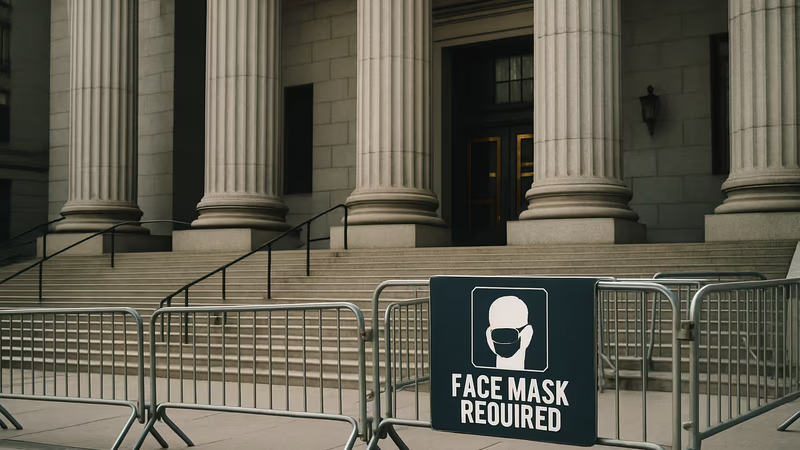
I received an email from someone about my sporadic posts on here and asking if I am alright. To answer, yes, I am alright. I am hunkered here in New York. I have taken to another medium to express my frustrations about what is happening. I never leave home without my N-95 masks. Shout out to my office manager for her foresight on stocking up when this virus initially hit China. She knew what was going to happen. Sadly, I sensed it but only because of what I was seeing in my travelling late last year and earlier this year.
Now, you cannot even get bleach or food half the time down here. By the way, please wear the masks if you are around people. It is inconvenient but it is the right thing to do. You do not have the right to get me or anyone else sick. If you’re dealing with a no-fault insurance defense matter, an experienced attorney can help protect your rights.
My favorite topic on here as of late is the Court system. I still cannot fathom how our 1970s model can handle the current reality. Perhaps some of us should sit on a committee and give ideas on how the rules of Court and even the CPLR need to be tweaked to handle the current reality? We can really take lessons from other state systems on how to modernize our systems. The first error I see is using Skype. That is outdated technology: early 2000s.
Free Consultation · No Fee Unless We Win
Does this apply to your situation?
Every case is different. Get a free, confidential case review from an experienced attorney who can tell you exactly where you stand.
Send a response – let us know you are alive and well and staying sane.
The Court System’s Technology Problem
The complaint in the original post was not really about videoconferencing software. It was about institutional design. The CPLR — the Civil Practice Law and Rules, New York’s civil procedure code — took effect in the 1960s and, despite decades of amendments, still assumes a practice built around physical papers, in-person appearances, and courthouse clerks’ offices. Layered on top of that are the Uniform Rules for the trial courts and the individual part rules of hundreds of judges, each with its own expectations about how motions are submitted, how conferences are held, and how exhibits are handled.
A system like that can function when everyone can walk into the courthouse. When nobody can, every assumption breaks at once. Calendar calls, settlement conferences, depositions, motion arguments, trials — all of it depended on physical presence, and the system had no ready substitute. Electronic filing existed in some courts but was far from universal, and remote appearances were the exception rather than a built-in option.
Other court systems — in other states and in the federal courts — had already moved further toward electronic filing, remote conferencing, and standardized digital practice before 2020. New York’s experience during the pandemic was a forced, improvised version of that transition, accomplished through emergency administrative orders rather than considered rulemaking.
Why Modernization Matters for Litigants
Court modernization sounds like an abstract policy debate, but it has concrete consequences for anyone with a case in the system.
Delay is a substantive harm. For an injured plaintiff waiting on a personal injury recovery, or a medical provider carrying hundreds of unpaid no-fault bills, every month of calendar backlog is real money. High-volume practices — and no-fault litigation in the New York City Civil Court and the District Courts on Long Island is as high-volume as civil practice gets — feel procedural friction more acutely than anyone. A system that requires an in-person appearance for a routine adjournment multiplies cost across thousands of files.
Procedural traps multiply in a disrupted system. When deadlines, calendars, and filing mechanics are in flux, the parties most likely to be hurt are those without counsel who watch the rules daily. Missed conference dates, miscalendared motions, and confusion over tolled deadlines generate defaults and dismissals that have nothing to do with the merits.
Remote practice is now permanent. What began as an emergency accommodation became a fixture. Virtual conferences and remote appearances persisted after courthouses reopened, precisely because they solved problems the old model never could. The question raised in this post — whether the CPLR and the rules of court should be deliberately redesigned around modern technology, rather than patched ad hoc — remains a live one.
For practitioners, the lesson of the period is durable: know not just the CPLR but the administrative orders and part rules that overlay it, because in a fast-moving environment the operative rule is often the most recent one posted, not the one in the statute book.
Related Resources
- Law office failure as a reasonable excuse in New York courts — the doctrine that often determines whether pandemic-era (and other) missed deadlines are forgivable
- CPLR 3212(g) paradigm and court procedures
- Critical timing rules for summary judgment motions under CPLR 3212(a)
- Reasonable excuse standards in default judgment cases
- No-fault verification requirements and court compliance
- New York No-Fault Insurance Law
- The firm’s Legal Encyclopedia collects our doctrinal guides to New York no-fault and personal injury law
- No-fault insurance defense practice — how we handle these cases for insurers and self-insureds
Legal Context
Why This Matters for Your Case
New York's no-fault insurance system, established under Insurance Law Article 51, is one of the most complex insurance frameworks in the country. Every motorist must carry Personal Injury Protection coverage that pays medical expenses and lost wages regardless of fault, up to $50,000 per person.
But insurers routinely deny valid claims using peer reviews, EUO scheduling tactics, fee schedule reductions, and coverage defenses. The Law Office of Jason Tenenbaum has handled over 100,000 no-fault cases since 2002 — from initial claim submissions through arbitration before the American Arbitration Association, trials in Civil Court and Supreme Court, and appeals to the Appellate Term and Appellate Division. Jason Tenenbaum is one of the few attorneys in the state who both writes his own appellate briefs and tries his own cases.
His 2,600+ published legal articles on no-fault practice are cited by attorneys throughout New York. Whether you are dealing with a medical necessity denial, an EUO no-show defense, a fee schedule dispute, or a coverage question, this article provides the kind of detailed case-law analysis that helps practitioners and claimants understand exactly where the law stands.
About This Topic
New York No-Fault Insurance Law
New York's no-fault insurance system requires every driver to carry Personal Injury Protection (PIP) coverage that pays medical expenses and lost wages regardless of who caused the accident. But insurers routinely deny, delay, and underpay valid claims — using peer reviews, IME no-shows, and fee schedule defenses to avoid paying providers and injured claimants. Attorney Jason Tenenbaum has litigated thousands of no-fault arbitrations and court cases since 2002.
271 published articles in No-Fault
Keep Reading
More No-Fault Analysis
Car Accident Recorded Statement in New York: Should You Give One?
The at-fault driver's adjuster wants a recorded statement within days of a New York car accident — and that call is designed to weaken your case.
Apr 5, 2026
Who Pays Car Accident Medical Bills in New York? A Step-by-Step Guide
New York no-fault PIP, primary health insurance, Medicaid/Medicare, and litigation liens — the full payment ladder for car-accident medical bills.
Apr 5, 2026
How Insurance Companies Use Colossus Software to Undervalue Your Injury Claim
Insurance companies use Colossus software to lowball your injury claim. Learn how this system works and how a Long Island attorney can fight back.
Feb 18, 2026
CPLR 3212(a) Timeliness: A Summary Judgment Motion Is Made When Served, Not When Filed
CPLR 3212(a) deadlines turn on service, not filing. BSS Medical v Metropolitan holds a mailed summary judgment motion timely — and why the rule needs updating.
Feb 18, 2022
The Neptune rule
New York no-fault insurers must request examinations under oath within 30 days of receiving claims, or the requests become invalid under the Neptune rule.
Feb 1, 2020
From the Department of Financial Services today
New York Department of Financial Services announces criminal charges against 18 healthcare providers for no-fault insurance fraud, highlighting ongoing enforcement efforts.
Oct 31, 2013Was this article helpful?
Disclaimer: This article is published by the Law Office of Jason Tenenbaum, P.C. for informational and educational purposes only. It does not constitute legal advice, and no attorney-client relationship is formed by reading this content. The legal principles discussed may not apply to your specific situation, and the law may have changed since this article was last updated.
New York law varies by jurisdiction — court decisions in one Appellate Division department may not be followed in another, and local court rules in Nassau County Supreme Court differ from those in Suffolk County Supreme Court, Kings County Civil Court, or Queens County Supreme Court. The Appellate Division, Second Department (which covers Long Island, Brooklyn, Queens, and Staten Island) and the Appellate Term (which hears appeals from lower courts) each have distinct procedural requirements and precedents that affect litigation strategy.
If you need legal help with a no-fault matter, contact our office at (516) 750-0595 for a free consultation. We serve clients throughout Long Island (Huntington, Babylon, Islip, Brookhaven, Smithtown, Riverhead, Southampton, East Hampton), Nassau County (Hempstead, Garden City, Mineola, Great Neck, Manhasset, Freeport, Long Beach, Rockville Centre, Valley Stream, Westbury, Hicksville, Massapequa), Suffolk County (Hauppauge, Deer Park, Bay Shore, Central Islip, Patchogue, Brentwood), Queens, Brooklyn, Manhattan, the Bronx, Staten Island, and Westchester County. Prior results do not guarantee a similar outcome.